

Last updated: August 4, 2026
The clip is everywhere. Governor Greg Abbott at a podium, directing the Public Utility Commission of Texas and ERCOT to shield Texans from data center infrastructure costs. It made the rounds on Instagram, the commentary accounts picked it up, and now every group chat from Midlothian to Mansfield is asking the same two questions.
Here are the answers, stated plainly before I show my work. Yes, your electric bill is rising, and the mechanism is infrastructure cost recovery rather than anything your household is doing differently. No, data centers are not measurably dragging home values across North Texas, though a fence-line lot is a different conversation than a county.
The claim I want you to walk away with is the one almost nobody is making: the protection being celebrated on social media is a directive, not a law, and underneath it a cost mechanism keeps running that touches every roof in this region rather than only the few hundred homes with a sightline to a server farm. I work Ellis County and the I-35E corridor every day, which puts me at ground zero for one of the largest data center buildouts in the state.
What Abbott Actually Ordered, and What He Did Not

On June 10, 2026, Abbott sent a formal letter to PUC Chairman Thomas Gleeson and ERCOT CEO Pablo Vegas carrying three directives: ensure that data center grid interconnections result in reduced residential electric bills, require data centers to fully fund the electric infrastructure costs tied to their own operations so residential ratepayers carry none of it, and review existing agency authority for further steps to protect Texans and their property (Office of the Texas Governor).
The deadlines were real. Both agencies had to file a joint memorandum by July 17, 2026 summarizing what they had done under existing authority, flagging where statute limited them, and recommending legislative fixes, with the PUC separately ordered to begin reducing residential transmission costs by July 31, 2026 (Kerr County Lead). On July 24, 2026, the agencies reported back and said they would recommend legislative changes for the 2027 session, including expanding the Lone Star Infrastructure Protection Act to cover large data centers and requiring those facilities to register water and electricity usage with the state (KVIA).
Read that sequence again, because the operative word is recommend. A directive instructs agencies to act inside the authority they already hold. It does not cap a rate, it does not rewrite a tariff, and it does not change the calculation on the bill sitting in your mailbox this month (Texas Policy Research). Teeth arrive when the Legislature convenes in 2027 and passes something, or the teeth never arrive at all. Anyone planning around the assumption that this problem has been solved is planning around nothing more than a press conference.
Your Bill Is Already Moving, and Not Because of Your Usage
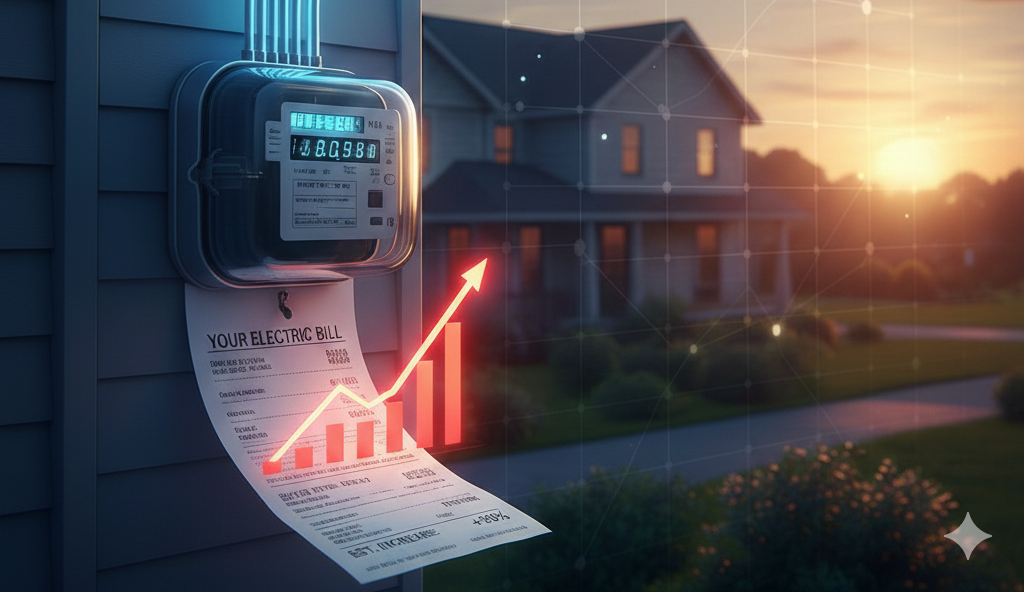
The number that should reset how you think about this has nothing to do with data centers directly. Distribution charges on the average Texas residential bill rose 44% between 2016 and 2026 while average household electricity usage stayed roughly flat (National Law Review, citing TexasElectricityRatings.com research). Families are not consuming more power. They are paying more to build and maintain the wires that carry it, and grid buildout is a shared cost recovered from ratepayers.
That mechanism is the one Abbott’s directive is trying to interrupt, and it’s the one that keeps working exactly as it always has until a statute changes it.
North Texas Market Insider — Grid Cost Watch
Your Electric Bill Went Up. Your Usage Did Not.
Between 2016 and 2026, the delivery portion of the average Texas residential electric bill climbed sharply while household consumption stayed roughly flat. The increase is coming from grid infrastructure cost recovery, not from families using more power.
Read this honestly: the 44% distribution-charge figure reflects total grid buildout over a decade, not data centers alone. The EIA’s 78.9% figure is a modeled high-demand scenario, not a forecast or a guarantee. Both point the same direction. Neither proves a single cause.
Sources: TexasElectricityRatings.com research via National Law Review; Energy Ogre Q1 2026 Texas Electricity Market Update; ElectricityPlans.com 2026 Texas Electricity Consumer Confidence Survey; EIA Short-Term Energy Outlook via Utility Dive. | North Texas Market Insider™ northtexasmarketinsider.com
The forward pressure is documented. The Energy Information Administration modeled a high-demand scenario in which ERCOT wholesale prices climb as much as 78.9% by 2027, from roughly $47.39/MWh to $84.80/MWh (Utility Dive, citing EIA Short-Term Energy Outlook), with ERCOT load growth at 15% between 2025 and 2027 against a 10% baseline, well above other major U.S. grid regions (energy market analysis citing EIA data). Retail is following. Texas residential rates averaged 15.87 cents per kWh as of March 2026, up roughly 5.75% year over year, while wholesale prices at ERCOT’s North Hub covering DFW were forecast to rise about 45% during 2026 summer demand spikes (Energy Ogre Q1 2026 Market Update). Nearly half of Texans, 47.4%, reported a higher monthly bill than a year earlier in a 2026 consumer survey, and 12.4% of those reported increases above 20% (ElectricityPlans.com 2026 Texas Electricity Consumer Confidence Survey).
Why This Reaches Every Home, Not Just the Ones Near a Campus
Everything the internet is arguing about in relation to noise really only concerns a few hundred properties with a sightline to a data center. The electricity cost recovery mechanism above concerns every roof from Red Oak to Waco, and it does not ask whether you can see anything from your porch.
Rising electricity costs do not enter debt-to-income calculations, so they will not change what a lender approves you for. What they do change is what a household is willing to spend once they run the real monthly number, which makes a permanent increase in electricity charges a drag on the entire region’s payment comfort. I want to be clear that this is my read of how the cost lands, it is not a published finding. So weigh it as analysis and not as research. What is documented is the underlying trajectory: at roughly 2.3% annual growth, the average Texas household’s $1,728 annual bill compounds to about $2,170 within a decade, before layering in any additional data-center-driven acceleration (NuWatt Energy Texas Rate Guide). The EIA high-demand scenario would move even faster than that.
North Texas Market Insider — The Ledger
Data Center Tax Revenue vs. Household Grid Costs in Ellis County
The revenue argument assumes data centers pay into the local tax base and homeowners see it back. Here is what the abatement agreements and adopted rate records actually show.
Cost side
$1,728
Average Texas household annual electric bill
Rising through grid cost recovery, not consumption.
Revenue side, as actually negotiated
100%
Personal property abated, City of Midlothian, 10 years
Personal property is where a data center’s value concentrates: servers, cooling, electrical equipment.
What a pass-through would have to clear
Countywide arithmetic: the annual per-household electric increase multiplied by 71,759 Ellis County households. This is the total annual tax relief that would have to reach residents to offset the grid cost alone.
The pass-through test
New taxable value only reaches a homeowner if the taxing entity adopts a rate below no-new-revenue. In each year on record since 2022, the City of Midlothian adopted a rate above no-new-revenue, meaning new value was captured as additional revenue rather than returned as rate relief.
Read this honestly: the assessed values of the Google Midlothian and Red Oak facilities are not public, and the exact monetary terms of both abatement agreements were never released, so no net dollar figure can be calculated. These abatements cover city and county taxes; school district treatment is governed separately and is not confirmed here. Texas ISD maintenance and operations rates have fallen statewide since 2019 under legislative rate compression, which is state policy and should not be read as a local pass-through from any facility. The $7.1M and $31.7M figures are countywide arithmetic showing a threshold, not a claim about any single entity’s budget. Electric cost figures are ERCOT-wide averages, and households served by municipal utilities or co-ops sit outside the deregulated retail market.
Sources: Waxahachie Daily Light, June 2019; Focus Daily News, June 2020, September 2022, and September 2024; Best Southwest Guide, July 2019; Data Center Knowledge; DataCenterDynamics; Connect CRE; City of Midlothian 2024 and 2025 Tax Rate Notices and Ordinance 2025-53; U.S. Census Bureau ACS via Data USA; NuWatt Energy Texas Rate Guide; Energy Ogre Q1 2026 Texas Electricity Market Update; TexasElectricityRatings.com research via National Law Review. | North Texas Market Insider™ northtexasmarketinsider.com
The strongest argument against my position also deserves a real hearing, and it comes from the people who court these projects. Texas Tax Code Section 151.359 grants qualifying data centers a temporary state sales tax exemption in exchange for at least 100,000 square feet of qualifying space, 20 new jobs, and $200 million in capital investment over five years, running 10 or 15 years depending on investment size (Texas Tax Code, via Justia).
Even carrying that exemption, these facilities can still generate substantial property tax revenue while placing almost no demand on schools, and Newsweek’s reporting identified that revenue dynamic as part of why some Virginia communities saw home values hold or gain near facilities (Newsweek). The economic development case is that a Midlothian or Red Oak homeowner comes out ahead on the tax side of the ledger even if the utility side rises.
That argument is legitimate but it doesn’t resolve the problem. Property tax relief is jurisdiction-specific and discretionary, arriving only where the facility sits and only if the taxing entities choose to pass it through rather than absorb it into budgets. Grid cost recovery is regional and automatic, spread across ERCOT ratepayers whether or not a single data center ever gets built in their county. Waxahachie gains nothing on the tax side from a campus in Lancaster while sharing in the transmission cost of one. Abbott’s directive, notably, asks the Legislature to consider repealing the sales tax exemption entirely (Kerr County Lead).
For more information on the latest data centers visit our North Texas Data Center Map.
The Scale Behind All of It
As of mid-2026, ERCOT was tracking more than 438,000 megawatts of proposed demand from large electricity users, with close to 90% of those requests coming from data centers (ERCOT). For scale, the most electricity the Texas grid has ever delivered in a single moment is 85,508 MW, set during the August 2023 heat wave. The new proposed demand is more than five times the entire historical peak of the grid it wants to plug into.
North Texas Market Insider — Grid Cost Watch
The Queue Is Five Times the Grid
Proposed demand sitting in ERCOT’s large-load interconnection queue as of mid-2026, measured against the most electricity the Texas grid has ever delivered in a single moment.
Close to 90% of these requests come from data centers.
The record set during the August 2023 heat wave.
Read this honestly: queue figures are requests, not construction. A large share of interconnection applications never energize, and some projects file in multiple locations at once. ERCOT’s own April 2026 long-term forecast of 368 GW by 2032 was sent back by regulators as unrealistically high. The queue measures ambition, not certainty.
Sources: ERCOT Trending Topic report on the New Batch Connection Process for Large Electricity Users, June 2026; ERCOT board materials via Yahoo Finance; ERCOT/CERAWeek reporting; FOX 26 Houston. | North Texas Market Insider™ northtexasmarketinsider.com
ERCOT received 225 new large-load interconnection requests during 2025, a 270% year-over-year jump that pushed the queue to roughly 226 gigawatts by December (Yahoo Finance, citing ERCOT board materials). By April 2026 Vegas confirmed the figure had cleared 410 GW, driven substantially by requests routed through Oncor, the transmission utility serving most of Dallas-Fort Worth (industry analysis citing ERCOT/CERAWeek data). The bulk of that demand sits in the DFW and I-35 corridor, already the most transmission-constrained load pocket in the ERCOT system.
ERCOT responded with a first-in-the-nation batch connection process under rules PGRR145 and NPRR1325, grouping large users into study cohorts rather than processing them one at a time, with Batch Zero beginning implementation in July 2026 (ERCOT). The agency’s April 2026 long-term forecast initially projected Texas peak demand reaching 368 GW by 2032, more than four times today’s record, before regulators sent it back for revision as unrealistically high (FOX 26 Houston). A forecast getting rejected for being too aggressive is still a forecast written by the people who run the grid.
Ellis County Is Not Watching This From a Distance
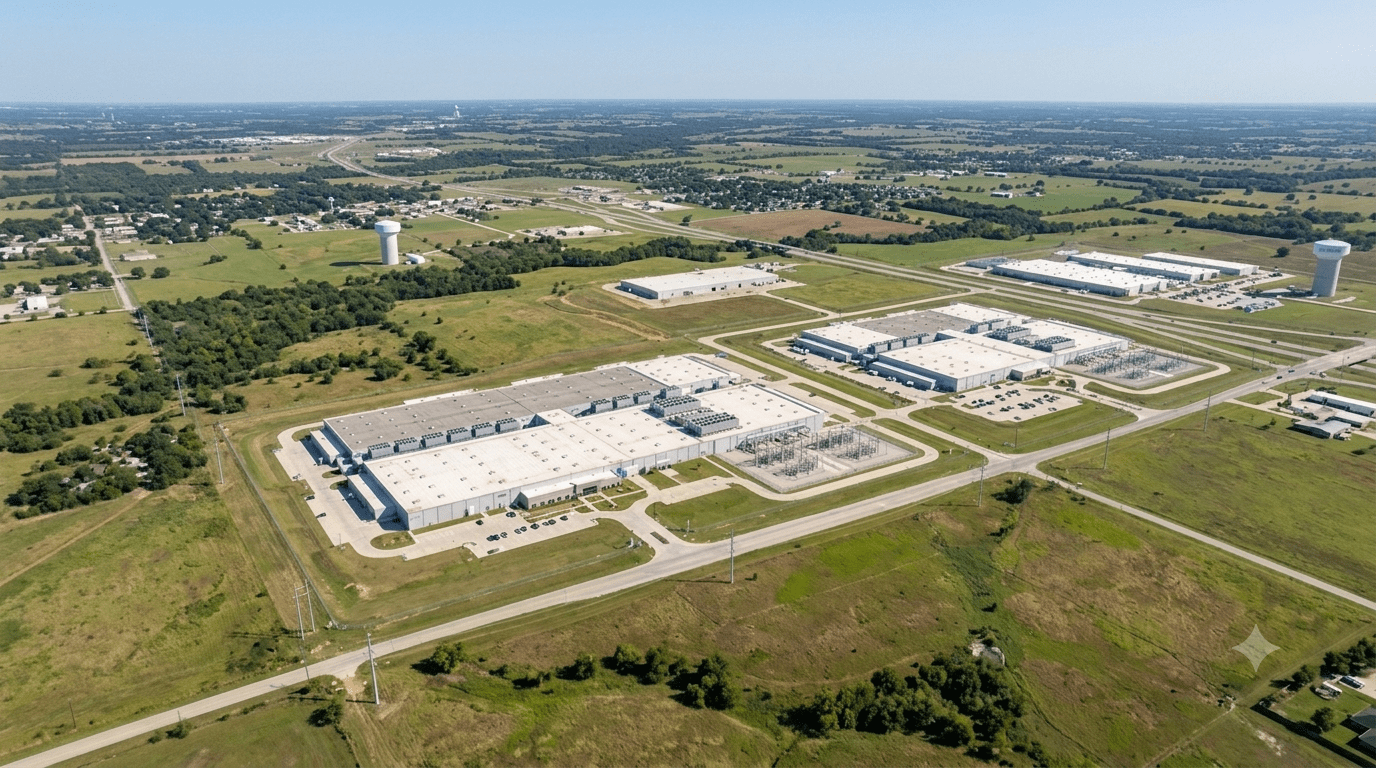
Google has operated data centers in Midlothian since 2019 and announced additional Texas investment in November 2025 (Google Data Centers). Independent trackers currently count 14 data center projects across Ellis County, representing roughly 8.5 gigawatts of combined capacity and more than $1 billion in tracked investment. These are facilities operated by Google, Yondr Group, DataBank, and Compass Datacenters across Midlothian, Red Oak, and Lancaster (PoweredByWho Ellis County tracker).
That concentration is why buyers relocating here deserve the full picture before they close rather than after. Our Ultimate North Texas Relocation Guide and the city pages for Waxahachie, Mansfield, and Arlington map what is growing where, including the data center infrastructure most listing descriptions leave out.
The Home Value Question, Answered Honestly
Two separate 2026 studies, one from George Mason University’s Center for Regional Analysis in Northern Virginia and one from Integra Realty Resources examining Indiana sites, found no statistically significant negative effect on nearby home values from data center proximity (Bisnow). The George Mason work went further, finding Northern Virginia home values decreasing as distance from a data center increased, with properties near a proposed Sabey site appreciating 42% against a surrounding market at 41% (Newsweek).
I am not going to sell you that one-point spread as outperformance. It is statistically indistinguishable from the market, and the researchers themselves flagged that the positive correlation most likely reflects site location logic rather than desirability. Data centers get built near existing infrastructure, highways, and employment centers, all of which were already pulling home values up before a single server arrived (Newsweek). The defensible conclusion is that proximity does not appear to drag values, not that proximity earns a premium.
North Texas Market Insider — Home Value Analysis
Data Centers and Home Values: The Split Verdict
The research does not say one thing. It says two things, and which one applies to you depends entirely on how close the fence line is.
Across a county or metro
No measurable drag on values
- George Mason University CRA, 2026: no statistically significant negative effect in Northern Virginia
- Integra Realty Resources, 2026: same conclusion across Indiana sites
- The 42% vs 41% finding near a proposed Sabey site is statistically indistinguishable from the surrounding market, not outperformance
At the fence line
Real, documented impact
- 5 to 15% reduction for homes adjacent to industrial-scale facilities (Kimley-Horn study for Prince William County, VA, 2023)
- 2 to 10% slower appreciation within one mile (Loudoun County, VA Department of Finance)
- 55 to 75 dB(A) typical property-line noise, against a WHO nighttime guideline below 40 dB(A)
Read this honestly: every study above examines Virginia or Indiana. No peer-reviewed North Texas study exists yet, and siting, buffering, setback distance, and cooling system type vary enough between facilities that no single number transfers cleanly to a specific Ellis County address. Treat these as ranges to investigate, not as an appraisal.
Sources: Bisnow reporting on the George Mason CRA and Integra Realty Resources studies; Newsweek; Central Texas Data Center Tracker citing Prince William County and Loudoun County studies; Real Simple agent interviews via Yahoo Lifestyle; Center for Environmental Data Sciences. | North Texas Market Insider™ northtexasmarketinsider.com
The counterevidence deserves equal weight. A 2023 Kimley-Horn study commissioned by Prince William County, Virginia found industrial-scale facilities adjacent to residential subdivisions can reduce nearby property values 5 to 15% through noise, visual impact, and perceived loss of neighborhood character, and Loudoun County’s Department of Finance found homes within one mile of large data centers appreciating 2 to 10% slower (Central Texas Data Center Tracker, citing county studies). Agents interviewed in Texas specifically reported that homes directly adjacent to facilities or substations take longer to sell, with buyers asking sharper questions during showings, even when the final sale price holds (Yahoo Lifestyle, citing Real Simple expert interviews).
Reconcile those findings and a working rule emerges for North Texas. Across a county or a metro, data centers are not a home value story, and the research is reasonably consistent on that point. Though, at the fence line, with a direct sightline and in audible range of the cooling equipment, they can start to affect value. What moves first is often not price but the number of days it takes to find the buyer who does not mind.
What Actually Generates the Complaints
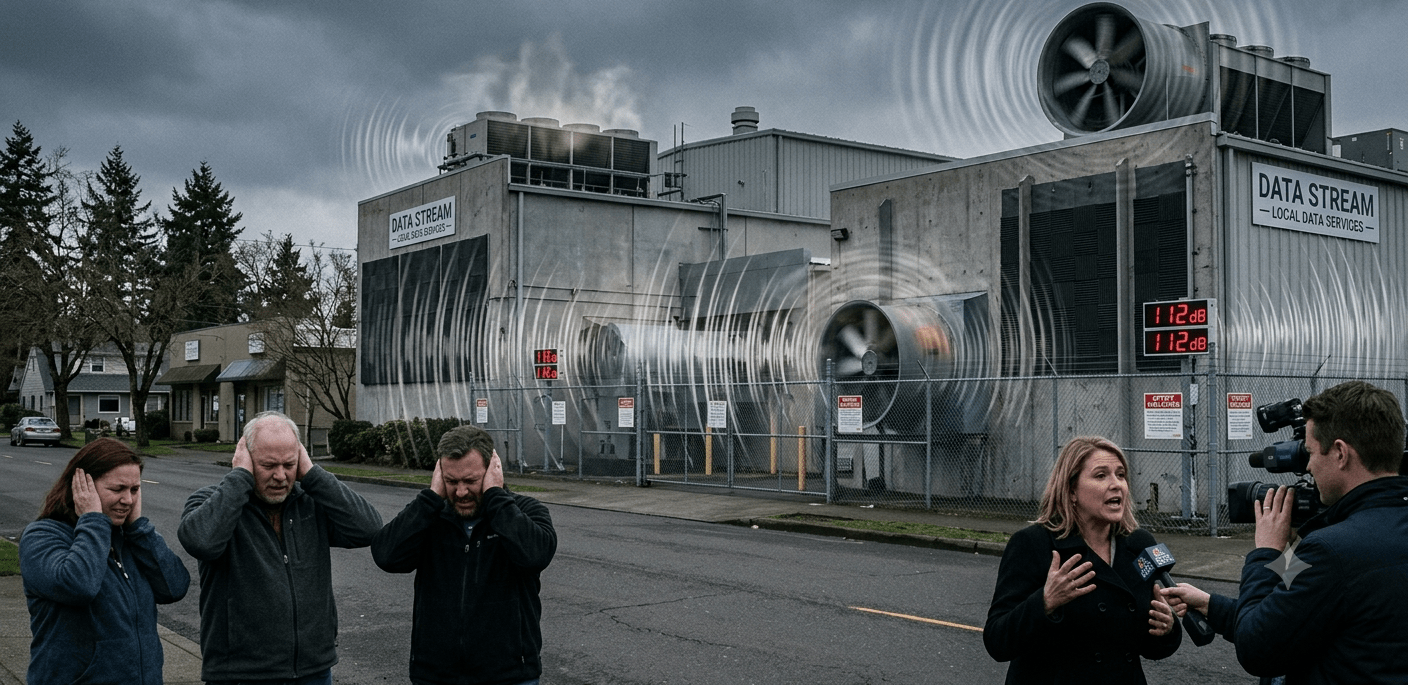
Noise still leads every documented complaint list against data centers. Measured sound at data center property lines typically runs 55 to 75 dB(A), with some facilities exceeding 80 dB(A) during peak cooling or generator testing, against a World Health Organization nighttime outdoor guideline below 40 dB(A) for undisturbed sleep (Central Texas Data Center Tracker). Prince William County responded by enacting a 50 dB(A) nighttime limit at residential property lines (Center for Environmental Data Sciences). Backup diesel generators can emit 200 to 600 times more nitrogen oxides than natural gas power plants according to the World Resources Institute, though most run only for periodic testing or actual outages (NBC Right Now).
Site location best practices recommend at least 300 feet of setback from residential property lines, closed-loop water cooling to cut both noise and consumption, fully enclosed sound-dampened generator housing, and high-opacity visual buffers at the perimeter (CEDS). If you are evaluating a home near an existing or proposed facility, pull the city council planning agendas for pending zoning changes, confirm where the generators and cooling equipment sit relative to the lot, and walk the property after dark. Air-cooled facilities with rooftop fans are the loud ones (CEDS).
Selling Near a Data Center Campus: The Actual Strategy

Disclosure is leverage, not a liability. Texas real estate law and the REALTOR® Code of Ethics require disclosure of material facts affecting a buyer’s decision, and proximity to major industrial or utility infrastructure is now something informed buyers raise unprompted.
Where most sellers get this wrong is in what they do with their asking price. Since the documented effect shows up in days on market before it shows up in sale price, the correct move is to buy time rather than discount preemptively. Price to your honest comparable set, plan a longer marketing window from the beginning, and hold your number through the early weeks rather than cutting at day 21 in a panic that converts a timing issue into a permanent price reduction. There are buyers who do not mind the data center exists. But, finding them takes longer, and a seller who prices as though that buyer will never appear has given away real equity to solve a problem they had not confirmed they had.
Load your marketing package accordingly. Setback distance, cooling system type, existing buffer and screening, and any recorded zoning limits on future expansion belong in the disclosure materials from day one, because those specifics are what convert a vague concern into a manageable known. We have walked through this pattern with other large-scale local development, including the 75-acre Palmetto Road development’s impact on Waxahachie home values and the 13,000 new homes headed to Waxahachie.
Buying or Relocating Into This Market

For out-of-state buyers, this is underwriting context rather than trivia. Texas runs a deregulated retail electricity market, so provider and plan selection can offset a meaningful share of rising base costs, which is why our North Texas Relocation Hub and the guide for those relocating from Washington state build utility trends into the cost-of-living comparison. If you are still narrowing between Ellis County suburbs, the Waxahachie Area matching quiz and the Explore North Texas city hub sort by budget, pace, and lifestyle, infrastructure included.
Running the true monthly number matters more in this environment than it did three years ago, and that conversation starts with a lender who will model it honestly. Here are the lenders I trust with my clients:
- Andrew Bryan, Miramar Mortgage: andrewthelender.com
- Rachael Carter, My Texas Mortgage Team: mytxmortgageteam.com
- Jennifer Nelson, Eustis Mortgage: eustismortgage.com
- Taylor Fruge, Lower Mortgage: lower.com
I recommend these lenders based on their expertise and service. I do not receive compensation for referrals.
What You Can Do This Month, Regardless of What the Legislature Does

Deregulation cuts both ways, and right now it cuts in your favor. Residential customers outside municipally owned utility territories can shop and switch providers, and spreads of several cents per kWh between providers serving the same delivery area are common (NuWatt Energy). Locking a fixed-rate plan ahead of summer peak is the highest-leverage move available to a Texas homeowner while the 2027 session remains hypothetical. Our About page covers how we work total cost of ownership into buying and selling decisions rather than stopping at purchase price.
Frequently Asked Questions

Will data centers make my electric bill go up in Texas?
Data center growth is a primary driver of rising ERCOT wholesale prices, with EIA modeling showing increases up to 78.9% by 2027 in a high-demand scenario (Utility Dive). Abbott’s June 2026 directive aims to prevent those infrastructure costs from reaching residential customers, but it remains a regulatory directive pending legislative codification (Texas Policy Research).
What did Governor Abbott order the PUC and ERCOT to do?
He directed the PUC to require data centers to fully fund their own electric infrastructure costs, to work with ERCOT to reduce residential transmission costs, and to file a joint memorandum with legislative recommendations by July 17, 2026 (Office of the Texas Governor).
Does living near a data center lower my home’s value?
Current research, including 2026 studies from George Mason University and Integra Realty Resources, finds no statistically significant negative effect on nearby home values (Bisnow). County-level studies in Virginia found reductions of 5 to 15% for homes directly adjacent to industrial-scale facilities, driven by noise and visual impact (Central Texas Data Center Tracker). Fence-line proximity is a different question from area proximity.
Why is my electric bill rising if my usage has not changed?
Distribution charges on the average Texas residential bill rose 44% between 2016 and 2026 while average household usage stayed roughly flat, meaning the increase is coming from grid infrastructure cost recovery rather than consumption (National Law Review, citing TexasElectricityRatings.com research).
How many data centers are in Ellis County?
Independent trackers count 14 projects totaling roughly 8.5 gigawatts, operated by Google, Yondr Group, DataBank, and Compass Datacenters across Midlothian, Red Oak, and Lancaster (PoweredByWho).
Why is Texas seeing so much data center growth?
ERCOT’s large-load interconnection queue cleared 410 gigawatts by mid-2026, with close to 90% attributable to data centers, driven by AI infrastructure demand, land cost, and the deregulated grid (ERCOT).
Do data centers get a tax break in Texas?
Texas Tax Code Section 151.359 provides a temporary sales tax exemption on equipment for qualifying facilities investing at least $200 million and creating at least 20 jobs, running 10 or 15 years (Texas Tax Code, via Justia). Abbott’s directive asks the Legislature to consider repealing it.
How noisy are data centers, and what setback is adequate?
Facilities commonly produce 55 to 75 dB(A) of continuous noise at the property line, and best practice calls for at least 300 feet of setback from residential property lines with sound-dampened generator enclosures (CEDS).
Should I avoid buying near a proposed data center in DFW?
Research does not support a blanket avoidance rule. Visit the property after dark and hear for yourself, written descriptions are often subjective. Confirm generator and cooling equipment placement relative to the lot, and pull local planning agendas for future expansion phases before you write an offer (Yahoo Lifestyle).
Will the Legislature actually pass data center cost protections?
The PUC and ERCOT recommended legislative changes for the 2027 session, including expanding the Lone Star Infrastructure Protection Act and requiring usage reporting, but no bill has passed. Current protections are regulatory directives rather than law (KVIA).
If you want to know how grid buildout and infrastructure site locations touch your specific street, subdivision, or relocation timeline in Ellis County or the greater DFW metroplex, reach out. Every figure above is sourced to primary government filings, peer-reviewed and consultancy research, and verified reporting as of August 2026, because guessing at this is how people overpay or underprice.
Bobby Franklin, REALTOR®
Legacy Realty Group – Leslie Majors Team
📲 214-228-0003 | northtexasmarketinsider.com
All statements in this article regarding neighborhood characteristics, infrastructure, and property value trends are drawn from published research and reporting rather than subjective judgments about who should live in any given area. Federal Fair Housing Act guidance prohibits real estate professionals from using neighborhood characteristics to direct buyers toward or away from communities on the basis of protected classes, and this article is offered strictly as factual market education for buyers and sellers evaluating infrastructure on its economic and quality-of-life merits (HUD Office of Fair Housing and Equal Opportunity). Per the NAR Code of Ethics and current advertising standards following the 2024 NAR settlement, commission structures remain fully negotiable and are not set by any association or MLS (NAR settlement summary).






Join The Discussion