
North Texas Data Center Map
Every DFW Data Center Tracked
North Texas is in the middle of the largest infrastructure land rush in its history, and most of the people living through it have no idea where it is happening. Dallas-Fort Worth is now the second-largest data center market in the United States, and JLL projects Texas will overtake Northern Virginia as the largest in the world by 2030. This map tracks 26 large-scale campuses driving that shift, from Sherman to Waco and Weatherford to Terrell.
North Texas Data Center Intelligence Map
Every pin on this map is a documented facility: operational, under construction, or proposed. Click any marker for the essential facts, the sources, and the part nobody else publishes: what that facility actually means for buyers, sellers, landowners, and anyone relocating into its orbit. This is the North Texas Market Insider read on the biggest economic force reshaping property values in our region.
North Texas Market Insider™ · Proximity Check
How Close Is the Nearest Campus to You?
Pick your city and see the three closest tracked campuses, roughly how far out they sit, and what stage each one is at. Straight-line distance from city center, so treat it as a starting point and not a survey.
Choose a city above. The three closest campuses will appear here and light up on the map.
Close enough to matter?
Distance is only the first of eight things worth checking. Cooling type, screening and berms, generator placement, the zoned school district, and what is still pending on the parcels around you all move the answer. I run that verification for buyers before we ever tour. Call 214-228-0003.
How to read this: distances are approximate, measured city center to campus site, and your specific address could be several miles nearer or farther. Proximity alone does not decide anything. Published research from George Mason University in Northern Virginia and a 2026 Indiana analysis both found no evidence that data centers systematically lower nearby home values. The documented risk factor is a poorly screened facility close to homes, not the presence of a campus in your area.
North Texas Market Insider™ · Data Center Field Guide
Three Ways a Data Center Sheds Heat, and What Each One Costs the Neighborhood
How a campus is cooled decides two separate things for the people living near it: how much water it draws, and how much noise it makes. The systems that spare your water supply are the ones that lean hardest on fans, and fans are what neighbors actually complain about. Two campuses can carry the same name on the sign and sit on opposite ends of both scales.
Evaporative
Open loopHeat leaves inside water vapor. That water is gone for good.
Closed-Loop Water
Sealed circuitThe same water circulates sealed. Dry coolers reject the heat to outside air.
Closed-Loop, Air-Cooled
Near zero waterA sealed refrigerant loop. Fans do all the heat rejection.
The two scales run opposite each other
Almost every article on this subject treats water as the only variable, which makes air cooling look like an unambiguous win. It is not. The less water a campus uses, the more of its heat has to leave on moving air, and moving air is what produces the low-frequency hum that generates nearly every documented complaint from data center neighbors.
Read the two rows together rather than picking one. A campus five miles from you on a shared water supply is a water question. A campus a quarter mile from your back fence is a noise question. Very few properties sit where both matter equally.
The two questions to ask before you buy
Which of the three systems is the campus near this property running, and how far is the heat rejection equipment from the nearest home? Those two answers move more than acreage, more than megawatts, and more than the operator's name on the sign.
An air-cooled campus a half mile out with real screening is a non-event for nearly every buyer I work with. An air-cooled campus with rooftop fan banks in your sightline is a different property, and an evaporative campus drawing from the supply your city serves is a conversation you will be having at purchase and again at resale.
Honest caveat: cooling type is frequently undisclosed at the proposal stage, and many campuses run hybrid or adiabatic systems that shift between modes by season, so treat an unstated architecture as unknown rather than assuming any of the three. The water figures are averages that vary considerably by climate and facility design. The noise ordering above is a gradient rather than a measurement: the air-cooled finding and the recommendation to require closed-loop water are both documented, while the middle placement of closed-loop water follows from how much heat rejection is left to fans rather than from a published comparison of all three. Noise also depends heavily on setback, screening, equipment placement and generator enclosure, none of which are cooling choices. Sources: water use effectiveness ranges from peer-reviewed climate-zone modeling of hyperscale facilities; the 80 percent evaporative loss share from industry water management analysis; the 5 percent closed-loop figure and the low-frequency noise findings from Community & Environmental Defense Services; the energy penalty from Google infrastructure leadership as reported by Axios, June 2026.
North Texas Market Insider™ · Data Center Field Guide
What AI Is Doing to Cooling: Direct-to-Chip and Immersion
AI racks generate heat at densities that moving air simply cannot carry away, which is pushing new campuses toward liquid contact with the processors themselves. You will hear both of these terms at council meetings over the next few years, and neither one answers the question a neighbor actually cares about.
Read this before the columns below
Direct-to-chip and immersion are ways of getting heat off the processor. They are not a fourth option alongside evaporative, closed-loop water, and air cooling. The heat still has to leave the property, and it still leaves by evaporation or by fans. A campus can be immersion cooled at the rack and evaporative cooled at the property line. Ask about both layers or you have only half the answer.
Direct-to-Chip
Cold platesCoolant runs through plates bolted onto the hottest processors.
Immersion
SubmergedWhole servers sit in a bath of non-conductive fluid.
Why this is arriving now
A conventional server rack could be cooled by pushing cold air past it. An AI training rack cannot, because the heat coming off a dense stack of accelerators exceeds what airflow can physically carry away in the space available. Liquid holds far more heat per unit of volume than air does, so once density crosses a certain line, contact cooling stops being an efficiency upgrade and becomes the only option that works.
For a homeowner, the practical read is narrow but useful. These technologies mostly quiet the inside of the building. They do not settle whether the campus draws on your water supply or runs fan banks near your fence line, because that decision is made at the property line by the facility system, and that is still the question to ask.
Illustrative, not to scale. The two racks occupy the same physical space and receive the same airflow. What changes is how much heat is packed into that space.
Honest caveat: this section is a forward-looking primer rather than a sourced comparison. It carries no performance figures, heat capture percentages, or rack density numbers on purpose, because reliable published values for those vary widely by vendor and configuration and none have been verified against a specific North Texas facility. No campus tracked on this map has publicly confirmed direct-to-chip or immersion cooling at this time. The mechanics described here are general to the technologies and should be treated as background for reading a filing or a council agenda, not as a description of any particular project. If an operator near you states an architecture publicly, that statement governs over anything on this page.
North Texas Market Insider™ · Buyer Field Guide
8 Things to Check Before Buying Near a Data Center
Run this before you tour, not after you fall in love with the house. Check each one off as you go, and open any item for what the work actually involves.
Zoning and pending applications
What can be built next door
How to do this
Pull zoning and pending applications for every parcel surrounding your target property, at both the city and the county level. A hay field today can become an 830-acre campus after one midnight vote, and the rezoning that changes your view will not appear on any listing sheet.
Cooling technology
Air-cooled versus water-cooled
How to do this
Identify the cooling architecture of any confirmed nearby facility. Evaporative-cooled campuses consume water continuously. Closed-loop air-cooled campuses use very little. They are different neighbors with different water and noise profiles, and the answer is frequently undisclosed at the proposal stage, which is itself information worth having.
Distance and screening
Berms, buffers, generator noise
How to do this
Measure the distance and read the site plan. Look specifically at screening, berms, tree buffers, and how close the cooling infrastructure and backup generators sit to the nearest homes. Noise is the documented risk factor in the research, not the presence of the building itself.
Transmission and substations
Pull the Oncor and ERCOT maps
How to do this
Review the Oncor and ERCOT project maps for new lines and substations crossing or bordering the parcel. A row of lattice towers is a live objection for a future buyer even where an appraiser finds no measurable impact, so this is a resale question as much as a view question.
Zoned school district
Not the mailing city
How to do this
Confirm the actual zoned district and campus rather than trusting the mailing address. A home that says Midlothian on the envelope can sit inside Waxahachie ISD, Midlothian ISD or another district entirely, and any school-related abatement only touches the district that granted it. This one catches families every season.
Active tax abatements
And when the benefit actually arrives
How to do this
Ask whether nearby projects carry active abatements and when the community benefit is scheduled to land. Local abatements defer property tax revenue during the exact years a community absorbs construction disruption, which is why residents keep asking what they are getting and when.
Local opposition and news
Is the project contested
How to do this
Read the local coverage and find the opposition. A contested project affects buyer perception in the near term even where it never affects appraised value, and perception moves a market well before data does. Organized opposition also wins screening and noise conditions that protect you, so this cuts both ways.
Construction-phase impact
Traffic, mud runoff, road wear
How to do this
Price the construction phase honestly, including truck traffic, mud runoff, road wear and the rental pressure that residents near existing sites consistently report. The build is where people actually feel the impact, and it arrives years before the tax base does.
All eight checked
You now know more about that parcel than most buyers know about the house they already bought. If anything on this list came back unclear, that is the conversation worth having before you write an offer. Call 214-228-0003.
I run this verification for buyers before we ever tour
Zoning, cooling architecture, screening, transmission maps, the zoned campus, abatements, the local fight and the construction window. Eight answers, parcel specific, before you fall in love with a house. Call 214-228-0003.
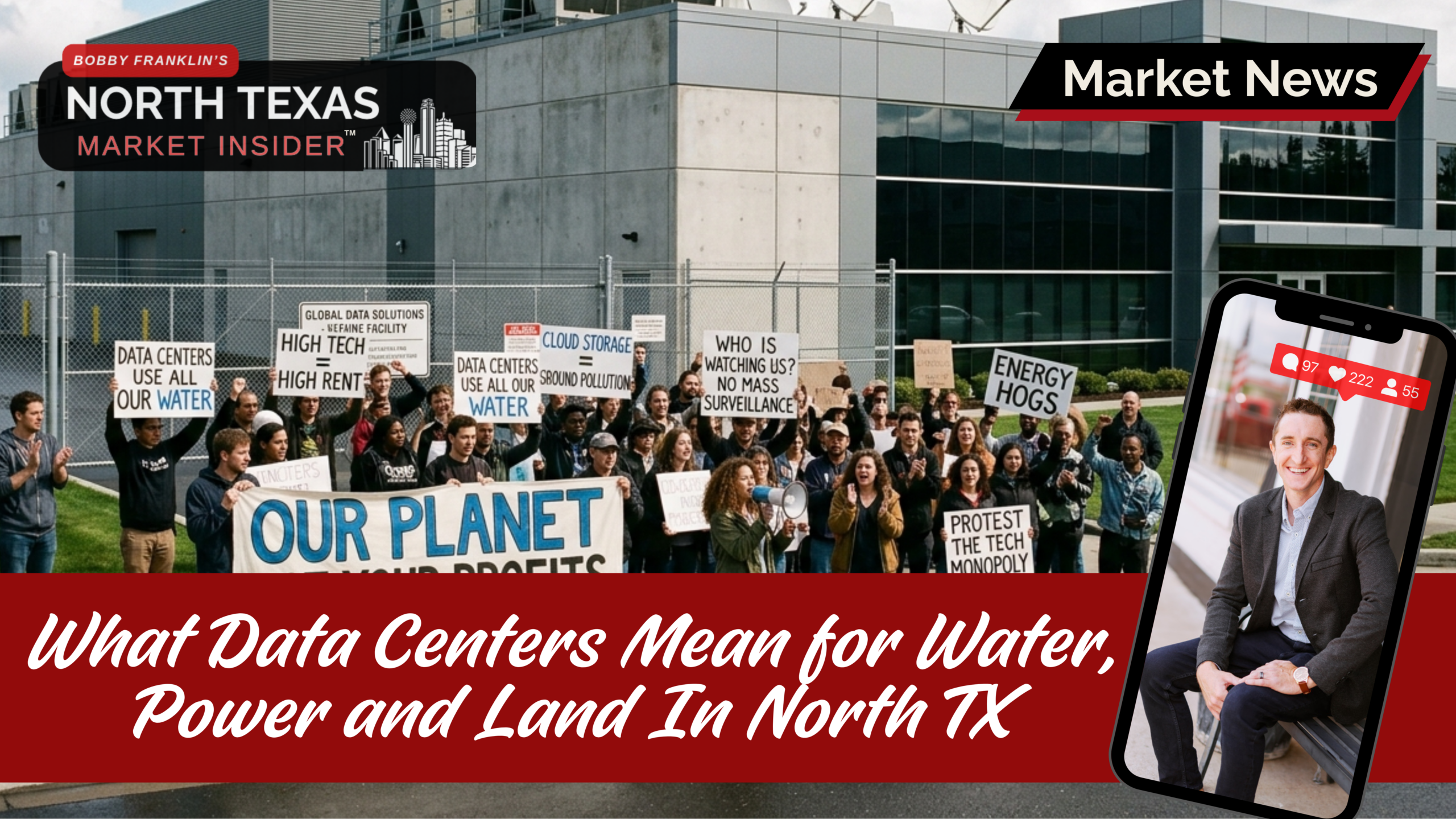
Data Centers And Their Impact On North Texas
North Texas is now the number one data center market on the planet, and Ellis County leads all 254 Texas counties in requested power. That has people alarmed, and some of the alarm is earned.
But the loudest claims and the real risks are not the same thing. Whether a data center drains your water depends on how it’s cooled. Whether it dents your home value depends on how far it sits and how it’s screened. And that terrifying 24 gigawatt number? Most of it will never be built, and the person who runs the grid said so out loud.
Read: The 24 Gigawatt Mirage: What Data Centers Mean for Water, Power and Land In Ellis County —>
North Texas Market Insider™ · Corridor Breakdown
Where the Data Centers Are: The Five Corridors
Twenty-six campuses cluster into five distinct corridors, and each one is telling you something different about where land and home values are headed.
The Ellis County Epicenter
Midlothian · Red Oak · Ferris
- Google MidlothianAnchored the corridor in 2019. Fifth building filed in 2026 at an estimated $880 million.
- Google Red OakOperational since November 2025.
- DataBank Red Oak$2 billion construction loan. 480 megawatts across up to eight buildings.
- Compass DatacentersFive buildings filled by a single tenant, three more coming.
- Lincoln Property540 megawatts planned on 131 acres.
- South Creek Ranch, Ferris5,200 acres, data centers leading before a single home goes up.
- PowerHouse and ProvidentBuilt around a 1.8 gigawatt switchyard, among the largest in the country.
The readEllis County leads all 254 Texas counties in requested power. Every approval here is being fought in a council chamber, which means terms are still negotiable in a way they no longer are further north.
The North and the Frontier
Denton · Plano · Alliance · Aledo · I-35 South
- Core Scientific, DentonBitcoin mine converting to AI, up to $6.1 billion. GPU supercomputer planned for 2027.
- Aligned, PlanoThird campus, partnered on a $700 million AI project.
- Meta, Fort WorthAlliance corridor, training on 100 percent renewable power.
- Prime, AledoMore than a billion dollars pushing toward the Parker County line.
- CyrusOne, WhitneySited beside a power plant in Hill County.
- Riot Platforms, CorsicanaA full gigawatt of approved power.
- Infrakey, near Waco925 megawatts proposed plus a gas plant bigger than any in McLennan County.
The readThe edges decide the next decade. These are the parcels where farmland is still priced like farmland and will not be for long.
The Garland Corridor
Garland · Lookout Drive
- Digital Realty20-year sales tax rebate. First 410,000 square foot building delivering in 2026.
- Stream DFW VIISame Lookout Drive corridor.
- NTTGrowing campus, same corridor.
- Prime Data CentersThree more buildings at Arapaho and Holford.
The readGarland competed for this business and won it. One street now hosts three global operators, which is what an intentional municipal strategy looks like when it works.
The Established Core
Dallas · Irving · Richardson · Carrollton
- Equinix Dallas InfomartThe interconnection heart of the South Central United States.
- QTS IrvingDoubling its campus on the bones of an old semiconductor plant.
- Digital Realty RichardsonEight buildings, nine fiber providers, in the Telecom Corridor.
- CyrusOne CarrolltonZero-water cooling while hosting 911 dispatch for four cities.
The readThe legacy backbone still carries the region, and Carrollton is the proof point that matters most: closed-loop cooling already works at flagship scale in this climate.
The Lancaster Wave
Lancaster · Southern Dallas County
- STACK DFW02Six buildings plus a dedicated Oncor substation on Belt Line Road.
- Skybox PowerCampus DallasA 300 megawatt private substation on the I-35E frontage.
- Project Orange and LabradorUp to thirteen buildings proposed across more than 530 acres on two adjacent sites.
The readThree institutional players choosing the same small city at the same time is not coincidence. It is a verdict on southern Dallas County land, and it is the clearest forward signal on this map for anyone holding acreage between Lancaster and the Ellis County line.

How many data centers are in North Texas?
This map tracks 26 large-scale campuses between Sherman and Waco, from Weatherford to Terrell, counting operational facilities, active construction, and approved or proposed projects. Statewide, a Texas Tribune analysis found 335 existing data centers with more than 248 in the works, and only Texas and Virginia had more than 100 active projects under way as of early 2026. The number changes monthly, which is exactly why this map exists.
Why is Red Oak getting so many data centers?
Three reasons: land, power, and position. Red Oak sits on the I-35E corridor 21 miles south of Dallas with large agricultural parcels, access to Oncor transmission infrastructure, and a city government willing to approve rezonings and tax abatements. Six campuses are now approved in a town of fewer than 20,000 people, which has made Red Oak both the fastest-growing data hub in the region and the center of resident pushback over noise, water, and farmland conversion.
Do data centers affect home values in North Texas?
They cut both ways, and anyone who tells you otherwise is selling something. The construction payrolls, permanent jobs, and tax base lift demand and fund school districts. At the same time, homes bordering an industrial-scale campus face real questions about noise, traffic, and viewshed that deserve a straight answer before you buy or sell. The honest read is parcel-specific: distance, buffering, road access, and what’s actually been approved next door. That’s exactly the analysis I do for clients near these sites.
What is the largest data center project in North Texas?
By planned power, the PowerHouse and Provident campus near Grand Prairie leads the region with a 1.8-gigawatt switchyard at full build-out, among the largest data center developments in the country. By dollars announced, Google’s $40 billion Texas commitment and Core Scientific’s planned $6.1 billion Denton conversion top the list. By acreage, Cawley Partners’ 5,200-acre South Creek Ranch near Ferris is the largest land assembly in recent North Texas memory.
Will the Texas power grid handle all of this?
That’s the open question driving state policy. ERCOT’s 2025 long-term forecast projects peak demand could reach 218 gigawatts by 2031, against a current record of 85.5 gigawatts. Senate Bill 6, signed in June 2025, gives ERCOT authority to curtail large loads of 75 megawatts or more during grid emergencies. The practical effect for property owners: land near existing substations and transmission lines has become some of the most strategically valuable acreage in the state.
Who tracks new data center projects in North Texas?
I do. This map is maintained by North Texas Market Insider as new filings, rezonings, and announcements surface. Each facility links to a full intelligence report covering data center growth, documented environmental impact, and community impact across North Texas. If a project breaks in your area, this page is where it shows up first.
Own Land Near One of These Sites?
If one of these pins is near your property, your land may have changed character before you changed your plans. If you’re buying near a proposed campus, you deserve the parcel-level facts before the headlines move the market. Either way, the conversation costs you nothing and the intelligence is current.

Bobby Franklin
Realtor®
Serving DFW | Ellis County
16 Northgate Dr. Ste 100
Waxahachie, TX 75165
What's Your Next Strategic Move?
Market Insights | Strategic Planning
