

By Bobby Franklin, REALTOR® | North Texas Market Insider™ | Legacy Realty Group – Leslie Majors Team
Serving Ellis County, Waxahachie, Midlothian, and the Greater DFW Metroplex | 214-228-0003
It’s midnight and you’re scrolling Zillow again. You keep landing on that new construction listing in Midlothian, then bouncing back to the “cheaper” resale home two zip codes away, running the same loop you’ve run a dozen times this week. The sticker on the new build is higher. The HOA is real and the upgrades stack up fast. So you talk yourself out of it and go to bed.
Here’s the question nobody at the model home and nobody in your group chat is saying out loud: what if the new construction home is the cheaper home, and the resale you keep calling a “deal” is the one that will quietly drain your account for the next ten years?
A landmark analysis released in May 2026, Realtor.com’s Total Cost of Ownership report, found that the average buyer of a newly built home saves $25,335 over the first 10 years of ownership versus the buyer of a 20-year-old home. That gap is driven entirely by lower utility bills and fewer major system replacements: HVAC, roofing, water heaters.
Now, $25,335 is the national figure, and I’m not going to let you walk into a Midlothian model home believing Texas hands you every dollar of it. We don’t. Our milder winters mean the utility-savings piece runs lighter here than it does in New England. But that’s only half the equation, and the half that breaks in our favor is the one builders aren’t advertising: new construction in the South is priced far more aggressively against resale than it is up north. The savings shift from your power bill to your purchase price. Hold that thought, because it changes the entire calculation, and I’ll show you the local math in a minute.
That number also doesn’t include builder incentives. In 2026, North Texas builders are handing out mortgage rate buydowns averaging roughly 1% below market. On a $450,000 purchase with 10% down, that’s worth more than $250 every single month before you account for anything else.
I’m Bobby Franklin, a REALTOR® with Legacy Realty Group, part of the Leslie Majors Team, and I’ve spent years reading the Ellis County and DFW new construction market from the inside. This is not a puff piece for builders. It’s a data-driven breakdown of what the research actually says, how it lands for buyers in Waxahachie, Midlothian, and across Ellis County, and what you need to know before you sign anything, including the parts the builder’s sales rep will never volunteer.
Let’s get into it.
The $25,335 Number: What It Actually Means (and What It Doesn’t)
When Realtor.com published its Total Cost of Ownership: Where Lower Operating Costs Offset the Price Premium report, it compared homes built in 2025 to homes built in 2005. A new build against a 20-year-old resale, head to head.
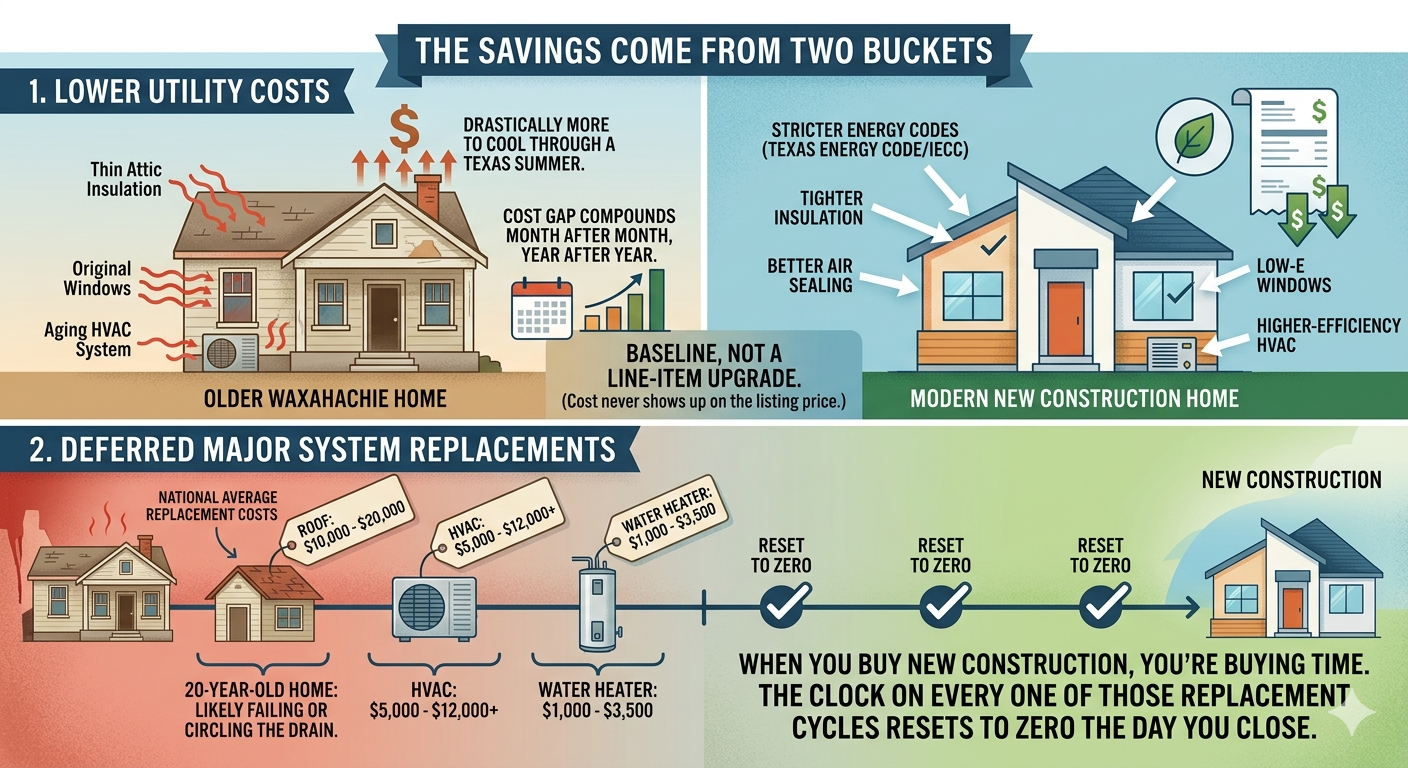
The savings come from two buckets.
1. Lower Utility Costs. Modern homes are built to meet stricter energy codes. In Texas, all new residential construction must comply with the Texas Energy Code, which is built on the International Energy Conservation Code (IECC). That means tighter insulation, better air sealing, low-E windows, and higher-efficiency HVAC as the baseline, not as a line-item upgrade. An older Waxahachie home with original windows, an aging HVAC system, and thin attic insulation costs dramatically more to cool through a Texas summer. We have a lot of Texas summer. That cost gap compounds month after month, year after year, and it never shows up on the listing price.
2. Deferred Major System Replacements. A 20-year-old home likely has a roof, HVAC, and water heater that are already failing or circling the drain. HVAC replacement alone runs $5,000 to $12,000-plus nationally. Roof replacement: $10,000 to $20,000. Water heater: $1,000 to $3,500. When you buy new construction, you’re buying time. The clock on every one of those replacement cycles resets to zero the day you close.
The study built its analysis on data from Pearl Certification’s Pearl SCORE® system, which rates every single-family home in the country across five performance pillars: Safety, Comfort, Operations, Resilience, and Energy. The methodology is rigorous and transparent, which matters when a number this big is on the table.
Here’s what the $25,335 doesn’t capture: builder warranties that pile value on top of the estimate, the financial cost of losing weekends to emergency repairs, and the simple sanity of not bracing every time the sky opens up. This is actually a conservative figure, for a lot of North Texas buyers, the real number runs higher.
Why Southern States, Including Texas, See Lower (But Still Real) Savings

There’s a nuance North Texas buyers need to understand instead of skipping past. The report showed real geographic variation. New England states like Massachusetts top the chart at nearly $39,000 in 10-year savings, because brutal winters magnify the efficiency gap between old and new homes.
Southern states, Texas included, show lower savings on the utility side. That’s the honest part. But here’s what offsets it, and it’s the part the headline misses: new construction in the South is priced far more competitively against existing homes.
According to the report, in 50 of the 300 largest metros, new construction already sells for less than existing homes at the median. In 16 more metros, the 10-year savings completely erase whatever price premium is left.
Translate that to North Texas:
- As of Q1 2026, the national median new construction listing price sits around $448,393, down 0.3% year over year, with the price premium over existing homes at its lowest first-quarter level since 2020.
- In DFW, and especially in Ellis County, builders like Bloomfield Homes, Highland Homes, and John Houston Homes are actively pricing to beat resale.
- The Midlothian market is carrying 15-plus active new construction developments with pricing that goes toe to toe with existing inventory.
If you’re shopping the $350,000 to $500,000 range in Ellis County right now, the gap between a new build and a 20-year-old resale is smaller than your gut is telling you, and the operating-cost math tilts hard toward new construction.
Builder Incentives in 2026: The Hidden Price Reduction Most Buyers Miss

This is where new construction stops being a close call and starts being a strategic advantage. Builders in 2026 are stacking incentives that no individual home seller can touch.
Mortgage Rate Buydowns
The sharpest tool in the builder’s kit right now is the permanent or temporary mortgage rate buydown. Per Realtor.com’s analysis, new-home buyers are paying roughly 1% less on their mortgage rate on average than resale buyers, thanks to builder-subsidized buydowns.
Run it on a $450,000 purchase with 10% down ($405,000 loan):
- At 6.3%: monthly principal and interest lands near $2,509.
- At 5.3%: monthly principal and interest lands near $2,253.
- Monthly savings: about $256.
- Annual savings: about $3,072.
- Over 10 years: about $30,720, before a single other incentive enters the conversation.
Now stack that on top of the $25,335 in utility and repair savings. You’re looking at a $56,000-plus advantage for the new construction buyer over a decade.
Closing Cost Assistance
Plenty of builders are covering partial or full closing costs, which typically run 2% to 5% of the purchase price. On a $400,000 home, that’s $8,000 to $20,000 staying in your pocket at the table. For a cash-constrained buyer, that line item is the difference between closing and walking away.
Price Reductions on Spec Inventory
As of mid-2026, the North Texas market has tilted toward buyers. Pending home sales are down significantly across the region, and builders are sitting on spec inventory they’re motivated to move. That motivation is leverage, and it’s leverage that didn’t exist two or three years ago.
Design Center Credits and Upgrades
Builders routinely offer $5,000 to $25,000 in design center credits, which lets you choose flooring, countertops, fixtures, and cabinetry within the community’s options at no added cost. That’s real money you’d otherwise spend out of pocket renovating a resale.
Here’s the one your sales rep will never say out loud. A builder can inflate the base price, then hand you a stack of “incentives” that only walk you back to the number the home was worth all along. The buydown is real, the closing credit is real, and the discount off a price that was padded to begin with is theater. This is the single most common way new construction buyers overpay while feeling like they won. The defense is simple and it costs you nothing: bring your own agent and price the total package against comparable sales, not against the builder’s own sticker. A headline incentive is only a deal if the base price was honest first. Work with an experienced agent, not just the on-site sales rep, to read the whole deal. More on exactly why you need your own agent in a minute.
The New Construction Warranty: Financial Protection Most Buyers Underestimate

One of the most overlooked financial benefits of new construction is the builder warranty, and in Texas you need to know precisely what it covers.
Most new homes here carry a 1-2-6 warranty structure:
- Year 1: workmanship and materials (drywall, flooring, paint, trim, finishes).
- Years 1 to 2: major mechanical systems (HVAC, plumbing, electrical).
- Years 1 to 6: structural defects (foundation, load-bearing elements, framing).
According to the Federal Trade Commission’s guidance on new home warranties, HVAC and systems coverage typically runs two years, with structural protection extending up to ten. In Texas, HB2023 (2023) introduced a 1-2-6 option that shortens structural coverage to six years if the builder provides that specific warranty type. Know which warranty your builder is handing you before you sign.
Why this matters in dollars: the $25,335 savings figure does not include what the warranty saves you. If your HVAC dies in Year 1, and it does happen, the builder eats it. On a resale, that same failure is a $6,000 to $12,000 surprise that comes out of your checking account. A builder warranty is, in plain terms, an insurance policy baked into the price of the home.
For North Texas specifically: our summers are punishing on HVAC systems. Two years of systems coverage means your air conditioning is protected through the most demanding climate years of the home’s life, which is exactly when a brand-new system is least likely to fail and most expensive to be wrong about.
New Construction in Waxahachie and Ellis County: The Local Math
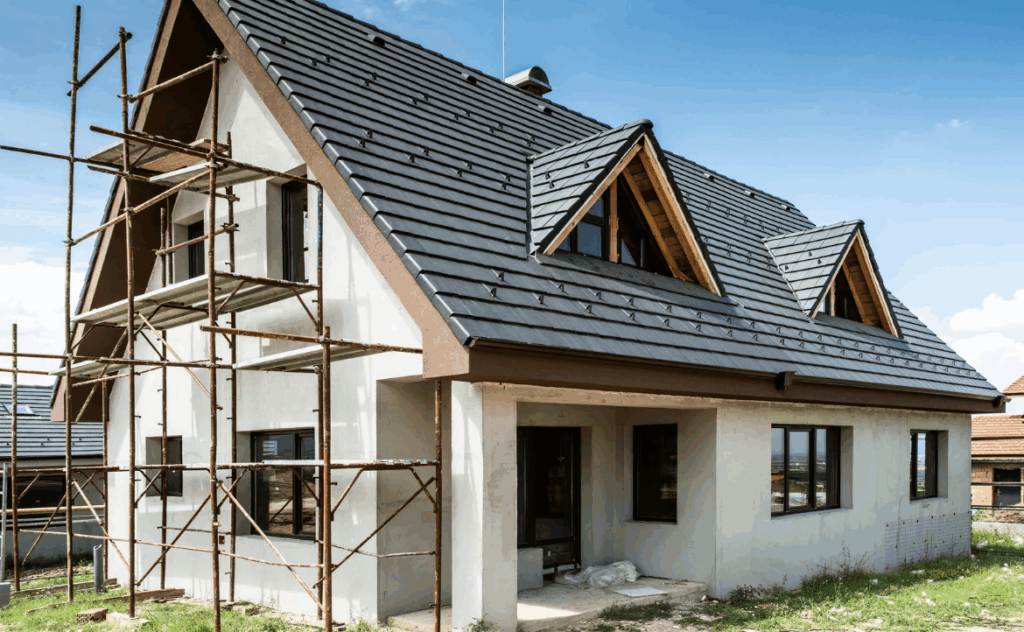
Let me pull this down from national averages to what’s happening in our own backyard.
Waxahachie sits about 30 miles south of Dallas on I-35E. Close enough to commute, priced well under the northern suburbs, and in the middle of one of the biggest development surges in its history. As of mid-2026:
- New construction in Waxahachie carries a median listing price near $449,900, with active developments spread across multiple price points and builders.
- The city approved the massive Minto development: 3,170 acres and up to 13,270 homes, a long-term vote of confidence in where Waxahachie is headed. Full breakdown here: Westlake Developers Are Bringing 13,000 Homes to Waxahachie.
- Homes in the high $300s to mid-$400s are drawing steady demand from buyers priced out of northern DFW.
Midlothian, Ellis County’s fastest-growing city, offers 15-plus active new construction developments along the strategic I-67 corridor, roughly 25 minutes from Dallas. Midlothian ISD earned a B rating (87 overall) from the Texas Education Agency for 2024 to 2025, which puts it among the most attractive landing spots for families in the entire region. More here: Is Midlothian ISD A Good School District? What Families Actually Want to Know.
For buyers relocating from higher-cost states, the math gets even louder. A family moving from California, Illinois, or Colorado into Ellis County is already banking massive savings on state income tax, housing, and cost of living. Stack new construction’s long-term operating advantage on top of that, and you’ve got a compounding wealth play, not a purchase. If that’s you, start here: Strategic Relocating From Illinois to North Texas or Relocating From Colorado to Texas.
The New Construction Process in North Texas: What Buyers Don’t Know Going In

Buying new construction is not buying resale with a fresh coat of paint. The process runs on its own timeline, carries its own risks, and stacks decisions in front of you that can cost tens of thousands of dollars if you make them blind.
Here’s the condensed version. For the full walkthrough, see The Complete North Texas New Construction Timeline and New Construction Process: Building & Buying in DFW.
Stage 1: Pre-Contract Research (Do Not Skip This)
Before you walk into a single model home, do the homework:
- Research the builder’s reputation beyond their own glossy website. Check Google reviews, Reddit’s r/Homebuilding, and local Facebook groups where the unfiltered truth lives.
- Understand the difference between a spec home (already built or under construction, limited customization, faster close) and a dirt build (you pick everything, 6 to 12 months, far more decisions).
- Know your school district cold. It shapes both your family’s daily life and your resale value.
Stage 2: Financing and the Builder’s Lender
Every major builder has a preferred or in-house lender, and they’ll wave incentives at you to use it: closing cost credits, rate buydowns, the works. Those incentives can be genuinely valuable. But understand your position.
You are not required to use the builder’s lender. Under RESPA (Real Estate Settlement Procedures Act), you have the right to choose your own financing, and no builder can condition the sale on using theirs, but they can condition the incentives. Always pull a competing quote from an outside lender so you can compare total loan cost, not just the rate on the flyer.
That said, some builder lender packages, the permanent buydowns especially, are the best deal in the room. Compare honestly, not defensively. The goal is the smartest number, not the moral high ground.
Stage 3: The Design Center: Where Budgets Go to Die
Builders price homes at a “base price” that covers standard features. The design center is where you upgrade, and it’s where the builder’s margin tends to be fattest.
Common upgrades: flooring, countertops, cabinets, lighting packages, exterior elevation, landscaping. They can add $20,000 to $100,000-plus to the final number depending on the community tier and how far you go.
The strategic move: spend your upgrade dollars on what’s hard and expensive to change after closing. Structural options (extra windows, bay windows, room extensions), cabinet layout, plumbing and electrical placement belong on that list. Flooring, fixtures, and paint usually don’t. You can DIY those or hire contractors at a lower cost once you have the keys.
I tell my clients often, it would be unreasonably expensive to make your house larger after construction. If you want the extended patio where the roof covers the patio, the full bathroom conversion, the bay window bump out or the media room addition upstairs, do that stuff now and settle for the cheaper floors and counter. If you want a pot filler, do that now because it can be upwards of $10-$15,000 to do it later after they tear out and replace your flooring, backsplash, a mend your cabinets.
Adding space and changing finishes are astronomically different in price once your house is built. You can always change the floors or counters in your house. But you only have one shot making your house physically bigger.
Stage 4: Construction Timeline and Inspections
Expect delays. Even the best builders routinely run 2 to 6 weeks behind on labor, permitting, or material supply. In a booming Texas growth market, that’s not a failure, that’s a Tuesday.
The part most buyers get wrong: even though the home is brand new, you still hire your own independent inspector. At least once during the framing stage, when the systems are still visible, and once before final walkthrough. Some builders push back on this. Treat that pushback as a flashing red flag. A legitimate builder welcomes the inspection because it confirms the quality they’re charging you for.
A good new construction inspector catches issues that get cosmetically buried and only surface later as expensive problems. The $300 to $500 you spend on it is one of the highest-ROI purchases in the entire homebuying process. There is no version of this where skipping it is the smart play.
If you’re looking for top quality home inspectors in the area, these are the two I trust:
Graham
Why You Need a Real Estate Agent When Buying New Construction (Even Though the Model Home Has a Sales Person)

This is the single most expensive mistake first-time new construction buyers make.
The builder’s sales rep works for the builder. Their fiduciary duty runs to the builder. They’re often professional, helpful, and genuinely knowledgeable. They are not your advocate, and they cannot:
- Negotiate the contract against the builder’s interests on your behalf.
- Flag unfavorable contract terms before you initial them.
- Tell you to walk away from a deal that isn’t right for you.
- Represent you in a warranty dispute or a construction defect fight.
Under the post-NAR Settlement rules effective August 2024, buyer’s agents must have a written buyer representation agreement in place before showing properties. That transparency requirement protects you. You know exactly what your agent does and what they cost, in writing, before anyone tours anything.
Here’s the part that surprises people: bringing your own agent to a new construction purchase generally does not raise the price you pay. The builder’s sales price is the sales price. What you gain is a professional who reads the contract for buried warranty limitations, HOA restrictions, earnest money terms, and addenda that quietly tilt toward the builder.
Register your agent before your first builder visit. Most builders require it to honor representation, and it costs you nothing. Walk in alone and you’ve handed away your only advocate before the conversation even starts.
New Construction vs. Resale: An Honest Side-by-Side for North Texas Buyers
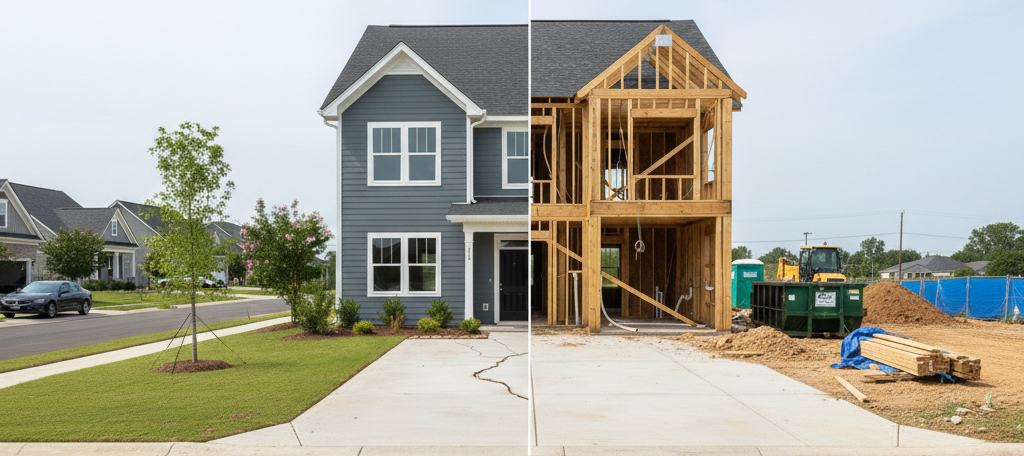
Most sites oversimplify this comparison into a cartoon. Here’s the honest version for the Ellis County market.
| Factor | New Construction | 20-Year-Old Resale |
|---|---|---|
| Upfront price | Typically 5 to 15% higher | Lower sticker price |
| 10-year operating costs | About $25,335 less (national avg.) | Higher utility and repair costs |
| Builder incentives | Rate buydowns, closing cost help, credits | Seller concessions vary |
| Warranty coverage | 1-2-10 structure included | None (or optional home warranty) |
| Energy efficiency | Built to current code | Varies widely, often poor |
| Customization | Design center options during build | What you see is what you get |
| HOA | Almost always present | Varies, many have none |
| Mature trees and landscaping | None (typically) | Established, real value |
| Character and charm | Newer aesthetic | More architectural variety |
| Timeline | 6 to 12 months for dirt build; 30 to 90 days for spec | 30 to 45 days standard close |
| Inspection control | Multiple stages possible | Standard pre-offer inspection |
| Negotiating power (2026) | High, buyer’s market, excess inventory | Moderate, depends on seller |
The right call depends on your priorities, your timeline, and the specific homes you’re comparing. What the table makes impossible to ignore is this: the “new construction is more expensive” story is incomplete, and once you fold in total cost of ownership, it’s frequently just wrong.
Who Is New Construction Right For in North Texas?

Not every buyer should chase new construction. Here’s the honest read.
New construction is likely your move if you:
- Plan to stay 5-plus years, where the operating savings compound.
- Hate maintenance surprises and want predictable costs.
- Are relocating and want a clean-slate home with a modern layout and current technology.
- Want to use rate buydown incentives to drive down your monthly payment.
- Are buying into a master-planned community where school, park, and amenity timelines matter.
- Need accessible design or modern smart-home features built in.
- Want builder warranty protection through the early years of ownership.
Resale might be the better play if you:
- Have to move in 60 days or less and don’t want to wait on a build or fight for spec.
- Have a strong pull toward a specific established neighborhood with mature trees and character.
- Are shopping a price range where new construction inventory is thin in your target area.
- Want to dodge HOAs entirely, though resale neighborhoods increasingly carry them too.
- Are buying to flip, where cosmetic renovation value can outpace new construction appreciation in specific submarkets.
If you’re weighing investment properties, read my earlier analysis: Investors Created 216% More Starter Homes Than Builders in 2025, which uncovers something surprising about where the real entry-level opportunity actually lives.
Energy Efficiency in North Texas New Construction: The Specifics Matter
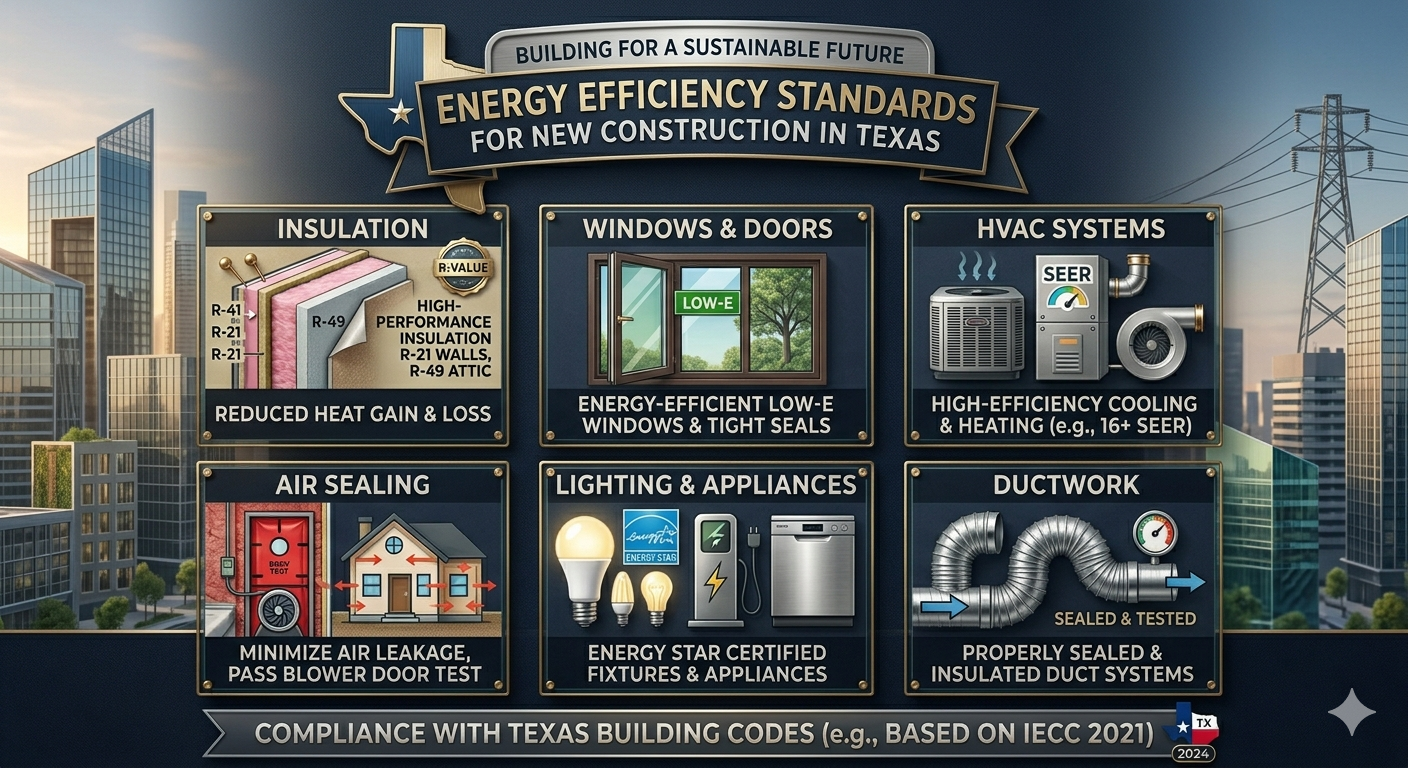
Texas summers don’t negotiate. The state’s per-capita energy consumption ranks among the highest in the nation, which is exactly why the Texas Energy Code, built on the 2015 International Energy Conservation Code (IECC), sets minimum standards every new home must clear.
In practical terms, a new construction home in Waxahachie or Midlothian comes with:
- Better insulation requirements, higher R-values for attic and wall insulation than what passed for standard 15 to 20 years ago.
- Air sealing standards that cut the infiltration of hot outside air forcing your HVAC to grind.
- Low-E windows, required in a climate zone like North Texas to knock down solar heat gain without killing natural light.
- High-efficiency HVAC minimums that meet current SEER (Seasonal Energy Efficiency Ratio) standards.
Some builders, especially the ones chasing Energy Star certification, blow past code minimums entirely. Energy Star certified homes use 10 to 20% less energy than standard new homes built to code, and up to 30% less than a typical resale.
The bottom line is simple. A 2025 new construction home in Ellis County is materially more efficient than a 2005 resale, even if both run air conditioning and neither has a panel on the roof. Across a Texas summer, that utility gap is real, recurring, and invisible on the listing price.
2026 Market Context: Why Right Now Is the Strategic Window

The May 2026 study didn’t land in a vacuum. It hit at a specific moment in the North Texas cycle, and the buyers who read that moment correctly are the ones who win.
According to my March 2026 North Texas Market Report, this is a buyer’s market. Pending sales are down significantly, inventory is elevated, and builders are sitting on spec homes they need to move. That combination produces leverage:
- Negotiating power is higher than it’s been in years. Builders need to sell, which makes incentives real and sometimes negotiable past what’s advertised.
- Rate buydowns are getting aggressive. As of 2026, some DFW builders are floating effective rates as low as 4.99% on select inventory homes through their preferred lenders. I have two buyers under contract capturing that 4.99% right now. If you’re reading this in 2026, that number is live and you should be moving on it. If you’re reading this years from now and rates never came back this low, this is the window you’ll wish you’d caught: a sub-5% builder buydown in a buyer’s market was the kind of opening that doesn’t reopen on schedule.
- Days on market for new construction are elevated. You’re not in a multiple-offer scramble on most spec homes, which means you have time to run proper due diligence instead of waiving it under pressure.
- The price gap between new and existing has narrowed to historic lows, which makes the 10-year operating-cost analysis even more lopsided in favor of new construction.
This window does not stay open forever. As the North Texas Market Insider Daily News tracks day to day, the regional fundamentals (population growth, corporate relocations, infrastructure investment) are still strong underneath the soft surface. When rate relief shows up and demand snaps back, builder incentives will disappear and spec inventory will clear in a hurry. The buyers who act while everyone else is waiting for a signal are the ones who capture a new home and the favorable pricing. That’s the whole game.
Relocating to North Texas? New Construction Is Your Starting Point
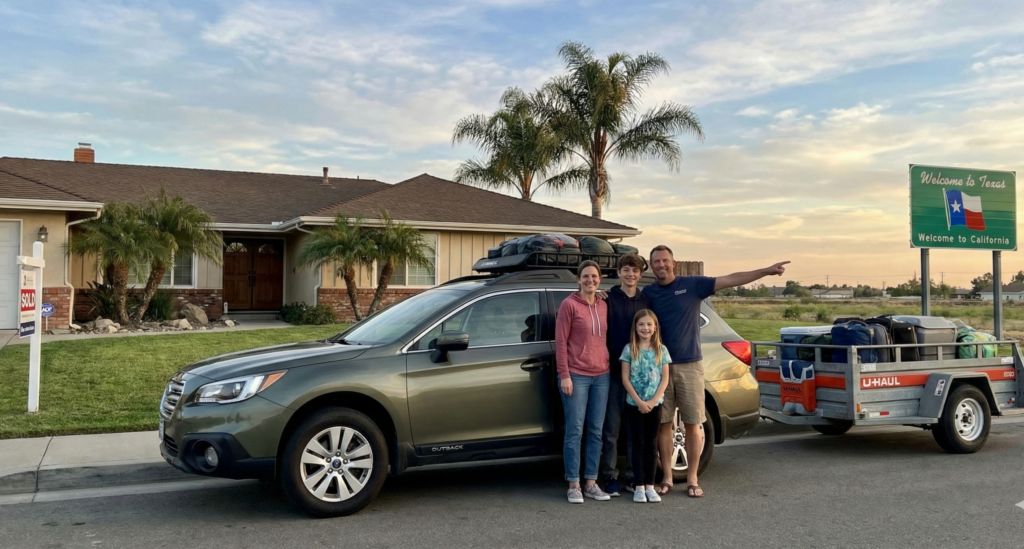
If you’re moving to DFW from out of state, new construction in Ellis County hands you advantages that go well past the financials.
Buy a resale remotely and you’re buying blind: deferred maintenance you can’t catch on a virtual tour, a neighborhood context you can’t read on a quick trip, and a price built on comps you can’t independently verify from 1,500 miles away.
New construction gives you:
- Standardized quality benchmarks from a known builder.
- Builder warranty protection from day one.
- Neighbors moving in on the same timeline, which builds social cohesion faster.
- Fresh infrastructure, roads, utilities, fiber, and amenities all going in new.
- Predictable timelines you can actually plan a cross-country move around.
For a personalized relocation consultation, start here: Schedule a North Texas Relocation Consultation.
Whether you’re coming from California, Illinois, Colorado, Utah, or even overseas, the math of relocating to North Texas works, and for a family moving sight-unseen, new construction is the product that protects you best.
Key North Texas Builders Active in Ellis County (What to Know Before You Visit)
If you’re actively shopping new construction in Waxahachie, Midlothian, and the surrounding communities, here’s the landscape.
Ellis County is carrying active communities from Perry Homes, Highland Homes, Centre Living Homes, Graham Hart homes, John Houston Homes, D.R. Horton, Bloomfield Homes, Coventry Homes, and others. Each operates at a different quality tier, price point, and design philosophy, and those differences matter more than the brochures admit.
My detailed evaluation of one standout is here: Bloomfield Homes: The Hidden Gem of Waxahachie.
A few strategic reminders before you walk a community:
- Register your agent on the first visit. Most builders won’t retroactively honor representation once you’ve toured unrepresented.
- Compare the builder’s lender incentives against outside lender costs with a qualified mortgage professional. Both, not one.
- Request the full warranty documentation before you go under contract, not after you’ve signed.
- Ask what the community looks like in three years. Get the full build-out plan, not just the phase you’re standing in.
- Get an independent inspection during framing if you’re doing a dirt build. Non-negotiable.
For the full build process across the major North Texas builders: The Complete North Texas New Construction Timeline.
The Total Cost of Ownership: Running the Real Numbers for a $450,000 Ellis County New Build

Enough national averages. Let me run the math on a realistic Ellis County purchase.
Scenario: you buy a 2,400-square-foot new construction home in Midlothian for $450,000 with 10% down ($45,000). The builder offers a permanent rate buydown that drops your rate to 5.5% against a prevailing market rate of 6.5%.
Monthly Payment Comparison (Principal and Interest only):
- At 6.5%: about $2,528 per month.
- At 5.5%: about $2,300 per month.
- Monthly savings: about $228.
- 10-year cumulative savings: about $27,360.
Operating Cost Savings (Conservative Texas Estimate, below national average):
- Annual utility savings vs. a 20-year-old comparable: about $800 to $1,200.
- Deferred HVAC replacement (Years 1 to 10): $6,000 to $12,000.
- Deferred roof replacement (Years 1 to 10): $0 (covered by warranty and age).
- Deferred water heater (Years 1 to 10): $0 (covered by warranty and age).
- Conservative 10-year total: $14,000 to $24,000.
Builder Incentives (Typical 2026 Package):
- Closing cost assistance: $8,000 to $15,000.
- Design center credits: $5,000 to $15,000.
- Rate buydown value (capitalized): $15,000 to $25,000.
Total Advantage vs. a Comparable 20-Year-Old Resale Over 10 Years:
Fold the operating savings, the rate buydown benefit, and the closing cost credits together, and the total financial advantage of a new construction home in Ellis County in this scenario reaches $55,000 to $85,000 over a decade. That holds even when the new home costs $30,000 to $50,000 more at the purchase price.
Be precise about what that number is made of, because precision is what makes it hold up when someone tries to poke it. These are four different kinds of dollar. The closing cost help and design credits are cash you keep at the table. The rate buydown is a financed cost you avoid month after month. The operating savings are repair and utility bills that never hit your account in the first place. Add them and the advantage is real, but it’s an advantage that arrives in different forms over different timelines, not a single check. Any agent who hands you one round number without showing the parts is selling you the headline, not the math.
This is exactly why the Realtor.com economists landed where they did: “The real story is that new construction expands a buyer’s budget.”
10 Most Commonly Searched Questions About New Construction Homes in 2026

These are the questions buyers are typing into Google, dropping into Reddit, and feeding to AI right now. Here are the honest, complete answers.
1. Is buying a new construction home worth it in 2026?
Yes, and the buyers who understand why are five steps ahead of the ones still arguing about sticker price. Lower operating costs ($25,335 national average over 10 years), builder incentives including rate buydowns (worth $250-plus a month), builder warranty coverage, and energy efficiency build a total-cost-of-ownership case that the “new is always expensive” crowd hasn’t run the numbers on. In a buyer’s market like mid-2026, with builders sitting on spec they need to move, the negotiating leverage is the highest it’s been in years. The window is the opportunity. Read it correctly and act while everyone else waits for a signal.
2. Are new construction homes more expensive than existing homes?
At the sticker price, usually yes, but the gap is closing fast. As of Q1 2026, the national price premium for new construction over existing homes is at its lowest first-quarter level since 2020. In 50 of the 300 largest metros, new construction is already cheaper at the median. In Ellis County, new construction starts in the mid-$300s and competes head to head with resale in the same range.
3. What builder incentives are available right now?
The heaviest hitters in the 2026 North Texas market:
- Permanent or temporary mortgage rate buydowns (averaging 1% below market, worth $250-plus a month).
- Closing cost assistance (often $8,000 to $20,000).
- Design center credits ($5,000 to $25,000).
- Price reductions on spec inventory, especially homes sitting past 30 to 60 days.
- HOA dues prepayment and other soft-cost coverage.
Always weigh the builder’s full incentive package against a competing outside mortgage quote before you commit to their lender.
4. Do I need a real estate agent to buy new construction?
You don’t legally require one, but you absolutely should have one. The builder’s sales rep works for the builder, not you. Your agent reviews the contract for unfavorable terms, advocates for your interests in the negotiation, coordinates your independent inspection, and guides you through the entire build at no added cost (the builder compensates the buyer’s agent in most North Texas transactions). Under post-NAR Settlement rules, you’ll sign a buyer representation agreement upfront. That’s a feature, not a bug.
5. What does a new construction home warranty cover in Texas?
Texas new homes typically carry a 1-2-10 warranty structure:
- Year 1: workmanship and finish items.
- Years 1 to 2: major mechanical systems (HVAC, plumbing, electrical).
- Years 1 to 10: structural defects (foundation, load-bearing elements).
Note that Texas HB2023 introduced a 1-2-6 option that shortens structural coverage to six years. Always request and read the full warranty documentation before closing. If a builder is offering 1-2-6, understand exactly what the shortened structural period means for you.
6. How long does it take to build a new construction home in North Texas?
6 to 12 months for a full dirt build, where you choose the lot, the options, and everything gets built from scratch. 30 to 90 days for a spec home that’s already built or near completion, with limited or no customization but a fast move-in. Expect 2 to 6 weeks of delay in any cycle. That’s standard in a high-growth Texas market.
7. What are the best new construction communities in Waxahachie and Midlothian?
Ellis County carries a deep, growing inventory at multiple price points, with active developments from Highland Homes, John Houston Homes, Perry Homes and others in and around Waxahachie and Midlothian. For current inventory and community-level analysis, contact North Texas Market Insider directly. Pricing, build quality, HOA terms, and build-out timelines are best navigated with a local expert who knows them from the inside.
8. Can I negotiate the price on a new construction home?
Yes, more in 2026 than at any point in recent years. In this buyer’s market, builders are carrying elevated spec inventory and are motivated to close. You have room to negotiate price reductions on standing inventory, enhanced incentive packages, lot premiums, and closing date flexibility. What builders rarely move on is the base price of a pre-sold home during active building. Your sharpest leverage is on completed or near-complete spec.
9. Should I get a home inspection on a new construction home?
Absolutely. The most common mistake new construction buyers make is skipping the independent inspection because “it’s brand new.” New homes have defects, sometimes serious ones, and an independent inspector catches what a builder walkthrough never will. Hire one at the framing stage and again at final walkthrough. A legitimate builder welcomes it. If yours resists, that’s a serious red flag, and you should treat it like one.
10. How do builder mortgage rate buydowns work?
A rate buydown is the builder (or seller) paying discount points upfront to lower your mortgage rate. In a permanent buydown, the rate drops for the life of the loan: the builder pays a lump sum at closing to your lender, which permanently reduces your rate. In a temporary buydown (like a 2-1), the rate is reduced for the first one or two years, then steps back up to the full rate. On a $450,000 home, a permanent 1% buydown from 6.3% to 5.3% saves about $256 a month, more than $30,000 over 10 years. That’s real value, not marketing fluff, though you should always measure the builder’s full package against what an outside lender will do.
The Bottom Line: Data Over Emotion

The new-construction-versus-resale conversation has been run for years on assumptions. That new is always pricier. That older homes carry more character and therefore more value. That builder incentives are tricks. That the sticker price is the real price.
The Realtor.com Total Cost of Ownership data takes those assumptions apart with rigorous analysis. New construction saves buyers real money over time through lower utilities, deferred maintenance, and warranty protection. The 2026 builder incentives are actually adding to those savings, not papering over a rip-off. In markets like Ellis County, where builder competition and a buyer’s market have pushed new construction pricing down, the gap between new and resale has narrowed to the point where the operating-cost advantage alone can justify the choice.
None of that makes new construction right for every buyer in every situation. The resale market has its own real case: mature neighborhoods, established trees, no HOA in some pockets, and character no new community can manufacture overnight.
What it does mean is that any buyer who dismisses new construction without running the actual numbers is leaving tens of thousands of dollars on the table over the life of their homeownership.
Run the numbers. Work with an agent who knows the local builder market from the inside. Make the decision on data, not defaults.
Ready to Explore New Construction in North Texas?
If you’re buying in Ellis County, Waxahachie, Midlothian, or the broader DFW area and you want builder-neutral guidance from someone who reads this market from the inside, reach out directly.
Bobby Franklin, REALTOR®
Legacy Realty Group – Leslie Majors Team
North Texas Market Insider™
📞 214-228-0003
📍 16 Northgate Dr. Ste 100, Waxahachie, TX 75165
🌐 northtexasmarketinsider.com
Serving Ellis County, Johnson County, Hill County, and the DFW Metroplex.
Disclosure: This article is written for educational and informational purposes. Nothing herein constitutes legal, financial, or tax advice. All real estate transactions are subject to current market conditions, individual qualification, and applicable federal and state laws including the Fair Housing Act, RESPA, and NAR Code of Ethics. All content is original, independently developed, and not sponsored by any builder or developer. Bobby Franklin is a licensed Texas REALTOR® with Legacy Realty Group, Broker Leslie Majors.