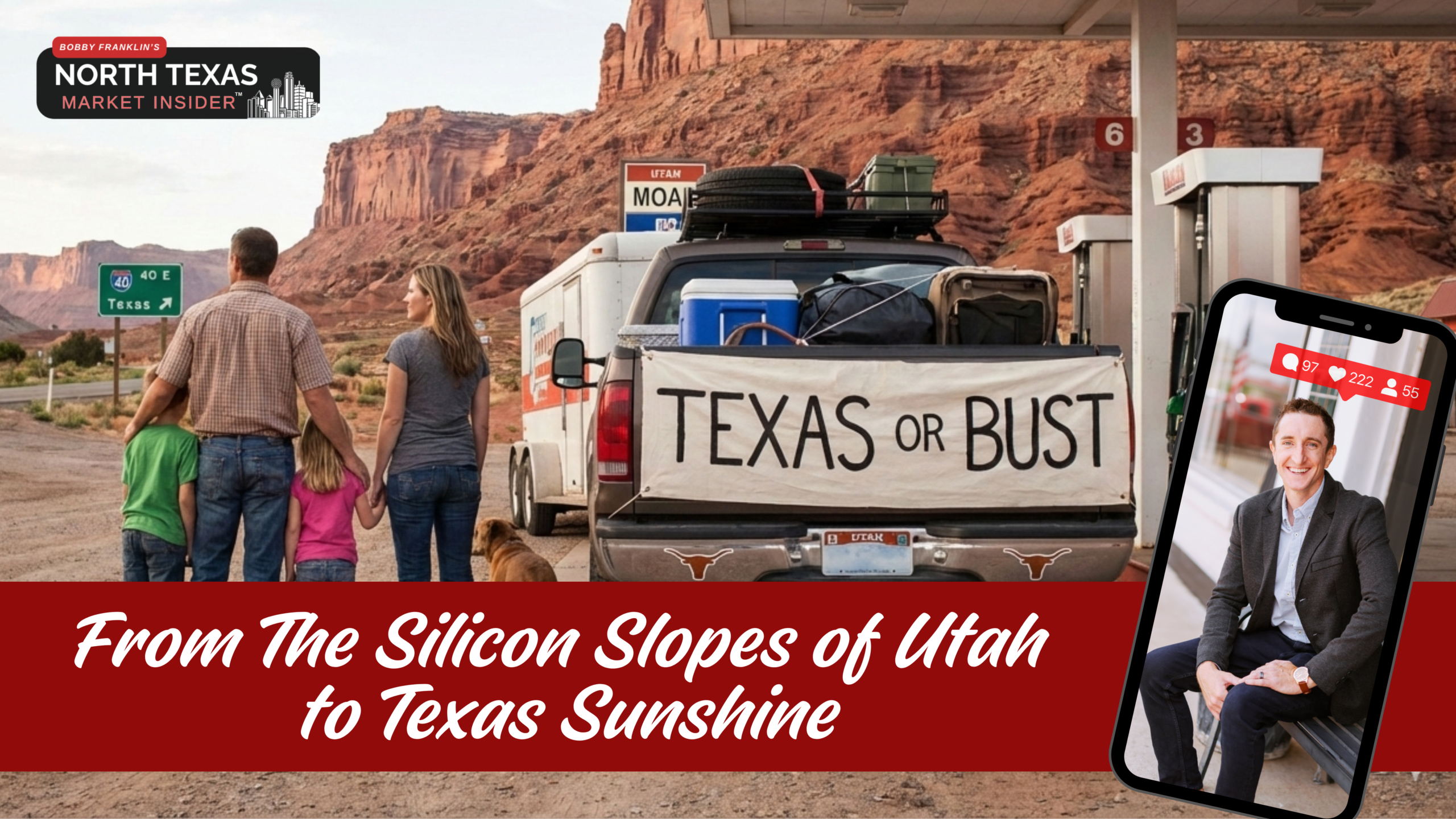
Why so many Utah families are choosing North Texas and what you need to know before you move to Texas
North Texas Market Insider™ · Utah Relocation
Why Utah Money is Flowing to North Texas
It usually starts with a January. The inversion settles into the valley, the air quality app goes orange for the fourth day running, and somebody in the house says out loud what everyone has been thinking since November.
Then the numbers back it up. Utah homeowners insurance rose faster than any other state's between 2021 and 2024, driven substantially by wildfire exposure, and the Wasatch Front carries a 57 percent probability of a magnitude 6.0 or greater earthquake over the next fifty years according to the Working Group on Utah Earthquake Probabilities. Earthquake coverage carries a deductible of five to fifteen percent of dwelling coverage, which on a $500,000 home is tens of thousands out of pocket before a policy pays anything.
North Texas trades that for hail. Real cost, real premium, but a standard deductible, a mature claims process, and a roofer who has handled a hundred of them. One catastrophe exposure priced into one policy rather than two layered risks where the bigger one arrives without warning.
Add Utah's flat state income tax disappearing entirely, housing that goes considerably further outside the Wasatch Front price structure, and school districts with meaningfully smaller class sizes than Utah families are used to. What you give up is the mountains, and that is not a small thing. It is the row that decides this for some families and it should be weighed first.
57%
Chance of a magnitude 6.0+ on the Wasatch Front in 50 years
5–15%
Earthquake deductible, as a share of dwelling coverage
Zero
Texas state income tax on wages or business profit
Earthquake probability figures are from the Working Group on Utah Earthquake Probabilities as published by the USGS and cover the Wasatch Front region. Insurance costs, deductible structures, and tax rates vary and change. General information, not advice.
North Texas Market Insider™ · Area Matcher
Find Your North Texas Landing Zone
Three questions, about twenty seconds. Tell me where in Utah you're leaving and I'll start you with the priorities most families from there name first. Change any of them, then set your budget, and I'll show you the areas worth a real look.
123✓
Where in Utah are you coming from?
I'll use this to suggest a starting point on the next step. You can change every one of them.
What actually matters most? Pick up to three.
0 of 3 selected. Tap to add or remove.
What's your home budget?
Purchase price, not monthly payment.
Your closest matches
Results are ranked only on the priorities and budget you selected, all of which you control. Every community listed is open to all buyers. Price ranges are general estimates and change with the market. See the full disclosure at the bottom of this page.
Utah → North Texas
Where Utah families are landing.
Most of my Utah clients aren't randomly picking a spot on the map, they're looking for suburbs that feel like an upgrade to the lifestyle they already have. Tap what matters to you and the rest will drop away.
Tell me what part of Utah you're coming from, and what you like or don't like about it, and I can usually narrow this list down to two or three specific DFW or rural areas that match your lifestyle and budget very closely.
Bobby Franklin, REALTOR® · Legacy Realty Group – Leslie Majors Team · northtexasmarketinsider.com
North Texas Market Insider™ · Utah Relocation
Four Kinds of Utah Buyer
If you're relocating from Utah, you're not just buying a house, you're making a strategic decision to enter one of the strongest markets in the nation. Almost every Utah client I work with is running one of these four plays. Find yours, then open it for what actually determines whether it works.
Career move
The Career Movers
4.5%Utah flat income tax, gone
Utah professionals relocating to DFW for corporate transfers, tech opportunities, or leadership roles with Texas-based companies. They're trading the Wasatch backdrop for a job market with several times the employers in it.
What determines whether it works
Salary on paper will often look flat or slightly lower than a comparable Wasatch Front role. That is the wrong comparison. Run take-home after eliminating Utah's flat state income tax, then run housing cost on top, and the picture usually reverses hard.
Get the relocation package in writing before you shop. Temporary housing allowance, closing cost coverage, and whether the employer will buy out your Utah home change which price band you should even be looking in. Many Utah buyers shop before they know this and end up re-shopping.
Underwriting wants stability. A new employer, a new state, and a first-day start date is a combination lenders scrutinise. An offer letter and a start date get you pre-approved cleanly; a verbal and a handshake do not.
Equity play
The Equity Reinvestors
$150K+typical gap on the purchase alone
Homeowners cashing out strong Utah appreciation, particularly from Lehi, Draper, and Herriman, who use that equity to buy more house here, pay down debt, invest in additional property, or build real cushion. Strategic capital moves, not emotional ones.
What determines whether it works
Know your capital gains position before you list. The federal exclusion on a primary residence is $250,000 of gain for a single filer and $500,000 for a married couple filing jointly, and it requires having owned and lived in the home two of the last five years. On a home bought before the Utah run-up, gain above that is taxable. Talk to your CPA before the listing goes live.
Sequence beats optimisation. Utah families who execute this cleanly sell first and land in a short-term rental here, which lets them write non-contingent offers. In this market a non-contingent offer is worth real money at the table, often more than the rent they paid to be in that position.
Then decide what the freed equity actually does. Paying cash and carrying no mortgage is a different plan from putting twenty percent down and deploying the rest, and the right answer depends on rates, your tax picture, and how fast you want a second asset producing.
Priced out
The Affordability Refugees
2,500+ sq ftfor what a 1,600 rambler cost you
Families and first-time buyers priced out of Utah's bidding wars who find that DFW inventory and price points finally deliver the space, yard, and neighbourhood they have been chasing. Not settling. Getting more.
What determines whether it works
Compare total monthly cost, not purchase price. This is where Utah buyers get the math wrong most often. Your Texas payment carries a far larger property tax and insurance share than your Utah payment did. Two homes at the same price in adjacent neighbourhoods can differ by hundreds a month once MUD or PID taxes and HOA dues are counted.
The gap is still real, it is just smaller than the sticker suggests. Run it honestly and you will usually still be ahead by a wide margin once the income tax saving is in, but you should see the true number before you fall in love with a floor plan.
Inventory here rewards patience in a way Utah's does not. You are unlikely to be in a bidding war on day one. Coming from a market where hesitation cost you the house, that adjustment takes a few weeks to trust.
Lifestyle switch
The Lifestyle Switchers
8–9months of usable outdoor weather
People trading Utah's long commutes, winter inversions, or mountain isolation for big-city amenities, diverse communities, and open Texas sky. Quality-of-life upgrades, not compromises.
The trade you are actually making
Say the hard part first: there are no mountains. Not smaller mountains, none. If canyon access after work is load-bearing in your life, this is the trade that will decide whether you are happy here, and no amount of square footage fixes it.
What you get back is time outdoors. Eight to nine usable months instead of a winter that keeps you inside four to five, no inversion, no AQI app in January, and lake culture that replaces ski culture rather than imitating it.
The diversity point is real and people underestimate it. Utah families relocating here consistently name their kids' schools and the food as the two things that surprised them most. If that is part of why you are leaving, this market delivers it at a scale the Wasatch Front cannot.
General information, not tax, legal, or investment advice. Tax rates and capital gains treatment depend on your individual circumstances and change over time. Consult a CPA and a licensed lender before acting on any of this.
North Texas Market Insider™ · Reality Check
What Utah Didn't Prepare You For
Twelve things that catch Utah families off guard in the first year. Four of them cost real money. Tick the ones that apply to you and build your own first-year number, then open any card for the detail underneath it.
Showing all twelve
Your estimated first-year add-on cost$0
Tick the boxes on the four cost cards below to build your number.
01Culture
Alcohol Is Everywhere and Nobody Thinks Twice
Aisles where Utah had 3.2% beer
Full-strength beer, wine, and spirits sit in grocery stores and gas stations outside dry counties. Happy hours are common. Restaurants serve doubles. For most Utah families this is the single biggest day-to-day culture shock, not because they drink, but because alcohol is so visibly normalized.
What actually changes
What you are leaving: metered pours capped at 1.5 ounces, a 5 percent ABV cap on grocery beer, state-run liquor stores closed Sundays and holidays, and cocktails limited to 2.5 ounces of total alcohol.
What to expect here: beer and wine in supermarkets and convenience stores, private liquor stores closed Sundays, bars open until 2:00 a.m., and no requirement to order food with a drink.
The practical note: Texas still has dry and partially dry counties, but essentially all of the DFW metro is fully wet. If you are shopping a rural county south or west of the metroplex, that is worth a five-second check.
02Costs money
Property Taxes Will Multiply What You Paid in Utah
10% annual homestead cap on increases
Utah's effective property tax rate runs well under one percent. Texas averages considerably higher, with no state income tax to offset it. On a $500,000 home the annual difference is thousands of dollars, and it is the most common budgeting mistake Utah buyers make.
The number everyone gets wrong
Here is the correction to something you will read everywhere, including on this page until recently. Texas caps annual increases in a residence homestead's appraised value at 10 percent plus the value of any new improvements, under Tax Code 23.23. It is not unlimited and it is not 15 to 20 percent.
The cap does not protect you in year one. It takes effect January 1 following the year you first qualify for the homestead exemption, so your first assessment here is uncapped. File as soon as you close and protest that first year, because that protest sets the base every future increase builds on.
Run the payment, not the price. A family comparing a $540,000 Salt Lake home to a $385,000 Midlothian home is comparing the wrong two numbers. Compare full monthly cost with taxes and insurance in. The gap narrows, and it still lands firmly in Texas's favour once the income tax saving is counted.
03Costs money
MUDs and PIDs: A Tax Layer Utah Does Not Have
$1,500–$4,200 a year, for 20–30 years
Utah has no Municipal Utility Districts. Texas does. Buy new construction outside city limits, which many Utahns do for the space and value, and a MUD can add that much annually to repay infrastructure bonds for water, sewer, and drainage. A PID works the same way.
How to spot one before you sign
Why it catches Utah buyers specifically: you are used to reading one combined property tax rate. Here the rate is a stack of separate entities, and a MUD line can add well over a full percentage point on top of city, county, and school district.
Ask for the total tax rate, not the monthly payment. A builder quoting a payment may be using the current rate on unimproved land. Two homes at the same price in adjacent neighbourhoods can differ by hundreds a month on this line alone.
Get it in writing before the option period ends. Most online mortgage calculators miss MUD and PID taxes entirely, which is exactly how an affordable new build becomes a payment you did not plan for.
04Outdoors
The Outdoor Recreation Gap Is Real
#5 → #23 Utah's national outdoor rank, then Texas's
In Utah you are fifteen minutes from a canyon, forty-five from a ski resort, and surrounded by five national parks. Texas is the opposite: the overwhelming majority of land is private. There are no mountains to hike into after work. Lakes replace ski resorts.
What replaces the mountains
Be honest with yourself about this one, because it is the adjustment Utah transplants name most often and the one with no workaround. Big Bend and Palo Duro Canyon are genuinely spectacular, but they are multi-hour drives, not a Tuesday evening.
What replaces it is lake culture. Dozens of lakes sit within an hour of DFW for boating, kayaking, and fishing, plus extensive trail systems and eight to nine months of usable patio weather. Plan to invest in lake gear the way you invested in ski gear.
The counterintuitive part: many Utah transplants report spending more total hours outdoors here, because Utah winters and inversions kept them inside four to five months a year. Colorado is a direct flight for ski trips.
05Weather
Hail, Tornadoes, and Ice Storms
#1 Texas ranks first nationally in hail damage
Utahns expect the heat. What blindsides them is hail that destroys roofs and cars, tornadoes that require a genuine safety plan, and ice storms that shut the region down because the infrastructure was never built for extended freezing.
What to check before you buy
Insurance is the real cost line. Texas homeowners premiums run substantially higher than Utah's, and hail is the primary reason. Budget for it rather than discovering it at closing.
But compare like for like. A Utah premium does not include earthquake coverage, which adds several hundred to a thousand dollars a year with a deductible of 5 to 15 percent of dwelling coverage. On a $500,000 Utah home that is tens of thousands out of pocket before the insurer pays anything. A Texas hail claim carries a standard deductible and your roofer handles the process.
Roof age drives insurability. As roofs age, carriers may shift from replacement cost to actual cash value, which pays depreciated value rather than the cost of a new roof. Ask the roof's age and last hail claim before you write an offer, and get an insurance quote during your option period.
06Culture
Friday Night Football Is Community Religion
10,000–20,000 stadium seats, at a high school
Utah has strong high school sports culture. Nothing prepares you for Texas football. Booster clubs run six-figure budgets, and band, drill team, cheer, and ROTC all revolve around the Friday night schedule from August through December.
How it reshapes your calendar
The commitment starts before school does. Marching band and football both run summer practice, often beginning in July. If you are moving in June or July with a participating kid, that schedule is already set and you are joining it late.
The real cost is Fridays. From late August through November, Friday nights are spoken for across the whole community, not just for families with kids playing. Restaurants empty out.
For a transplant family this cuts both ways. It is either the fastest route into a new town or a season of feeling outside it, and which one you get depends almost entirely on whether you show up.
07Daily life
Guns Are More Visible Than You Are Used To
Same law different culture
Both Utah and Texas are constitutional carry states allowing permitless carry for adults 21 and older, so the statutes are close to identical. The surprise is not legal, it is cultural: open carry in holsters is common and visible here in a way it is not along the Wasatch Front.
What actually changes
What changes day to day: you will see sidearms in grocery stores, restaurants, parks, and gas stations regularly. In Utah carry culture exists but tends toward the discreet. Here it is unremarkable.
Private property still controls. Businesses can and do prohibit carry with specific statutory signage, and those signs are legally binding. Schools, courthouses, polling places, and secured airport areas remain off limits.
The honest note: the adjustment is psychological rather than practical, and most families stop noticing within a few months. If it makes you uncomfortable, that is a reasonable reaction worth naming before you move rather than discovering at a hardware store in month two.
08Wildlife
Scorpions and Fire Ants Are Your New Roommates
$75–$125 a month for pest control
Utah has rattlesnakes and black widows. Texas introduces two pests you have genuinely never dealt with: striped bark scorpions that come indoors seeking water and shelter, and fire ants that build mounds across every lawn in warm months.
What to expect and what to do
The scorpion is painful, not dangerous. A striped bark scorpion sting is comparable to a wasp for most people, though anyone with a known sting allergy should treat it seriously. Expect one or two weekly during peak season in many North Texas neighbourhoods.
Fire ants are the bigger daily nuisance if you have kids or dogs. Mounds appear fast after rain following a dry stretch, and they are aggressive when disturbed.
What actually works: quarterly exterior service handles most of it, monthly is common in newer construction on the edge of undeveloped land, and sealing exterior gaps plus keeping mulch off the foundation does more than people expect. Shaking out your shoes becomes second nature.
09Culture
BBQ Is Regional Identity, Not Just Cuisine
4 distinct regional styles
Utah does not have a defining food culture the way Texas has barbecue. Central Texas runs salt-and-pepper brisket over post oak with no sauce. East Texas goes chopped and saucy on a bun. South Texas leans barbacoa. West Texas cooks over direct mesquite heat.
Why this tells you something real
This is cultural currency, not just food. People drive four hours and wait four more for a legendary pitmaster. Having opinions about the differences is part of being a Texan, and nobody will explain the rules to you.
What it tells you about the place: the reverence for something slow, inherited, and deliberately unimproved says a lot about how this culture weighs tradition against innovation. It shows up in how people choose contractors, how they pick a church, how long they stay with a bank.
Coming from a state with its own strong community identity, this is the part most Utah transplants find easiest to embrace. Same instinct, different object.
10Daily life
Frontage Roads Are a Parallel Highway Universe
More than any state thousands of miles of "feeders"
Utah's freeway system is straightforward: on-ramp, off-ramp, done. Texas has more frontage road mileage than any other state, creating an entirely separate road network with its own traffic lights, U-turns, and commercial corridors running alongside every major highway.
Why this affects what you buy
Why they exist: when Texas upgraded existing highways to Interstates, building frontage roads preserved access to adjacent property instead of buying out those access rights. It became standard practice, and the result runs alongside most freeways in the state.
What it means for a home search: "close to the highway" here does not mean what it means in Utah. A property backing a frontage road carries constant surface traffic, not just freeway noise, plus lighting and commercial activity. Appraisers treat that as a value factor and so should you.
Give it a few months. The Texas turnaround at every major intersection is how the system is designed to work, and missing an exit stops being a disaster once you learn the pattern.
11Costs money
The Homestead Exemption Has a Hard Deadline
April 30 file or lose the year
Applications are accepted January 1 through April 30 of the tax year. Miss it and you forfeit that year's savings, though Texas allows a late filing for up to two years after the delinquency date with a penalty attached.
The order nobody explains
Your Texas driver's license address must match the property. Appraisal districts reject applications where it does not, which means the paperwork chain matters: register the vehicle first, then get the license at the property address, then file the exemption.
This is also what starts your 10 percent appraisal cap. The cap takes effect January 1 following the year you first qualify, so filing late does not just cost one year of savings, it delays the protection limiting every future increase.
You file once. The exemption stays on the property as long as it is your principal residence, with no annual refiling.
12Daily life
Your Paperwork Clock Starts the Day You Arrive
30 / 90 days, and they are different clocks
Thirty days to register your vehicle with the county tax office. Ninety days to get a Texas driver's license from DPS. Most people assume it is one deadline handled in one trip. It is not.
Do these in the right order
Register the vehicle before you go to DPS. The license application asks for proof of Texas registration, so the county tax office is your first stop. Getting this backwards costs an entire wasted morning.
Texas dropped the annual safety inspection for most non-commercial vehicles in January 2025, but emissions testing is still required in a set of counties including Dallas, Tarrant, Collin, and Denton. If you are landing in the northern corridor, you are in an emissions county.
Budget for the new resident fee. New residents pay a vehicle tax of $90 or the difference between the prior state's sales tax and the Texas rate, plus registration and title fees.
Nothing matches that filter. Try another one.
Figures are general estimates for the North Texas market and vary by property, neighbourhood, and provider. Property tax, insurance, and firearms references are general information, not legal or tax advice. Confirm current rules and rates with the appropriate authority before relying on them.
North Texas Market Insider™ · Climate Ledger
Utah Weather vs North Texas Weather, Honestly
This is not a weather comparison, it is a risk trade. You are swapping a low-frequency catastrophic risk with no warning for a high-frequency manageable one with warning and functioning insurance. Three of these eight rows go against Texas. They are marked as such. Tap any row for the detail underneath it.
North Texas winsUtah wins
Air qualityUtahWinter inversionvsNorth TexasOpen, flat, and windyNorth Texas
STATE
An average of roughly 18 days a winter where fine particulate exceeds federal standards, with multi-day episodes trapping pollution in the valley. Salt Lake City has ranked worst in the nation during peak inversion.
North Texas
North Texas has no valley to trap anything. There is no inversion season, and no winter morning where you check an air quality app before deciding whether the kids can play outside.
Why this one is not close
This is the single most cited reason Utah families give for leaving, and it is the row where the trade is most lopsided. Inversion is a topography problem. The Wasatch Front is a bowl, cold air settles, and pollution has nowhere to go until a storm clears it.
North Texas is flat and open. Air moves. Whatever else you give up in this comparison, you are not giving this up, and families with asthmatic kids tend to notice within the first winter.
Wildfire and insuranceUtahPremiums up 59% since 2021vsNorth TexasHail claims that payNorth Texas
STATE
Utah saw the sharpest homeowners insurance increase of any state between 2021 and 2024, from an average near $1,126 to roughly $1,795, per the Consumer Federation of America. Some carriers are declining to renew in fire-exposed areas entirely.
North Texas
Texas premiums are higher in absolute terms and you should budget for that honestly. The difference is that hail is routine, roofers here specialise in the claims process, and coverage is available.
The number that matters is availability, not price
Texas homeowners insurance costs more. That is true and you should plan for it. But compare the right thing: a high premium you can buy is a different problem from a moderate premium you cannot renew.
Utah's increase was driven substantially by wildfire exposure, with the state insurance commissioner pointing to continued building in high-risk zones. Utah has built thousands of homes in high-risk areas over the past decade, second only to California.
The comparison people forget: a Utah premium does not include earthquake coverage. Add that and the gap narrows considerably.
Catastrophic riskUtah57% chance of a magnitude 6.0vsNorth TexasTornado warnings with 10 to 30 minutesNorth Texas
STATE
The Working Group on Utah Earthquake Probabilities puts the Wasatch Front region at a 57 percent probability of one or more magnitude 6.0 or greater earthquakes, and 43 percent for magnitude 6.75 or greater, in the next 50 years. Zero seconds of warning.
North Texas
Real risk, genuinely lower severity for any given address, and every event comes with advance notice. You shelter for fifteen to thirty minutes and life resumes.
Read the earthquake numbers carefully
Be precise about what those figures cover. The 57 and 43 percent probabilities are for the Wasatch Front region, which includes 45 other faults. The Wasatch fault zone itself carries an 18 percent probability. That is still an uncomfortable number for a 50-year window.
The deductible is the part nobody mentions. Earthquake coverage typically carries a deductible of 5 to 15 percent of dwelling coverage rather than a flat dollar amount. On a $500,000 home that is tens of thousands out of pocket before the policy pays anything.
A Texas hail claim carries a standard deductible and a contractor who has handled a hundred of them. That is the real difference: not whether something happens, but whether the system is built to absorb it.
WaterUtahChronic droughtvsNorth TexasWater your lawnNorth Texas
STATE
Utah's water supply depends overwhelmingly on snowpack, reservoirs draw down fast in dry years, and localised restrictions and survival-watering guidance have become routine rather than exceptional.
North Texas
North Texas has its own dry stretches and occasional restrictions, but nothing resembling a decade-long structural shortage tied to a single snowpack.
What actually changes
This one shows up in daily life faster than people expect. Landscaping choices, whether a pool is reasonable, whether you feel guilty running sprinklers. Utah transplants routinely mention it as a small thing that turned out not to be small.
Do not overstate it in the other direction. North Texas has watering schedules in dry summers and its own long-term supply planning. It is a difference of degree, but the degree is large.
Terrain and recreationUtahMountains, canyons, five national parksvsNorth TexasFlat. Lakes instead.Utah
STATE
Fifteen minutes to a canyon, forty-five to a ski resort, and world-class hiking, climbing, and skiing effectively out your back door.
North Texas
Dozens of lakes within an hour of DFW, extensive trail systems, and state parks. There are no mountains. Not smaller ones. None.
This is the row that decides it for some families
Say the hard part plainly: this is the biggest thing you give up, and no amount of square footage compensates for it if canyon access after work is load-bearing in your life.
What replaces it is lake culture, which is genuinely a culture here rather than a consolation. Boats, weekends on the water, and eight to nine months of usable outdoor weather instead of four to five.
The counterintuitive part: many Utah transplants report more total hours outdoors here, because Utah winters and inversions kept them inside for months. Colorado is also a direct flight.
SummerUtahHot but dry, cool eveningsvsNorth Texas95 to 100°F with humidityUtah
STATE
Salt Lake Valley summers run in the 90s with low humidity and evenings that cool off meaningfully. Shade actually works.
North Texas
June through September, and the humidity is a bigger adjustment than the temperature. Outdoor activity moves to mornings and evenings.
The adaptation timeline is real
Most Utah transplants describe the same arc: the first summer is genuinely rough, the second is manageable, and by the third they barely think about it. Your body acclimates faster than you expect.
What makes it workable: air conditioning is universal and built into every home rather than an add-on, pools are standard in master-planned communities, and builders design covered patios and outdoor kitchens because the climate demands it.
The honest framing: Utah's winter keeps you inside four to five months. Texas summer keeps you inside during afternoons for three. Count the hours rather than the misery.
Utah electricity runs meaningfully cheaper per month than Texas, though winter natural gas heating narrows the annual gap considerably.
North Texas
Running air conditioning hard from June through September costs real money, and your summer bills will be noticeably higher than what you are used to.
Compare annual, not monthly
Monthly comparisons flatter Utah and mislead you. Utah's lower electricity rate is offset by a winter heating season Texas mostly does not have. Add both sides of the year and the annual totals land far closer than the monthly numbers suggest.
Still, be honest: Texas is the more expensive side of this row. Budget a few hundred dollars a year more, and set it against the housing and income tax difference rather than pretending it does not exist.
WinterUtahLong, and it traps youvsNorth TexasMild, with occasional hard freezesNorth Texas
STATE
Months of freezing, ice-covered roads, high heating bills, and the inversion season layered on top. Half the year indoors is a fair description.
North Texas
DFW averages roughly 248 freeze-free days. January lows sit near freezing and cold snaps are short. Snow is rare.
But take the freeze seriously
You know about the 2021 storm, and it was as bad as you heard. Texas has since invested in grid weatherisation and mandated winterisation for power plants, but the honest read is that infrastructure here is built for heat, not for extended cold.
What that means practically: know where your water shutoff is before your first February, and expect the region to slow down dramatically during an ice event because it does not have the equipment Utah takes for granted.
Net of that, DFW winters feel roughly like Utah's late October, for about three months.
Figures are drawn from the sources named and are general information rather than advice. Earthquake probabilities are from the Working Group on Utah Earthquake Probabilities as published by the USGS; insurance increase figures are from the Consumer Federation of America. Insurance costs, utility rates, and weather patterns vary by property and change over time. Confirm current figures with a licensed insurance agent before relying on them.
North Texas Market Insider™ · Schools
Four Ways Utah Families Choose a District
Most Utah families arrive with a shortlist of district names they found online, and about half the time those names are not the right fit for their student or their budget. These are the four patterns I actually see, sorted by what a family is optimising for. Unlike agents who point everyone toward their own farm area, my job is getting you in the right place, not just any place.
Each bar is drawn on the same $0 to $2.6M scale, so the widths are directly comparable across all four tiers.
The districts that come up in every conversation with a Salt Lake County or Utah County tech family who will not compromise on education.
What you're actually getting
Academic programs that stand up against Alpine and Davis, Utah's gold standard, with the kind of parent involvement and booster funding that shows up in facilities, arts, and athletics.
The price comparison surprises people. Coppell and the Lovejoy attendance areas in Allen and Fairview land in a similar band to Draper or Holladay, but with no state income tax on top. Southlake sits above that, and you should know it going in.
Best for dual-income professional families leaving the Salt Lake or Utah County corridors who need elite schools, and who also want the income tax windfall and access to a far larger job market.
Tier 2Value + outcomes
$400K–$700K
"Strong Schools, Smart Money"
Allen ISD · Frisco ISD · Plano ISD · Prosper ISD · Wylie ISD
Large, established Collin County districts with deep course catalogues and enough scale to run programs a smaller district simply cannot.
What you're actually getting
This is where the value equation gets interesting for Utahns. Median prices in Allen and Plano generally sit below what you would pay in Lehi, Herriman, or Saratoga Springs, with newer construction, larger homes, and dramatically more dining, shopping, and entertainment than anywhere along the Wasatch Front.
Scale is the feature. Multiple high schools per district means more AP and dual-credit options, more career pathways, more room for a kid to find their thing. A student who would be one of forty in a small district is one of four hundred here.
Be honest about the offset. Texas property taxes run considerably higher than Utah's, so the monthly payment gap is narrower than the sticker gap. Over five to ten years the income tax saving still wins comfortably.
Tier 3Long game
$280K–$475K
"We're Playing the Long Game"
Midlothian ISD · Waxahachie ISD · Red Oak ISD · Melissa ISD · Forney ISD
Growing districts in the corridors south and east of the metroplex, where the same money buys meaningfully more house and often actual land.
What you're actually getting
This is where Utahns unlock real financial leverage. For the price of a modest home in Eagle Mountain or Spanish Fork you can buy significantly more house here and bank the difference. That is wealth-building capital, not a lateral move.
These districts are growing fast, which cuts both ways. New campuses are being built and attendance boundaries get redrawn as they open. Ask which campus a home feeds to and whether a rezoning is on the calendar, because the answer can change between contract and closing.
Best for families from the south end of the Wasatch Front who are motivated by financial freedom over district prestige, and who liked the feel of smaller Utah cities. This is my home corridor, so I will tell you plainly: the growth here is real and it is early.
Lake Whitney, the rural Central Texas corridor, and Rockwall's Lake Ray Hubbard access. The draw here is not the district at all. Note the bar: this range is wider than the other three combined.
What you're actually getting
Be honest with yourself about what you are optimising for, because it is not schools. It is acreage, water, and a genuinely different pace. These are small districts where your kid is known by name, which some families want badly and others find isolating.
This is the Utah outdoor trade, priced sanely. Utah's recreation corridors carry a premium on everything near them. Here you can own lakefront or multi-acre property for a fraction of what a comparable outdoor-lifestyle property costs near Park City or Bear Lake. Lake Whitney is about ninety minutes from DFW; Rockwall is thirty minutes from downtown Dallas.
Two things to check before you commit: the commute measured honestly at the hour you would actually drive it, and whether the land qualifies for an agricultural valuation, which changes the property tax math on acreage substantially.
School district information is provided as general information only and reflects the districts Utah families most frequently ask about. Attendance boundaries, program offerings, campus assignments, and performance data change and vary by campus. Verify all school information directly with the district before making any purchase decision. Home price ranges are general estimates and vary by neighborhood, campus, and market conditions. As a REALTOR® I comply fully with the Fair Housing Act and cannot and will not direct buyers toward or away from any community based on race, color, religion, sex, national origin, familial status, or disability.
By Bobby Franklin, REALTOR® — North Texas Market Insider | Serving Ellis County, the I-35E Corridor, and the DFW Metroplex Last updated: July. Continue reading
The Intelligence You Need Before You Buy Here’s the thing about Texas property taxes that...
Market Snapshot · Live NTREIS Data
What the DFW Market Is Actually Doing
In California, what a home sold for is public record. In Texas it is not. Sales price information provided to appraisal districts is confidential under Tax Code 22.27, which means the national sites you have been browsing are estimating closed prices here rather than reporting them. These four charts come from NTREIS, the MLS, where the confirmed numbers actually live.
Median Sales Price
What Your Equity Actually Buys
The middle point of all closed sales, so one luxury outlier cannot skew it. This is the number to hold your California sale price against. Compare it to your own median, not to your neighborhood's best comp. The gap between the two is the real size of the move you are considering.
Chart: Median sales price across the DFW market, tracked monthly. Source: NTREIS MLS.
Closed Sales
How Much Is Actually Trading
Completed transactions where financing cleared and the home changed hands. Read it against price, never alone. Rising prices with rising volume is genuine demand. Rising prices with falling volume means sellers are holding a number that fewer buyers will accept, and that is precisely when concessions start showing up in contracts.
Chart: Closed sales volume across the DFW market, tracked monthly. Source: NTREIS MLS.
Percent Of Original List Price
How Far Sellers Actually Move
What homes closed for measured against their original ask, before any price reductions. Near 100 percent means sellers are holding firm. Below it, that gap is your negotiating room. This is the single most useful number to carry into an offer, and out-of-state buyers almost never ask for it.
Chart: Percent of original list price received across the DFW market, tracked monthly. Source: NTREIS MLS.
Showings To Pending
How Hard Sellers Are Working
How many showings it takes to produce one home going under contract. This is the earliest honest signal on the page. A low number means homes are selling on the first weekend and you will be competing. A climbing number means sellers are opening the door again and again before anyone writes, and that is buyer leverage arriving weeks before it ever reaches an asking price.
Chart: Showings required per pending sale across the DFW market, tracked monthly. Source: NTREIS MLS.
All four charts update automatically from NTREIS as new sales close. Want these numbers filtered to the specific submarkets you are considering, with your California sale price run against them? Call 214-228-0003.
Bobby Franklin, REALTOR® · Legacy Realty Group – Leslie Majors Team · northtexasmarketinsider.com
North Texas Market Insider™ · Utah Relocation
What Utahns Want To Know About Texas
Ten answers on the questions that come up on every Utah relocation call: what actually gets cheaper, how far your equity really goes, what happens to the mountains, and whether there is a ward waiting for you when you land.
Is it really cheaper to live in Texas than in Utah?
For most people yes, and the gap is wider than you would guess. Housing is the biggest single line: Texas medians run well below Utah's, which is a substantial discount on the largest purchase you will ever make.
Utah does have lower property taxes. But Utah charges a flat state income tax and Texas charges zero, so on a $100,000 household income that is thousands a year you simply keep. Between housing and income tax, most Utah families come out clearly ahead even after Texas's higher property taxes and insurance.
How far does my Utah home equity go in DFW?
Much further than most people expect. Many Utah sellers sell a modest Wasatch Front home and buy a newer, significantly larger home in North Texas while lowering their monthly payment or clearing other debt.
It is common to see families move from a 1,600 square foot rambler in Sandy or Draper into a 2,500-plus square foot new-construction home in a master-planned community, with money left over. Exactly how far it stretches depends on your Utah price point and which DFW suburb you choose.
What about the bugs? Everyone says Texas has giant cockroaches.
This is probably the number one culture shock for Utahns, and it is real. Utah is high desert with very few insects. Texas has more bugs, full stop. American cockroaches, the big ones, are common outdoors in warmer months.
The good news is they are mostly outdoor roaches, not the infesting kind. Regular pest control keeps a home virtually bug-free. It shocks you for a few months and then becomes completely normal, the same way shovelling snow once did.
I'm LDS. Is there a Church community in North Texas?
A thriving one. Texas has dozens of stakes and multiple operating temples, with more under construction and announced. In DFW specifically there are wards and stakes across Fort Worth, Arlington, Colleyville, Plano, Frisco, Allen, McKinney, Prosper, Denton, Lewisville, and Richardson.
You will not have Wasatch Front ward density, nowhere will. But you will find an active, welcoming community within days of moving, and many DFW wards already carry a strong contingent of Utah transplants.
I'll miss the mountains. What does Texas actually offer outdoors?
This is the honest trade-off, and I am not going to talk you out of it. You will not find anything resembling the Wasatch Range or the Cottonwood canyons. Texas is flat. That is simply reality.
What you gain is a different outdoor life: dozens of lakes within an hour of DFW for boating and fishing, state parks, extensive trail systems, and eight to nine months of usable patio and pool weather. Many Utah transplants say they spend more total hours outdoors here, because Utah winters kept them inside four to five months. Colorado is a direct flight for ski trips.
How are the alcohol laws compared to Utah?
Night and day. Beer and wine sell in grocery stores and gas stations, liquor in private stores closed Sundays, and you can order what you want at any bar or restaurant without ordering food alongside it. Bars run until 2:00 a.m. and there is no cap on drink strength.
Texas does have dry and partially dry counties, but essentially all of the DFW metro is fully wet. If you are shopping a rural county south or west of the metroplex, that is worth a quick check.
What about tornadoes? Should I be scared?
Understandable question, and the numbers help. The DFW metro averages roughly one to two tornadoes per county per year, and the large majority are rated in the weakest categories with minor damage. Peak season is April and May.
Here is the comparison that matters coming from Utah. Modern radar and phone alerts give ten to thirty minutes of warning every single time. The Wasatch Fault gives zero. Texans shelter for fifteen to thirty minutes and go back to normal. Most locals treat tornado season roughly the way Utahns treat avalanche season: respect it, prepare, live your life.
Are the schools good? Utah's class sizes are huge.
Texas varies widely by district, which is actually the advantage, because you get to choose. Many DFW suburbs have nationally recognised districts, and class sizes in those districts are meaningfully smaller than what you are used to along the Wasatch Front.
The important difference: the quality gap between DFW school districts is wider than the gap you are used to in Utah. Research specific districts before you choose a neighbourhood, because here the district decision genuinely drives the home search rather than following it.
How long does a Utah-to-Texas move take to plan?
Most families spend six to eight weeks on the planning side, getting moving quotes, decluttering, and organising records, then another thirty to ninety days on the home purchase or rental process here.
The drive from Salt Lake City to DFW is roughly 1,200 miles, seventeen to nineteen hours. A scouting trip to narrow neighbourhoods first, then a local agent handling video walkthroughs between visits, is how most of my Utah clients do it. Many close within forty-five to sixty days of first reaching out.
What's the bottom line, am I really better off financially?
For most Utah families the math is decisive. You save a substantial sum on the home purchase, you keep the money Utah's flat income tax was taking every year, and your overall cost of living drops.
Texas property taxes and insurance are higher, and that is a real annual cost you should budget for honestly. But it is a fraction of what you save on housing. Within the first few years the purchase savings alone can cover a decade of the higher ongoing costs, and the income tax saving compounds every year after that.
Question that isn't on this list? That's usually the one worth a phone call. Tell me where in Utah you're coming from and what you're trying to solve, and I'll give you a straight answer about how it works here.
Bobby Franklin, REALTOR®Legacy Realty Group – Leslie Majors Team214-228-0003
North Texas Market Insider™ · Working Together
Your Utah-to-Texas Relocation Specialist
I work with Utah relocators regularly, and I have learned to lead with the hard part rather than bury it. There are no mountains here. Not smaller ones, none. If canyon access after work is load-bearing in your life, that is the conversation we should have first, before square footage or school districts or anything else.
Everything after that is easier. I will tell you what your Wasatch Front equity actually buys, where the master-planned communities feel like Daybreak or Herriman, and which districts have the class sizes you are hoping for. I will also tell you when the move does not make sense, which happens more often with Utah families than most people would guess.
What I provide
The mountains conversation first because it is the variable that decides whether you are happy here, and it should not be an afterthought.
Lake and land alternatives what actually replaces the outdoor life, and what it costs, mapped honestly rather than sold.
Total tax rate breakdowns including MUD and PID exposure, which Utah does not have and which most Utah buyers have never evaluated.
Virtual property tours walked live on video with commentary, for buyers still in Utah.
Neighbourhood translation mapped against the Wasatch Front. If you liked Draper or Sugar House, I will tell you where that actually is here.
Lender connections who handle out-of-state relocations routinely and understand a Utah closing timeline.
School district guidance campus-level rather than headline ratings, with honest class size comparisons.
Post-move support homestead exemption filing by April 30, the 30 and 90 day paperwork clocks, and community connections.
Ready to plan your move to Texas?
Market insights · Strategic planning · No pressure
Bobby Franklin, REALTOR®Legacy Realty Group – Leslie Majors Team · TREC #0805459
Your Utah Agent - Selling Before You Move
A smooth relocation isn’t just about finding the right home in Texas. It starts with getting top dollar on the home you’re leaving behind.
If you’re selling in Utah before making your move, you need someone on the ground there who operates the way I do here, with local expertise, clear strategy, and no hand-holding required.
Misty Maki | Utah County & Salt Lake County
Principal Broker | Maki Real Estate
📍 Spanish Fork, Utah | Serving Utah County, Salt Lake County & surrounding areas
Misty covers the communities most North Texas transplants are leaving: Spanish Fork, Mapleton, Provo, and Salt Lake City. She runs a structured, no-nonsense operation built on local expertise and clear execution, which is exactly why I trust her with my clients moving in from Utah.
If you’re selling your Utah home before relocating to Texas or looking for your next home in Utah, Misty is your first call.
“Since entering real estate in 2005, I’ve focused on serving clients with professionalism, accurate insight, and calm, strategic guidance. Maki Real Estate was founded with a commitment to using real estate as a vehicle for positive social impact—without compromising on results. If you’re considering buying or selling, it would be my honor to help you make decisions that reflect your lifestyle goals and protect your best outcome.” – Misty Maki
Let’s make your Utah-to-Texas move happen.
Bobby Franklin
Realtor®
Serving DFW | Ellis County 16 Northgate Dr. Ste 100
Contains information related to marketing campaigns of the user. These are shared with Google AdWords / Google Ads when the Google Ads and Google Analytics accounts are linked together.
90 days
__utma
ID used to identify users and sessions
2 years after last activity
__utmt
Used to monitor number of Google Analytics server requests
10 minutes
__utmb
Used to distinguish new sessions and visits. This cookie is set when the GA.js javascript library is loaded and there is no existing __utmb cookie. The cookie is updated every time data is sent to the Google Analytics server.
30 minutes after last activity
__utmc
Used only with old Urchin versions of Google Analytics and not with GA.js. Was used to distinguish between new sessions and visits at the end of a session.
End of session (browser)
__utmz
Contains information about the traffic source or campaign that directed user to the website. The cookie is set when the GA.js javascript is loaded and updated when data is sent to the Google Anaytics server
6 months after last activity
__utmv
Contains custom information set by the web developer via the _setCustomVar method in Google Analytics. This cookie is updated every time new data is sent to the Google Analytics server.
2 years after last activity
__utmx
Used to determine whether a user is included in an A / B or Multivariate test.
18 months
_ga
ID used to identify users
2 years
_gali
Used by Google Analytics to determine which links on a page are being clicked
30 seconds
_ga_
ID used to identify users
2 years
_gid
ID used to identify users for 24 hours after last activity
24 hours
_gat
Used to monitor number of Google Analytics server requests when using Google Tag Manager
1 minute
You can find more information in our Cookie Policy and .