

How To Choose A North Texas Builder

Homebuyers talking over plans with their home builder and real estate agent

North Texas Has Dozens of Homebuilders & They Are Not the Same

Most buyers pick their builder by accident. They drive past a community, they like the sign, so they walk into whichever model home has the best-staged kitchen, and sit down with the sales rep before they’ve thought about what they actually need. That’s how you end up in the wrong home with the wrong builder for your situation, having paid for upgrades you didn’t want and skipped the ones that really mattered.

Side By Side

How Much Say Do You Want In Your Home?

Builders fall into three lanes, and the difference comes down to how much of the house is already decided before you walk in. Move the slider toward what matters most to you and see which lane fits.

Speed & Budget Balanced Control & Craft
Move fast, spend less Some flexibility Build it my way
 

Pick A Plan

Production builders · move in fastest

  • Timeline4 to 8 months
  • Plan changesMinimal to none
  • Finish selectionsSet menu
  • Price positionLowest per square foot
  • Move-in ready stockUsually available
  • IncentivesDeepest of the three

You are buying efficiency. They build the same plans repeatedly, which is exactly why the timeline is predictable and exactly why you cannot move that wall. Materials are bulk-purchased and the process is standardized end to end.

Right for you if you want the most house for the money, need to close on a schedule, and can live inside someone else's floor plan.

 

Pick A Plan, Then Change It

Semi-custom builders · the middle ground

  • Timeline8 to 14 months
  • Plan changesStructural options available
  • Finish selectionsBroad design center
  • Price positionMiddle, wide range
  • Move-in ready stockOccasional
  • IncentivesModerate

Where most North Texas move-up buyers land. You start from a plan library but can genuinely modify it, move walls, add a room, extend a patio. Quality and what is actually included vary widely inside this category, which is where knowing the builders matters most.

Right for you if you want the home to feel like yours without designing from a blank page, and a year is an acceptable wait.


Start From Scratch

Custom builders · usually on your own land

  • Timeline12 to 18+ months
  • Plan changesIt is all yours
  • Finish selectionsUnlimited, you source
  • Price positionHighest, most variable
  • Move-in ready stockNone
  • IncentivesRarely applicable

Designed around how you actually live, frequently on your own land. Deeper involvement, higher craftsmanship, and a real partnership through construction. Your outcome depends heavily on the builder's project management being genuinely good, because there is no template catching mistakes.

Right for you if you have acreage or a specific lot, want something genuinely your own, and can stay engaged for a year or more.

The Thing Most Buyers Get Wrong

Most people who say they want a custom home actually want the middle lane. They want a bigger primary closet and a real mudroom, not to spend eight months in design meetings. Figure out which specific changes matter to you before you shop, because that answer determines which builders belong on your list at all.

Once you know the lane, the question is which builders in that lane actually deliver, and which cities in this corridor they build in. That is the conversation to have before you walk into a sales office.

Match Me To The Right Builders

Timelines and price positioning are typical ranges for the DFW market and vary by builder, community, plan, and current conditions. Categories overlap in practice; some builders operate in more than one lane. General education, not a recommendation of any specific builder.

Walk In Prepared

Build Your List Of Questions

The sales office is very good at answering the questions buyers usually ask. These are the ones they are not expecting. Pick your situation and take the list with you.

Which lane are you in?

Where are you right now?

Your List

12 questions

One question I would ask before any of these: is my agent registered with this community? Most builders require it on your very first visit, and after that it usually cannot be fixed.

Call Before You Tour

A preparation tool, not legal or financial advice, and not a rating of any builder. Answers vary by builder, community, and contract. I am a REALTOR®, not an attorney, engineer, or inspector.

Builder Vetting Scorecard

Have You Actually Checked This Builder Out?

Texas does not license homebuilders, so nobody vetted this company before they were allowed to build houses. That job is yours. Check off what you have genuinely verified and see where you stand. Nothing is submitted or saved.

The Company Itself

Track Record

Build Quality

After You Move In

Verified So Far

0 of 14

Still Unchecked

    Walk A Builder With Me

    A planning tool, not a rating of any builder and not legal, engineering, or financial advice. A high score reflects the thoroughness of your own research, not the quality of any company. I am a REALTOR®, not an attorney, engineer, or inspector. Verify all builder information independently through the Texas Secretary of State, county court records, the Better Business Bureau, the Texas Attorney General, and conversations with current homeowners.

    The Mistakes That Cost New-Construction Buyers the Most

    This is the part the sales office won't walk you through. These are the errors I watch buyers make over and over, and every one of them is avoidable.

    Treating the model home as what you’re getting

    The model is loaded with upgrades, premium finishes, and design-center selections that are not in the base price. Buyers fall for the model and then feel deflated when their actual budget builds something plainer. Know the difference before you fall in love.

    Walking in without your own representation

    The friendly person at the sales desk is good at their job, and their job is representing the builder. More on this below, because it’s the most important thing on this page.

    Ignoring who you’ll be competing against later

    When you buy new, you inherit two competitors the day you close. The builder is still selling homes just like yours in the same community, and they set the price. And your neighbors, in nearly identical homes, become your competition the moment any of you want to sell. Thinking about your eventual resale before you buy is the kind of move most buyers never make, and it’s exactly where an agent who understands the whole market earns their place at the table.

    Skipping the independent home inspection

    New does not automatically mean flawless. You have every right to your own inspection on a brand-new home, and the good builders expect it. Use it.

    Why You Need Your Own Agent at the Builder's Table

    Here’s the truth that the model home will never tell you: the sales rep sitting across from you works for the builder. They’re often skilled, often genuinely likable, and entirely on the builder’s side of the table. They are not there to get you the best deal. They are there to get the builder the best deal. That’s not a criticism. It’s their job.

    You deserve someone on your side of that table. An agent who represents you, who knows the builders in this market, who has seen what their contracts actually say, and who negotiates the incentives, the upgrades, and the terms with your interests in mind, not the builder’s. Someone who can compare three builders honestly because they aren’t paid to sell you any single one.

    There’s one rule that matters more than any other here, and it can cost you representation if you miss it: bring your agent on your very first visit, or register your agent before you go. Most builders require your agent to be involved from that first contact in order to represent you on the purchase. Walk in alone, give them your information, and you may have forfeited your right to independent representation on that community before you understood what you gave up. The call to make before you tour a single model home is the call to me.

    Once you’re represented, the rest of the process gets easier: lining up the right financing, comparing builder incentives against your own lender, reading the build contract with clear eyes, and making sure the home you fall in love with is also a smart buy. If you haven’t started on financing yet, that’s the first conversation, and I can point you in the right direction there too.

    New Construction Guides

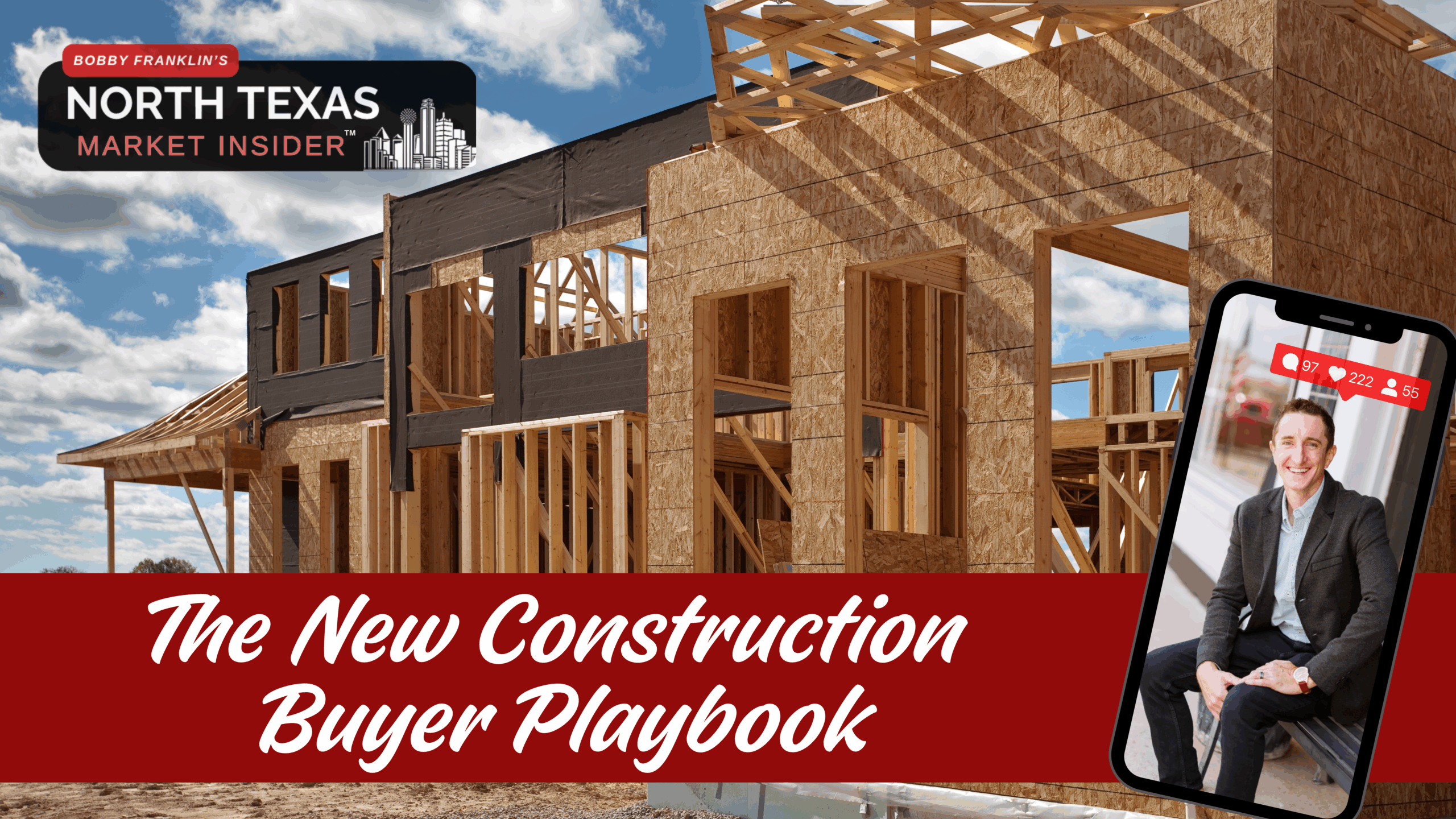
    The new construction playbook with Bobby Franklin, the North Texas market insider

    The New Construction Buyer Playbook

    From spec homes to choosing countertops, all of your decisions are covered.

    (click the image to read)

    How To choose a home inspector

    How To Choose A Home Inspector

    and why you should ALWAYS have one

    (click the image to read)

    The North Texas home buying guide from Bobby Franklin, the North Texas market insider

    The North Texas Home Buying Guide

    The Entire Process step by step.

    (click the image to read)

    First Time Buyers

    First Time Buyer Survival Guide

    Everything you need to know as a first time home buyer.

    (click the image to read)

    North Texas Market Insider™ · Choosing A Builder

    How To Tell One Builder From Another

    Nineteen answers on evaluating builders, judging construction quality, and checking whether a company will still be standing behind the house in five years. This page is about which builder. The buying process itself is covered separately. I am a REALTOR®, not an attorney, engineer, or inspector.

    Texas does not license homebuilders. So how do I check one out?

    This surprises nearly everyone, and it changes how you have to vet a builder.

    The Texas Residential Construction Commission was abolished. Its enabling act became ineffective August 31, 2009, the agency finished winding down by August 31, 2010, and no successor licensing body was created. There is no state license for a residential homebuilder or general contractor in Texas.

    The state does license specific trades. Electricians and HVAC contractors are licensed through TDLR, and plumbers through the state plumbing board. The builder assembling them is not.

    What you can actually check: the Texas Secretary of State for the legal entity and registered agent; county district and county court records for construction defect and breach of contract suits; the BBB for complaint volume and how the company responded; the Texas Attorney General's consumer complaint records; TDLR for the subcontractors' trade licenses; and TREC if the builder runs a licensed sales arm.

    The absence of licensing is not a reason to panic. It is a reason to do the homework yourself, because nobody did it for you before that company was allowed to build houses.

    What is the real difference between production, semi-custom, and custom?

    Three different products, three different price structures, three very different timelines.

    Production. Preset floor plans with limited changes, bulk-purchased materials, the fastest and least expensive path. Typical DFW build runs roughly four to eight months. You are buying efficiency.

    Semi-custom. A library of plans with real structural modifications available, move a wall, add a room, plus broader finish selections. Roughly eight to fourteen months. Most of the flexibility people actually want, at a real but manageable premium.

    Custom. Designed from scratch for your lot. Twelve to eighteen months or more. Maximum control, maximum cost, and maximum dependence on the builder's project management being genuinely good.

    Most buyers who say they want a custom home actually want semi-custom. Figure out which changes matter to you before you shop, because that answer determines which builders belong on your list at all.

    Are national builders worse than regional or local ones?

    Not worse. Different, with real tradeoffs in both directions.

    National production builders dominate DFW. By 2025 starts, D.R. Horton led with roughly 7,100, Lennar second at 5,313, Green Brick third at 3,337, with Bloomfield, Highland, Meritage, Ashton Woods, Pulte, First Texas, and David Weekley rounding out the top ten. They bring deep lot inventory, predictable timelines, and the most subcontractor leverage. The product is standardized, which is exactly why the timeline is predictable and exactly why you cannot move that wall.

    Regional builders generally offer more design flexibility and better local knowledge, with smaller incentive packages.

    Local and boutique builders can move fastest on genuine custom requests and frequently do the most careful work. They also carry the least financial cushion if a supply chain problem hits mid-build.

    Volume is not quality and it is not the opposite of quality. What it does predict is process consistency. A big builder is more likely to deliver exactly what they delivered last time. Whether that is good news depends entirely on what they delivered last time.

    Does build quality actually vary between builders at the same price?

    Substantially, and there is a structural reason for it.

    Per NAHB, builders use an average of 24 different subcontractors on a single home and subcontract out 84 percent of construction costs, up from 77 percent in 2003. The builder is a general contractor coordinating two dozen independent crews.

    That is why quality varies phase to phase and house to house within the same builder. The framing crew on your home may not be the framing crew on the house next door. A builder's quality is really the quality of their subcontractor selection, their supervision, and whether they enforce standards when a crew is behind schedule.

    NAHB publishes over 300 residential construction quality guidelines. They only matter if a builder actually holds crews to them.

    Two homes at the same price in the same corridor can be built very differently. The difference is rarely materials. It is almost always supervision.

    How do I judge quality walking a house under construction?

    Go at framing, before insulation and drywall. That is the only window where the bones are visible.

    What to look for:

    Framing. Studs bowed more than about a quarter inch should have been replaced. Look for load-bearing studs over-notched or over-bored where plumbing and electrical were run through them.

    Window flashing. Installed backwards it directs water into the wall instead of out. This is common, invisible after drywall, and expensive later.

    Roofing nails. Over-driven or under-driven nails both fail early.

    Vapor barrier. Missing or incomplete sections.

    The slab. Unevenness, exposed rebar, or cracks wider than a quarter inch.

    You are not there to catch everything. You are there to see whether the work looks careful, and to see how the builder responds when you ask a question. A superintendent who welcomes the walk is telling you something. So is one who does not.

    Can I trust builder reviews, ratings, and awards?

    Treat them as marketing until proven otherwise.

    Peer-reviewed Harvard Business School research by Luca and Zervas found roughly 16 percent of Yelp reviews were filtered as suspicious. Much of the builder review ecosystem specifically is managed by corporate reputation departments.

    Red flags: an all-five-star profile, bursts of positive reviews clustered in time, professionally staged photos in customer reviews, and reviews that read like they were written from a template.

    On awards, one specific caution. If you see a builder citing a J.D. Power new home builder ranking, check the year. J.D. Power discontinued that study after 2010, announcing in July 2011 that it would not proceed with the 2011 edition. Any builder presenting it as current is presenting sixteen-year-old data.

    Court records, BBB complaint patterns, and a conversation with someone who has lived in one of their homes for two years will tell you more than every star rating combined.

    How do I check a builder's lawsuit and complaint history?

    Four places, all free, none of which the builder will point you toward.

    County court records. Search the builder's legal entity name in the district and county clerk records for the counties they build in. Construction defect and breach of contract suits are public. A large builder will have some; that is volume. What you are reading for is pattern and frequency relative to how much they build.

    The BBB. Less about the letter grade, more about complaint volume, whether the company responded, and how disputes resolved.

    The Texas Attorney General. Consumer complaints filed with the Consumer Protection Division are public record. They are informational rather than findings of wrongdoing.

    Texas Secretary of State. Confirm the entity is in good standing and note whether the building entity is the same one signing your contract.

    Search the exact legal entity, not the brand name. Builders frequently operate through multiple LLCs, and the litigation history may sit under a name that is not on the sign.

    What happens if my builder goes out of business mid-build?

    The answer depends heavily on whether you have closed, and it is the strongest argument for looking hard at financial stability.

    If the builder fails before closing, you are frequently an unsecured creditor. The Bankruptcy Code gives consumer deposits limited priority under 11 U.S.C. §507(a)(7), capped at $3,800 per individual for cases filed on or after April 1, 2025. Deposits well beyond that are exposed.

    Homes near completion usually do get finished, because construction debt attaches to the property. Deposits paid before escrow are the most vulnerable. Money held in escrow or trust has meaningfully better protection.

    If the builder fails after closing, you own the home, but a bankruptcy discharge typically extinguishes the builder warranty. This is where a third-party insured warranty becomes very valuable.

    This risk is real and it scales inversely with builder size. It is not a reason to avoid local builders, several of whom do excellent work. It is a reason to ask how deposits are held and to keep the amount at risk as small as the contract allows.

    Is a third-party warranty better than the builder's own?

    Generally yes, and one Texas detail makes it matter more here.

    Third-party administrators including 2-10 Home Buyers Warranty, StrucSure, PWSC, and RWC back the warranty with insurance. 2-10 reports covering roughly one in five new homes across 48 states. If your builder disappears, the carrier still pays qualifying structural claims.

    A self-administered warranty depends entirely on the builder still existing and still caring. It can also be drafted to serve the builder, since they wrote it.

    The Texas detail worth knowing: some builders warrant through single-purpose LLCs named after the address, and those entities can be dissolved after closing. A warranty from an entity designed to disappear is worth less than it looks.

    Ask who administers the warranty and get the answer in writing. Note that even with third-party backing, the builder is usually still your first call in year one, which is why the next question matters as much as this one.

    How do I evaluate the warranty department, not just the warranty?

    This is the question that separates builders, and almost nobody asks it during the sales process.

    The warranty document tells you what is covered. It tells you nothing about whether anyone answers the phone in month seven.

    What to ask the builder: Who handles warranty requests, is it in-house or third-party administered, what is the committed response time in writing, and what is the escalation path when a request stalls.

    What to ask actual homeowners: Did you submit a warranty request, how long did it take, did they fix it right the first time, and did anyone follow up. That last one is the tell.

    Every builder shows beautifully in a staged model home. The difference between builders shows up when something needs fixing and the sales office has already moved to the next phase. Warranty performance is the single most reliable quality signal available to you, and it is free to research.

    What should I ask people who already live in the community?

    Knock on doors in an earlier phase. It is the best hour you will spend, and people are remarkably willing to talk about their houses.

    Five questions worth asking:

    How was the build process, and did they communicate? Radio silence during construction is a common complaint and a real predictor.

    Have you filed a warranty claim, and how did it go? The most valuable question on the list.

    What has broken or needed attention? Patterns across several homes are meaningful. One person's bad experience is not.

    Did the home deliver on time, and how were you told if not?

    Would you buy from them again? The pause before the answer tells you as much as the answer.

    Look for the homes that are two or three years old, not the ones that just closed. New homeowners are still in the honeymoon. Year three is when you find out what the builder actually built.

    How much of the model home is standard and how much is upgraded?

    Less standard than it looks, and this is where expectations get set wrong.

    The model is the builder's showcase. It typically carries structural options, a premium lot, and a fully loaded design center package, frequently tens of thousands above the base price once you strip all of it out.

    Ask for two things in writing: the base features list for the plan you are considering, and a list of every option installed in the model with its price.

    Then ask to walk a spec home or a recently completed home instead. A plain spec shows you the true standard finish level and the actual workmanship, without the staging, the upgraded lighting, or the furniture scaled to make rooms read larger.

    If a builder is reluctant to show you anything but the decorated model, that is information. The confident ones walk you through a spec without being asked twice.

    Who is my construction manager, and how many homes are they running?

    The most useful question almost nobody asks, and one of the strongest predictors of how your build actually goes.

    When J.D. Power was still studying builder satisfaction, the construction manager consistently ranked among the top drivers of whether buyers were happy. That has not changed. One person coordinating two dozen subcontractor crews determines whether mistakes get caught before drywall or after closing.

    An overloaded superintendent is a leading cause of phase-to-phase defects. They are not careless. They are running too many houses to inspect any of them properly.

    Ask directly: who is the construction manager on my home, how many homes are they supervising simultaneously, will I have their contact information, and what happens if they leave the company mid-build.

    A builder who names the person and gives you their number is running a different operation than one who routes everything through the sales office.

    What should I ask about foundation engineering for North Texas clay?

    This is where a builder's engineering discipline shows, and it is the most consequential quality question in our market.

    DFW sits on expansive Blackland Prairie clay that swells and shrinks with moisture. It remains the single most common geotechnical cause of structural distress in North Texas homes. Post-tension slabs are the standard engineered response.

    Ask for the lot-specific geotechnical report rather than a subdivision-wide one, and ask for the plasticity index of your soil. A PI above roughly 30 calls for specialized engineering attention. You can also hire an independent structural engineer to review the design and observe the pour.

    One thing that matters specifically in Ellis County. If you are building on unincorporated county land, there are no municipal building inspections. Nobody from a city is checking that work. That shifts verification onto you and makes an independent engineer and a phase inspection considerably more important than they would be inside city limits.

    Does buying early or late in a community affect quality?

    It can, in both directions, and the effects are not symmetric.

    Early phases mean the crews are still learning the plans, and early mistakes tend to be plan-comprehension errors. You typically get the best lot selection and the lowest base pricing. You also live in a construction zone for years.

    Middle phases are frequently the sweet spot. The crews have built the plan repeatedly, the process is dialed in, and the community is far enough along that you can see what it will become.

    Late phases get built-out amenities and mature landscaping, and sometimes tired crews on the last lots, which are frequently the least desirable ones left.

    If you are looking at an early phase, weight the pre-drywall inspection heavily. If you are looking at a late one, ask specifically why those lots did not sell.

    How does the builder handle change orders and substitutions?

    A process question that reveals more about a builder than most direct quality questions do.

    On change orders: what is the cutoff for changes, what does the administrative fee run, and how long does a change add to the schedule. Builders who make this painless generally run tight operations. Builders who cannot answer are telling you the process is chaotic internally.

    On substitutions, which matter more: supply chain disruptions mean materials get swapped. The question is whether you find out. Ask whether you are notified before a substitution, whether you can reject one, and whether you are credited if the substitute costs less.

    Unflagged material substitution is a documented source of defects and disappointment, and it happens quietly. A builder who commits in writing to notifying you is worth more than one who promises premium finishes and swaps them without a word.

    Do HERS scores and ENERGY STAR certification mean anything?

    They mean something specific and narrower than most buyers assume.

    The HERS Index measures energy performance. A home built to the 2006 IECC reference scores 100, lower is better, and zero is net-zero. A score in the 50s means roughly half the energy use of that reference home.

    ENERGY STAR certification requires a home to be at least 10 percent more efficient than code, with certified homes averaging about 20 percent better per EPA.

    The important limitation: these measure energy performance, not construction quality. A home can be tightly sealed and efficiently insulated while having sloppy framing or a poorly detailed roof.

    Ask whether the HERS rating was issued for your specific home or modeled for the plan. A rating on the actual house means someone tested it. In Texas summers the difference between a 55 and an 85 is real money every August, so this is worth asking about even though it proves nothing about the bones.

    Should an arbitration clause affect which builder I choose?

    It is worth weighing, and most buyers never notice it is there.

    Binding arbitration clauses are common in builder contracts. They waive your right to a jury trial, frequently limit discovery, and the builder may have influence over the arbitration forum and rules.

    This is not automatically disqualifying. Arbitration can be faster and cheaper than litigation, and plenty of reputable builders include it as standard practice rather than as a shield.

    What to actually compare: whether the clause is mutual or binds only you, who selects the arbitrator, who bears the cost, and whether it is combined with a short warranty period and a self-administered warranty. That combination is the one worth pausing on.

    If two builders are otherwise close, the one whose contract preserves more of your remedies is the better bet. Read the dispute resolution section before you fall in love with a floor plan.

    How long should a builder have been in business, and does it matter?

    Tenure matters less than local track record, and NAHB's own buyer guidance points the same direction.

    The better question is how many homes they have built in this specific area. A builder with thirty years in Houston and eighteen months in Ellis County is a new builder here. North Texas clay, our hail exposure, and county-versus-city permitting are learned locally.

    What to ask: how many homes have you completed in this county, how many in this specific community, can I see homes you built here three to five years ago, and has the company operated under other names.

    That last one matters. Builders sometimes reorganize under new entities after trouble, and the reputation does not always follow the name.

    A newer builder is not automatically riskier, and some of the most careful work in this corridor comes from small operations. But a newer builder should be paired with more verification, a third-party warranty, and smaller money at risk before closing.

    I work with builders across Ellis County and the I-35E corridor and I have walked homes at every stage of construction with most of them. I will tell you what I have actually seen, including the parts that are not on anybody's brochure. That conversation works better on the phone than on a webpage.

    Call Bobby · (214) 228-0003

    General education, not legal, engineering, inspection, or financial advice. I am a REALTOR®, not an attorney, licensed engineer, home inspector, or CPA. Nothing here is a statement about the current quality, financial condition, or business practices of any specific builder. Market share figures reflect 2025 DFW starts as reported by the Dallas Morning News; subcontracting and quality-guideline figures are from NAHB; warranty administrator figures are from company-published data; bankruptcy priority amounts are current for cases filed on or after April 1, 2025 and adjust periodically; energy rating standards are from RESNET and the U.S. EPA. Statutory and regulatory references reflect Texas law as of 2026. Verify all builder-specific information independently through county records, the Secretary of State, the BBB, the Texas Attorney General, and conversations with current homeowners before making a decision.

    Bobby Franklin, REALTOR® Legacy Realty Group – Leslie Majors Team 214-228-0003

    Ready to Build? Let's Find the Right Builder Together.

    You’ve seen the profiles, you know the categories, and you know the mistakes to avoid. The next step is the one that actually saves you money and protects you: a conversation before you walk into a sales office. Tell me what you’re looking for, and I’ll match you to the builders that genuinely fit, then stand on your side of the table all the way to closing

    Schedule an Insider Call and let’s build the plan before you ever sign a builder’s contract.

    Bobby Franklin Realtor®

    Bobby Franklin

    Realtor®

    Serving DFW | Ellis County
    16 Northgate Dr. Ste 100

    Waxahachie, TX 75165

    Ready To Build Your Dream?

    1 On 1 Consultation | Market Advantage