Let me be direct with you because that’s what I do.
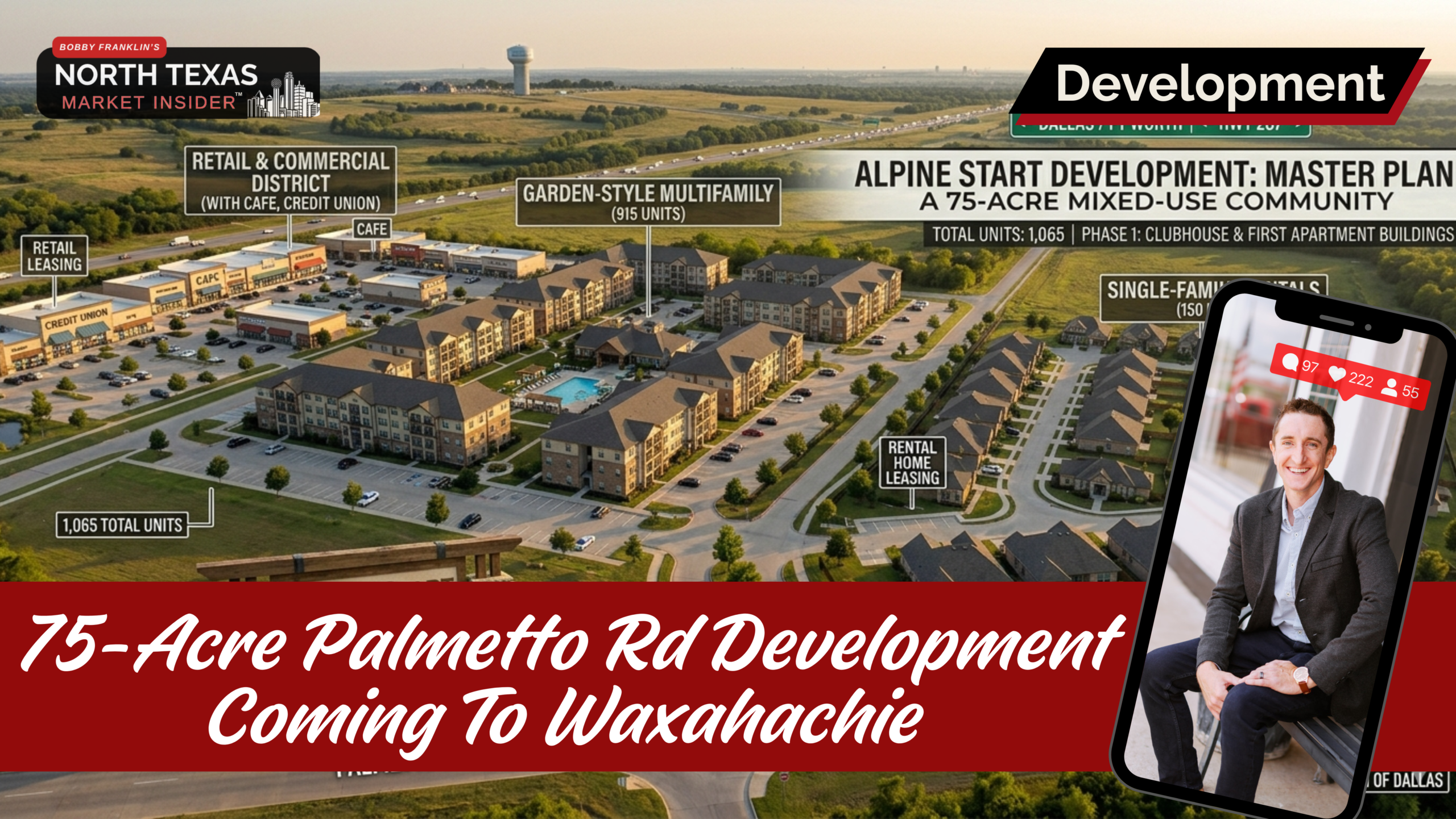
A 75-acre, 1,065-unit mixed-use development is coming to Palmetto Road in Waxahachie, Texas. Phase 1 alone carries a $35 million price tag and that’s just the opening bid. The full project spans multiple phases, with a total capital commitment that hasn’t even been publicly disclosed yet. Construction begins this year and if you own a home anywhere in Ellis County, this project is going to affect your property value, your timeline, and your next move, whether you’re paying attention to it or not.
Most agents in this market will see this headline and move on. Maybe post something generic about “exciting growth in Waxahachie.” What I’m going to do is tell you what this development actually means, for your equity, for your timing as a seller, for your strategy as a buyer or investor, with the specificity that most real estate content refuses to give you.
That’s the difference between a real estate agent and a market intelligence source. I’m the latter.
While everyone else is catching up to this story, you’re already reading the analysis. That gap is exactly where the opportunity lives. Let’s get into it.
For full context on Waxahachie, start with: Waxahachie “The Gingerbread City”
What Exactly Is Being Built on Palmetto Road?
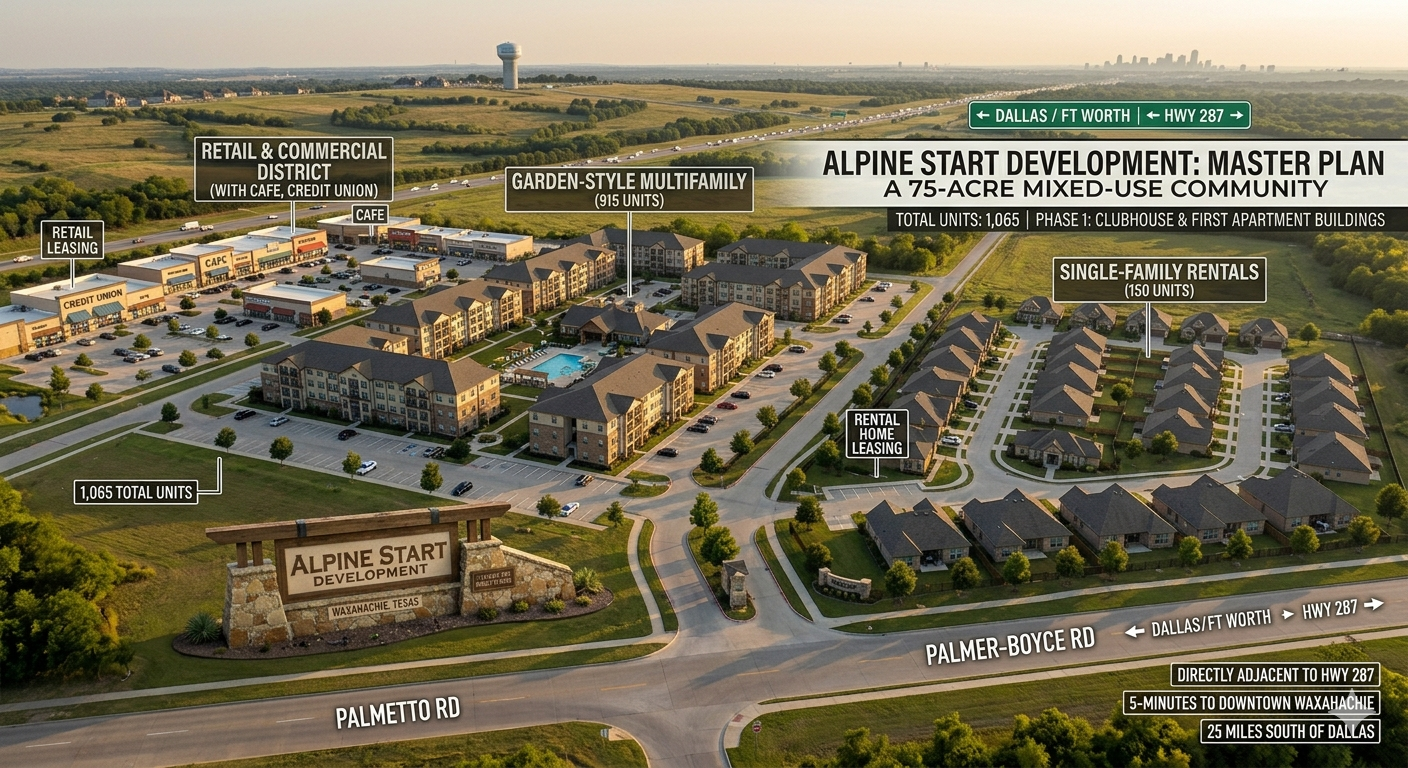
The Palmetto Road development, led by Dallas-based Alpine Start Development, is a master-planned, mixed-use community along FM 878 (Palmetto Road) and Palmer-Boyce Road, right off U.S. Highway 287 in south Waxahachie. Twenty-five to thirty miles south of Downtown Dallas. A corridor that city planners have been circling for years and that serious capital just committed to in a major way.
Here are the numbers. Total site: 75 acres. Unit mix: approximately 915 garden-style multifamily apartments and 150 build-to-rent single-family homes, 1,065 units total. Phase 1 budget: roughly $35 million, covering 15 multifamily buildings, 198 tuck-under garages across more than 325,000 square feet, and a 5,590-square-foot clubhouse. That $35 million is Phase 1 only. The TDLR filing describes the first phase of construction. The total capital commitment across all phases has not been publicly disclosed. Neighborhood retail follows in later phases. Construction could break ground this year.
Here’s the detail that stops me cold and should stop you too: Alpine Start has Japanese rail giant Nishi-Nippon Railroad as an investor in this project. A Japanese railway company with interests in multiple American real estate developments just put money into south Waxahachie. That is not the behavior of speculative capital chasing a trend. That is institutional, international conviction in this market’s long-term trajectory.
This is what intelligent capital does. It moves before the mainstream catches on. It bets on trajectory, not current headlines. And right now, intelligent capital, both domestic and international, is betting on Waxahachie.
I’ve been tracking the macro backdrop behind this move for a long time, Property Values Skyrocket: Explosive Growth In Waxahachie On The Way. Palmetto Road isn’t a surprise to anyone who’s been watching. It’s a confirmation.
Why Is Waxahachie Attracting This Kind of Capital Right Now?
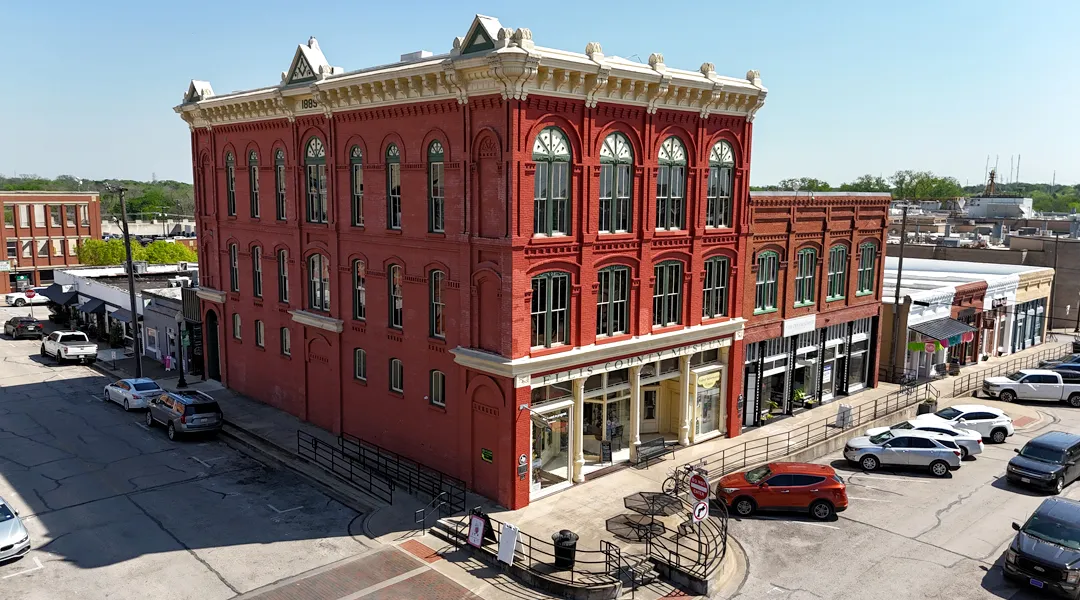
This is the question most people aren’t asking and it’s the most important one on the board.
Developers don’t commit $35 million to Phase 1 of a 75-acre project because they think it might work out. They commit that capital because the demographic data, the population projections, the infrastructure investment, and the employment demand all converge in one direction. They’ve done the analysis. They’ve stress-tested the assumptions. They brought in a Japanese railway company as an equity partner and they decided Waxahachie is where they want to invest their money. So should you.
Waxahachie’s population is projected to climb from roughly 55,000 residents in 2025 to more than 64,000 by 2030. That’s not speculation, it’s driven by measurable forces: affordability relative to North Dallas suburbs, direct highway access to major employment centers along I-35E and U.S. 287, and a relentless wave of corporate relocations reshaping the DFW employment base.
The relocation buyer is a critical variable here. I work daily with buyers coming from California, Washington, Colorado and Arizona. Markets where selling one home unlocks enough equity to buy something significantly larger in Ellis County while dramatically lowering their cost of living. These aren’t fringe buyers. They are an increasingly dominant demand force in this corridor. I’ve documented exactly what that shift looks like on the ground: Relocating From California To Texas and Relocating From Washington.
Now here’s the piece most people completely missed: Palmetto Road isn’t the big story. It’s a small chapter in a much bigger one.
In early 2026, the City of Waxahachie approved a 3,170-acre master-planned community west of I-35E. A development that will ultimately deliver up to 13,270 homes, 1.2 million square feet of commercial space, multiple school sites, and nearly 34,000 additional residents over a multi-year buildout. I covered that in detail here: Westlake Developers are Bringing 13,000 Homes to Waxahachie.
Stack Palmetto Road on top of that 3,170-acre approval, the up and coming Myrtle Creek development, on top of Loop 9 infrastructure work and the 40+ new construction communities active in Waxahachie in 2026. Now stack all of that on top of continued I-35E investment and you’re not looking at isolated projects anymore. You’re looking at a city in structural transformation.
Structural transformation is where fortunes in real estate get made. The people who recognize it early and act on it are the ones who capture the most value. The people who wait for the story to be obvious will find either too much competition or that the market has already moved on without them.
How Will This Development Actually Affect Your Home Value?

I’m going to give you the honest, layered answer, because there isn’t one number that covers every homeowner in Waxahachie, and anyone who tells you otherwise is selling you something.
The long-term picture is strong. Full stop.
Major mixed-use developments of this scale consistently support property values over time. New residents. New amenities. New retail investment. Heightened submarket visibility. The Urban Land Institute has documented this pattern across major U.S. metros. Mixed-use communities that blend residential, retail, and employment uses tend to create more resilient neighborhoods and attract stronger buyer demand that drives long-term appreciation.
Waxahachie’s average home price is already in the low $400,000s. Projections have values climbing toward the mid $500,000s, potentially the low $600,000s by 2030 if growth continues on its current trajectory. Projects like Palmetto Road and the Minto master planned community are what underpin those projections. They provide the housing supply, the amenities, and the commercial infrastructure that a growing population requires.
The short-term picture is nuanced. That’s precisely where the strategic edge lives.
Homes within a 5 to 10-minute drive of Palmetto Road are most directly exposed to both the upside benefits and the cost-variables. Here’s how to read each position:
Sellers: You have a window right now, during the early-to-mid buildout phase, where relocating buyers and strategic investors are paying close attention to this corridor. The announcement effect is real. The moment major capital commits to a submarket, buyers who previously overlooked it start circling. That wave is already forming. The sellers who move with it capture the premium. The sellers who wait to crest it find themselves competing against new construction.
Landlords and investors: 1,065 new rental units is a real number, don’t dismiss it. But those units are phased in over multiple years, not dropped overnight into a static market. Population growth and job creation are filling the demand side simultaneously. This is a growing market absorbing new supply into expanding demand, not a fixed pool getting diluted.
Properties directly adjacent to higher-traffic roads: Know your position honestly. Construction noise, congestion, and proximity trade-offs are real in the short run. Homes a few streets away often capture most of the upside with fewer of those variables. Price and market accordingly. Wishful thinking is not a strategy.
The Insider take: location-specific evaluation matters more than any market-wide headline. If you want to know exactly where your property sits in this equation, lets have a conversation. Schedule a Relocation Consult.
Should You Sell Before, During, or After Palmetto Road Is Built?
Here’s the distinction that separates strategic thinking from guesswork: you don’t time markets, you read cycles. There’s a difference, and it matters more than you think.
Timing the market means guessing when prices peak. Reading cycles means understanding where you are in a development arc and aligning your decision to the strongest demand wave. One is a gamble. The other is intelligence applied to action.
Here’s how major projects like this move through the market and where the windows open:
Wave 1: Announcement. The moment a project of this scale is confirmed, when filings happen, budgets and groundbreaking timeline are announced, investors and early-adopter buyers start circling. Strategic sellers who are already positioned well will attract buyers by thinking five moves ahead. We are in Wave 1 right now.
Wave 2: First occupancy. Once Phase 1 delivers and the first residents move in, the community has proved itself. Retail suddenly follows. The area gains credibility with buyers who needed proof before they committed and now demand broadens. New construction competition for sellers starts becoming a real factor.
Wave 3: Amenity maturity. Schools, parks, commercial uses, and infrastructure improvements reach full operation. The broadest wave of buyer interest arrives and prices start to fully reflect the transformation. This is when the story becomes obvious to everyone. It’s also when the early advantage is gone.
If your goal is maximum exposure to relocating buyers while North Texas inventory remains relatively constrained, listing during Wave 1 or early Wave 2 is the play. You’re selling into accelerating demand before the full inventory of new construction alternatives exists. That window is open right now. It will not stay open indefinitely and when it closes, you’ll know it when new construction competition really ramps up.
For investors holding property in this corridor: you have more runway than sellers need. Rental demand will be supported through Wave 2 as incoming population fills new units and surrounds your asset with amenities. Evaluate your exit in Wave 3 when appreciation is fully priced in. But make that decision deliberately, not reactively when the market forces your hand.
For a direct look at how capital commitments of this scale play out in real DFW submarkets, take a deep dive into the Love Field infrastructure analysis Love Field’s $1B Power Play: The Real Story Nobody’s Telling You.
One more thing on the macro environment, because it shapes how you execute in any wave. North Texas inventory has risen from pandemic-era lows but remains below historical norms across most submarkets. Buyers are rate-sensitive right now. They’re disciplined, pre-qualified and focused on value propositions. Sellers who price with intelligence, focus on presentation, and market with hyperlocal specificity are the ones who are closing. Sellers who price on hope and wait are watching their listing age. This market does not negotiate with wishful thinking.
What Does This Mean for Investors and Landlords?
This is the section where I’m going to say things most agents won’t say to your face. Stay with me.
The flood narrative ,“1,065 new units are going to crash rents in Waxahachie”, is the wrong frame. But the opposite delusion, “this doesn’t affect my investment at all”, is equally dangerous. The truth is more useful than either extreme.
Waxahachie’s population is growing fast enough that new supply is being absorbed into a simultaneously expanding demand base. This is not a static market getting new inventory dumped into it. It’s a growth market attracting capital to serve a growing population. Phased delivery over multiple years means the market absorbs each tranche as demand continues to build. That’s a fundamentally different risk profile than a market being overbuilt into flat demand.
The unit mix matters more than the headline number. Garden-style multifamily and single-family rentals serve different renter profiles than existing scattered-site single-family rentals in older stock. Well-amenitized, class-A new construction typically attracts higher-income renters who may not have been in your existing rental pool at all. The competition is not always as direct as the fear-driven take implies.
Now, here’s the part you need to actually hear: if your rental property is tired, under-amenitized, or poorly positioned relative to what Palmetto Road will offer, this is your wake-up call. Not a gentle nudge. A wake-up call.
Audit your asset now. Compare your unit’s condition, your amenities, your lease terms, and your pricing to what’s coming online. Make the strategic improvements that close the gap or make the strategic decision to harvest the equity and redeploy it into a stronger position. Both are intelligent moves. Staying put and hoping the market tolerates a low-quality rental listing notice is not.
For longer-term investors, the opportunity is in the neighborhoods with strong connectivity to Palmetto Road and the Minto master planned community that still trade at a discount relative to closer-in suburbs. As Waxahachie adds residents, commercial space, and infrastructure at scale, the entire submarket reprices. Early positions in well-located pockets capture the most of that repricing. Institutional capital and build-to-rent operators are already circling this market. Their activity provides liquidity and price support for individual owners who decide to exit at the right moment.
The schools angle is a direct demand driver that never gets old in this market. Is Waxahachie ISD a Good School District? breaks down what Waxahachie ISD offers and why it remains one of the most powerful forces pulling relocating families into this corridor.
How to Position Your Home to Win in This Market
Five steps ahead thinking means you’re already thinking about positioning before your competition knows the story exists. Here’s the framework. Not the generic checklist, but the actual logic that separates the sellers who win from the ones who wonder what happened.
Get a hyperlocal valuation, not an algorithm estimate. Zillow doesn’t know about Palmetto Road. It doesn’t know about the 3,170-acre Minto master planned community. It doesn’t know about Loop 9 or the continued U.S. 287 infrastructure investment. Any valuation that doesn’t incorporate the full development pipeline isn’t telling you what your property is worth right now, it’s showing you a backward-looking average when you need forward-looking intelligence.
Know which wave you’re selling into and price for it. Announcement phase, early buildout, or maturity? Your pricing strategy, your timeline, and your marketing approach should be calibrated to where you actually are in the development cycle, not to a generic market conditions summary. This is the difference between reacting to the market and leading it.
Lead with access and future value, not square footage. Relocating buyers from California and Washington are not cross-shopping on square footage. They’re evaluating commute times, highway access, school district quality, community character, and the cost-of-living delta versus what they’re leaving behind. Your marketing should lead with U.S. 287 access, drive time to employment centers, proximity to downtown Waxahachie, and the future mixed-use ecosystem being built around Palmetto Road and the 3,170-acre Minto community. Tell the story of where this market is going, not just where it is today. That’s what moves the sophisticated buyer.
Compete on condition. New construction is coming. Buyers will cross-shop your home against brand-new product with modern finishes and builder warranties. Move-in ready, updated, well-presented homes win that comparison. Deferred-maintenance homes lose it and lose it badly in a market where buyers have options. Strategic renovation investment focused on kitchens, baths, and first impressions closes the gap without overspending. Don’t spend a dollar more than necessary, but don’t pretend condition is irrelevant.
Use Waxahachie’s character as a competitive weapon. Here’s what new construction can never replicate: the downtown square, the established neighborhoods, the community identity that comes with 150 years of roots. That’s a differentiator and it’s yours to use. The Complete Guide To Waxahachie’s Annual Events is a direct tool for helping buyers picture a life here, not just a transaction.
Choose your representation with the same intelligence you’d apply to any strategic decision. The market rewards sellers aligned with an agent who was tracking this development pipeline before it hit mainstream headlines, not one catching up to the story after it’s already priced in. If your agent is just now learning about Palmetto Road, you are already behind.
FAQ: The 10 Questions Waxahachie Homeowners Are Actually Asking

1. Is the new Palmetto Road development good or bad for homeowners?
Net positive over the long-term, for most homeowners. Significant private investment. Added housing variety. A catalyst for new retail and infrastructure in south Waxahachie. Short-term variables like construction traffic and proximity noise are real but temporary. The trajectory is favoring upward movement for surrounding home prices. How to position yourself to capture that trajectory is the REAL question worth asking.
2. Where exactly is the development located?
FM 878 (Palmetto Road) and Palmer-Boyce Road, directly off U.S. Highway 287 in south Waxahachie. Roughly 25 to 30 miles south of Downtown Dallas with quick I-35E access.
3. How much is being invested and when does construction start?
The $35 million figure comes from the TDLR filing and that filing covers Phase 1 only: the 15 multifamily buildings, garages, and clubhouse. The total capital commitment across all phases of the 1,065-unit project has not been publicly disclosed. What we know so far is that $35 million is the opening move, not the whole hand. Groundbreaking could occur as early as this year, subject to permitting and typical development timelines.
4. How close does my house need to be to feel the impact?
Homes within roughly a 5 to 10-minute drive will feel the most direct effects. But signature developments of this scale can shift perceptions of an entire city. Buyers who never considered Waxahachie start really considering it. Even homeowners farther north or west could be tracking leasing velocity, retail absorption, and traffic patterns as the project builds out. This is a market-wide story, not just a neighborhood one.
5. Will 1,065 new apartments hurt single-family resale values?
Not in the way the fear-driven headline implies. Well-designed, professionally managed multifamily communities in growing markets consistently support, not suppress, surrounding single-family values by creating more vibrant, amenity-rich environments. Rental housing also builds a pipeline of future buyers for nearby neighborhoods. Implementation quality matters: design standards, management caliber, retail mix.
6. Should I sell before or after the project is complete?
The most strategic window for most sellers is right now in Wave 1. Relocating buyers and investors are paying attention. New construction competition hasn’t arrived yet. Inventory is still below historical norms. Timing is always personal and it has to align with your goals, equity position, and transition plan. But the window is open, and windows have a way of eventually closing.
7. What other major developments are coming to Waxahachie?
In January 2026, the city approved a 3,170-acre master-planned with Minto Communities. It will be a master planned community west of I-35E with up to 13,270 homes, 1.2 million square feet of commercial space, multiple school sites, and approximately 34,000 new residents over a multi-year buildout. Read full coverage here: Westlake Developers are Bringing 13,000 Homes to Waxahachie. Together, these two projects don’t just represent growth. They represent the structural transformation of a city’s entire trajectory.
8. What will happen to Waxahachie schools as the population grows?
Waxahachie ISD is already one of the most prominent districts in Ellis County, and large-scale residential growth always puts school capacity on the agenda. The 3,170-acre Minto master planned development incorporates future school sites, including a middle school and multiple elementary campuses directly into its layout. Stay in contact with WISD for boundary updates, new campus timelines, and program changes. The Waxahachie ISD guide on North Texas Market Insider is the starting point.
9. How do I track the project’s progress?
Texas Department of Licensing and Regulation filings. Waxahachie city council and planning and zoning meeting agendas. Local development coverage. At the neighborhood level, your best real-time intelligence comes from an agent who is actively tracking this pipeline, not one who finds out when the news does.
10. What’s the first step if I’m thinking about selling or relocating because of this growth?
Have a direct, specific conversation grounded in the full development picture, not just your last 90-day comps. Palmetto Road, the Minto community, Loop 9 progress, I-35E investment, relocation buyer waves, all of it together. That’s what produces real strategic advice. Start the conversation with a Buyer or Seller Consultation.
The Bigger Picture You Can’t Afford to Miss

Here’s what I need you to understand before you close this article.
Waxahachie is not just.a small town getting a few apartment buildings. It is a city in the early stages of a structural growth cycle. The kind that five years from now, people will look back on and say, “I wish I had seen that coming. I wish I had moved when the window was open.”
The data is not subtle. Population projections are accelerating. Private capital is committing at a scale that signals institutional conviction. $35 million for Palmetto Road alone, plus the Minto Community approval that puts nearly 34,000 future residents on the map west of I-35E. Infrastructure is already being built to support the growth, not waiting to scramble and catch up to it. Relocating buyers from out of state or overseas are bringing equity and purchasing power that permanently resets price ceilings in markets like this one.
The homeowners and investors who understand this trajectory and who make strategic decisions now about timing, positioning, and representation are the ones who capture the most value from it. The ones who wait for the story to be obvious will find the market has already moved without them and they’ll miss the window. The window won’t look the same in twelve months as it does today.
This is the entire value proposition of North Texas Market Insider: intelligence that arrives early enough to act on. Not cheerleading. Not generic updates. Hyperlocal, pipeline-aware analysis that connects macro trends to micro opportunity before the rest of the market catches up.
If you’re a homeowner in Waxahachie or Ellis County and you want to know exactly how Palmetto Road and the 3,170-acre Minto master planned community affect your property, your equity, and your next move, lets talk.
The information is here. The opportunity is here.
The only question is whether you’re going to use it or watch someone else do it and wish you had.
This article is for informational and educational purposes only and does not constitute legal or financial advice. All real estate decisions should be made in consultation with a licensed Texas real estate professional. This content complies with the Fair Housing Act, which prohibits discrimination in housing-related activities based on race, color, religion, sex, disability, familial status, national origin, or any other protected characteristic. Real estate commissions in Texas are fully negotiable. For federal fair housing protections, visit HUD’s Fair Housing Act overview. For RESPA and NAR settlement information, visit the CFPB’s RESPA guide and NAR’s legal resources page.
Bobby Franklin, REALTOR® | Legacy Realty Group – Leslie Majors Team | 214-228-0003 | northtexasmarketinsider.com