

Roughly 34% of Dallas-Fort Worth homeowners currently carry a mortgage rate above 5%, according to UT Arlington’s housing research. The mortgage lock-in effect is weakening in DFW, with over a third of homeowners experiencing the opposite.
The 30-year fixed climbed to 6.66% this week, a one-year high, per Freddie Mac’s Primary Mortgage Market Survey. Every feed is running that headline, and it will push another wave of people into the freeze without a single one of them checking their own note.
I am Bobby Franklin, REALTOR® with Legacy Realty Group – Leslie Majors Team, and I track this weekly because it changes how I advise clients across Ellis County and the greater North Texas region. What follows is the mechanics behind the move, the dollar cost on a real North Texas loan, my actual position on where rates go from here, and how to still score a good deal on a house and negotiate your way to a lower payment, even though rates are high

The Number: What Happened This Week
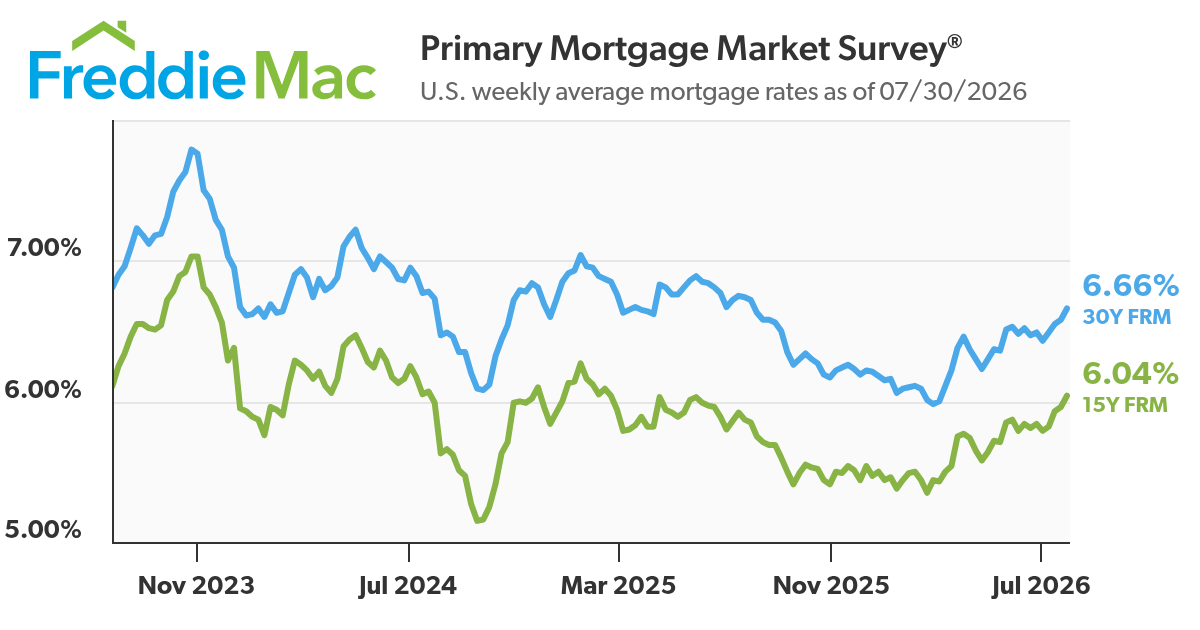
Freddie Mac’s July 30, 2026 survey put the 30-year fixed at 6.66%, up from 6.58% the prior week and marking a fourth consecutive weekly increase, as NPR reported. That is the highest reading since roughly this point last summer, when the average sat at 6.72% per Mortgage News Daily’s tracking of the Freddie Mac series. The 15-year fixed moved with it to 6.04% in Trading Economics’ coverage of the same release.
Rates dipped into the high 5% range earlier this year, a milestone I covered when the 30-year fell below 6% for the first time since 2022. We have seen increases of roughly 60 to 70 basis points back up since. Anyone who told you in March that the direction was settled had no idea what was coming.
The Three Forces Behind the Move

Oil and the Strait of Hormuz
Renewed conflict involving Iran and disruption to shipping lanes near the Strait of Hormuz drove oil sharply higher this summer. Higher energy costs push through shipping and production, which lifts inflation expectations, which lifts the yield on the 10-year Treasury note that mortgage rates track most closely, as NPR’s reporting on the Freddie Mac data explained. Investors in the 10 year treasury, don’t want to lose those profits when inflation goes up, so they demand a higher yield which pushes up your mortgage rate. Zillow senior economist Kara Ng framed it in that same coverage as a live readout: what you pay at the pump is telling you something about what you will pay to borrow.
A Divided Federal Reserve
Here is the piece the headlines skipped. The Fed held its benchmark rate steady the Wednesday before the spike, but three members of the rate-setting committee voted to hike instead, a rare split documented by NPR. Bond markets read that internal disagreement as a live signal for September and repriced immediately. Mortgage rates moved before the Fed did anything at all, which is the part few people understand about how this actually works.
A Slowing Economy That Is Still Spending
The Bureau of Economic Analysis released its advance second-quarter GDP estimate the same week, showing growth of 1.5%, down from 2.1% in the first quarter and below the 1.8% to 2.0% economists expected, per the BEA’s official release. Slower growth normally pulls rates down over time. The composition of this slowdown argues otherwise. The drag came primarily from lower government spending and a trade swing tied to heavy imports for AI infrastructure buildout rather than from weakening households, as Yahoo Finance’s breakdown noted. Real consumer spending accelerated to 3.2%, and core inflation eased only to 3.4% from 4.4%, well above the Fed’s 2% target, CNBC reported. Resilient demand paired with sticky inflation is precisely the environment where the Fed stays reluctant and mortgage rates stay elevated.
I walked through a nearly identical setup earlier this year, and the conclusion has not changed: elevated rates are not a reason to freeze, they are a reason to move with intention.
The Round Trip: Sub-6% to 6.66% in Six Months

The whiplash we’re experiencing has a documented origin and it can be traced back to January. In January 2026, President Trump directed Fannie Mae and Freddie Mac to purchase up to $200 billion in mortgage-backed securities specifically to push borrowing costs down, Reuters reported at the time. FHFA Director Bill Pulte later raised the purchasing caps for both entities from $40 billion each to $225 billion each. The National Association of REALTORS® confirmed rates fell nearly 0.2 percentage points the day after the announcement in its Washington Report, and by early March the 30-year fixed rate sat below 6%.
Then the Iran conflict resumed and unwound most of the progress. Morgan Stanley’s team called the ceiling on this in January, arguing that a one-time $200 billion infusion into a roughly $9 trillion mortgage bond market was unlikely to move rates far or for long. They were right, and the people who treated sub-6% as a new floor rather than a brief, policy-supported dip are the ones absorbing it now.
Volatility of this shape is exactly what sustains the freeze. I broke that dynamic down in my piece on the mortgage rate lock-in effect and why it functions like a curse: rates that spike and retreat inside a single year keep homeowners frozen in houses that no longer fit their lives.
Where I Think Rates Go From Here

Most agents will not put a number on this, which is understandable, because forecasts are how agents lose credibility. I am going to give you mine anyway, along with the specific conditions that would prove me wrong, because a forecast without a disconfirming condition is not analysis. It’s just wishful thinking.
My position: rates finish 2026 at or above where they sit today, and a return to the 5% range before 2027 is unlikely.
The oil premium is a policy variable not a random weather event. Conflict-driven supply risk doesn’t resolve on a schedule, and nothing in the current posture forces it to resolve at all. Markets are pricing an open-ended condition, that’s not showing any real promise for resolution anytime soon. This is why the premium has held steady rather than slowly tapered off, like many hoped it would.
Three dissenting hawkish votes tells you where the committee’s floor actually sits. A Fed that cannot reach consensus to hold is not a Fed positioned to cut, and bond markets have already priced that read. When investors see indecisiveness in the Fed, they hedge against worst-case scenario.
Core inflation is at 3.4% against a 2% target leaves no room to work with. The lever that produced the spring dip already fired and unfortunately the Iran conflict continues to undo all of that progress. Federal policy has already spent its ammunition on this particular problem.
What would change my mind: meaningful de-escalation in the Gulf that pulls crude back down, or two consecutive core inflation prints below 3%. It is extremely unlikely that inflation will pair down before de-escalation in the Gulf.
What 6.66% Costs You in Dollars
Principal and interest on a $300,000 loan, standard 30-year amortization:
North Texas Market Insider
What Each Rate Actually Costs You
Principal and interest on a $300,000 loan, 30-year fixed. Bars show total additional cost versus a 6.5% baseline across the full loan term.
Principal and interest only. Payments exclude property taxes, homeowners insurance, PMI, and HOA dues, which in Ellis County frequently add several hundred dollars per month. Full-term figures assume the loan is held 30 years without refinancing, so most borrowers will pay less than the number shown. Because principal is identical across every row, all additional cost is interest.
North Texas Market Insider™ · northtexasmarketinsider.com
Scale that to $400,000, closer to median new construction sales prices in Midlothian and Mansfield. A $400,000 loan on a 30-year fixed runs $2,396 monthly at 5.99%, where rates sat in late February, against $2,571 at today’s 6.66%. That is $175 more per month and roughly $63,000 in additional interest across the full term. Run the numbers yourself with any amortization calculator and those are the inputs.
Six months of waiting cost that much. It also explains why the spread between lenders matters more than the headline rate. A 0.25% difference between two lenders on a $300,000 loan runs roughly $15,000 over the life of the loan, which I document in my Mortgage Lender Guide for North Texas buyers. Shopping the rate is where the recoverable money lives.
Three lenders I trust with my clients in this market:
- Andrew Bryan, Miramar Mortgage | andrewthelender.com
- Rachael Carter, My Texas Mortgage Team | www.mytxmortgageteam.com
- Jennifer Nelson, Eustis Mortgage | eustismortgage.com
- Taylor Fruge, Lower Mortgage | lower.com
I recommend these lenders based on their expertise and service. I do not receive compensation for referrals.
What This Means If You Are Selling in North Texas

Back to the 34%. If you bought or refinanced after early 2022, pull your note before you decide anything. The gap between a 5.5% existing rate and today’s 6.66% is not the trade-up penalty the national narrative has trained you to fear, and on a move that puts you in the right house for the next decade, the math frequently works out in your favor.
The rest of the local picture supports moving. DFW has already absorbed a real correction, with Case-Shiller showing Dallas-area values roughly flat year over year and about 4.5% below the June 2022 peak, according to a detailed weekly DFW market analysis. Median sales price across North Texas MLS data sits around $363,665 as I documented in my pricing strategy breakdown, and UT Arlington’s housing expert describes the region as moving from a frenzied seller’s market into a more balanced but slower environment.
A market that has already corrected, paired with rates that are elevated but nowhere near catastrophic, is a workable setup for a seller who prices to the data rather than emotion. It does however, punish anyone who prices on hope. With days on market climbing and buyers newly rate-sensitive, your first two to four weeks carry more weight than any window that follows. Learn more about pricing strategy with my Home Sellers’ Checklist Guide.
What This Means If You Are Buying
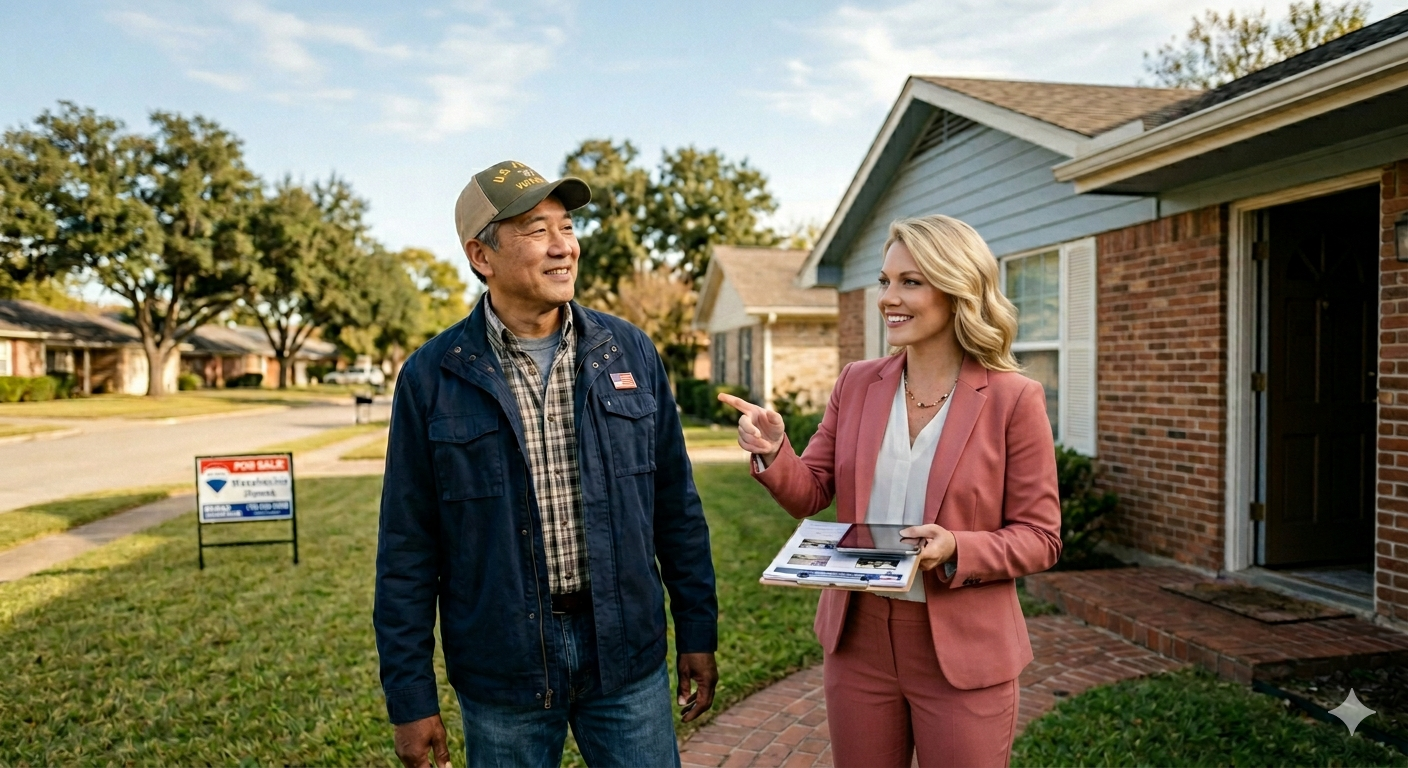
Higher rates cut into your purchasing power, and they cut into your competition at the same time. Days on market are stretching, price reductions are climbing across the metroplex, and buyers who can close today are negotiating from a position almost no one has held since 2021.
Builder incentives are the leverage nobody explains honestly. Builders across North Texas are stacking rate buydowns, 2-1 and 3-2-1 structures and in some cases permanent sub-5% fixed buydowns, alongside closing cost credits and flex cash. That is real value, but it is not free. A buydown lets a builder hold base price steady while the market softens, and the cost of the incentive is frequently sitting inside the purchase price you are paying. A builder would rather give you $20,000 in rate buydown than cut $20,000 off the sticker, because the sticker sets the comp for every remaining home in the community.
Which does not mean you should refuse the incentive. It means you compare the incentivized price against resale comps in the same submarket rather than against the builder’s own list price, and you ask directly whether the same incentive is available as a price reduction. Sometimes it is. I track these packages constantly across Midlothian, Mansfield, and Arlington, and in several communities you can stack two or three and functionally erase the gap between today’s rate and last spring’s. Just know what you are trading.
Depending on the difference between the fixed rate the builder is offering and the current market rates, it may be well worth taking the lower rate from the the builder, so long as you know that it’s baked into the price.
On financing, if you are inside 30 to 45 days of closing, most lenders lock your rate for free, and in a headline-driven environment locking beats floating. Further out, ask about lock-and-shop programs that hold a rate for 60 to 90 days before you have a property under contract, often with a float-down if rates fall, a strategy detailed in this June 2026 lock-versus-float guide. A float-down typically adds about 0.25% of the loan amount upfront and can return thousands if rates retreat before closing, per this rate lock cost breakdown.
How Commissions Actually Work Now
Most agents gloss over this, so let me be direct. Following the National Association of REALTORS® settlement that received final court approval in November 2024, sellers can no longer advertise a specific buyer’s agent commission inside the MLS, per this 2026 commission settlement breakdown. Buyers sign a written representation agreement before touring homes, and compensation on both sides is fully negotiable rather than customary.
If you’re buying a home, know that you will need to price this into your offer and that the seller has every right to push back. If you’re a seller, know that when you don’t offer to pay at least a portion of the buyer agents commission, you are pricing out a lot of buyers who could otherwise afford your home.
In practice, most sellers still offer buyer-agent compensation as a concession because it widens the buyer pool and frequently produces a faster, stronger sale. That is now a disclosed, negotiated decision rather than an assumption.
Frequently Asked Questions
Why did mortgage rates jump to a one-year high in July 2026?
Rates reached 6.66% on a combination of rising oil prices tied to renewed conflict near the Strait of Hormuz, a hawkish split on the Federal Reserve’s rate committee signaling a possible September hike, and core inflation that remains sticky despite slower GDP growth, per NPR’s July 2026 reporting.
Will mortgage rates keep rising?
My read is that rates finish 2026 at or above current levels. This will be driven by a persistent oil risk premium, a Fed that cannot reach consensus to hold, and core inflation holding steadily above a 2% target. Gulf de-escalation or two consecutive sub-3% core prints would change that view. Most forecasters currently expect a 6% to high-6% range through the balance of the year, according to current lender guidance.
Am I locked in if I have a low rate?
Check before you assume. Roughly 34% of DFW homeowners carry a rate above 5%, per UT Arlington, which puts the trade-up gap well under two points for a large share of this market. The lock-in story is accurate for people who financed in 2020 and 2021. It is frequently wrong for everyone else.
Should I wait to sell until rates come down?
For most North Texas sellers, no. Rates round-tripped from below 6% to 6.66% inside a single year, which tells you how unreliable timing the market is. A well-priced home today typically nets more than the same home sitting unsold on a rate drop that may never arrive on your schedule, as detailed in this related analysis.
How much does a higher rate cost me monthly?
On a $300,000 loan, moving from 6.5% to 7.0% adds roughly $100 per month, and 7.5% adds about $202. On a $400,000 loan, the move from 5.99% in February to today’s 6.66% runs approximately $175 per month and about $63,000 across a full 30-year term.
Are builder rate buydowns actually a good deal?
Frequently yes, but with a caveat. A buydown lets a builder protect base price rather than cut it, so the cost is often inside the purchase price. Compare the incentivized price against resale comps in the same submarket rather than the builder’s list, and ask whether the incentive is available as a price reduction instead.
What is a rate lock and should I use one now?
A rate lock is your lender’s written commitment to a specific rate for a defined window, typically 30 to 45 days at no cost. In a volatile environment with Fed meetings on the calendar, locking is the safer play inside 45 days, per this 2026 rate lock cost guide.
What is a float-down option?
A float-down lets you relock once at a lower rate before closing if rates drop meaningfully, usually by at least 0.25 percentage points. It generally costs 0.25 to 0.50 points upfront and can save thousands if rates fall before you close, as explained in this lock-versus-float breakdown.
Why did rates drop below 6% earlier in 2026 if they are back up now?
In January 2026, President Trump directed Fannie Mae and Freddie Mac to purchase up to $200 billion in mortgage-backed securities to push rates down, per Reuters’ original reporting. It worked temporarily. Renewed geopolitical conflict and inflation pressure reversed most of it.
How does the NAR settlement affect what I pay in commission?
Buyer’s agent compensation is no longer advertised in the MLS and gets negotiated directly, though most sellers often still offer it as a concession. Buyers sign a written representation agreement before touring that spells out exactly what their agent will be paid, per this breakdown of the settlement’s practical effects.
Is now a good time to buy in North Texas despite higher rates?
For buyers with stable income and a realistic budget, yes. Inventory is elevated, price reductions are common, and builder incentives can offset a meaningful share of the higher rate as long as you understand where the incentive is priced.
The Bottom Line

A one-year high in mortgage rates is a real economic event driven by oil, a divided Fed, and inflation that refuses to break. It is not a reason to freeze, and for a large share of this market the freeze was never justified in the first place.
DFW already took its correction, which has left elevated inventory and stacked builder incentives sitting in a market where a third of homeowners are carrying rates above 5% and have no idea the trade-up math already works for them. That combination does not last indefinitely. It lasts exactly as long as everyone keeps waiting.
The people who lose money in an environment like this one are not the ones who moved at 6.66%. They are the ones who waited for a number that never came, then moved anyway at a worse one.
If you want your actual numbers rather than a national average, reach out through North Texas Market Insider or text 214-228-0003. I will pull your note, your neighborhood’s data, and your real equity position, then tell you what today’s rate does to your specific move.
Last updated: August 2, 2026
Bobby Franklin, REALTOR® | Legacy Realty Group – Leslie Majors Team | TREC #0805459
Equal Housing Opportunity. All information is deemed reliable but not guaranteed and is subject to change. This article is for informational purposes and does not constitute financial or legal advice.





Join The Discussion