
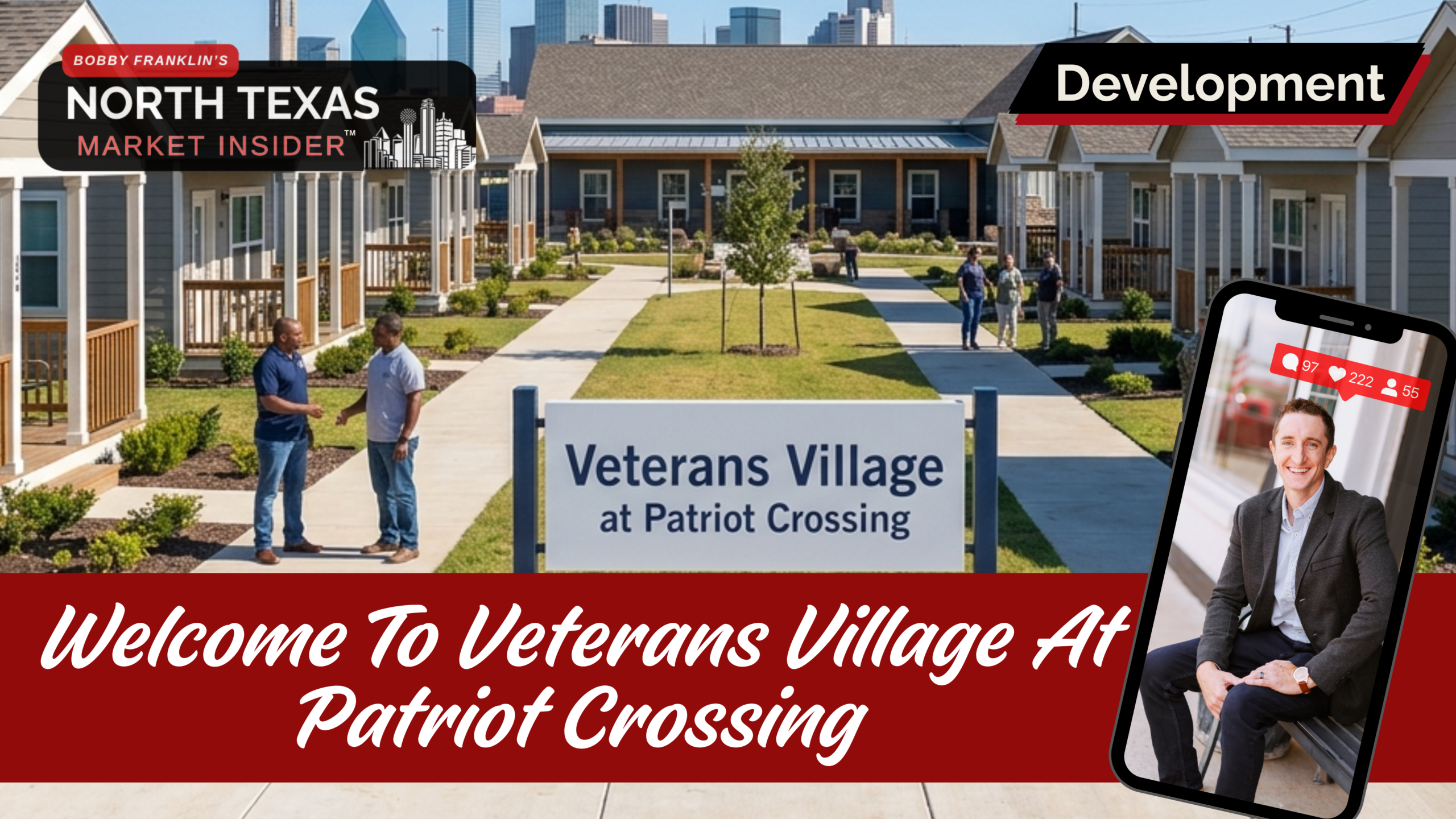
By Bobby Franklin, REALTOR® | North Texas Market Insider™
Most people saw the headline, thought “good for veterans,” and kept scrolling.
That’s the wrong read. That’s the read that leaves money on the table, misses the demographic wave, and lets the prepared buyers and investors move while everyone else is still processing.
When a city council votes unanimously to convert a decade-dead parcel, one that burned through $4 million and failed every previous attempt at development, into a purpose-built veteran housing village directly across from the largest VA hospital in North Texas, that’s not charity. That’s infrastructure, and infrastructure is the earliest, clearest signal this market ever sends.
I’m five steps ahead of the headline. Let me show you what this vote actually means.
The Vote: What Happened and Why It Matters
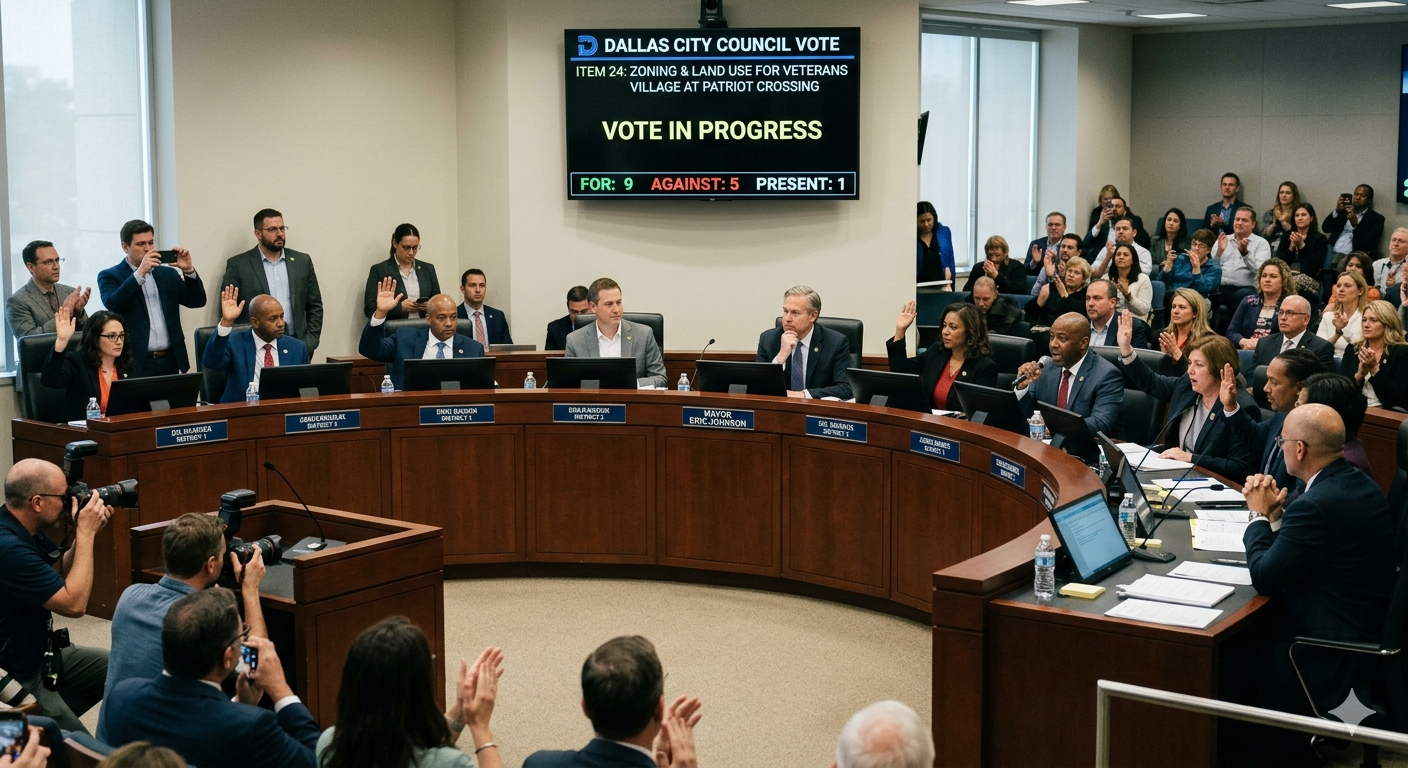
On May 27, 2026, the Dallas City Council voted unanimously to transfer 7.33 acres of city-owned land at 4515 South Lancaster Road to the Veterans Community Project, a nonprofit founded by combat veterans that has already built six successful villages across the country. Fortunately for this project, that land has been dead for over a decade. The city paid more than $4 million for it in 2015 as part of a development called “Patriots Crossing” that never materialized. Request after request for proposals with multiple failed RFPs and still nothing moved, until now. As KERA News reported in its coverage of the vote, this parcel sat as a monument to municipal inertia for years, directly across from the largest VA hospital in North Texas.
In roughly six months, Dallas City Manager Kimberly Bizor Tolbert’s office and Council Member Maxie Johnson found a partner, structured a deal, and got a unanimous vote. That kind of speed on a parcel that previously burned through $4 million and failed at every previous development attempt, tells you exactly how much political will is now sitting behind veteran support infrastructure in North Texas. It’s no longer rhetorical, it’s now structural.
The development, which will be called the Veterans Village at Patriots Crossing, will deliver, per NBC 5 DFW and FOX 4:
- 50 transitional tiny homes – 260 square feet for individuals, 360 square feet for family units
- A 7,000-square-foot community center with full-time, on-site case managers
- Pet-friendly grounds with a dog park – because VCP knows many veterans in crisis won’t enter a shelter that forces them to abandon their animal, especially with so many veterans utilizing them for ESA.
- Zero rent for residents, with case management participation as the only requirement
The Veterans Community Project must raise approximately $4 million by December 31, 2027 to retain the land, against a total project cost of roughly $15 million. Dallas will be VCP’s seventh village nationally, joining Kansas City, Colorado, St. Louis, and Milwaukee. The model it’s importing here has an 85% success rate moving veterans into permanent housing, with an average stay of about 11 months.
As Urban Land Magazine profiled in its examination of the VCP model, the homes use trauma-informed design: single door, single window, back-to-wall layout with clear sightlines, all details engineered for veterans carrying PTSD. The aim is to keep eligibility radically open. Any veteran who took the oath qualifies, regardless of discharge status, length of service, or whether they’re eligible for VA benefits.
This is a proven national model landing in the middle of the most veteran-dense metro in Texas and the real estate implications are already starting.
The Veteran Homelessness Numbers in DFW – What’s Actually True
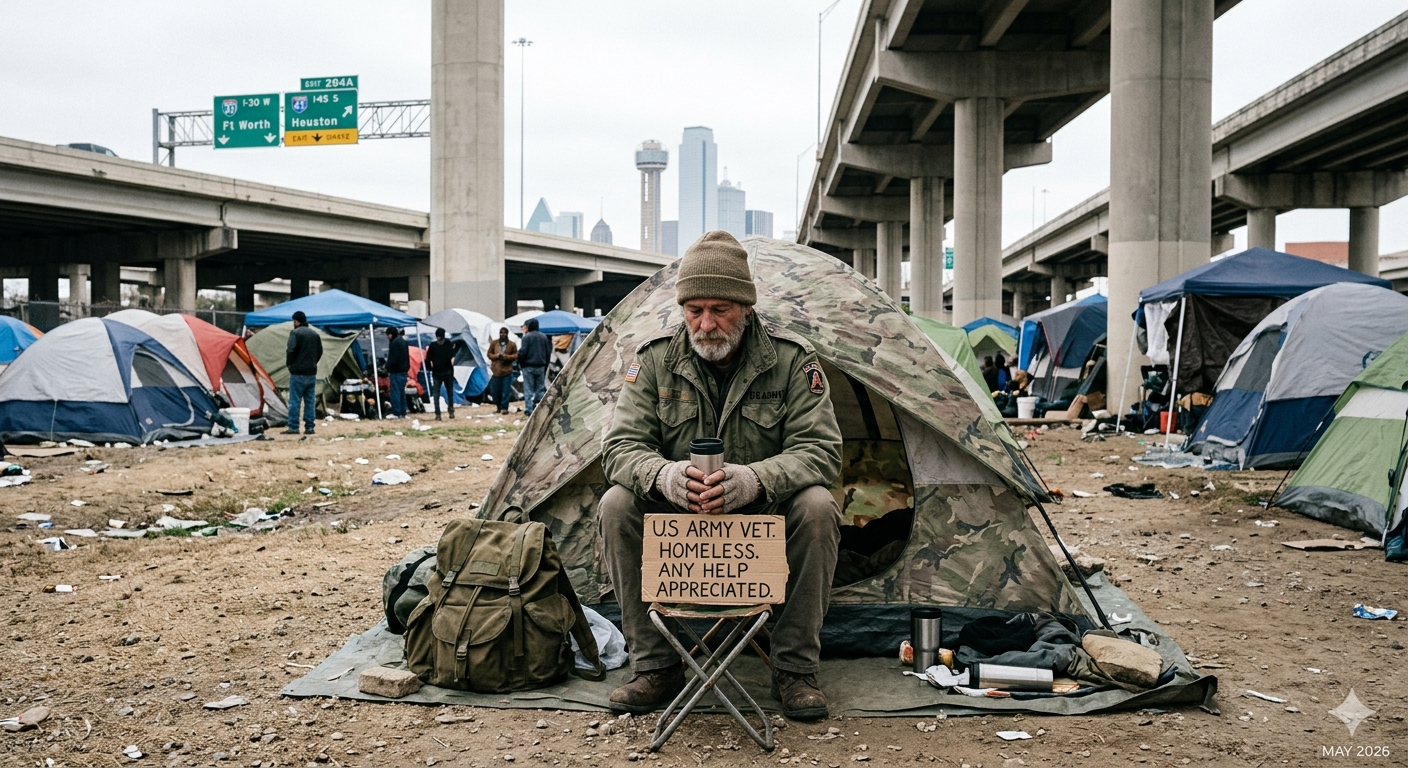
Before we get to the opportunity, let’s deal with the facts on the ground.
On a single night in January 2024, 32,882 veterans experienced homelessness across the United States, which is the lowest number recorded since measurement began in 2009, down 55.6% since 2010, according to the VA’s analysis of the HUD Point-in-Time Count. That progress is real. It’s also the direct product of coordinated investment, the exact kind of investment this Dallas vote represents. But it’s definitely still not enough, which is why VCP is coming to Dallas.
Locally, the numbers are even more striking. Dallas and Collin counties have been federally certified as having “effectively ended” veteran homelessness by the U.S. Interagency Council on Homelessness, HUD, and the VA. As Housing Forward documented, the region has housed 2,265 veterans since 2019 and is among fewer than 20% of U.S. communities to earn this designation. The region can now identify any veteran who falls into homelessness and rehouse them, typically within 90 days.
“Effectively ended” doesn’t mean zero. The Mayor said so himself. The 2025 Point-in-Time count still found 3,541 individuals experiencing homelessness in Dallas and Collin counties on a single night. The village being built on South Lancaster Road exists to catch the cases that slip through. The persistent, individual situations that a “functional zero” system is designed to resolve, not ignore.
The scale of the veteran community here in DFW is enormous. The Center for a New American Security’s assessment of DFW veterans puts the region at approximately 386,358 veterans, roughly one-fourth of Texas’s entire veteran population, with veterans making up 8.1% of the adult DFW population. About 57,000 are post-9/11 veterans.
This is not a fringe demographic. Veterans are a core market across North Texas and the city just made a loud, unanimous declaration about how it’s treating that market.
What Veteran Housing Actually Does to Your Property Values
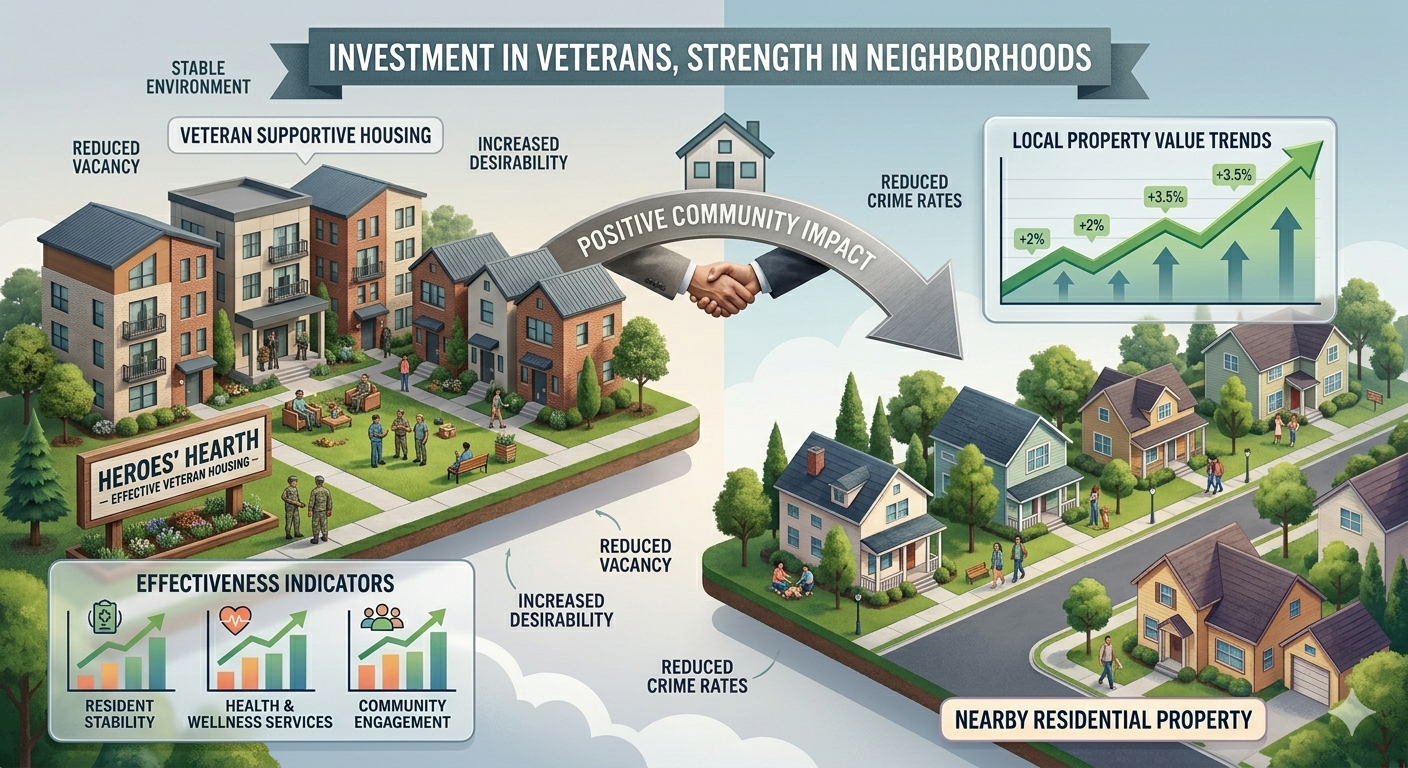
Let me say this directly, because every homeowner within two miles of this site is quietly asking it and most are too polite to say it out loud: Will this hurt my home’s value?
The answer is no, and it’s not even close.
The research on this is not ambiguous or split. It is one-directional, conducted across multiple cities, over multiple decades, by researchers with zero stake in the outcome. Let me walk you through it.
NYU’s Furman Center for Real Estate and Urban Policy examined 123 supportive housing developments across New York City over an 18-year period and found that supportive housing has no statistically significant negative impact on property values within 500 feet. Neighboring values within two blocks actually rose 3–4% more than comparable properties over the first five years after opening. As the Coalition for the Homeless summarized the findings, the size of the development had no link to its effect on surrounding values.
That’s not an outlier either, the broader research says the same thing:
The Urban Institute studied affordable housing in Alexandria, Virginia and found developments actually increased nearby property values. 0.09% in higher-income neighborhoods, 0.11% in lower-income ones. Small, statistically significant, and positive.
Georgia Tech’s School of Public Policy analyzed Low-Income Housing Tax Credit developments in Los Angeles and found no significant decrease in surrounding values, confirming a broader research consensus that these developments broadly increase nearby values.
Here’s what this means strategically. The “veteran village will tank my home value” narrative is a NIMBY reflex, not a market reality. The research is clear: well-managed supportive housing like a professionally run, trauma-informed, case-managed veterans village with full-time staff consistently holds or raises surrounding values. The sellers who panic on the rumor are the ones who lose. The buyers and owners who understand what the evidence actually says are the ones who profit. Anyone telling you otherwise is not reading the research.
The Veteran Buyer Opportunity the Market Is Sleeping On
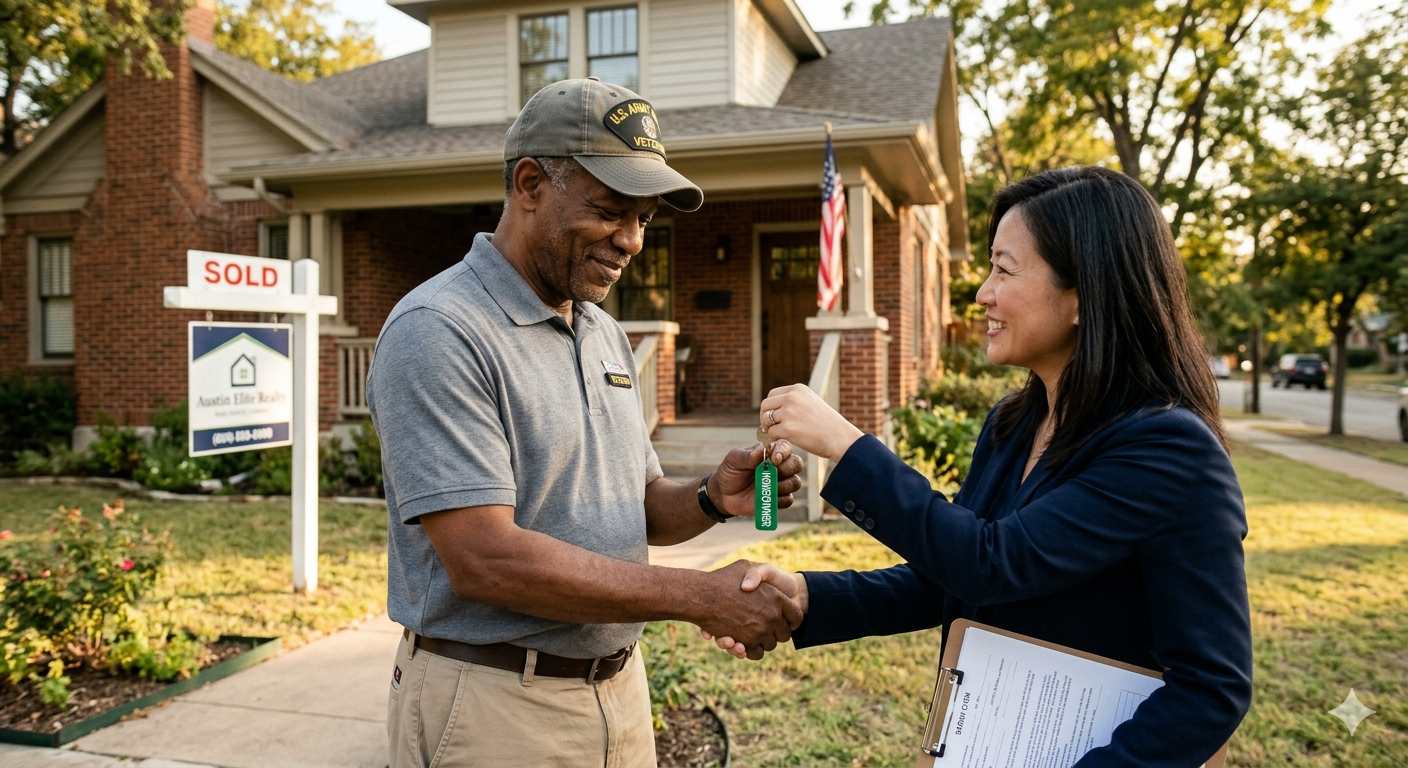
Here’s the pivot most agents won’t make: the Dallas vote on homeless veterans is actually a signal about the buying power of veteran homeowners and North Texas is sitting on top of one of the most underutilized buyer pools in the country.
Veterans don’t just have federal loan benefits. They buy at dramatically higher rates than civilians. According to the Urban Institute’s analysis of U.S. Census data, 76% of U.S. veteran households owned homes, which is 14 percentage points higher than non-veteran households. The VA loan isn’t just a benefit. It’s the structural reason veterans build wealth through real estate at rates civilians can’t match.
Texas actually leads the entire nation in VA loan volume. The VA’s home loan program is the most powerful buying tool in America, and most people who don’t have military connections have never looked at it closely. Here’s what it actually delivers:
- Zero down payment with full entitlement – 100% financing on any qualifying property
- No private mortgage insurance (PMI) – saving hundreds of dollars per month versus FHA or conventional loans with less than 20% down
- A 2026 loan limit of $832,750 for borrowers with partial entitlement and no limit at all for veterans with full entitlement
- A one-time VA funding fee – 2.15% for first-time use, 3.30% for subsequent use, that is completely waived for any veteran with a service-connected disability rating of 10% or higher
On a $400,000 loan, that funding fee exemption is worth $8,600 to $13,200 that a qualifying disabled veteran simply never pays.
The first step is a Certificate of Eligibility (COE), which confirms to lenders that you qualify. The VA’s COE guide walks through every path to getting it whether its online, by mail, or through a lender who can pull it in minutes through the VA portal. My guide to getting pre-approved and understanding your financing options covers the full journey for buyers in this market.
Texas Veteran Benefits That Stack On Top of the VA Loan
The VA loan is federal, meaning every eligible veteran in America gets it. Texas adds a state-level layer that turns the deal into something civilians in high-tax states are genuinely shocked by when they hear the math.
The 100% disabled veteran property tax exemption. Under Texas Tax Code Section 11.131, a veteran with a 100% service-connected disability, or individual unemployability, pays zero property tax on their Texas homestead. No cap on home value. No income test. As the Texas Comptroller’s office details, the exemption transfers to an un-remarried surviving spouse. Partial exemptions apply by rating: per the Texas Veterans Commission, 70–99% earns a $12,000 exemption, 50–69% earns $10,000, 30–49% earns $7,500, and 10–29% earns $5,000.
In a state where property taxes are the primary cost of homeownership, eliminating them entirely is not just a perk, it’s a wealth-generation event.
No state income tax on military retirement. Texas is one of nine states with zero state income tax. Your military pension is untouched. For an O-5 or O-6 retiree leaving California, that’s thousands of dollars annually back in your pocket giving you direct buying power in this market.
The Texas Veterans Land Board. Separate from your federal VA benefit, the Texas General Land Office’s VLB programs offer home loans up to $832,750, land loans up to $150,000 with 5% down on tracts of one acre or more, and home improvement loans up to $50,000. Veterans with a service-connected rating of 30% or greater qualify for a discounted rate. You can stack a VLB loan with a VA loan and the Texas Department of Housing and Community Affairs’ HUD-VASH program has deployed more than 2,700 vouchers statewide, including 120 additional vouchers to the Dallas VA Medical Center alone.
Stack the federal VA loan with the Texas disabled veteran exemption, the no-state-income-tax environment, and VLB programs and you’re not just getting a good deal. You’re operating in a completely different financial universe than most other civilians, especially those in California, Colorado, or Washington.
Veteran Relocation to North Texas – Why They’re Coming and Where They’re Landing
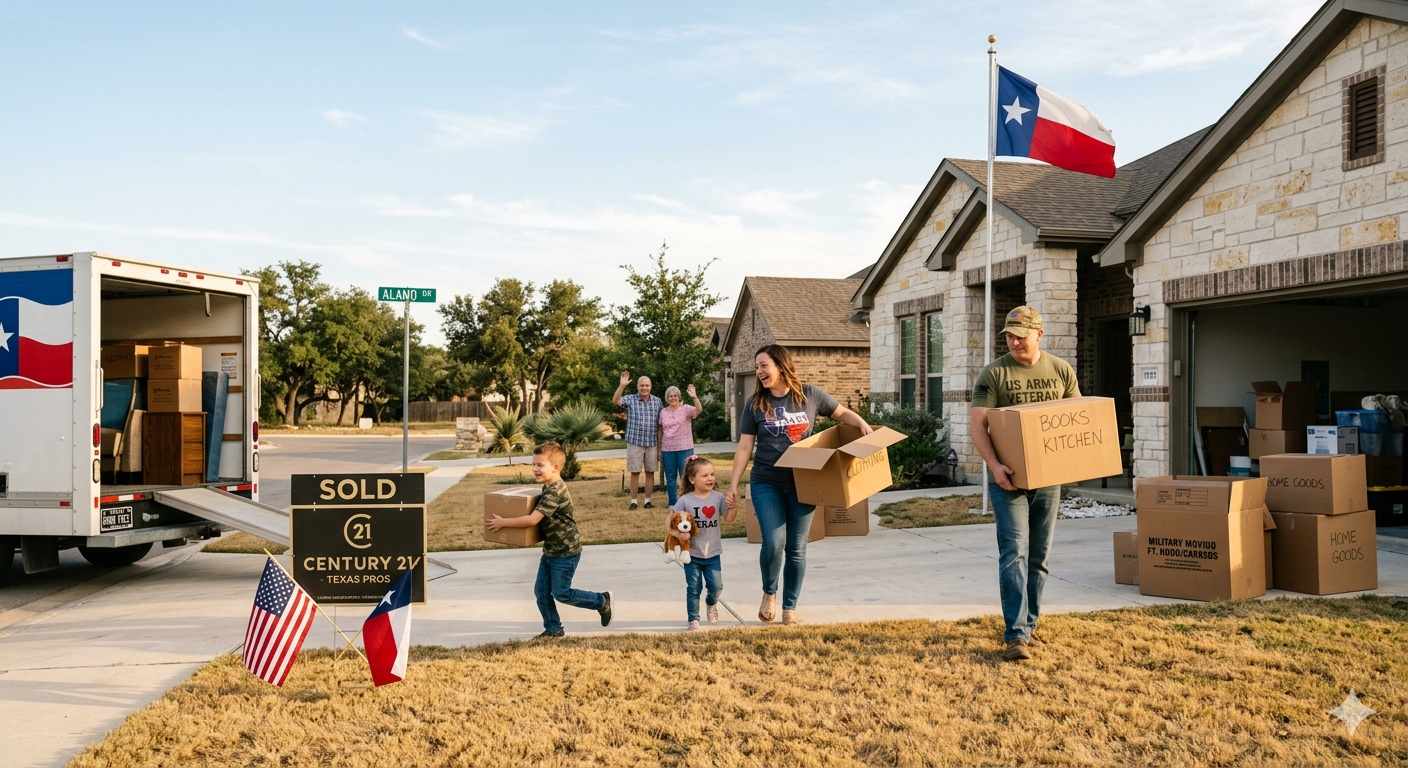
The veteran migration into North Texas is not a trickle. It’s a calculated exodus from high-tax states toward the one market that maximizes every benefit they earned.
The math is straightforward. California fully taxes most military retirement pay. So do Montana, Rhode Island, Vermont, and Utah above modest thresholds. Texas taxes none of it. Layer on the property tax exemptions, the affordability of the I-35E corridor, and the density of VA infrastructure concentrating here like the Dallas VA Medical Center, the Veterans Village, the VLB programs and North Texas quickly becomes the rational destination for any veteran optimizing their post-service life.
The broader migration numbers confirm it. DFW added 177,922 residents between July 1, 2023 and July 1, 2024, making it the third-largest numeric population gain of any U.S. metro according to the U.S. Census Bureau. When I look at search migration data for Ellis County markets, the top metros with buyers searching to move in include Los Angeles, Seattle, and Denver. The veterans leaving the coasts are not randomly picking Texas. They’re making an informed financial decision.
I run relocation services for buyers coming from California, Colorado, Washington, Arizona, Utah, and buyers returning from Germany. The full picture of what this move looks like lives on my North Texas relocation hub.
The I-35E Corridor: The Most Overlooked Veteran-Friendly Market in DFW
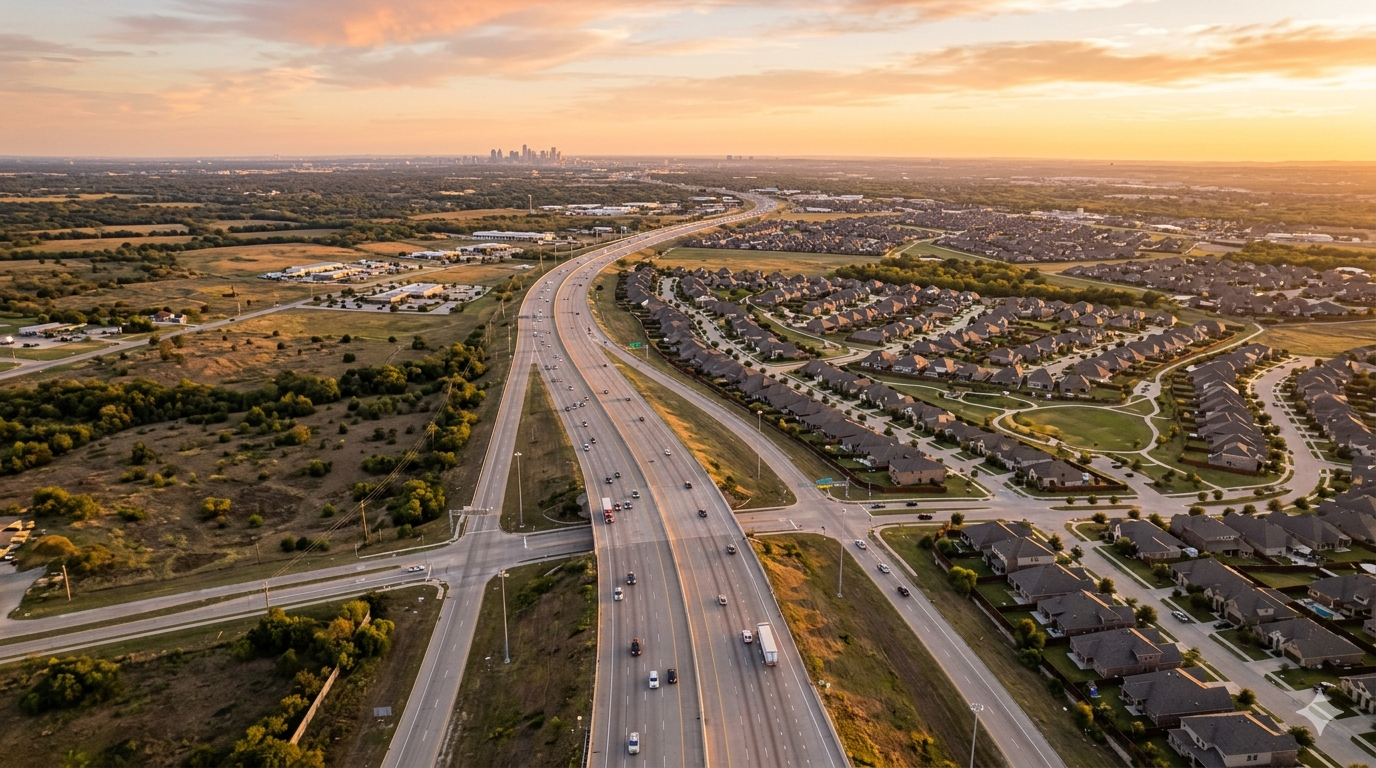
This is where strategy meets geography.
Draw a line south from the Dallas VA Medical Center down I-35E. You hit DeSoto, Lancaster, Cedar Hill, then Red Oak, Waxahachie, Midlothian, Ennis, and the Ferris/Palmer stretch. Every community in that corridor is within a reasonable drive of VA healthcare, every one of them is more affordable than the northern suburbs and every one of them just got more strategically important because the city of Dallas put a landmark veteran infrastructure investment at the northern anchor of that axis.
Ellis County’s median sale price runs around $376,000 to $418,000 which is well below the $832,750 VA loan limit. A veteran with full entitlement can buy virtually anything in this market with zero down. Push further south: Ennis runs around $267,000, Red Oak around $325,000. Those are prices that don’t exist in Dallas or Tarrant County for comparable space and comfort.
Here’s how to play each market:
Waxahachie – The Ellis County seat. Historic character, strong schools, county veterans services office, and the anchor of the corridor. My home base for a reason.
Midlothian – Growing fast with new construction perfectly paired with VLB loan requirements. Strong schools. Family infrastructure.
Red Oak – Currently undervalued relative to its neighbors, with significant appreciation potential as the corridor fills in from the north. The value play for the next three years.
Ennis and Ferris/Palmer – The frontier of the corridor. Land is still available, VLB land loans are made for exactly this geography, and this acreage is slowly disappearing.
DeSoto, Lancaster, and Cedar Hill – The southern Dallas County markets closest to the Veterans Village and the Dallas VA Medical Center. Shortest commute to VA healthcare with strong fundamentals and more runway than the northern suburbs.
Mansfield – Bridging Ellis and Tarrant counties, with major development reshaping what’s possible on the western edge of the corridor.
The tactical move for a veteran buyer: get your COE locked, get fully pre-approved (not just pre-qualified, there’s a meaningful difference), and target properties near planned infrastructure. Proximity to VA investment drives appreciation. Infrastructure begets demand. Demand begets value. I laid out the full regional trajectory in my 2026 North Texas housing market forecast.
The Financial Case for Veterans Buying in North Texas Right Now
Let’s run the actual math so this stops being abstract.
Scenario A – Veteran with a 30%+ disability rating buying in Waxahachie at $400,000:
- Down payment: $0
- PMI: $0
- VA funding fee: $0 (waived at 10%+ disability rating)
- Monthly mortgage at 6.5%: approximately $2,528 principal and interest
- Property taxes with homestead exemption (30–49% rating, $7,500 exemption applied): meaningfully reduced
- Property taxes if 100% rated: $0
Scenario B – Veteran with no disability rating buying the same home at $400,000:
- Down payment: $0
- PMI: $0
- VA funding fee (first use, financed into the loan): $8,600 that’s rolled into the loan balance, not paid at closing
- Monthly mortgage at 6.5% with fee financed: approximately $2,583 principal and interest
- Property taxes: standard Ellis County rate, approximately $600–$735/month at 1.8–2.2%
- Total monthly cost: still dramatically below what a conventional buyer pays
Compare that to a conventional buyer: 20% down ($80,000 cash out of pocket), PMI if they put less down, same property taxes, same rate. The VA loan without any disability rating is still structurally superior to a conventional loan for any veteran who qualifies with zero cash out the door, no PMI and a competitive rate. The disability exemptions are the elite-tier version stacked on top of an already powerful baseline.
That’s the structural advantage. Veterans don’t build equity faster because they’re more motivated. They build it faster because the instrument they’re using is categorically better.
How Veterans Are Buying Homes in North Texas: The Step-by-Step
This needs to be clear and actionable, not theoretical.
Step 1: Request your Certificate of Eligibility. Free, fast, and available through VA.gov, by mail with VA Form 26-1880, or, fastest of all, through a VA-approved lender who can pull it through the VA portal in minutes. You can’t move without it.
Step 2: Get fully pre-approved. Pre-qualification is a guess. Pre-approval verifies your income, assets, and credit and gives you a real number to shop with. In this market, showing up without one puts you behind immediately.
Step 3: Verify your disability rating and tax exemption eligibility. The Texas homestead exemption is not automatic, you file with your county appraisal district after closing. Waiting means losing a full year of the benefit. If you’re 100% rated, your property tax goes to zero the year you file.
Step 4: Explore VLB programs. If you’re buying new construction or acreage, the Texas Veterans Land Board loan may stack advantageously with your VA benefit. The GLO’s programs are separate from federal VA benefits and underutilized.
Step 5: Work with a REALTOR® who understands VA transactions. VA appraisals follow different requirements than conventional appraisals. Sellers and builders sometimes push back on VA offers based on unfamiliarity, not market reality. The right agent navigates that for you, not against you. My first-time buyer guide and homeowner path walkthrough cover everything from pre-approval to closing.
What Sellers and Investors Along the Corridor Need to Know
For sellers: Don’t panic-sell on the rumor that veteran housing development depresses your home’s value. Decades of research say the opposite. Hold your position. Price to the fundamentals. If you want a real number on what your home is worth right now, request a complimentary home valuation.
For investors: The supportive-housing infrastructure concentrating along the I-35E axis: VA Medical Center, Veterans Village, HUD-VASH vouchers, VLB programs, is a leading indicator of durable demand. Veterans who receive housing assistance become stable long-term renters and eventual buyers. Red Oak and Ennis offer the strongest value-to-appreciation ratios in the corridor right now: Red Oak is currently priced roughly 20–25% below Waxahachie for comparable product while sharing the same northward growth pressure as Ellis County fills in from I-20 south. Ennis sits at the frontier of the corridor where land is still available, prices haven’t repriced to reflect infrastructure investment, and the VLB land loan creates a buyer pool with no conventional equivalent. Both markets are where Waxahachie and Midlothian were five years ago. Watch the infrastructure and move before the market catches up.
FAQ: The 10 Most Searched Questions About Veteran Housing in Dallas

1. Where is the new Dallas homeless veteran community being built?
At 4515 South Lancaster Road in City Council District 4 directly across from the Dallas VA Medical Center, on the site of the failed Patriots Crossing development the city has owned since 2015.
2. Who is building the Dallas veterans village and how many homes will it have?
The Veterans Community Project is a nonprofit founded by combat veterans and they are building 50 transitional tiny homes (260 sq ft individual, 360 sq ft family), a 7,000-sq-ft community center, and a dog park. Dallas is VCP’s seventh village nationally.
3. When did the Dallas City Council approve the veteran housing community?
The council voted unanimously on Wednesday, May 27, 2026. No groundbreaking or completion date has been set yet.
4. How much will the Dallas veterans village cost and how is it funded?
Estimated total cost is roughly $15 million, funded through private philanthropy. VCP must raise approximately $4 million by December 31, 2027, to retain the city land.
5. Do homeless veterans pay rent at the Veterans Community Project?
Zero rent. The only requirement is participation in case management services. Veterans can stay as long as needed and any veteran who took the oath is eligible, regardless of discharge status or VA eligibility.
6. Does a homeless veteran community lower nearby property values?
No and the research is not split on this. NYU’s Furman Center, the Urban Institute, and Georgia Tech all found that supportive housing has a neutral-to-positive effect on surrounding property values. Neighbors within two blocks of Furman Center study sites saw values rise 3–4% more than comparable properties.
7. Has Dallas really ended veteran homelessness?
Dallas and Collin counties hold federal certification as having “effectively ended” it, meaning they can identify and rehouse any veteran who becomes homeless, typically within 90 days. It’s a systems designation, not a literal zero. The region has housed 2,265 veterans since 2019.
8. How many veterans live in the DFW area?
Approximately 386,358 or about one-fourth of Texas’s total veteran population. Veterans make up roughly 8.1% of the adult DFW population. About 57,000 are post-9/11 veterans.
9. What’s the difference between a homeless veterans village and a VA home loan?
Entirely different programs for entirely different people. The village is transitional housing for veterans experiencing homelessness. The VA home loan is a federal benefit helping veterans with stable income buy homes zero down, no PMI, competitive rates. If you’re employed and thinking about buying, the loan is your tool. If you’re facing homelessness, the Village is your tool.
10. How do I buy a home using a VA loan in Texas?
Request your COE through VA.gov or a VA-approved lender, get fully pre-approved, and work with a REALTOR® experienced in VA transactions. In Texas, stack federal VA benefits with Texas Veterans Land Board programs and disabled-veteran property tax exemptions. Contact me directly and I’ll connect you with trusted lenders and walk you through every step.
Work With a REALTOR® Who’s Five Steps Ahead of the Headline
The Dallas vote isn’t the story. The story is what comes after it, it’s the veteran buyers who deploy their VA benefits into the most affordable, VA-infrastructure-dense corridor in the metro, the sellers who understand the research and price accordingly and the investors who watch infrastructure signals before the market reprices them.
That’s the intelligence this platform exists to deliver.
If you’re a veteran, active-duty service member, or military family buying, selling, or relocating anywhere in North Texas let’s talk before the market figures out what I already know.
When you’re ready to finance, I work with three trusted local lenders who know VA transactions inside and out: Andrew Bryan at andrewthelender.com, Jennifer Nelson at Eustis Mortgage, and Taylor Fruge at Lower.
RESPA Disclosure: I recommend these lenders based on their expertise and service. I do not receive compensation for referrals. You are never obligated to use any lender I mention and are free to choose any lender you wish.
Bobby Franklin, REALTOR® | Legacy Realty Group – Leslie Majors Team
📲 214-228-0003 | northtexasmarketinsider.com
This content is for informational purposes only and does not constitute financial, legal, or tax advice. Bobby Franklin and Legacy Realty Group are committed to the principles of the Fair Housing Act and the NAR Code of Ethics, serving all clients equally without regard to race, color, religion, sex, handicap, familial status, national origin, veteran status, or any other protected class.