
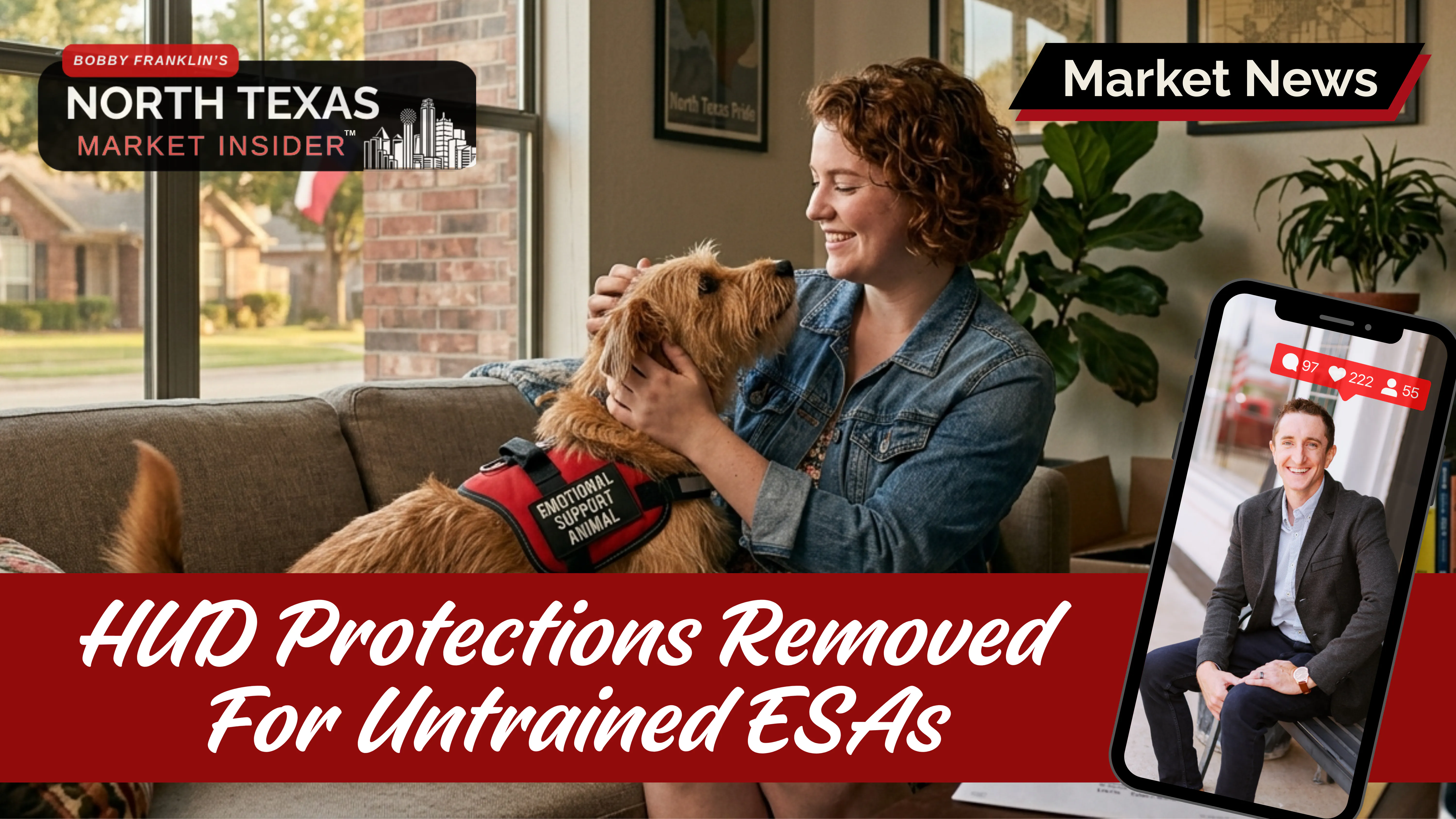
By Bobby Franklin, REALTOR® | North Texas Market Insider™ | Legacy Realty Group – Leslie Majors Team
Serving Ellis County, Waxahachie, Midlothian, Red Oak, Ennis, and Greater DFW
Published June 2026 | Updated Regularly
This article is written for educational purposes and is not legal advice. Fair housing law is evolving fast right now; consult a licensed Texas real estate or fair housing attorney for guidance specific to your situation. Full disclaimer at the bottom.

If you own a rental property anywhere in North Texas, or you’re a tenant who relies on an emotional support animal, stop scrolling. The rules just shifted underneath you, and most landlords and renters across DFW have no idea it happened. That gap, the space between what just came out of Washington and what people on the ground actually understand, is exactly where the prepared operator wins.
Here’s the part nobody’s saying out loud: the federal protection changed, but in Texas the state-law exposure and the private-lawsuit window did not, so the landlords celebrating loudest are the ones most likely to get burned.
On May 22, 2026, the U.S. Department of Housing and Urban Development issued a sweeping enforcement memorandum titled Enforcement Guidance: Assessing Requests for the Use of an Animal as a Reasonable Accommodation Under the Fair Housing Act. This was not a tweak. HUD’s Office of Fair Housing and Equal Opportunity rewrote how it handles emotional support animal complaints from the ground up, permanently rescinded its 2020 guidance, and dramatically narrowed federal enforcement protection for untrained ESAs.
Whether you’re a landlord in Waxahachie wondering whether you can finally enforce that no-pets policy, or a tenant in Midlothian worried about what this means for your dog or your cat, this is your complete breakdown. Written by a local expert who tracks every layer of housing policy hitting North Texas before it reaches the rest of the market.
What HUD Actually Did on May 22, 2026, and Why It Matters

Start with the facts, not the spin.
HUD’s FHEO issued an internal enforcement memo instructing every regional office that, effective immediately, the agency will only find “reasonable cause” and pursue fair housing charges in animal accommodation cases involving animals individually trained to perform specific tasks related to a disability. Untrained emotional support animals, the ones that provide comfort and companionship without task-specific training, are no longer protected by federal fair housing enforcement at the HUD level.
This is a seismic shift. For more than a decade, HUD’s guidance treated ESAs as “assistance animals” under the Fair Housing Act, which meant a landlord who denied an ESA request backed by a therapist’s letter was exposed to a potential federal discrimination charge. That enforcement posture is gone.
Here is the core of the new standard, as summarized by fair housing attorneys reviewing the memo: requests to waive a pet policy for an animal trained to perform specific disability-related tasks are presumptively reasonable, while requests to waive a pet policy for untrained ESAs are not.
What HUD withdrew specifically:
- FHEO Notice 2013-01: Service Animals and Assistance Animals for People with Disabilities in Housing and HUD-Funded Programs
- FHEO Notice 2020-01: Assessing a Person’s Request to Have an Animal as a Reasonable Accommodation Under the Fair Housing Act
Those were the two documents that, for years, told landlords they could not charge pet fees for ESAs and had to accept a mental health provider’s letter as sufficient justification. Baker Donelson’s legal analysis lays out the full scope of the rollback.
The ADA Alignment: What “Individually Trained” Actually Means
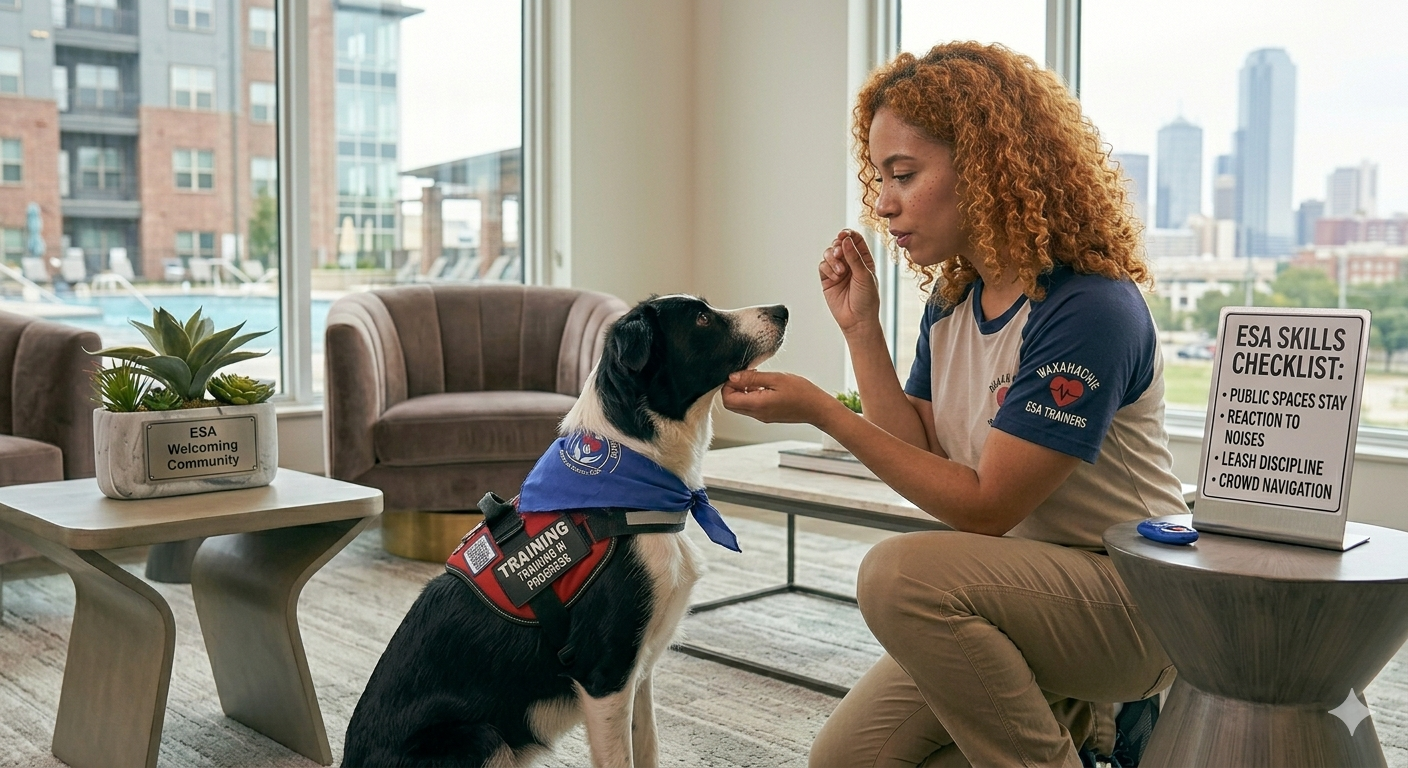
To see where HUD is heading, you have to understand the Americans with Disabilities Act, because HUD has now explicitly stated it intends to align its Fair Housing Act standards with the ADA definition of service animals, to the maximum extent possible.
Under the ADA, a service animal is one individually trained to do work or perform tasks for the benefit of an individual with a disability, including a physical, sensory, psychiatric, intellectual, or other mental disability. The ADA has never recognized emotional support animals, animals whose entire function is to provide comfort through their presence. The ADA National Network has drawn that line for years, and it just became the most consequential distinction in housing.
HUD’s May 2026 memo adopts that training standard. Going forward:
- An animal qualifies for Fair Housing accommodation at the federal enforcement level only if it has been individually trained to perform tasks directly related to a disability.
- Providing comfort, well-being, or companionship is not sufficient to count as “work” or “tasks” under the new definition.
- HUD will not limit covered animals to dogs the way the ADA does; trained animals of other species can still qualify.
- New complaints filed with HUD FHEO involving untrained ESAs will be dismissed or receive a no-cause finding.
Read between the lines and the message is direct: HUD believes the old ESA system was being abused, and it is aligning enforcement with a harder, more verifiable bar.
The Road That Led Here: How We Got to This Point

None of this happened overnight. Understanding the timeline is what lets you see the next move before it arrives.
July 2025: Henderson v. Five Properties LLC (Fifth Circuit). A Louisiana federal judge handed landlords a landmark win, ruling that a tenant seeking a fee waiver for an ESA had to prove the waiver was both necessary and reasonable for her specific situation, not simply hand over an ESA letter. Judge Vance found HUD’s prior guidance unpersuasive and lacking legal force. For Texas property owners this matters enormously, because Texas sits inside the Fifth Circuit, the same court that produced the decision. The full breakdown of the ruling is worth a read if you own rental property here.
September 17, 2025: HUD withdraws its prior ESA guidance. HUD pulled both the 2013 and 2020 documents from active enforcement, signaling the philosophical shift to come. The agency stated that prior guidance went beyond what the Fair Housing Act actually requires, created compliance burdens not found in the statute, and made American housing more expensive and less fair.
May 22, 2026: HUD issues the new enforcement memorandum. The full policy direction crystallizes. Every open ESA case in the FHEO regional offices is being routed to the Acting Deputy Assistant Secretary for individual review, and the new standard now governs all new complaints.
The rulemaking on the horizon. HUD has signaled it intends to pursue formal rulemaking, which would convert this posture into legally binding regulation rather than guidance. When that process finishes, it establishes a new federal standard with full legal force. That process has not yet begun, and that distinction is everything, which I’ll come back to.
What This Means for North Texas Landlords Right Now
If you own rental property in Red Oak, Ennis, or anywhere across the DFW metroplex, here is the practical breakdown.
What You CAN Now Do (With Significantly Less Federal Risk)
1. Decline untrained ESA requests without fear of HUD FHEO enforcement. FHEO has stated plainly that it will no longer pursue fair housing charges for denying an untrained ESA, and new complaints of that type will be dismissed at the federal level.
2. Apply pet fees and deposits to ESAs, with caveats. The prior guidance prohibiting pet fees and deposits for ESAs has been rescinded, and the Henderson precedent supports reasonable, consistently applied fees. Housing providers can now assess pet fees and deposits for untrained ESAs with far more confidence than they had a year ago.
3. Reject documentation from ESA mills and online certification sites. Generic letters from internet registries, the kind with no actual therapeutic relationship behind them, can now be rejected with greater confidence. HUD is not going to prioritize those cases.
4. Require legitimate documentation from licensed providers. You can require that ESA documentation come from a licensed mental health professional who has a genuine therapeutic relationship with the tenant and personal knowledge of the disability-related need.
What You CANNOT Do (The Caveats That Can Still Cost You)
This is where North Texas landlords need to slow down, because confidence without precision is how you end up in court.
Here is the trap I’m already watching landlords walk toward: they read “HUD won’t enforce” as “I’m in the clear,” move to revoke or deny an accommodation, and hand a tenant’s attorney a two-year window to sue under a statute that never changed. Federal enforcement pulled back. Your liability did not. The agents and owners who understand that distinction will operate from strength. The ones who don’t are about to learn it the expensive way.
1. You cannot automatically deny every ESA request. The Fair Housing Act statute itself has not changed. Disability discrimination in housing is still illegal under federal law. HUD’s memo only changes FHEO’s enforcement posture; it does not amend the statute.
2. Private lawsuits are still very much on the table. Tenants retain the right to file private civil rights actions in federal or state court within two years of an alleged violation, fully independent of any HUD complaint. An attorney can still sue a landlord for an FHA violation even when HUD declines to act.
3. State and local law is untouched, and in Texas that is the headline. Most states have independent fair housing laws with their own enforcement. Texas has its own Fair Housing Act under Texas Property Code Chapter 301, and the Texas Workforce Commission’s Civil Rights Division handles housing discrimination complaints entirely independently of HUD. State enforcement of ESA protections can continue even where federal enforcement has pulled back.
4. Section 504 of the Rehabilitation Act is explicitly carved out. HUD’s memo specifically states it does not address how FHEO will handle Section 504 complaints, which cover properties receiving federal funding. If your property participates in HUD programs, vouchers, or federal subsidies, the older standards may still apply to you.
5. Do not weaponize fees. Setting pet fees artificially high specifically to deter tenants with ESAs is still discrimination under the Fair Housing Act. Fees have to be reasonable and applied consistently to every animal.
6. Trained psychiatric service animals keep full protection. Animals genuinely trained to perform tasks for individuals with psychiatric disabilities, including anxiety, PTSD, and depression, qualify as service animals under the new standard and retain full housing protection.
What This Means for North Texas Tenants With ESAs

If you’re renting or apartment hunting across North Texas and you rely on an emotional support animal, here is the honest read on your new landscape.
Your Protections Narrowed at the Federal Level. They Did Not Disappear.
The hard truth first: if your animal is untrained, meaning it provides comfort through presence but has not been trained to perform specific tasks, HUD will no longer pursue a discrimination complaint on your behalf if a landlord denies your request. That is a real reduction in your practical protection, and pretending otherwise helps no one.
Your options, though, are not gone:
Option 1: Document task-based training with your provider. If your animal has been trained to perform specific tasks, interrupting an anxiety episode, performing deep pressure therapy during a panic attack, alerting to a specific psychiatric event, you may qualify under the new trained standard. Document that training clearly.
Option 2: File with the Texas Workforce Commission Civil Rights Division. The Texas Fair Housing Act operates independently of HUD, so you can file a state-level complaint without ever going through the federal process.
Option 3: Consult a private attorney. Private Fair Housing Act lawsuits remain available within two years of an alleged violation. A fair housing attorney can evaluate your case regardless of HUD’s new posture.
Option 4: Negotiate directly with your landlord. Plenty of landlords will still choose to accommodate ESAs voluntarily. The new guidance does not require denial; it only removes federal enforcement risk for those who do deny. A well-documented request from a legitimate licensed provider can still carry real weight.
What Strong ESA Documentation Looks Like Now
If you want to maximize your odds of accommodation in this climate, your ESA letter should come from a licensed mental health professional who:
- Has an established therapeutic relationship with you, not a one-time online consultation.
- Is licensed in the state where you live.
- Includes their license number and state of licensure.
- Clearly states your qualifying disability.
- Explains the connection between your disability and the need for the specific animal.
- Is not an online “ESA registry” or certification mill.
Steer clear of any service offering same-day ESA certificates, ESA “registrations,” or flat-fee letters with no clinical evaluation. Those carry essentially zero weight under the new enforcement standard, and they never carried legal weight under the old one either.
The Gray Areas: What Is Still Genuinely Unsettled
Even experienced fair housing attorneys are warning against overconfidence on either side of this. Here is what remains in flux:
How courts will read the new standard. HUD’s memo is enforcement guidance, not law. Different federal district courts can reach different conclusions about what the Fair Housing Act itself requires, independent of HUD’s posture. Henderson governs the Fifth Circuit, covering Texas, Louisiana, and Mississippi; other circuits may land elsewhere.
What “trained” means in practice. The new standard requires individual training to perform tasks, yet there is no established verification protocol behind it: no required certification, no training registry, no defined bar for what qualifies as training. Housing providers should consult counsel before rewriting any policy.
Previously approved ESAs. The memo says nothing about tenants who already hold approved ESA accommodations under the prior standard. There is no reason to revoke them; they were properly granted under the law as it stood at the time.
The rulemaking process. HUD has signaled intent to codify this through formal rulemaking. Until that rulemaking is finalized and published, the new posture is policy, not binding law. That difference will matter in every borderline case for the next year or more.
How This Lands in the Broader North Texas Rental Market

This change is not arriving in a vacuum. It is hitting a North Texas rental market already in motion. As our 2026 North Texas Housing Market Forecast lays out, inventory is rising, days on market are climbing, and buyers and renters are gaining negotiating leverage they have not held in years.
For landlords across Ellis County and Greater DFW, a friendlier ESA enforcement environment colliding with rising rental inventory means the landlord-tenant power dynamic is genuinely moving. That is not a license to act recklessly, since private lawsuits and state enforcement remain real, but property owners who felt boxed in by ESA accommodation requirements now have meaningfully more room to operate.
For tenants, especially those relocating here from California or other high-cost states where ESA protections may run broader, understanding the Texas-specific landscape is essential. Our North Texas Market Insider Daily News tracks the regulatory shifts hitting buyers and renters in real time, before the rest of the market catches up.
What Real Estate Agents Need to Know: Compliance and Ethics

As a REALTOR® operating under the 2026 NAR Code of Ethics and Texas Real Estate Commission standards, here is the compliance frame that matters.
Do not make definitive statements about ESA rights to clients. Given how fast this is moving, the correct posture for any agent, whether advising a landlord or a tenant, is to present the facts, name the gray areas honestly, and direct clients to licensed legal counsel for definitive guidance.
Your Fair Housing obligations as an agent have not changed. The prohibitions on steering, discrimination, and disparate treatment based on disability are exactly where they were. Agents remain fully bound by federal and state fair housing law regardless of HUD’s enforcement shift.
RESPA is unaffected. The Real Estate Settlement Procedures Act governs your disclosure and referral obligations in every transaction, and the ESA policy change has zero bearing on it.
The NAR settlement rules remain in force. Written buyer agreements before showings, no commission advertising on the MLS, fully negotiable compensation: all of it stands in every transaction you run.
State advertising rules apply to all content. This article, and anything you publish touching fair housing or disability rights, has to comply with Texas Real Estate Commission advertising rules requiring accurate, non-deceptive presentation.
Deeper Dive: What the Fair Housing Act Still Protects

With this much confusion in the air, a clear-eyed look at what the Fair Housing Act still guarantees is worth the time.
The Fair Housing Act, codified at 42 U.S.C. § 3601 and following, prohibits housing discrimination based on race, color, national origin, religion, sex, familial status, and disability. The disability protections cover:
- A physical or mental impairment that substantially limits one or more major life activities.
- A record of having such an impairment.
- Being regarded as having such an impairment.
Under the FHA, landlords are required to provide reasonable accommodations, meaning changes to rules, policies, practices, or services when necessary to give a person with a disability equal opportunity to use and enjoy a dwelling.
What HUD’s new guidance does is narrow the enforcement definition of which animals qualify as a reasonable accommodation. It does not remove disability as a protected class, does not erase the reasonable accommodation obligation, and does not stop courts from reaching their own conclusions about what the statute requires. That distinction between trained service animals and untrained emotional support animals is now more consequential than it has ever been.
Service Animal vs. Emotional Support Animal: The Definitive 2026 Comparison

This is where landlords and tenants alike get tangled. Here is the cleanest breakdown possible.
| Service Animal | Emotional Support Animal (ESA) | |
|---|---|---|
| Legal Definition | Individually trained to perform tasks for a person with a disability | Provides comfort or companionship through presence; no training required |
| Training Required | Yes, specific task training | Historically no; under new HUD guidance, required for federal enforcement |
| ADA Coverage | Yes, with public access rights | No, never covered by the ADA |
| Fair Housing Act | Full protection, unchanged | Federal enforcement protection effectively removed for untrained ESAs as of May 2026 |
| Texas State Law | Protected | Protected under the Texas Fair Housing Act, independent of HUD |
| Pet Fees | Cannot be charged | Can now be assessed per HUD guidance; still legally uncertain in some contexts |
| Documentation | Not legally required under the ADA; landlord may ask two questions | Letter from a licensed mental health professional with an actual therapeutic relationship |
| Species | Primarily dogs under the ADA; any species under the FHA | Any common household animal: cat, dog, rabbit, bird, and so on |
What Happens to Tenants With Already-Approved ESAs?
This is one of the most common questions property managers and tenants are asking right now, and the short answer is the reassuring one: nothing needs to change for an existing, properly approved ESA tenant.
HUD’s memo does not require landlords to revoke previously granted accommodations. Tenants who received ESA accommodation under the prior standard were properly accommodated under the law as it existed then, and retroactively yanking those accommodations would create legal exposure with no corresponding benefit under the new guidance. For pending requests, the ones submitted but not yet approved, landlords now have more latitude to evaluate them under the trained-animal standard before granting accommodation.
What About Federally Subsidized Housing in North Texas?
If you live in or manage housing that receives federal funding, Section 8 vouchers, public housing, HOME program housing, or other federally assisted programs, the picture gets more complicated.
HUD’s May 2026 memo explicitly excludes Section 504 of the Rehabilitation Act from its scope. Section 504 provides broader disability protections for federally funded programs and applies independently of the Fair Housing Act. For residents in HUD-funded housing, the prior assistance animal standards may remain operative under Section 504 until HUD issues specific guidance on that law. HUD’s recent citizenship verification requirements for federally funded housing run on an entirely separate track from this ESA shift; those touch eligibility for assistance, not accommodation requests.
If you’re a landlord in the Housing Choice Voucher program here, or a tenant receiving assistance in one of our Ellis County or DFW communities, talk to a housing attorney before changing any policy based on the May 2026 memo.
A Step-by-Step Framework for North Texas Landlords

Pulling all of it together, here is a practical framework for property owners. This is not legal advice; it is a starting point to review with a licensed Texas real estate or fair housing attorney before you implement anything.
Step 1: Don’t panic, and don’t overreact. The guidance creates more latitude, not a green light to summarily deny every ESA request. Private lawsuits, state enforcement, and genuine accommodation obligations are all still live.
Step 2: Create or update a written animal policy. Document it clearly, covering all animals rather than just ESAs, and apply it consistently to every applicant and tenant. Consistency is your single best legal protection.
Step 3: Establish a documentation standard. Decide what you will require for accommodation requests. At minimum, require a letter from a licensed mental health professional with an established therapeutic relationship that includes a license number, state of licensure, and an explanation of the disability-related need for the specific animal.
Step 4: Reject ESA-mill documentation carefully. Online registries, certificate mills, and generic letters with no clinical backing can be rejected, but document your reasons and apply the same standard to every request.
Step 5: Set your fee policy. If you assess pet fees for ESAs, keep them reasonable, many attorneys suggest staying under 10% of annual rent, apply them consistently to all animals, and never structure them as a deterrent.
Step 6: Fully accommodate trained psychiatric service animals. Animals trained to perform tasks for individuals with mental health disabilities still qualify under the new standard and must be accommodated without pet fees or breed restrictions.
Step 7: Consult legal counsel. Before any policy change, talk to a fair housing attorney who knows Texas law. The Texas Workforce Commission Civil Rights Division handles Texas fair housing complaints, and understanding your state-level exposure matters more now than ever.
A Step-by-Step Framework for North Texas Tenants With ESAs

Step 1: Get proper documentation now. If you have an untrained ESA and rely on it for housing, work with your provider to evaluate whether your animal can be trained to perform specific disability-related tasks.
Step 2: Know your Texas rights. File with the Texas Workforce Commission Civil Rights Division if you believe you’ve faced housing discrimination. State enforcement operates independently of HUD.
Step 3: Know the difference between federal and state housing. In HUD-funded housing, public housing or Section 8, your protections may be broader under Section 504 than under the Fair Housing Act. Ask your housing provider which laws govern your specific situation.
Step 4: Use Disability Rights Texas. This is a free resource for Texans with disabilities navigating fair housing. Call 1-800-252-9108 or visit their intake page.
Step 5: Keep detailed records. If a landlord denies your request, document everything in writing: dates, the nature of the request, what documentation you provided, and the landlord’s response. That record is essential if you later pursue a complaint or a lawsuit.
The Bigger Picture: Is This the Right Direction?

Fair housing advocates and disability rights organizations have raised serious concerns about this shift. The Disability Rights Education & Defense Fund has called HUD’s move a policy reversal that undermines the housing rights of people with psychiatric and mental health disabilities, who are the primary users of ESA accommodations.
The concern is real. Anxiety, depression, PTSD, and related conditions are among the most prevalent disabilities in the country, and ESAs have served as a critical accommodation tool for people who do not need or qualify for a fully trained psychiatric service dog. Setting task-specific training as the threshold for federal protection raises a bar that many legitimate disability needs simply cannot clear.
On the other side, housing providers and landlord groups have argued for years that the old system was being systematically abused, with an explosion of online certificate mills letting nearly anyone buy a letter for a small fee and producing documentation landlords had no real ability to assess. The May 2026 guidance, and the rulemaking expected to follow, is one administration’s attempt to reset that balance. Whether the courts and future administrations affirm the reset is an open question.
For North Texas real estate professionals, the takeaway is clean: stay informed, stay careful, and never position yourself as the final authority on a legal landscape that is actively being contested.
How This Hits the Ellis County and DFW Rental Market Specifically

The rental market across our coverage area, from Waxahachie and Midlothian to Arlington and the broader DFW metro, has been under unusual pressure for years.
Ellis County’s rapid growth, including the 13,000-home development headed to Waxahachie, is bringing new rental inventory online. At the same time, our 2026 market data shows pending home sales down 20.56% in May 2026, pushing more would-be buyers into the rental pool.
More competition among renters, more landlords reassessing their property management policies in a new regulatory environment. The HUD ESA shift is one more variable in an already complex equation, and the owners and investors who understand all the variables at once are the ones who position before the rest of the market reacts. For the readers who want to stay ahead of the regulatory and market changes shaping North Texas real estate, our North Texas Market Insider Daily Intelligence is built to keep you five steps ahead.
FAQ: The 10 Most-Asked Questions About HUD’s New ESA Ruling

These are the questions people are searching most across Google, Reddit, and the real estate forums.
1. Can a landlord legally deny an emotional support animal in 2026?
At the federal enforcement level, increasingly yes, for untrained ESAs. HUD’s May 22, 2026 memo states FHEO will no longer pursue fair housing charges against landlords who deny them. The Fair Housing Act itself was not amended, private lawsuits remain possible within two years, and Texas state fair housing law operates independently of HUD. A landlord denying an ESA request should consult counsel first and document the decision carefully.
2. Does HUD’s new ruling mean I no longer need a letter from my therapist?
No, documentation is still your best protection. HUD may no longer pursue charges for denying an untrained ESA federally, but a legitimate letter from a licensed mental health professional with an established therapeutic relationship remains your strongest tool, for requesting accommodation from landlords who choose to accommodate, for state-level complaints, and for private legal action. The difference is that online ESA-mill letters now carry essentially zero weight under any framework.
3. Did HUD’s guidance change the Fair Housing Act itself?
No. HUD’s memo is agency guidance, not a statute, a regulation, or a court ruling. The Fair Housing Act, passed by Congress, has not changed. HUD is only changing how it enforces the Act. Courts can still interpret the statute differently, and private plaintiffs can still sue under it regardless of HUD’s posture.
4. Can landlords now charge pet deposits and pet rent for ESAs?
It’s more permissible than before, but it still carries risk. HUD’s guidance removes the prior prohibition on ESA pet fees from the federal enforcement framework, and the Henderson ruling supports reasonable, consistently applied fees. Using fees to discriminate or deter accommodation is still illegal, though, and Texas law may give tenants additional protection. Keep fees reasonable, consistently applied, and implemented only after legal review.
5. What animals are still protected under the new standard?
Animals trained to perform specific tasks for a person with a disability, regardless of species, keep full federal housing protection. That includes psychiatric service dogs trained to interrupt panic attacks, perform deep pressure therapy, or detect oncoming dissociative episodes. The new standard tracks the ADA definition of trained task performance but, unlike the ADA, does not limit covered animals to dogs.
6. My ESA was already approved. Can my landlord take the accommodation back?
There is no legal basis to revoke a properly granted accommodation. HUD’s memo does not address previously approved ESAs, and nothing in it suggests landlords should retroactively rescind them. If your landlord tries, consult a fair housing attorney and contact the Texas Workforce Commission Civil Rights Division.
7. Does this affect ESAs in public housing or Section 8?
Section 504 of the Rehabilitation Act is explicitly excluded from the May 2026 memo. For properties receiving federal funding, public housing, Section 8 vouchers, HOME program housing, the old accommodation standard may remain operative under Section 504. HUD has said it will address Section 504 separately. If you live in federally funded housing, consult your provider and a fair housing attorney before assuming anything has changed.
8. Can a landlord ask what my disability is or request my medical records?
No. Under the Fair Housing Act, a landlord may ask for documentation confirming your need for an accommodation, but cannot demand your specific diagnosis, your medical history, or copies of your records. The documentation has to come from a healthcare professional who can confirm the disability-related need. That protection has not changed.
9. What should I do if a Texas landlord denies my ESA request illegally?
You have several options: file with the Texas Workforce Commission Civil Rights Division for state-level enforcement; file with HUD FHEO, though for untrained ESAs that is now less likely to produce action; consult a private fair housing attorney about a federal civil rights lawsuit within two years of the violation; or contact Disability Rights Texas at 1-800-252-9108. Document everything in writing before, during, and after the request.
10. Will HUD’s ESA policy become permanent law?
Not automatically. The May 2026 memo is enforcement guidance, not law. HUD has stated its intent to pursue formal rulemaking, the process of publishing a proposed rule, taking public comment, and finalizing regulations, which would make the standard legally binding. That process typically takes one to several years. In the meantime, the new posture governs HUD FHEO complaints while the underlying statute and existing case law stay operative, and a future administration could reverse course through new guidance or rulemaking.
Where This Leaves the North Texas Real Estate Community

This is a genuine turning point in fair housing enforcement, one that will shape landlords, tenants, property managers, and agents across North Texas for years. The smartest posture is the same for everyone in the chain: stay informed, move carefully, and refuse to treat agency guidance as settled law until the courts and the rulemaking process confirm it.
For landlords in Waxahachie, Midlothian, Red Oak, and Ennis, you have more flexibility today than you did before May 22, 2026. Use it deliberately, document everything, and get legal review before any major policy change.
For tenants with ESAs, your rights narrowed at the federal enforcement level, but they did not vanish. Know your Texas-specific protections, work only with legitimate licensed providers, and pursue state-level remedies without hesitation if you believe you’ve been discriminated against.
For agents, this is exactly the kind of market intelligence that separates an authority from an order-taker. Understanding the regulatory landscape as fluently as you understand the listing inventory is what builds client relationships that last, and what keeps you on the right side of the NAR Code of Ethics and TREC requirements.
If you have questions about the North Texas rental or purchase market, or you’re ready to make a strategic move in Ellis County or DFW, reach out directly.
Bobby Franklin, REALTOR®
Legacy Realty Group – Leslie Majors Team
16 Northgate Dr. Ste 100, Waxahachie, TX 75165
📲 (214) 228-0003 | northtexasmarketinsider.com
This article is provided for informational and educational purposes only. It does not constitute legal advice and should not be relied upon as such. Real estate, fair housing, and disability laws are complex and change frequently. Always consult a licensed Texas real estate attorney or fair housing specialist for guidance specific to your situation. Bobby Franklin is a licensed REALTOR® in the state of Texas and does not provide legal advice. All content is original, written specifically for NorthTexasMarketInsider.com, and complies with the Fair Housing Act, RESPA, the NAR Code of Ethics, and Texas Real Estate Commission advertising standards.