

Where independently owned boutiques, James Beard-nominated restaurants, live music, and one of Dallas’s most walkable streetscapes converge in the heart of North Oak Cliff. This is the neighborhood that proved Dallas has a creative soul worth celebrating.
Why Bishop Arts? 60 Local Businesses, All Walkable
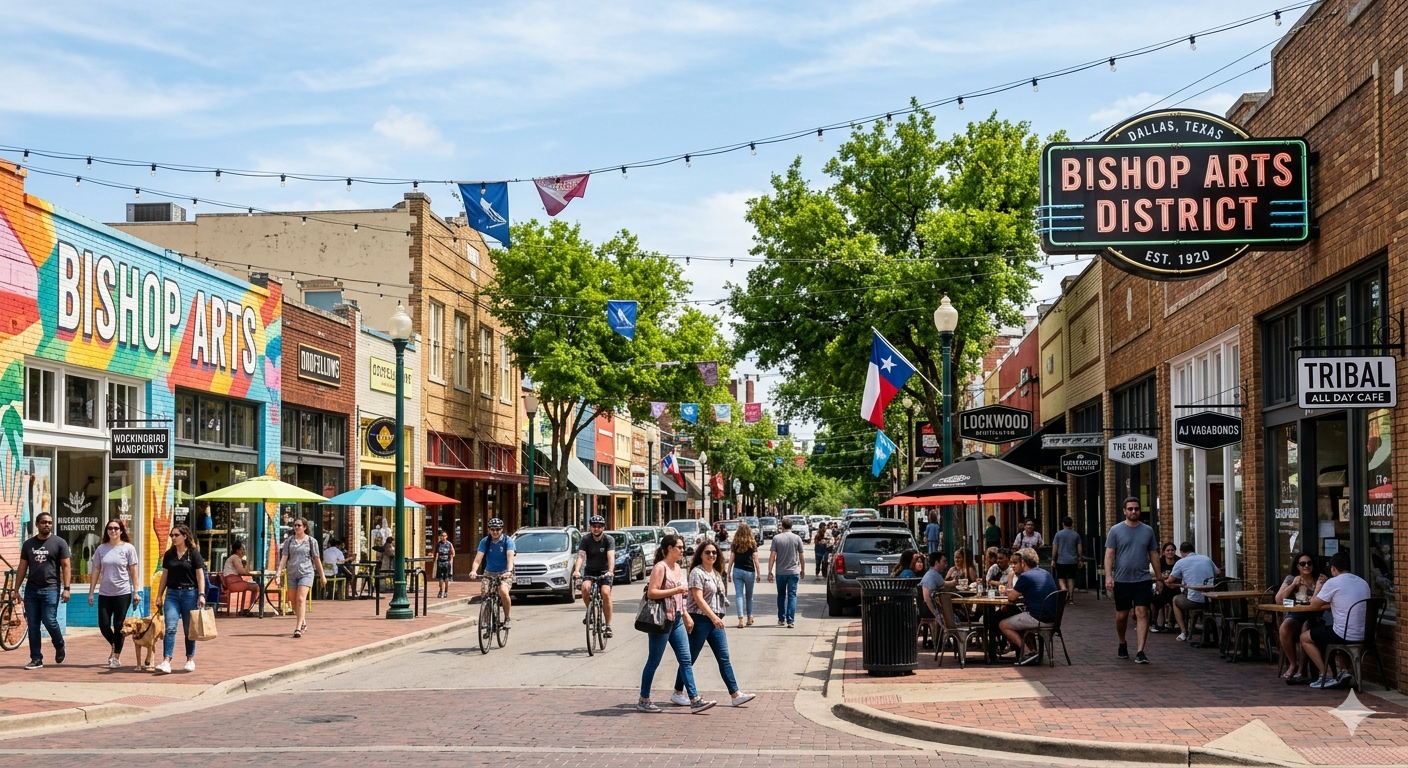
Bishop Arts is the walkable heart of Oak Cliff and the most concentrated independent district in Dallas. Tucked into North Oak Cliff about three to four miles southwest of downtown across the Trinity River, it packs more than sixty locally owned restaurants, galleries, boutiques, and bars into roughly 49 walkable blocks, with no national chains in the core. What separates Bishop Arts from almost every other neighborhood I sell is the buyer behavior: people do not cross-shop it against the suburbs. They choose Bishop Arts specifically, because nothing else in Dallas opens your front door onto a district like this.
The district is the draw. You can spend a weekend without leaving it, from barbecue at Lockhart Smokehouse and pie at Emporium Pies to a table at Lucia that books months out. A pour at Bishop Cider Co. or Ten Bells Tavern, and an afternoon at The Wild Detectives, the bookstore-and-bar that doubles as a community hub. The Bishop Arts District anchors a real arts culture, from the Bishop Arts Theatre Center to the growing Oak Cliff Film Festival. The area has become enough of a destination that celebrities turn up on the regular. Part of the district carries National Register historic status, which protects the turn-of-the-century building stock that gives Bishop Arts its character.
The residential streets around the district have quietly posted some of the strongest appreciation in all of Oak Cliff. The median sale price sat around $515,000 in early 2026, up roughly 11 percent year over year, with new-construction infill at the top of the market reaching $850,000 and beyond. The housing is a deliberate mix: original Craftsman bungalows and cottages, mid-century properties, renovated townhomes and lofts, and a rising supply of modern infill. The buyers chasing them skew toward young professionals, remote workers, and people relocating from Austin and the coasts, where this lifestyle would cost far more.
Getting around rewards the car-light life Bishop Arts is built for. The Dallas Streetcar connects the district straight into downtown, DART bus routes thread through, and I-35E and I-30 put the rest of the metroplex within easy reach. Green space sits close by, with Kidd Springs Park, Lake Cliff Park, and the Dallas Zoo all minutes away. For daily life, most of what you need is only a walk, not a drive away.
Two honest notes before you buy. First, buyers trade square footage for walkability here, and they pay a premium for it, so the dollar-per-foot math looks different than it does farther out in Oak Cliff or the suburbs. Second, Bishop Arts is served by Dallas ISD, and campus quality varies by address, so mapping the specific school matters as much here as anywhere in the city. The ongoing wave of mixed-use and apartment development is reshaping the edges of the district, which is exactly why the appreciation has been strong and why knowing which blocks are changing is part of buying smart.
What Makes Bishop Arts Special:
- Sixty-Plus Independents, Zero Chains: A walkable core of locally owned restaurants, galleries, boutiques, and bars across roughly 49 blocks, anchored by a National Register historic district.
- Some of Oak Cliff's Strongest Appreciation: A median sale price around $515,000 in early 2026, up roughly 11 percent year over year, with new-construction infill reaching $850,000 and beyond.
- Buyers Who Choose It On Purpose: Young professionals, remote workers, and relocators from Austin and the coasts who want walkability over square footage and are not cross-shopping the suburbs.
- Walk Out the Door: The Dallas Streetcar to downtown, DART bus routes, and quick I-35E and I-30 access, with downtown three to four miles away.
- Historic Stock Meets New Infill: Craftsman bungalows, cottages, lofts, and renovated townhomes alongside a rising supply of modern new construction.
Bishop Arts Housing Market Stats
How To Use These Charts
Use these charts to track; Days on Market, Closed Sales, Sales Price and Shows to Pending.
Just hover over the image to see specific data points for each month.
SALES PRICE
The median sales price represents what Bishop Arts homes actually sold for in a given month, not what sellers hoped to get. It is the single most important number for reading market conditions in Bishop Arts, the most walkable independent district in Dallas.
Why median matters more than average: Bishop Arts housing runs from renovated bungalows and condos to new-construction infill reaching $850,000 and beyond. The median lands on the exact middle point, half the homes sold for more and half sold for less, which strips out the distortion a single high-end new build would otherwise create in an average. In a district where a restored 1920s cottage can sit on the same block as a brand-new infill home, the median keeps the read honest while the average gets pulled toward the newest product.
For Sellers: a rising median signals real buyer demand, and in Bishop Arts that demand is structural. Limited historic-district supply, a lifestyle that cannot be copied in the suburbs, and a buyer pool that chooses this neighborhood on purpose have driven a roughly 11 percent year-over-year appreciation. Scarcity plus intentional demand is a strong position, and right now it sits on the seller’s side.
For Buyers: tracking the price trend tells you whether you are buying into appreciation or buying into negotiating room. The gap between list price and sales price is the tell. When homes close at or above list, sellers control the negotiation. When sales prices settle below list, the leverage shifts to you. In a district gentrifying block by block, that gap also separates the streets that have already been bid up from the ones with room left to run, and the right comparison depends entirely on whether you are buying original historic stock, a renovation, or new construction.
MEDIAN DAYS ON MARKET
Median Days On Market Shows: how many days a home in Bishop Arts sits on the market before going under contract. The median approach takes the highest and lowest numbers and finds the exact middle, eliminating distortion from extreme outliers like quick cash sales or overpriced listings that sit for months.
Why It’s Important: This number reveals everything about supply and demand dynamics in Bishop Arts. Low days on market (under 30 days) means strong buyer demand. Homes are moving fast and multiple offers are common. High days on market (over 60 days) signals buyer selectivity, more inventory relative to demand, and significant negotiating power.
For Sellers: Understanding current days on market helps set realistic expectations about timing and pricing strategy. If homes are selling in 20 days, the market rewards well-priced properties. If homes are sitting for 90 days, you need aggressive pricing and marketing to compete effectively.
For Buyers: This metric tells you whether you need to make quick decisions or have time for thorough due diligence. Seasonal patterns matter with Spring and Summer typically showing lower days on market as family buyers coordinate with school schedules.
MEDIAN SHOWS TO PENDING
Median Shows to Pending Reveals: how many showings a home in Bishop Arts received before going under contract. This metric helps sellers understand what’s normal when their home gets showings and helps buyers gauge competition levels in the Bishop Arts market.
Why It’s Important: Low shows to pending (under 10) means buyers are making quick decisions. It signals a strong seller’s market where well-priced homes receive offers fast. High shows to pending (over 20) indicates buyer selectivity, with people touring many properties before committing. This data reveals which price ranges and cities have the most buyer interest.
For Sellers: If Bishop Arts homes are averaging 8 showings before going pending, getting 15 showings without offers signals a pricing or presentation problem. This gives you realistic expectations and helps you adjust strategy before losing valuable market time.
For Buyers: High shows to pending means you have time to be selective without losing properties to faster-moving competition. Combine shows to pending with days on market to understand complete market dynamics. Low numbers on both metrics mean hot seller’s market, high numbers mean buyers have the advantage.
CLOSED SALES
Closed Sales Represent: the total number of residential homes that successfully sold in Bishop Arts each month. Unlike active listings or pending contracts, these are actual completed sales where financing cleared, inspections passed, appraisals came in at value, and both parties made it through closing.
Why It’s Important: This is the heartbeat of the local market. High volume signals buyer confidence and healthy fundamentals, while declining volume reveals market friction. Rising prices with increasing volume signals a genuine seller’s market, while rising prices with declining volume suggests weakening momentum.
For Sellers: High closed sales volume indicates strong buyer activity and favorable selling conditions. You’re competing in a market with proven absorption rates, meaning well-priced homes are selling consistently.
For Buyers: High volume means more competition and faster-moving inventory. Declining volume creates opportunities for patient negotiation and gives you time to be selective without losing properties to faster-moving competition.
Thinking About Bishop Arts Or the Markets Around It?
Bishop Arts is the lifestyle-and-appreciation play, and for the buyer who wants it, nothing else in Dallas is close. A walkable district of sixty-plus independents, real arts culture, and strong appreciation, all minutes from downtown, is a combination you cannot manufacture. But the smartest buyers I work with measure Bishop Arts against the alternatives before they commit.
The rest of Oak Cliff, especially Kessler Park, offers larger historic homes on bigger lots for buyers who want space over walk-out-the-door density. Uptown offers the same walkable energy and nightlife at a markedly higher price. And the suburbs offer the square footage and the consistent schools that a 49-block historic district was never built to deliver. The right answer for you depends on whether you are buying the walkability, the space, or the schools. I am the agent who runs all of it honestly and helps you make the call that fits your money and your life.
When you are ready to talk Bishop Arts, or the neighborhoods buyers weigh against it, let’s talk.
Bobby Franklin, REALTOR®
Legacy Realty Group – Leslie Majors Team 214-228-0003
northtexasmarketinsider.com


Bobby Franklin
Realtor®
Serving DFW | Ellis County
16 Northgate Dr. Ste 100
Waxahachie, TX 75165
Whats Your Next Strategic Move?
Market Insights | Strategic Planning