
By Bobby Franklin, REALTOR® | North Texas Market Insider™ | Legacy Realty Group – Leslie Majors Team | Waxahachie, TX | 214-228-0003 | Published June 2026
When Dallas opened a permanent 120-officer downtown police command center last month, most people in this market filed it under “public safety news” and kept scrolling. That is the most expensive mistake you can make with a real estate signal.
Here is what that announcement actually is: the latest confirmed data point in a documented historical pattern where urban safety investment leads suburban property appreciation by three to five years. Every city that has executed a credible downtown safety recovery has watched the same sequence play out. Safety leads. Capital follows capital and people follow capital. The urban core reprices. The overflow demand aka the priced-out, the commuter, the value-seeker, each flow down the highway corridor into the suburbs. The suburbs that were positioned on that corridor before the mainstream figured it out captured appreciation that the late movers paid a premium to access.
Dallas is running that playbook right now. The I-35E corridor of Waxahachie, Midlothian, Red Oak, Ennis, Ferris, Palmer and others is the corridor these buyers will be flowing towards and the window to position ahead of the rush is open right now, not in 2028 when the data starts confirming what I’m telling you today.
Safety Is Not a Soft Amenity. It Is a Priced Asset.
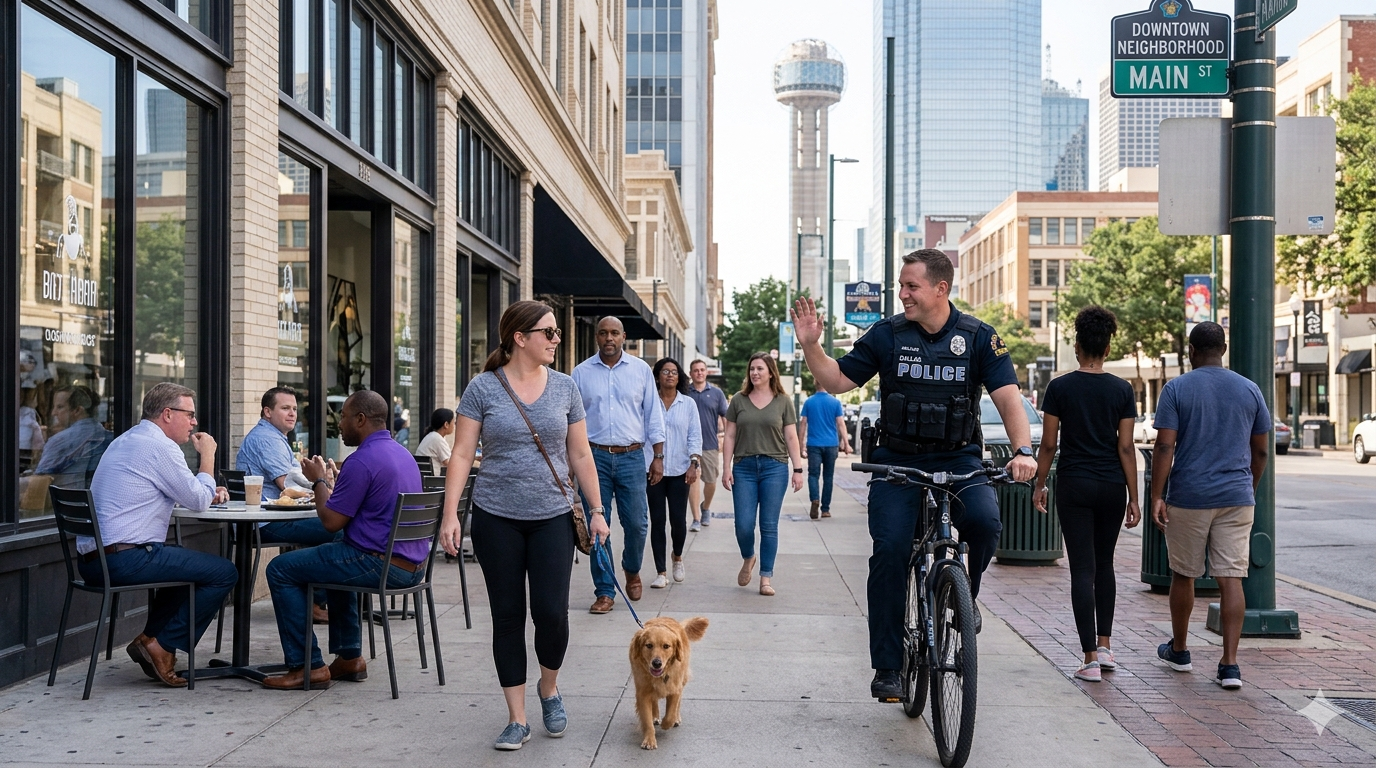
I want to kill one assumption before we go any further: the idea that “safety” is a feel-good neighborhood quality that doesn’t show up in hard transaction data. It does. Economists have been measuring it for nearly five decades and the finding is consistent: a 10% reduction in crime moves property values UP by 1.5% – 3.5%. That is not just my opinion either. That is the result of fixed-effects panel analysis across roughly 3,000 urban zip codes, replicated across multiple decades and multiple research designs. The zip codes that saw the largest crime reductions in the 1990s also saw home values rise 7% – 19% over the decade.
Think about what that means at scale. Apply a 10% crime elasticity to Dallas’s current downtown numbers with violent crime down 12% in 2025, down another 16-18% year-to-date in 2026 and you are talking about a sustained 25-30% crime reduction. The implied property value increase on an $8.1 billion downtown baseline is $300 million to $850 million in affected asset value and that’s just the floor. Boston Consulting Group, which produced the strategic framework for Dallas’s Safe in the City initiative, models more than $4 billion in incremental downtown property value over five years under full execution. BCG cited CoStar, the Urban Land Institute, the Brookings Institution, and the National Bureau of Economic Research in that projection. That is not a marketing spun document, it’s an institutional research output.
Here is the finding that most people in this conversation have never encountered: researchers at MIT found that when Cambridge, Massachusetts reduced its overall crime rate by 16%, that safety improvement alone directly accounted for 15% of the neighborhood’s total price appreciation during the same period. 1 in 7 dollars of appreciation was caused by safety and nothing else. That is the magnitude of the force Dallas just set in motion.
There is a layer on top of the crime statistics that matters even more for the near-term signal. Research published in The Economic Journal found that visible disorder like encampments, vandalism, quality-of-life violations, etc. works it’s way into prices independently of actual violent crime data. Buyers read visible disorder as a signal of where a neighborhood is headed, not just where it is now. A neighborhood cleaning up its visible disorder is broadcasting future safety to the market before the crime statistics get a chance to confirm it. Downtown Dallas’s 82% reduction in quality-of-life violations and the complete resolution of every downtown encampment is not a footnote in this story. It is the market’s first look at the trajectory, and trajectory is what buyers pay for.
New York, Denver, DC – The Pattern Has a Track Record

The most powerful thing I can show you is not a model, but what actually happened in every city that has run this playbook before Dallas.
Start with New York in the 1990s. Violent crime fell 56% citywide and roperty crime fell 65%. That is nearly twice the national decline over the same period. You can read here from The National Bureau of Economic Research where they documented the crime drop and its causes. What happened next in the suburban counties surrounding the city is astonishing.
The FHFA House Price Index which is the Federal Housing Finance Agency’s measure of average single-family home value change over time using repeat sales data, tells the story in the numbers. With 2000 set as the baseline of 100:
| Suburban NYC County | 1995 HPI | 2005 HPI | Decade Appreciation |
|---|---|---|---|
| Bergen County, NJ | 76.91 | 170.82 | +122.1% |
| Essex County, NJ | 76.36 | 175.72 | +130.1% |
| Morris County, NJ | 78.16 | 165.83 | +112.2% |
| Westchester County, NY | 74.30 | 170.47 | +129.4% |
The broader Middle Atlantic division rose 24.9% over the five years ending in 2000. The NYC suburbs more than doubled that pace over the decade following the crime drop and Bergen County’s HPI roughly tripled. Every county in that ring ran the same playbook at the same time.
NYC is the largest case but not the only one. Denver’s LoDo district was written off as a skid row in the late 1980s, then was rebuilt through safety infrastructure, private capital, and Coors Field as an anchor institution. It quickly became one of Denver’s most valuable submarkets within just a decade. Urban Land Magazine documented appreciation rates that outpaced Denver comparison neighborhoods through the late 1990s and 2000s. The same mechanism applied: safety improved first, then capital followed, then overflow demand landed in the commuter corridors.
Washington DC’s NoMa neighborhood is the most direct parallel to what Dallas is executing right now. A Business Improvement District launched safety investments in 2004 including a private ambassador patrol model structurally similar to Dallas’s Safe in the City’s coordination. Redfin’s current NoMa data shows median sale prices above $700,000 on a neighborhood that was functionally abandoned in 2003. Private capital commitment. Safety anchor. Multi-year lag. Full suburban diffusion.
That is what a recovered urban core does to its commuter ring. Dallas is where New York was in 1994; one year into a documented crime drop, capital just starting to move, the suburban repricing still three to four years out. The I-35E corridor is at 1993 New Jersey. The lag between the urban turning point and the suburban price acceleration is approximately 3 – 5 years and that lag is not a problem. It is the entry window.
What Dallas Actually Built And Why It’s Different This Time
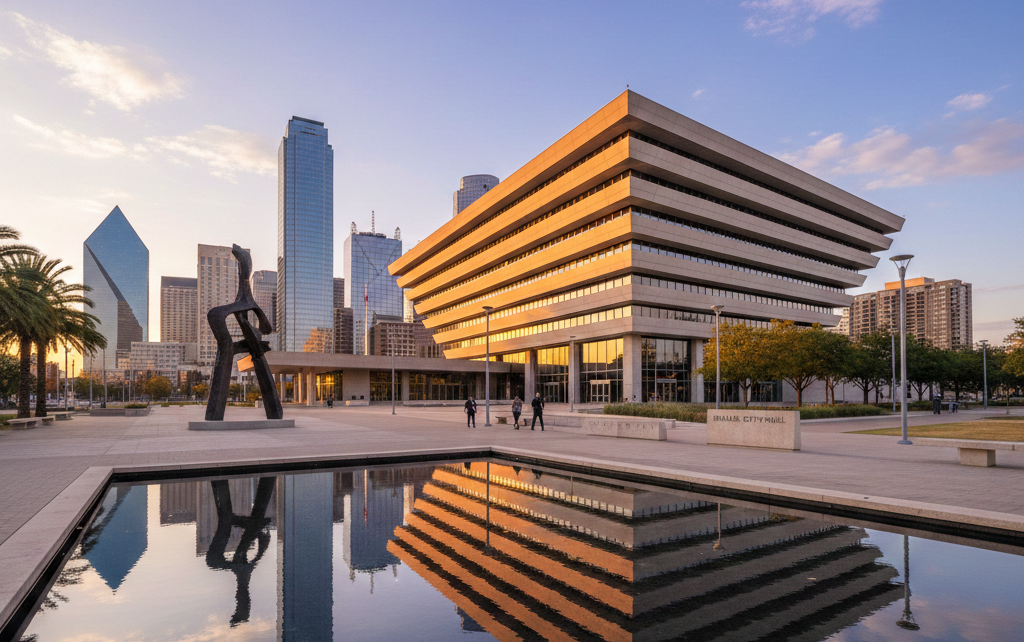
I’ve watched Dallas announce downtown safety initiatives before. This one is different, and the difference is structural.
The Safe in the City coalition built around Downtown Dallas Inc., the Dallas Police Department, the City of Dallas, and Housing Forward is not funded by the municipal budget. It is funded by approximately $1 million in private capital from the Dallas Citizens Council, the Dallas Regional Chamber, the Communities Foundation of Texas, and the Hoblitzelle Foundation, committed for at least three years. When private institutional money backs a safety initiative instead of city council appropriations, the signal to outside investors is categorically different. Private capital does not commit three years of funding to a program it expects to fail.
The command center itself has 120 dedicated officers on the 10th floor of Radiance Plaza, directly across from City Hall, with unified communications connecting DPD to DART Police and private security. This is permanent infrastructure, not a FIFA tournament deployment. DDI CEO Jennifer Scripps has said publicly and repeatedly that the infrastructure is designed to outlast the event that forced its timeline. The public data dashboard at safedowntowndallas.com tracks the numbers quarterly showing real accountability infrastructure, not just a shiny press release.
BCG’s involvement is the credibility signal that matters most to institutional investors. When a firm that advises Fortune 50 boards provides a pro-bono strategic assessment and puts its name on a $4 billion incremental property value projection, that projection travels in investor circles that no city hall announcement reaches. The BCG document also modeled the downside. AT&T’s potential Plano relocation triggers a projected 30% downtown property value decrease, approximately $2.7 billion in at-risk value. Modeling the downside is what makes the upside credible. Organizations that only publish good news are not producing intelligence. BCG published both, and the civic coalition moved fast precisely because the asymmetric risk was quantified.
The numbers are already confirming the thesis. Downtown Dallas is showing violent crime down 12% in 2025, and down another 16-18% year-to-date through May 2026. Quality-of-life violations down 82%. DART reported a 17% drop in crimes against persons and 28% drop in property crimes across its downtown footprint. FOX 4 reported Dallas closed 2025 with 43 fewer murders and approximately 1,000 fewer total violent offenses. The Dallas Police Department now carries 3,300 officers, the highest staffing in a decade, with 130 dedicated to the downtown unit. These are not projections. These are published results just one year into execution.
The Three-to-Five-Year Lag Is the Entry Window
This is the insight that changes how you read the current moment in the Ellis County market.
Urban safety improvements do not reprice suburban markets immediately. The NYC crime drop started in 1991. The suburban New Jersey and Westchester price acceleration shows up in the data beginning around 1996-1998. The 3-5 year lag exists because the repricing has to stack in the right order. Pension funds and institutional investors move into the recovering urban core first. Then office tenants re-sign and new tenants come in, retail then follows residential and the urban narrative in national media shifts from “recovering” to “recovered.” Then, and only then, does the buyer who can’t afford the repriced urban core start looking 30 miles south on I-35E and discovering that Waxahachie exists, that Midlothian has 15 active builder communities, that Red Oak is 22 minutes from downtown at a median under $340,000.
Dallas’s urban crime turning point was in 2024. The BCG framework was published in 2024, the private capital committed in 2025 and the command center opens in 2026. The Texas Stock Exchange, backed by BlackRock and Citadel also launches in 2026. By the NYC timeline, the suburban overflow demand that follows a fully confirmed Dallas recovery lands somewhere in the 2028-2030 window.
Ellis County’s FHFA house price index is already up 140.6% from 2009 to 2024, and up 55.3% just since 2019. That existing appreciation came from DFW-wide population growth, pandemic-era demand, and suburban affordability dynamics. The downtown safety variable is entirely new and it was not in the Ellis County equation before 2024. It does not replace what was already driving this corridor, it just stacks on top of it.
Waxahachie is tracking toward 52,000 residents in 2026 at 3.47% annual growth. Ellis County hit 232,387 as of July 2024 with a long-range projection above 500,000 by 2050. The growth base has independent of the downtown safety story. The downtown story is the next accelerant that has not yet been priced in.
The corridor that captures the overflow from a recovering urban core is not the one physically closest to downtown. It is the one with the best commute-to-cost ratio on the primary growth axis. I-35E running south from Dallas is that axis. Waxahachie, Midlothian, Red Oak, Ennis, and Ferris are on that axis. Buyers who enter the corridor in 2026-2027 are at the front of the lag window. Buyers who wait for the prices to show up in Zillow’s trending data are paying extra for confirmation.
What I’m Watching to Know If I’m Right or Wrong
I’m going to give you the three specific data points that would change my read on this, because market intelligence without falsifiability is just storytelling.
1. Downtown Dallas violent crime, sustained. A one-year reduction means nothing. A durable multi-year reduction is what actually moves the needle. If downtown violent crime reverses upward(crime increases) by more than 10% in any two consecutive quarters through 2027, the BCG upside model weakens and the lag timeline extends. Watch the Safe in the City data dashboard quarterly, it’s public and it’s updated consistently.
2. Anchor tenant behavior. The Texas Stock Exchange launching in downtown Dallas in 2026 is the single most bullish institutional signal this corridor has received. If the AT&T Plano move triggers a second major anchor exit rather than replacement tenants backfilling the space, the BCG upside case weakens materially. Track Class A office lease signings in downtown Dallas through 2027. The direction of that data will tell you whether the urban core is absorbing the AT&T departure or buckling under it.
3. Institutional capital deployment. Private equity, REIT allocations, and mixed-use development commitments in downtown Dallas are the leading edge of the capital stack that eventually creates the overflow demand. If institutional capital starts exiting rather than entering, the lag extends and the Ellis County window stays open longer or even indefinitely, which is actually fine for buyers on the corridor because that means more runway at current entry pricing.
Where I Could Be Wrong And Why That Matters

I am going to give you the full honest version of the limits of this argument, because the credibility of the analysis depends on it.
The academic literature does not have a single study that causally isolates a pure urban-to-suburban safety spillover effect. Every major study, including Pope and Pope, Linden and Rockoff, and Gibbons, measures the safety-to-property-value relationship either within a metro or within a very small geographic radius. The NYC suburban repricing pattern is compelling and consistent across four counties, but it is corroborative evidence, not a controlled experiment.
The 3-5 year lag is observational. It fits the NYC data and it fits the structural logic of how capital stacks. It has not been published as a formally estimated causal finding, so I am presenting it as a historically documented pattern, not a guaranteed timeline.
BCG’s $4 billion projection is a consulting model with named methodology and real data sources. It is also a forward-looking estimate made by human beings who cannot fully anticipate execution risk, anchor tenant decisions, or macro market conditions over a five-year horizon. Take it seriously, but not as written in stone. Life can happen.
Ellis County’s 55.3% appreciation since 2019 happened without any downtown safety initiative. Pandemic demand, in-migration, suburban affordability, and DFW-wide population growth drove that appreciation on its own. The safety premium argument adds a variable to a story that was already in motion but it does not carry the story by itself.
What this means practically: the downtown safety investment is a legitimate market signal that has not yet been priced into I-35E corridor real estate. It is not a guarantee that it will happen, but is a well-evidenced, historically consistent, institutionally backed signal that the structural demand environment for this corridor is stronger than current pricing reflects. That gap between signal and price is exactly what market intelligence seeks to identify and acting on it before the mainstream confirms it is the entire point.
Frequently Asked Questions

Does urban crime reduction actually increase suburban home values, or is that just a theory?
It is a measured relationship, not a theory. Fixed-effects panel analysis across 3,000 urban zip codes found that a 10% crime reduction moves property values up by 1.5-3.5%. MIT researchers found that a specific safety improvement directly caused 15% of a Cambridge neighborhood’s price appreciation during the same period. These findings use research designs built to isolate causality, not just observe correlation. The relationship is real and its magnitude in any specific market depends on the scale of the crime reduction and the starting conditions.
How long does it typically take for downtown safety improvements to show up in suburban home prices?
The NYC precedent, the largest documented case, shows a 3-5 year lag between the urban crime turning point and measurable suburban price acceleration. The lag exists because capital has to move first: institutional investors into the urban core, then office tenants, then retail, then the urban narrative shifts in national media, and only then will overflow buyers who can’t afford the repriced core find the next best option in the suburban corridors. Dallas’s urban turning point was in 2024. That puts the I-35E corridor repricing window at 2028-2030 by that timeline.
What is the “Safe in the City” initiative and why does it matter for real estate?
Safe in the City is a public-private coalition that produced a BCG-designed strategic framework for downtown Dallas safety, funded by approximately $1 million in private capital from the Dallas Citizens Council, the Dallas Regional Chamber, the Communities Foundation of Texas, and the Hoblitzelle Foundation. That money was committed for at least three years. BCG projects more than $4 billion in incremental downtown Dallas property value over five years under full execution. The private funding structure rather than municipal investment is what makes it credible to institutional investors and distinct from a standard public safety announcement.
Why would downtown Dallas getting safer matter to someone buying in Waxahachie or Midlothian?
Because the mechanism is not direct. The police command center itself doesn’t raise Waxahachie home prices. What happens is that as downtown Dallas reprices upward following the safety recovery, buyers who want Dallas metro access but can’t justify urban-adjacent pricing look for the best commute-to-cost alternative on the growth corridor. I-35E is that corridor. Waxahachie, Midlothian, Red Oak, Ennis, and Ferris among others sit on it. The NYC suburban counties ran this same dynamic from 1995 to 2005. That diffusion pattern is what the 3-5 year lag anticipates for Ellis County in the 2028-2030 window.
What is the biggest risk to this growth?
Two specific risks. First: AT&T’s Plano relocation. BCG’s own model quantifies a 30% potential decrease in downtown Dallas property values, approximately $2.7 billion, if the departure triggers anchor-tenant erosion rather than replacement. If that scenario unfolds, the urban repricing engine stalls and the suburban exodus weakens with it. Second: if the Safe in the City crime reductions reverse aka downtown violent crime returns to 2023 levels in 2027-2028, then the BCG upside case does not materialize. Both risks are publicly trackable through the data sources I named above.
How does this analysis apply to a buyer looking at Ellis County right now?
The trade is this: the structural demand environment for the I-35E corridor is stronger than current pricing reflects, and current market conditions independently favor buyers through elevated days on market, aggressive builder incentives, active seller concessions. Both conditions are unlikely to coexist in 2028-2030 when the lag window resolves. A buyer who enters in 2026-2027 captures the macro tailwind before it’s priced in and the cyclical entry conditions while they last. A buyer who waits for the exodus to be confirmed in the Zillow data pays for the confirmation. Always verify with a lender that the specific numbers will work for your financial situation before making any real estate decision.
What does visible disorder have to do with property values and why does Dallas’s 82% quality-of-life reduction matter?
Research published in The Economic Journal found that visible disorder capitalizes into prices independently of violent crime statistics. Buyers read encampments, vandalism, and loitering as signals of downward neighborhood trajectory, not just current conditions. A neighborhood visibly cleaning up broadcasts future safety before the crime statistics fully confirm it. Downtown Dallas’s 82% quality-of-life reduction and the permanent resolution of every downtown encampment through the Street to Home initiative is the market’s first look at trajectory. Trajectory is what buyers pay for before the statistics catch up.
The Bottom Line
The historical pattern is documented. Every city that has executed a credible downtown safety recovery has watched capital move first, then people follow capital, then the overflow reprices the corridor. The lag runs 3-5 years from the urban turning point. Dallas’s turning point was in 2024, with the math pointing to 2028-2030 for the full Ellis County repricing to mature.
A buyer who reads this in June 2026 and acts on it is buying into Ellis County with intelligence the market hasn’t priced in yet. A buyer who reads it in 2029 after the Zillow algorithm has already tagged Waxahachie as “trending” is paying for the confirmation of something that was visible three years earlier to anyone who was paying attention.
This is what the North Texas Market Insider exists to do. Not to describe what already happened. To show you what is happening now and what is likely to happen(based on the data) before the mainstream catches up to it.
If you want to understand exactly what this means for your specific situation, whether you’re buying, selling, holding, or still trying to decide, schedule a consultation here and let’s work through it together.
My Trusted Lender Partners
Andrew Bryan: andrewthelender.com
Jennifer Nelson: eustismortgage.com
Taylor Fruge: lower.com
RESPA disclosure: I recommend these professionals based on service quality; I do not receive compensation for referrals. Always compare loan estimates from multiple lenders before making a financing decision
Bobby Franklin, REALTOR® | Legacy Realty Group – Leslie Majors Team
📲 214-228-0003 | northtexasmarketinsider.com
Bobby Franklin is a licensed Texas REALTOR® (TREC #0805459) with Legacy Realty Group – Leslie Majors Team, serving buyers, sellers, investors, and relocators across Ellis County, the DFW metroplex, and greater North Texas. All content represents the author’s market analysis and professional opinion based on publicly available data as of June 2026. This article provides general market information and does not constitute financial, legal, or investment advice. Housing markets can change rapidly. Always consult with qualified real estate, mortgage, legal, and financial professionals before making real estate decisions. Bobby Franklin operates in full compliance with the Fair Housing Act, RESPA, and NAR Code of Ethics. Equal Housing Opportunity.