
By Bobby Franklin, REALTOR® | Legacy Realty Group – Leslie Majors Team | North Texas Market Insider™ Last updated: November 2, 2026
A new headline is circulating: Robots can frame a house in about eight hours, and that headline is going to hit your neighbor’s group chat long before anybody reads past it. Promise Robotics CEO Ramtin Attar told HousingWire that his system can assemble the structural framing for a typical two-story, 1,800-square-foot house in roughly eight hours, which is a genuinely impressive number that describes the skeleton of a home, not a finished house anyone can move into, and so far no one has independently verified it as a viable completion time for D.R. Horton’s new robotic program.
The deal behind the headline is real, and the detail most people will miss is exactly where it’s happening. On October 13, 2026, Promise Robotics announced a multiyear agreement giving D.R. Horton access to its Factory-as-a-Service platform to support production of more than 1,250 homes. Every one of those homes is slated for the Phoenix metro, according to what Promise told ResiClub, and they’ll come out of a new Arizona factory that BetaKit reports is expected to start manufacturing in early 2027, building mostly single-story homes.
For North Texas homeowners, whether a robot can run a nail gun is the least interesting question on the table. The question that actually moves money is whether industrialized framing makes new construction faster, more consistent, more competitive, and what a homeowner should do about it when they’re selling an existing house a few miles from a builder’s model home.
Two takes to this question are already making the rounds, and both of them are wrong. “Sell now before the robots wipe out your equity” and “wait until robots make houses cheap” are both selling a future that the evidence hasn’t delivered yet, and a homeowner who acts on either one is pricing around a press release instead of a market.
Here’s the real story: if you’re selling a resale home in North Texas, you are already competing with new construction, regardless of whether a robot ever touches a stud in the Metroplex. The sellers who win this cycle will price against the homes buyers can actually tour this weekend, builder spec inventory included, and they’ll accept the technology headlines for what they really are, untested speculation.
What Did D.R. Horton Actually Announce?
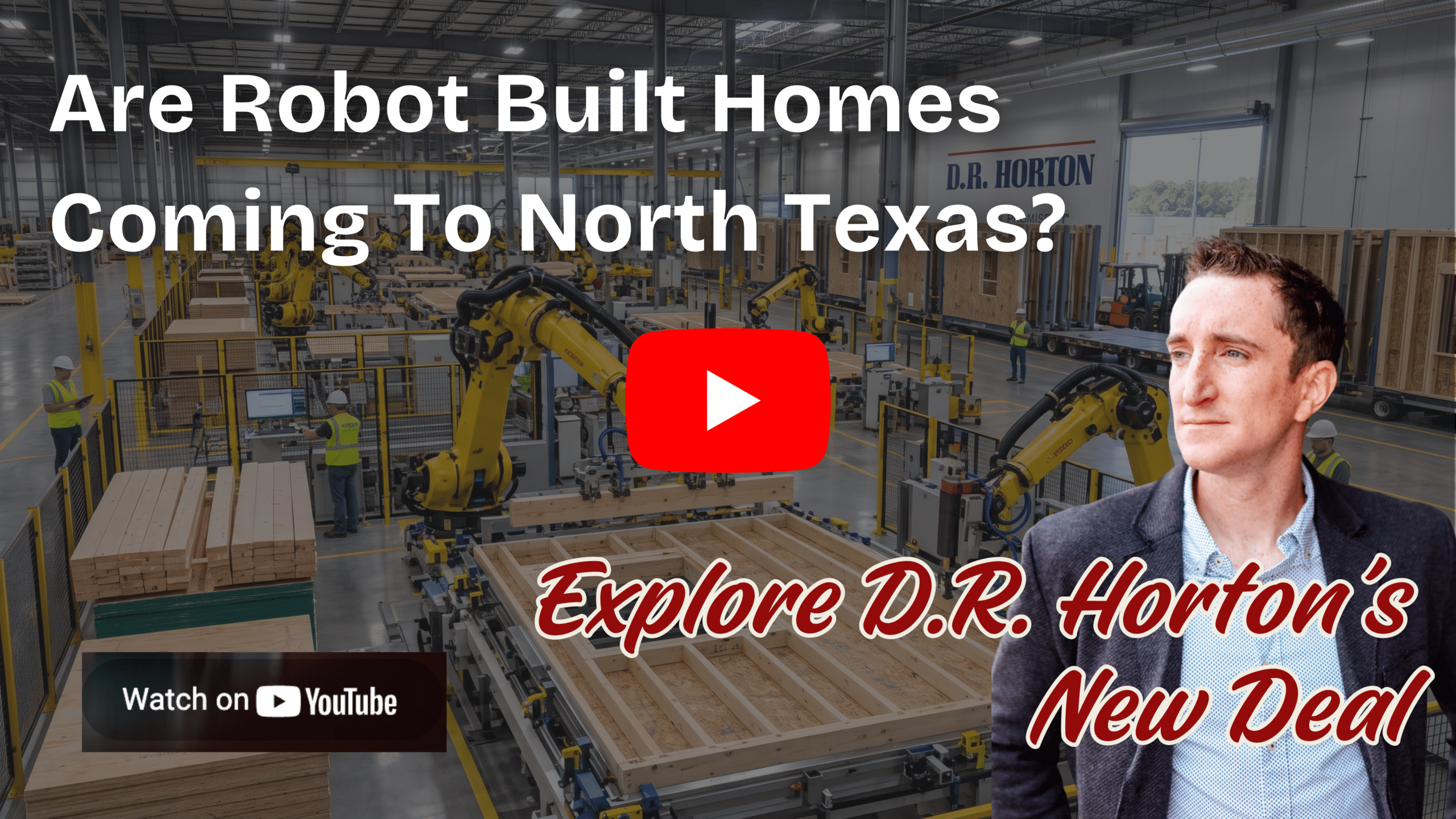
D.R. Horton didn’t buy a fleet of robots to park next to every slab in America. Rather, it secured access to an integrated production service, one that ties existing home designs, production planning, robotic manufacturing, factory operations, and on-site installation into a single workflow.
That integrated structure gives builders automated manufacturing capacity without shouldering the cost and headache of developing and running its own factory. The catch will be that the factory output still has to mesh with land development, foundations, trucking, site crews, inspections, and every trade that shows up after the framing is done. HousingWire’s reporting digs into both the operational upside and the business risks, and the honest read is that a framing robot is only as fast as the slowest crew behind it.
Here’s how the announcement stacks up against the assumptions already floating around.
The announcement versus the assumption
The Deal, Decoded
The Announcement vs. The Assumption
What the D.R. Horton and Promise Robotics agreement actually confirms, and what the headlines are filling in on their own.
More than 1,250 homes through a multiyear agreement.
That any are finished, or that every D.R. Horton division is participating.
All 1,250 homes slated for metro Phoenix, with a new Arizona factory expected to start manufacturing in early 2027.
Any North Texas factory, community, or delivery schedule.
A company-reported framing assembly time for one specific house example.
A finished, inspected, move-in-ready house in eight hours.
Efficiency, capacity, and consistency as stated objectives.
A guaranteed reduction in what a homebuyer actually pays.
Sources: Promise Robotics announcement (Oct. 13, 2026); ResiClub; BetaKit; HousingWire.
The agreement size comes from Promise Robotics’ announcement, the Phoenix location from ResiClub, the factory timeline from BetaKit, and the framing benchmark from HousingWire’s interview with Attar.
A signed commercial contract proves that the biggest builders are adopting this technology, and that alone should get every agent and homeowner in the Metroplex paying attention. What it doesn’t prove yet is that every promised benefit shows up at scale across a large U.S. production program, and anybody telling you otherwise is reading you the brochure instead of the balance sheet.
Can Robots Really Frame a House in Eight Hours?
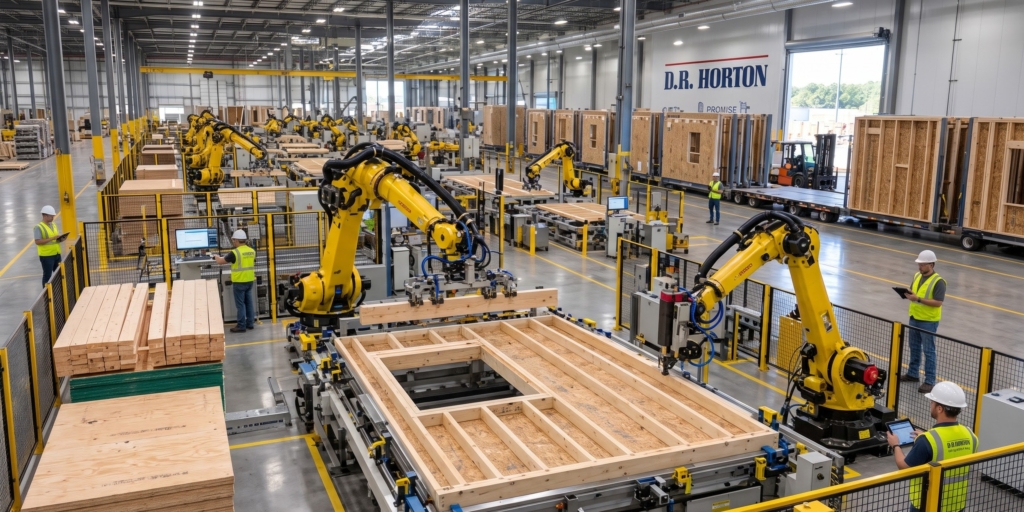
The answer is far more specific and convoluted than headlines suggest. Attar described framing a typical two-story, 1,800-square-foot house with a basement and attached garage in about eight hours, while more complex duplex projects ran closer to two to two-and-a-half days, per HousingWire. Those are company-reported examples tied to particular floor plans, not a stopwatch time that applies to every house a builder puts on a lot.
Here’s the part nobody is talking about: the 8 hour benchmark house isn’t even the product this D.R. Horton deal is building. A two-story home with a basement makes sense in Canada, where Promise got its start, but BetaKit reports the D.R. Horton homes will be mostly single-story, single-family houses in the Phoenix area, so the eight-hour number describes a different kind of house in a different kind of market.
Getting that precision right shuts down three misunderstandings before they cost anybody money.
Read the Fine Print
What Eight Hours Actually Covers
The benchmark measures one stage of the build. Everything else on the way to closing still runs on its own clock.
The benchmark house
Two-story, 1,800 sq ft
Basement and attached garage, framed in about eight hours. More complex duplex projects ran two to two and a half days.
The D.R. Horton deal
Mostly single-story homes
Single-family houses in the Phoenix area. The eight-hour number describes a different kind of house in a different market.
Sources: HousingWire interview with Promise Robotics CEO Ramtin Attar; BetaKit. Framing time is a company-reported benchmark, not independently verified.
Framing Is Not Home Completion
A structural frame is the bones of a house, not a house you can close on. Nothing in the benchmark suggests that site prep, foundation work, roofing, plumbing, electrical, HVAC, insulation, drywall, finishes, utility connections, and final approvals all happen inside the same eight hours. This draws a clear line between structural assembly and a completed home.
The U.S. Census Bureau runs a completely different clock, tracking the stretch from permit authorization to construction start and from start to completion in its construction length-of-time tables, milestones that have nothing to do with how fast a structural package gets assembled.
For a buyer juggling a home sale, a lease that’s running out, scheduling movers, or an upcoming school-year deadline, the only date that matters is projected completion and closing, not how fast robots can complete a single step on the production line. The North Texas new construction timeline guide walks through every milestone between signing the contract and getting the keys, and it’s the framework every buyer should have in hand before falling for a speed claim.
The Starting Point Matters
A speed claim is only as useful as its start and finish lines. Does the clock start once engineering is done, after materials are processed, or when components land on the job site, and is it measuring factory fabrication, structural assembly, or some blend of the two?
The public reporting does not give permission to stretch the eight-hour example into a promise that design, factory production, transportation, installation, and inspection all fit inside one workday. Until a builder hands over a detailed scope and schedule, treat it as exactly what HousingWire calls it, an “attributed assembly benchmark” that says nothing about savings across the full build cycle.
The Viral Image Proves Less Than It Looks Like
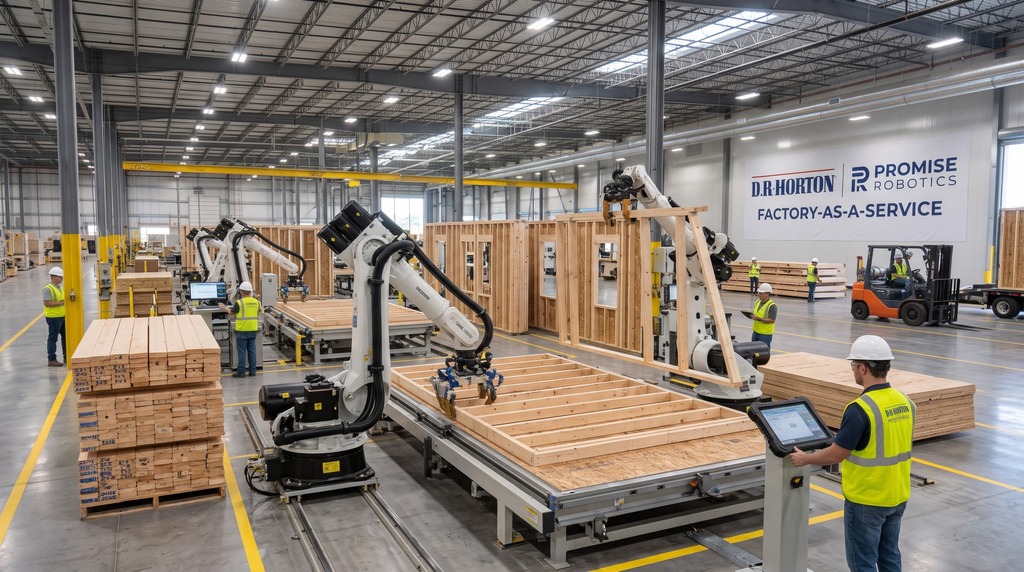
That image of robotic arms standing beside a framed house making the rounds on social media proves nothing about what’s happening at any specific development. Without an authenticated source behind it, it’s simply promotional content, not documentation of a D.R. Horton job site.
The verified workflow is more grounded and a lot more useful to understanding the process. Automated systems will manufacture housing components inside of factories, and trained installation crews will assemble those components on site.
How Does Robotic Homebuilding Work?
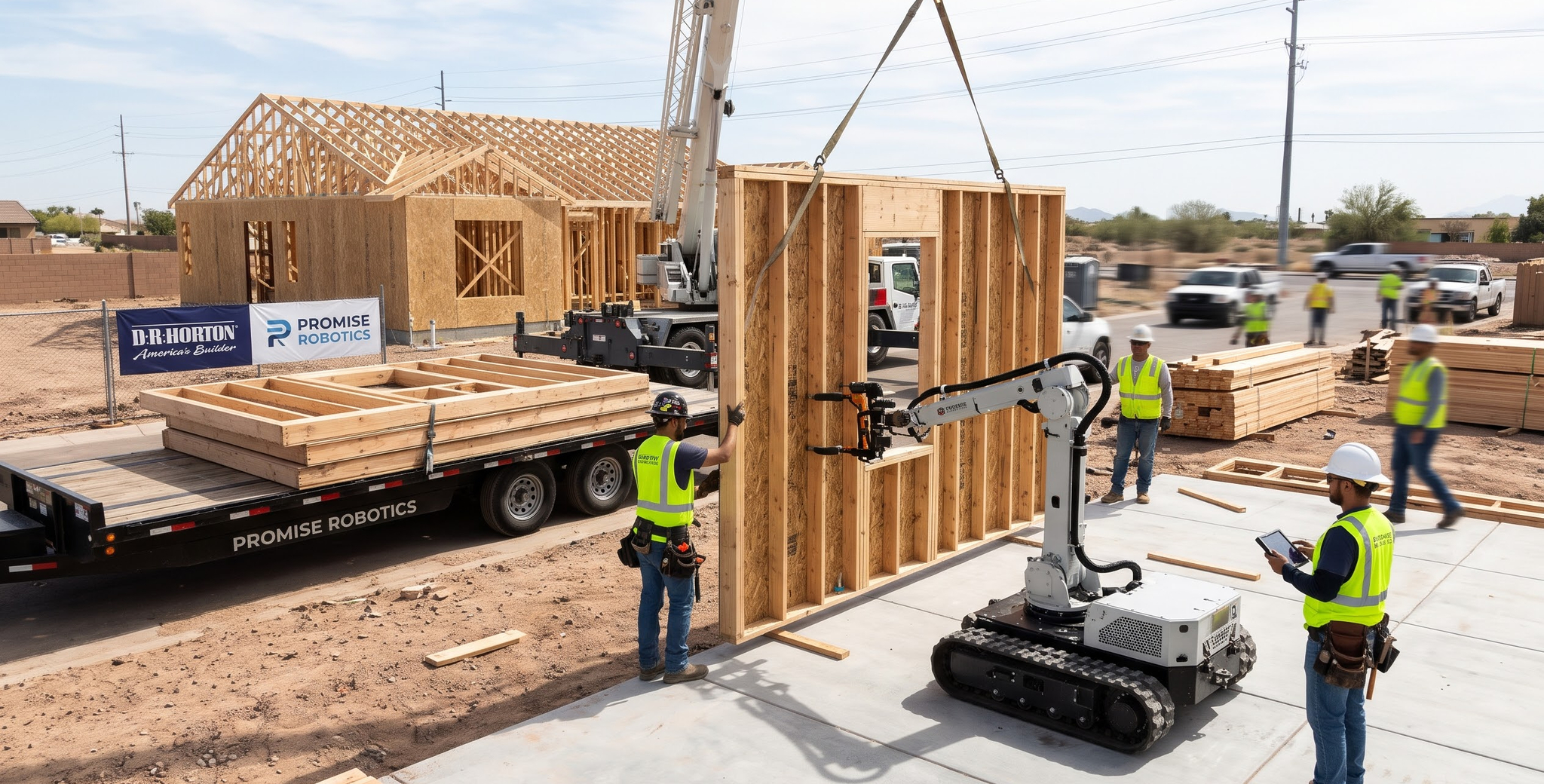
Promise Robotics calls its approach “physical AI,” software that directs real work in the physical world instead of just generating text, images, or recommendations, running on a platform that links building information, production coordination, and robotic execution.
In plain terms, the process starts with a builder’s existing designs, converts them into manufacturing instructions, coordinates production, and connects the finished components to installation on site.
The breakthrough here was never a machine that can drive a fastener into a stud. The breakthrough is design data, material requirements, factory work, and site installation all running as one coordinated production system, and the only scoreboard that proves it works is completed homes, correction rates, real costs, and on-time delivery, not a slick demo video.
Why Use Factory-as-a-Service?
The model lets homebuilders tap automated production capacity without building and running their own factories, which cuts their direct exposure to the cost and complexity of factory ownership.
What it doesn’t do is make the underlying economics disappear. Somebody still pays for the facilities, equipment, maintenance, staffing, software, transportation, and the idle capacity that sits there when orders slow down. That’s the stress test nobody puts in the press release. A factory provides a fixed cost that doesn’t care whether the housing market is hot or cold, so when demand cools, the orders will shrink long before the payroll, equipment loans, and the lease payments do. A production model built for full capacity starts bleeding money the moment the line slows down.
For homeowners and potential buyers, that hands you a clean filter: stop watching how sophisticated the robots get and start watching whether the system becomes a dependable way to deliver finished homes.
What Kind of Home Is This?
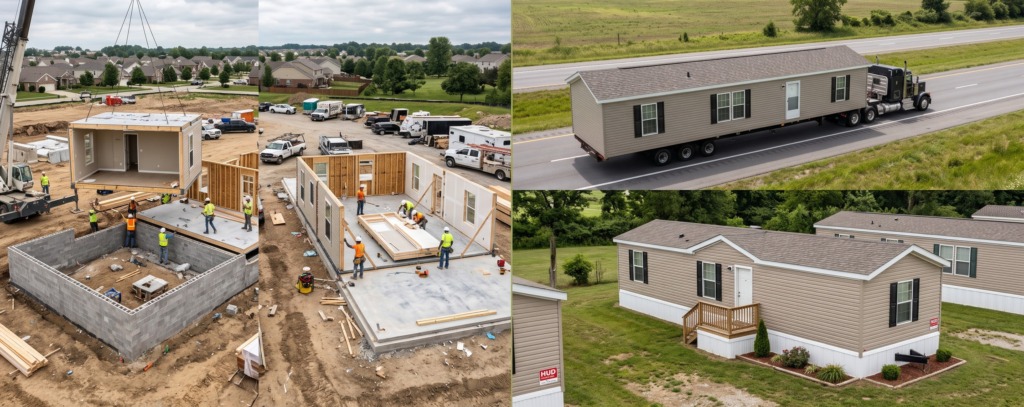
“Robot-built” describes how a home was produced, not how it’s classified by a lender, a building code, or the law. A buyer still needs to know what was manufactured, how the home was assembled, which codes apply, and how the property is classified, and Fannie Mae’s factory-built housing guidance draws a hard line between qualifying modular, prefabricated, panelized, and sectional housing on one side and manufactured housing on the other.
Know What You’re Buying
Five Construction Terms That Should Never Be Confused
“Robot-built” describes how a home was produced. Lenders, codes, and appraisers care about how it’s classified.
Robot-assisted framing
Automation helps produce structural components. The term alone says nothing about the finished home’s legal classification.
Panelized construction
Wall or other structural assemblies are built as panels and integrated into the home.
Modular construction
Factory-built, and treated separately from HUD-code manufactured housing by Fannie Mae when its requirements are met.
Manufactured housing
Identified by features including a permanent chassis and a HUD Data Plate and Certification Label.
3D-printed construction
A completely different technology, never a synonym for robot-assisted wood framing.
The financing test
Treated like site-built when it is:
- Legally classified as real property
- Built to local building codes
- Permanently attached to an approved foundation
That’s Fannie Mae’s standard for qualifying modular, prefabricated, panelized, and sectional homes.
Source: Fannie Mae Selling Guide B2-3-02.
That classification decides how the home gets financed. Fannie Mae treats qualifying panelized and other factory-built housing the same as site-built housing, provided the home is legally classified as real property, conforms to local building codes, and sits permanently on an acceptable foundation, which makes factory involvement not an automatic barrier to a conventional mortgage. These are only eligibility conditions, not necessarily a promise that every lender will approve every property or every borrower. Before a single nonrefundable dollar goes down, ask the lender how they’ll classify the home, what documentation they need, and how the appraisal will work. Get an insurance quote for the actual address and specifications too, and never assume the word “robotic” earns either a discount or a surcharge.
Texas has its own construction-technology storyline running in parallel, and that one involves 3D printing. ICON partnered with Lennar to 3D-print 100 homes at Wolf Ranch in Georgetown, as Community Impact reported, but it’s an entirely different system from Promise Robotics’ wood-framing approach.
The takeaway is simple: never evaluate one of the biggest purchases of your life through a vague label. Ask for the actual construction specifications, and ask the lender how they’ll classify the property before you sign anything.
Will Robot-Built Homes Be Cheaper?
They might be someday, but there is no verified buyer discount attached to this announcement, period. Neither the announcement nor Attar’s interview disclosed independently verified per-home savings. Nor did it disclose the agreement’s dollar value, or factory capital costs.
“Savings” means four different things depending on who’s talking, and homeowners who treat them as interchangeable end up making expensive decisions.
- Production savings: less spending to manufacture or assemble components.
- Schedule savings: less time between construction milestones or completed deliveries.
- Capital savings: less money tied up in work that hasn’t produced a closing yet.
- Consumer savings: a lower purchase price, financing cost, or ownership expense.
The first three can make a builder’s operation leaner without producing a matching price cut for every buyer who walks into the sales office. Faster cycles and better capital efficiency are potential benefits on paper, but the real results have yet to be proven.
Framing Is Only One Cost
NAHB’s 2024 Cost of Constructing a Home survey put the framing stage at only 16.6% of construction cost in its sample, which is a small slice of what it costs to build. To be fair, it’s not necessarily 16.6% of any given home’s retail price and at this point is not a D.R. Horton-specific number.
That context explains why a dramatic leap in one construction stage doesn’t automatically translate into a dramatic drop in the finished home’s price. A buyer is purchasing the whole property and the completed house, not just the bare frame. So before anyone assumes automation creates a bargain, they need to analyze this in context of the complete home purchase: the specific home, the lot premium, included features, financing terms, closing costs, expected taxes, the insurance quote, association obligations, and completion status.
Compare Financing, Not Just Price
A lower advertised payment is often a financing story dressed up as a price story. The Consumer Financial Protection Bureau tells buyers to request Loan Estimates from multiple lenders and ask each one for the same kind of loan with the same features, so the comparison is truly apples to apples.
For a North Texas buyer weighing a new build against an existing home, “which listing is cheaper?” is the wrong question. The right question is which transaction fits the budget, the ownership horizon, and the buyer’s tolerance for risk once the actual terms are on paper.
The North Texas guide to builder mortgage buydowns digs deeper into how those offers work, but every decision should run on current written loan disclosures, because older advertised rates and sample payments are not the same as live offers.
Are Robot-Built Homes Better Quality?
Automation can improve repeatability, but repeatability is not proof that every finished home beats a conventionally framed alternative. D.R. Horton’s stated goal for the partnership is “greater consistency and predictability,” but that’s an objective, not an independently verified defect rate.
Quality only gets judged by evidence, not by what kind of tool held the fastener. Approved plans, documented inspections, correction records, installation details, and how the finished home actually performs tell a buyer far more than the phrase “AI-built” ever will.
Evaluate the Handoffs
Factory production and on-site installation are separate parts of the workflow, so every component has to survive the trip to the site and get assembled into a finished structure by installation crews.
The handoffs are where the smart questions live. Ask who verifies dimensions before production, who checks components when they arrive, who documents connections after assembly, and how the team resolves any gap between the plans and real field conditions. A good builder should be able to answer every one of those with something specific and documented.
Do Not Skip Independent Inspections
A new production method never replaces a clearly defined inspection scope. Texas inspectors work under TREC’s standards of practice, which spell out their responsibilities and limitations, and buyers need to understand what an inspection covers and when a specialist should be brought in.
Before signing, ask about permission, access requirements, notice periods, and the right timing for independent inspections, then coordinate with the builder and inspector early enough that no critical stage gets covered up before the agreed review happens. The DFW new construction building and buying resource is a strong starting point for those conversations about inspection milestones, design selections, and lot due diligence.
Request Performance Evidence
A robot-assisted frame tells a buyer nothing on its own about how airtight, comfortable, or efficient the finished home will be. The Department of Energy notes that certified assessors use blower-door tests and infrared imaging to find exactly where a house is leaking air.
When a sales office leans on “built with advanced technology” as an energy claim, push past it. Ask what was tested, who did the testing, and whether the results apply to the actual home being purchased.
Is D.R. Horton Using Robots in North Texas?
No. The October 13 announcement names the commercial agreement and the more-than-1,250-home production commitment. Promise told ResiClub that all 1,250 of those homes will be built and located in metro Phoenix, starting from a factory in Gilbert, Arizona. There is no North Texas factory and no North Texas subdivision anywhere in this deal.
Calling D.R. Horton a North Texas homebuilder describes where the company is rooted, not where this manufacturing program operates. The accurate version of the story is that a North Texas-based builder has signed a robotic-production agreement for homes in Phoenix. The inaccurate version, the one already circulating, is that robots are now framing D.R. Horton houses in Dallas-Fort Worth.
What Would Confirm Local Adoption?
If a builder ever claims robotic framing in a specific North Texas community, demand evidence tied to that community instead of leaning on a national corporate headline.
- A written statement identifying the participating division or community.
- A description of the components being produced and where they originate.
- Confirmation of the approval and inspection process for the actual project.
- A construction schedule showing how factory production integrates with site work.
- Completed local examples that can be evaluated without relying on promotional renderings.
Until that evidence shows up, any North Texas rollout stays in the unconfirmed column.
Keep Local Comparisons Specific
A homeowner in Waxahachie, Prosper, or anywhere else in the Metroplex shouldn’t assume a factory announcement in Arizona changes the value of their property overnight. The starting point is always the inventory competing for the same buyer today.
The Waxahachie-area real estate guide, the Midlothian city guide, the Red Oak city guide, and the Prosper real estate and community guide are built for exactly that kind of location-specific research across different price ranges and corners of the region, because every North Texas market reacts differently and the only comparison that counts is actual addresses against current inventory.
Will Robots Lower Existing Home Values?
Nothing disclosed in this agreement measures any effect on North Texas resale values, and with every home in the deal headed to Phoenix, there is nothing local to measure yet.
The real scenario to watch is this: if builders eventually deliver comparable new homes at sharper prices or with more attractive terms, those homes become stronger alternatives to certain resale listings. That pressure is a competitive reality worth tracking, and it doesn’t need a robot to exist, because builder incentives and spec inventory are already doing it today.
The reverse assumption is just as weak. No seller earns a premium simply because people framed the house instead of robots, because a buyer needs a documented reason to pay more for that particular property.
Substitutability Is the Key Question
The question that decides everything is whether the new home and the resale home are realistic substitutes for the same buyer. Do they serve a similar budget, offer a similar layout, require a comparable commute, and come with similar lot characteristics and ownership obligations?
A new production home and an older acreage property compete in completely different ways than two similar houses inside the same development, and those differences deserve real analysis instead of being flattened into a regional prediction about “robot homes.”
Land supply and development timing need their own analysis too. The Frisco land-supply article and the coverage of the proposed large-scale Minto community in Waxahachie tackle separate supply questions that will shape North Texas competition far sooner than any factory in Arizona.
The Craftsmanship Premium: Why Robots Could Make Hand-Built Homes Worth More
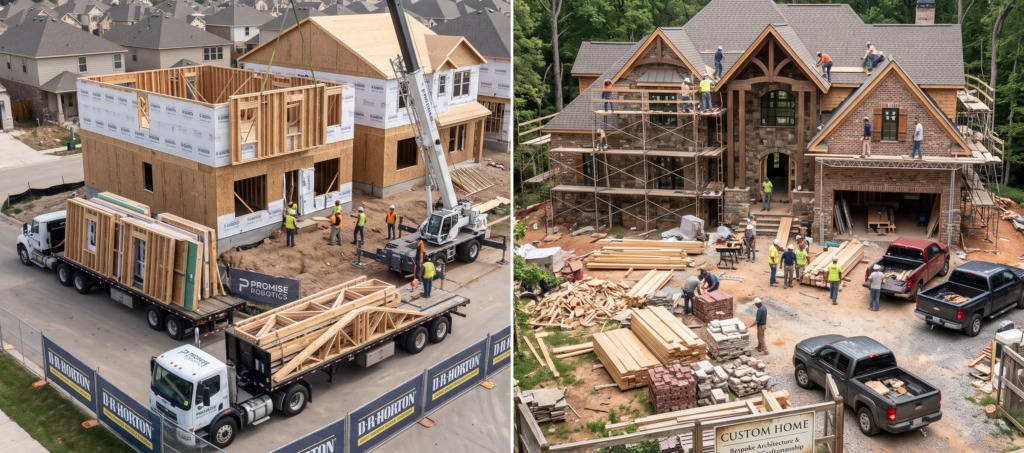
Walk into any furniture store and you already understand the next chapter of this story. A solid wood dining table and a flat-pack particle board table can hold the same plates, fit the same room, and serve the same family, yet nobody confuses them, and nobody expects them to carry the same price tag. One reads as something somebody built, and the other reads as something a machine stamped out by the thousand. If robotic framing scales the way Promise Robotics and D.R. Horton are betting it will, housing is headed for its own version of that split, and the homes on the hand-built side of the line stand to collect the premium.
Buyers Already Pay More for “Somebody Made This”
The instinct behind the furniture comparison is backed by real research. In a series of studies published in the Journal of Marketing, researchers found that many consumers were willing to pay up to 17% more for handmade products than for machine-made versions of the same item, because buyers felt the maker’s care was built into the object, as ScienceDaily reported on the “handmade effect” study. Those studies tested everyday goods like mugs, soap, and leather products rather than houses, so nobody should read that 17% as a home-price forecast, but the psychology is exactly the same one that will show up in a showing.
Housing has also run this experiment before. When factory-built homes first went into mass production after World War II, buyers in a 1951 Journal of Marketing survey named poor construction and “ugly standardization” more often than the speed and low price that were supposed to sell them, a stigma JSTOR Daily traces all the way to the present. Modular builders still describe that perception as their biggest hurdle, with one CEO telling Pro Builder that part of the public still believes “modular is cheaper, of a lower quality, and won’t hold up.”
Where the Furniture Analogy Breaks, and Why the Premium Survives Anyway
Here’s the honest part that makes the argument stronger instead of weaker. A robot-framed house is not particle board. It’s the same dimensional lumber, assembled with machine precision, and nothing in the public record shows it performs worse than a frame built on site. The premium won’t come from the material.
It will come from the same place the furniture premium really comes from. When a production home becomes something that rolls off an automated line in identical panels, the home that was built by a crew, on its own lot, with its own quirks and its own story, becomes the thing that feels rare. Buyers don’t pay more for solid wood because they ran a stress test on the table. They pay more because it feels made, and commoditization on one side of the market is what creates the scarcity on the other.
Today, Almost Everything Is Still “Hand-Built”
Timing matters, and right now the scarcity doesn’t exist. Non-site-built construction, modular and panelized combined, accounted for just 3% of single-family homes completed in 2025, according to NAHB’s analysis of Census data, and every home in the D.R. Horton deal is headed to Phoenix. The line between “hand-built” and “factory-built” is already blurrier than most buyers realize too, since about 65% of new single-family roofs were going up on trusses in Home Innovation Research Labs’ builder practices survey, components that are typically built off site and trucked in.
That means the craftsmanship premium is a forward play, not a pricing tool a North Texas seller can lean on this spring. It becomes real only when robot-framed production homes show up in volume in the same submarkets where resale homes compete, and the sellers and builders who understand that early will be the ones positioned to cash it in.
Where the Premium Will Show Up First
It won’t show up on the appraisal, at least not at first. Fannie Mae already treats qualifying panelized and factory-built homes the same as site-built housing, and appraisers price homes off comparable sales, so the premium has to show up in buyer behavior before it ever shows up in the comps.
Watch for it in the places where perception drives the deal. Custom and semi-custom builders who start marketing “site-built by our own crews” as a selling point, established neighborhoods where every home has its own character, and listings where buyers start asking how a home was built in the same way they now ask about foundation repairs and roof age. Demand moves first in showing traffic, days on market, and the number of offers a home draws. Price will follow the competition that demand creates.
The Seller’s Move: Document the Build
A premium you can’t prove is just a talking point, and that’s the line between sellers who collect this one and sellers who only claim it. If your home was custom or semi-custom built, gather the builder’s name, the original plans, construction photos, permits, and any warranty paperwork, because in a market where a growing share of new homes come off an assembly line, the story of who built yours and how becomes marketing that a production listing simply can’t match. The premium isn’t automatic and it never will be, but for the seller who can document the craftsmanship, robotic framing just handed them a selling point their competition doesn’t have.
How Can Sellers Compete With New Construction?

The winning seller strategy was never an argument against robots. It’s a clear, supportable case for why this home stacks up against the buyer’s actual alternatives, and building that case means looking well past nearby resale asking prices to include comparable builder inventory, the terms attached to current incentives, completion status, and the features included in each specific home.
Build a Buyer-Alternative Review
Before choosing a list price, organize the comparison around what a buyer can actually purchase.
- Comparable resale closings: relevant properties with similar characteristics and appropriate adjustments.
- Active resale competition: the alternatives buyers can tour right now.
- Completed builder inventory: specific homes, not just starting prices for an unfinished plan.
- Current incentive terms: written conditions, expiration dates, and eligibility requirements.
- Total ownership costs: property-specific taxes, insurance quotes, association dues, and any applicable assessments.
- Timing: the difference between a completed property and one with construction uncertainty still ahead.
Market Documented Advantages
A resale home can offer features that are expensive, unavailable, or simply different in a competing new build, and the job is to identify those features and prove them. Installed window coverings, established landscaping, a usable outdoor living area, garage dimensions, storage, completed improvements, and a layout that solves a specific buyer’s problem are all worth putting on the table.
Measurable beats vague every single time. Actual garage dimensions outsell “large garage.” Installation dates, invoices, and warranty paperwork outsell “updated systems,” and an honest description of condition beats “low maintenance” because buyers can tell the difference. Marketing has to present a truthful picture without exaggerating advantages or hiding relevant facts, a principle at the heart of the REALTOR® Code of Ethics.
Do Not Copy Builder Incentives Blindly
A seller can weigh different offer structures without assuming a builder’s advertised financing package can or should be duplicated. The question is what each option actually does for the seller’s net proceeds and the buyer’s financing within lender and contract requirements, and for that comparison, standardized disclosures beat promotional payment examples every time, which is why the CFPB built its guide to comparing specific mortgage offers around the Loan Estimate.
No universal rule says a price reduction always beats a credit or that an incentive always protects value. The written offer, the financing constraints, likely appraisal issues, and the seller’s own priorities make that call.
Make Timing an Informed Choice
Never pick a listing date because a social post predicts robot-built houses are about to flood the market. Base it on the household’s real moving needs, current competition, property preparation, and what it actually costs to carry the home longer.
If the sale is funding a new purchase, build the plan around documented milestones and contractual obligations, because a claimed eight-hour framing benchmark should never decide when someone gives notice on a lease or commits to a move-out date.
What Should Buyers Ask Before Signing?

A technology-forward builder should still answer ordinary due-diligence questions clearly, and innovation is good a reason to ask sharper questions, never a reason to stop asking them.
- What is automated? Identify the actual components and tasks.
- What does the speed claim measure? Define its starting point, ending point, and exclusions.
- Where is the production facility? Ask how manufacturing and delivery fit the project schedule.
- What changes are still possible? Get structural-selection and change-order deadlines in writing.
- Who approves the design? Identify the responsible professionals and the approval process.
- How are inspections coordinated? Ask about factory documentation, site inspections, and independent access.
- How are problems corrected? Request the reporting and escalation process.
- What does the warranty say? Read the actual coverage, exclusions, notice requirements, and deadlines.
- What financing conditions apply? Get property-specific lender guidance and comparable Loan Estimates.
- What happens if completion slips? Review delay provisions before committing deposits or moving dates.
For buyers coordinating an out-of-state move, the North Texas relocation resource center helps organize the bigger search, because construction method has to be weighed alongside location, budget, ownership costs, and the practical realities of the move itself.
One more thing before you walk into any builder’s sales office: under current NAR practice rules, you’ll typically sign a written buyer agreement before touring, and the compensation in it is negotiable. So confirm the builder’s registration and compensation terms separately from your own agreement. Representation is never automatically free, and a builder’s registration policy shouldn’t stop you from having someone in your corner.
What Could Limit Robotic Construction?
The announcement is a big deal, but scaling takes far more than proving a robot can manufacture a component. Factory-built housing has promised to revolutionize American homebuilding for more than seventy years, and the same obstacles keep showing up: builders are slow to change how they work, factories cost a fortune, local rules differ from one city to the next, and production lines often have to stay busy to pay for themselves.
Local Approval Requirements
How much work gets done before components reach a job site depends on local permitting and inspection rules. Attar told HousingWire that some municipalities allow windows, plumbing, or mechanical systems to be installed in the factory while others limit how much work can happen before components reach the site, which means an impressive result in one jurisdiction is not a schedule promise that transfers to the next one.
Coordination Beyond Framing
The workflow still depends on site installation and every construction activity that follows. Faster framing only matters if the builder converts it into faster completions, lower costs, or more predictable schedules. The question that actually measures performance is how much sooner comparable homes were completed, not how fast the frame went up, and the indicators worth tracking are repeat customers, completed homes, delivery reliability, documented correction rates, and disclosed economics.
The Insider Take

Every time a headline like this drops, the market splits into two camps, the people who panic and the people who shrug, and both of them leave money on the table. The robots aren’t the story, and for North Texas they aren’t even in the deal. The real tory is that a builder the size of D.R. Horton is actively hunting for ways to build faster and more predictably, which means anybody selling a resale home in North Texas will be increasingly competing with new construction whether a robot ever touches a stud in the Metroplex or not.
That’s where the opportunity lives. Sellers who understand their real competition, who document what their home offers that a production build can’t match, and who price against the homes buyers can tour this weekend instead of a technology headline are going to win while everybody else argues about robots in the comments. Buyers who ask the ten questions above, compare written loan offers, and insist on independent inspections will walk into new construction carrying leverage instead of hope.
So here’s the move. If you’re selling within a few miles of a builder’s model home, that builder’s spec inventory is part of your comp set right now and the seller who prices like it is the one who closes.
Robot-Built Homes: Verified FAQ

Ten questions on the D.R. Horton agreement, the eight-hour framing claim, and what it means for North Texas buyers and sellers, each answered with a linked source.
1. Is D.R. Horton really using robots to build houses?
Yes. D.R. Horton signed a multiyear agreement to use Promise Robotics’ Factory-as-a-Service platform to support production of more than 1,250 homes. The platform connects robotic component manufacturing with factory operations and on-site installation, which is a long way from robots performing every task in a finished home, as laid out in the official announcement.
2. Can robots really frame a two-story house in eight hours?
Promise Robotics’ CEO reported that its system assembles the structural framing for a typical two-story, 1,800-square-foot house with a basement and attached garage in about eight hours. That’s an attributed company benchmark, not a universal guarantee and not an independently verified result for D.R. Horton’s new agreement, according to HousingWire.
3. Does eight-hour framing mean the entire house is finished that day?
No. The eight-hour figure covers structural assembly, not a finished and approved home. HousingWire explicitly cautions that it doesn’t establish savings across the full construction cycle, which depend on how framing integrates with later trades and inspections.
4. Where will D.R. Horton’s robot-built homes be produced?
In metro Phoenix. Promise told ResiClub that all 1,250 homes in the agreement will be built and located there, and BetaKit reports the new Arizona factory is expected to begin manufacturing in early 2027. No community-by-community delivery schedule has been released.
5. Is D.R. Horton bringing robotic framing to Dallas-Fort Worth?
Not under this deal. Promise has said every one of the 1,250 homes in the agreement is slated for metro Phoenix, according to ResiClub, and the October 13, 2026, announcement names no North Texas factory or community. Any future local rollout should be verified through a specific division or community announcement rather than assumed from D.R. Horton’s Arlington headquarters.
6. Will robot-built D.R. Horton homes cost less?
No guaranteed purchase-price reduction has been disclosed. The public reporting identifies potential operational benefits, but independently verified per-home savings and several key financial metrics were not provided, as HousingWire notes.
7. Are robot-built homes safe, and do they still need inspections?
The production label alone says nothing definitive about the safety or condition of a particular home. Judge the home by its approvals, installation, inspection documentation, and finished condition, and make sure any independent inspection has a clearly understood scope and limitations under TREC’s inspection standards.
8. Is a robot-built house the same as a manufactured home?
Not necessarily. “Robot-built” describes how some of the work gets done, while manufactured housing is a distinct classification. Fannie Mae separately addresses qualifying modular, prefabricated, panelized, and sectional housing and states that those categories are not considered manufactured housing under its guidelines.
9. Can buyers get a conventional mortgage on a robot-framed home?
Potentially, yes. Fannie Mae permits qualifying panelized and other specified factory-built housing under requirements that include real-property status, local-code conformity, and an acceptable permanent foundation, though the lender still has to approve the specific property, loan, and borrower.
10. Should homeowners sell before robot-built homes become cheaper?
Not on the strength of this announcement. It doesn’t establish a future retail discount, puts no homes in North Texas, and shows no measured effect on local resale values, which makes it a poor stand-alone reason to sell. The smarter move starts with the homeowner’s own circumstances and the property’s current competition, backed by an address-specific review of resale alternatives, relevant builder inventory, condition, timing, and likely net proceeds.
Get an Address-Specific Strategy
If a builder is putting up model homes down the road from you, advertising a lower payment, a faster build, or the latest construction technology, I want to see your house next to their inventory before you pick a list price. Call me and I’ll put their spec homes, their current incentives, and your real resale comps side by side, so you price against the market buyers are actually shopping instead of the headlines they’re reading.
Buying new construction instead? Let’s lock in your plan for representation, financing comparisons, inspection timing, and construction milestones before you sign anything in a sales office. You’ll find more local market, new construction, and relocation resources at northtexasmarketinsider.com.
Bobby Franklin, REALTOR®
Legacy Realty Group – Leslie Majors Team
16 Northgate Dr., Suite 100, Waxahachie, TX 75165
Call Bobby Franklin at 214-228-0003
Plan a North Texas relocation or research the DFW new construction buying process.
Editorial and Consumer Disclosures
Equal housing opportunity: Housing choices should be evaluated using the consumer’s stated criteria and property-specific information, without discriminatory preferences or limitations. The Fair Housing Act prohibits discrimination based on race, color, national origin, religion, sex, familial status, or disability. Review HUD’s explanation of fair housing rights and obligations.
Compensation and consumer choice: Brokerage fees and commissions are negotiable and are not set by law. No standard commission, automatic builder-paid compensation, or guaranteed no-cost representation is promised here. Recommendations should not depend on the compensation offered by a property’s seller. Read NAR’s guidance on compensation, agreements, and compensation-based recommendations.






Join The Discussion