

Last updated: October 5, 2026
By Bobby Franklin, REALTOR® | North Texas Market Insider™ | Legacy Realty Group – Leslie Majors Team
On September 15, Realtor.com and Zillow joined a 14-organization coalition called Let America Build, and most of the headlines ran straight to rescue language, with one trade outlet announcing that Realtor.com had assembled an “all-star crew to fix US housing crisis” (Inman).
Here’s the read nobody else in this market is giving you. No listing portal is going to fix affordability, and the coalition never claimed it could. What Let America Build actually does is aim a spotlight at the place where affordability gets won or lost: the zoning map, the permit desk, and the city council agenda. In North Texas that fight is already underway, and the metro that led the nation in housing permits in 2024 is both the best proof that building works and an early warning of what happens when the building slows down.
What Let America Build Actually Is (and What It Isn’t)
Let America Build started as a Realtor.com initiative at South by Southwest in 2025. On September 15, 2026, it expanded into an industry-wide public awareness campaign with 14 founding participants: Realtor.com, Zillow, T3 Sixty, eXp Realty and NextHome, the National Association of Home Builders, Veterans United, Habitat for Humanity, ICON, Land Use Labs, HomeServices of America, RISMedia, the Asian Real Estate Association of America, the LGBTQ+ Real Estate Alliance, and the National Association of Hispanic Real Estate Professionals (PR Newswire). Some early coverage listed the National Association of REALTORS® as a founder, but NAR does not appear on the coalition’s official roster.
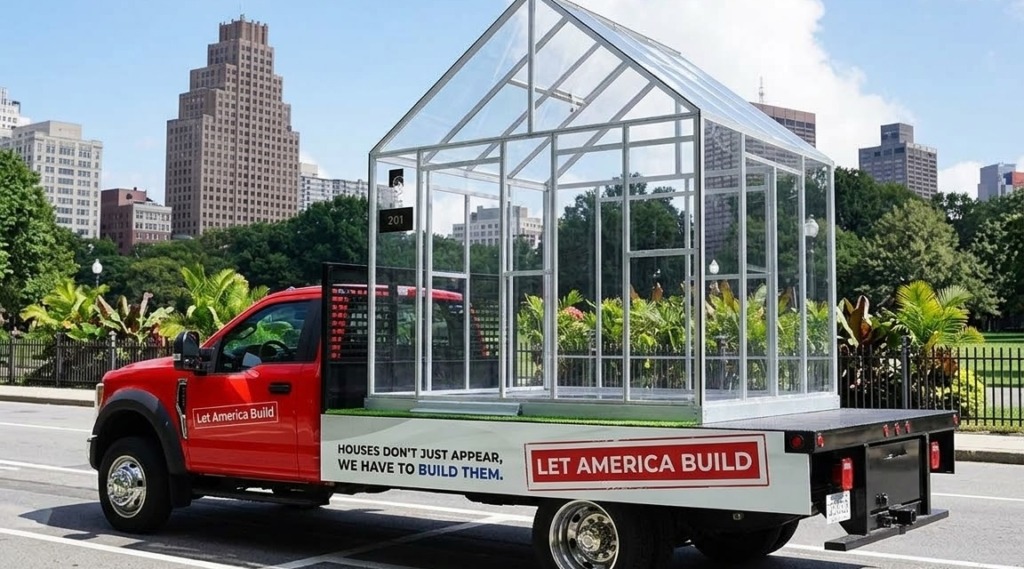
The centerpiece is LetAmericaBuild.org, a consumer education site that explains how land use, permitting, housing types, and construction shape supply. The campaign states plainly that it “does not endorse or oppose candidates, political parties or ballot measures” (PR Newswire). Its first public stunt since launch was a glass house mounted on a truck and driven through Boston on September 24, built to make the national shortage something people could physically see (PR Newswire).
That’s the whole machine. There’s no merger, no construction fund, and no pricing mechanism. Zillow and Realtor.com are still competing for the same buyers they were competing for the day before the announcement. So why should a buyer in Midlothian or a seller in Arlington care about a public awareness campaign? Because the coalition is pointed at the one lever that actually moves long-run affordability, and because it arrived at the exact moment Washington handed that lever to local governments.
The Gap Is Real, and the South Owns the Biggest Piece of It
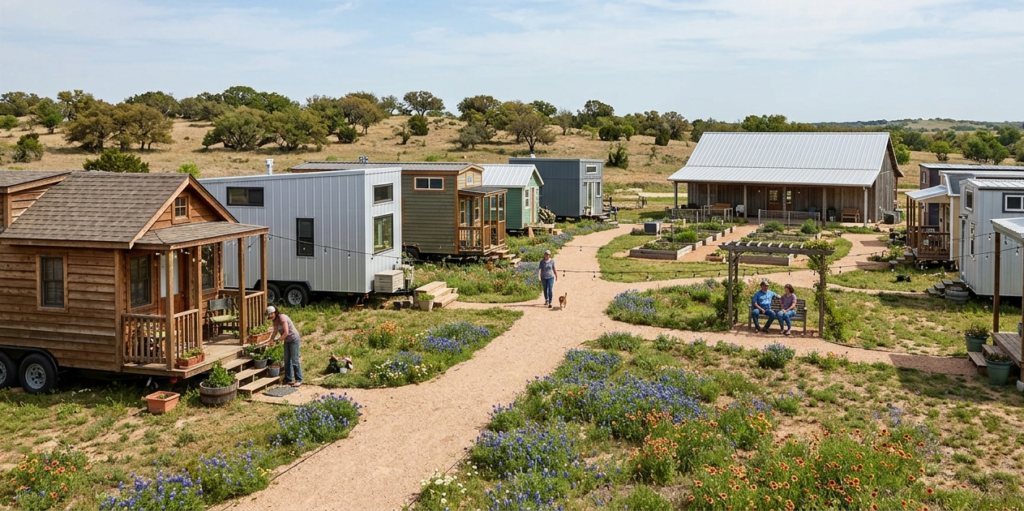
Realtor.com’s 2026 Housing Supply Gap Report puts the national shortage at an estimated 4.03 million homes in 2025, up from 3.8 million in 2024, because roughly 1.41 million new households formed while only about 1.36 million homes were started. The South carries the largest cumulative deficit of any region at about 1.62 million homes (Realtor.com via PR Newswire).
The number that should get your attention is the invisible one. Realtor.com estimates 1.82 million Millennial and Gen Z households were “missing” in 2025, the highest count in four years, meaning adults who would have formed their own households but didn’t because the housing wasn’t there at a price they could manage. That’s pent-up demand sitting in spare bedrooms and roommate leases, waiting for the market to open a door.
Every economist builds this estimate a little differently. Zillow’s own model, using 2024 Census data, puts the national deficit at 4.7 million homes, roughly flat for the first time in years (Zillow Research). The methods differ, but the direction doesn’t, and Realtor.com’s analysis found that even if construction jumped 50% above the 2025 pace and pent-up demand fully dissipated, it would still take roughly seven years to eliminate the deficit (Realtor.com via PR Newswire). Whatever you’re planning to do in real estate, you’re planning it inside a shortage that outlasts any single rate cycle.
Does Building More Actually Lower Prices? The Evidence Says Yes
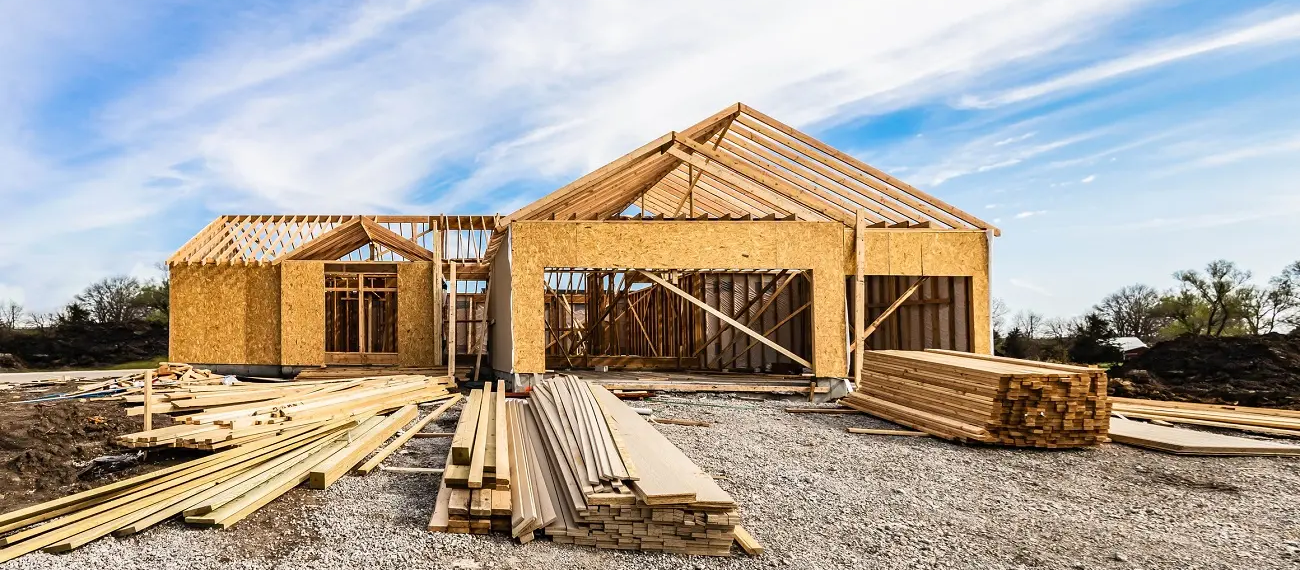
“Just build more” sounds like a bumper sticker until you look at the research, which has gotten remarkably specific over the last several years.
Economists Brian Asquith, Evan Mast, and Davin Reed studied large new apartment buildings in lower-income neighborhoods and found they decreased rents in nearby units by about 6% relative to units slightly farther away or near sites developed later (Review of Economics and Statistics, 2023). Mast’s separate work on migration chains traced what happens after the ribbon cutting: a new market-rate building that houses 100 people ultimately leads 45 to 70 people to move out of below-median-income neighborhoods, with most of that effect landing within three years (Journal of Urban Economics, 2023). New homes at the top of the market open doors further down.
A study in the Journal of Political Economy Macroeconomics tested the same question across German municipalities, using weather-driven construction delays as a natural experiment, and found that a 1% increase in new supply lowered average rents by 0.19%, with the relief reaching lower-quality units too (JPE Macro, 2025).
Here’s where the smart reader separates from the crowd. What this research proves is not that prices collapse, but that housing costs grow more slowly than they would have without the new supply, and that difference compounds year after year until it becomes the gap between a metro where a teacher can still buy a starter home and one where he/she can’t. A region that builds aggressively doesn’t get cheap. It gets less expensive than it would have been, and over a decade that’s the whole ballgame.
The coalition also put a price tag on what’s standing in the way. The National Association of Home Builders found that government regulation now accounts for 26.4% of the final price of an average new single-family home, or $131,734 (NAHB, 2026). Zillow added a lever hiding in plain sight: building one home on each of the 300,242 small vacant lots listed for sale in June 2026 could shrink the national housing deficit by 6.3% (Zillow Research). Infill is not glamorous, but it’s already platted, already on a road, and already sitting there.
The Law Behind the Campaign

The coalition exists to push implementation of the 21st Century ROAD to Housing Act. The Senate passed its version 89 to 10 in March, the Senate gave final approval 85 to 5 on June 22, and the House followed 358 to 32 on June 23 (Clerk of the House, Roll Call 224). The bill became law on July 11, 2026, without the president’s signature, as Public Law 119-101 (Congressional Research Service). In a Congress that agrees on almost nothing, that’s the closest thing to a mandate that the housing market has seen in a generation.
The supply provisions are where this gets interesting for North Texas, because almost every one of them runs through city hall (Bipartisan Policy Center). The Build Now Act ties a city’s Community Development Block Grant money to how much housing it actually produces, which puts federal grant dollars in places like Dallas and Fort Worth on the line every time a council slow-walks a permit. A new $200 million-a-year Innovation Fund goes a step further by paying municipalities that increase supply through permitting and zoning reform, turning a yes vote on a rezoning into a competitive advantage. Those same CDBG dollars can now pay for construction of new affordable housing instead of only repairs and services, and the law eases rules on manufactured homes while directing HUD to clear barriers for modular builders in FHA construction financing, two changes that matter most in exactly the kind of fast-growing, land-rich counties that ring the metro.
The law also takes a shot at Wall Street. Beginning January 7, 2027, investors that control 350 or more single-family homes are barred from buying more, with exceptions for build-to-rent and several other categories. Those investors are not required to sell what they already own, and the restriction sunsets after 15 years (EisnerAmper; Greenberg Traurig).
Now read the fine print on timing, because it tells you who really holds the cards. HUD’s first Build Now notices to cities were due September 9 and are already marked overdue, and the grant adjustments themselves don’t kick in until fiscal year 2029 (BPC Implementation Tracker; HUD Exchange). HUD has until July 2027 just to set up the Innovation Fund, and Congress hasn’t passed full-year FY2027 housing appropriations, with the government running on a continuing resolution through December 11 (CRS). Washington can offer money, incentives, and model codes on a multi-year delay, but Washington doesn’t approve a single subdivision in Ellis County. Every rezoning, every plat, and every permit timeline gets decided by a city council or a county commission, and Let America Build is a bet that public pressure at that level is what turns a federal law into actual rooftops. That’s the right bet.
DFW Is the Live Experiment

If you want to see what “build more” looks like at scale, you’re living in it. Dallas-Fort Worth cities and counties authorized 71,788 new housing units in 2024, more than any other metro in the country, outpacing Houston, New York, Phoenix, and Atlanta, and North Texas approved 22.2 units per 1,000 existing homes, the third-fastest rate among metros with more than a million residents (Dallas Morning News).
Look at what that bought us. In August, DFW closed 7,329 single-family sales at a median price of $390,000, essentially unchanged from a year earlier, with homes averaging 58 days on market and 4.3 months of inventory (MetroTex Association of REALTORS®). Homes.com still ranks DFW second in the nation in sales volume, trailing only Chicago (Homes.com). Flat prices instead of runaway appreciation, buyers with room to negotiate, and a market that keeps moving: that’s the dividend of a decade spent saying yes to construction. You can track those numbers in real time on the live DFW market dashboard.
Now look at the warning lights, because they’re flashing right next to the good news. DFW had 36,028 homes for sale in August, down 3.5% year over year while national inventory rose 5.4% (Homes.com). Pending sales fell 11% and new listings fell 10% (MetroTex). The pipeline is thinning too: Zillow counted 61,275 residential permits in the Dallas metro over the 12 months ending July 2026, down 11.9% from a year earlier and 28.5% below the pre-pandemic trend (Zillow). Zillow estimates have put the metro roughly 50,000 homes short even while it led the nation in permits (Dallas Morning News).
Put those together and the picture is clear. DFW didn’t solve its shortage. It outran it for a while, and the engine is now throttling back. The buyer-friendly resale market of 2026 and the long-run shortage are not contradictions; they’re two readings of the same machine, one on the speedometer and one on the fuel gauge. A metro can feel soft on the resale side today while it quietly sets up a tighter market in 2027 and 2028, and that’s exactly the market-within-a-market reality agents here navigate every week.
Why the Southern Corridor Is Where This Gets Decided
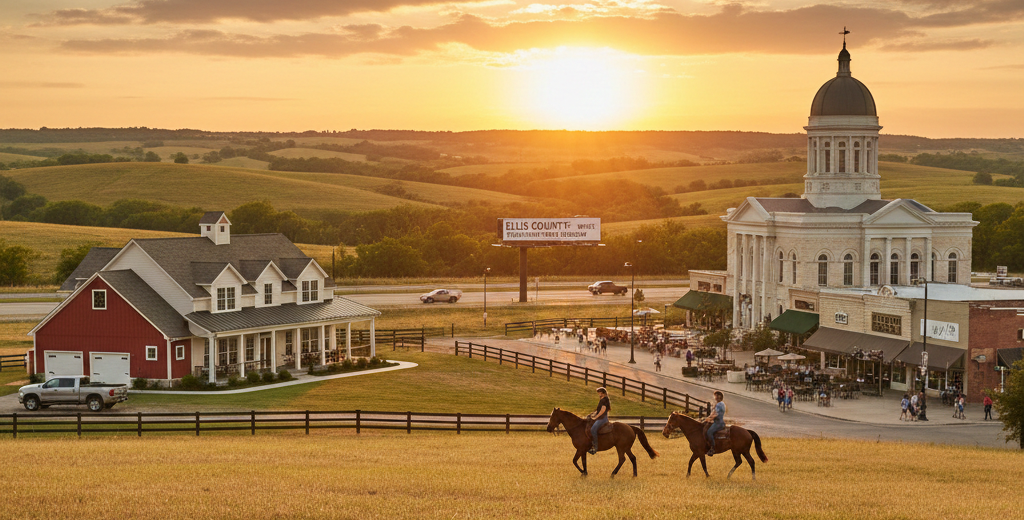
Collin County is still the permit king of North Texas, issuing 19,082 permits in 2025, and Collin and Denton together held steady at roughly 29,300 units (Census Building Permits via FRED: Collin; Denton). The real story is happening at the other end of I-35E. Ellis County permits jumped from 2,972 in 2024 to 3,678 in 2025, a 23.8% increase, while Tarrant County fell 26% (Census via FRED: Ellis; Tarrant). From a small base, Ellis is still roughly one in twenty DFW permits, which is exactly the point: the corridor’s share is rising. Census estimates put Ellis County at 240,867 residents as of July 2025, up 25.2% since 2020 (Census QuickFacts), ranking it 11th in the nation for percentage growth among counties with at least 50,000 people (Texas Demographic Center via TxDOT). Buyers are paying for it, too: in August, the Ellis County median sale price hit $436,250, up 9% from a year earlier on a month of just 309 sales, while the metro held flat (MetroTex).
Here’s the twist most people in this market have missed. Texas already passed its own pro-building law, SB 15, which since September 1, 2025, caps minimum lot sizes at 3,000 square feet on new subdivisions of five acres or more. It only applies to cities with more than 150,000 residents in counties with more than 300,000 people (Texas Legislature, SB 15). That covers the big core cities, and it leaves Waxahachie, Midlothian, Red Oak, Ennis, and Ferris entirely outside the rule. The fastest-growing corridor in the metro writes its own lot-size rules, its own subdivision standards, and its own permit timelines.
That makes the southern corridor the purest test case in North Texas for what Let America Build is really asking. Water capacity, road improvements, subdivision approvals, and lot-size rules are all local decisions here, with no state mandate doing the work for anyone.
You don’t have to imagine what that fight looks like, because Waxahachie just had it. In January, the city council approved Minto’s planned development on more than 3,100 acres with room for up to 13,270 homes by a 3 to 2 vote, a project the Waxahachie Sun reported could grow the city’s population by 65% (Waxahachie Sun). Residents filled the hearing with concerns about traffic on Brookside Road and flooding on neighboring property (Citizen Portal). The people who push back at those meetings aren’t wrong about the strain. Traffic, drainage, school capacity, and water supply are real costs of growth, and the answer is cities that plan infrastructure ahead of rooftops instead of cities that slam the door. That’s what the Minto deal attempted, with commitments for a four-lane Brookside Road expansion, $12.5 million in staged road improvements, and $13.5 million toward a future public-safety facility. Whether those commitments keep pace with the homes is the question every corridor city is about to answer.
The cities along this corridor that treat growth as an opportunity will capture the next decade on their own terms. The ones that treat every new subdivision as a threat will watch that growth leapfrog them, and their existing homeowners will pay for it in scarcer, pricier options for their own kids. Those decisions get made in council chambers, often in meetings where a few dozen residents are the only people in the room, and anyone who wants to know where North Texas prices go over the next ten years should be reading those agendas.
The Playbook: What to Do With This Right Now

If You’re Buying
The long-run shortage is real, but it doesn’t change what you should do this quarter. Freddie Mac’s average 30-year fixed rate climbed to 7.28% on October 1, up from 6.34% a year earlier (Freddie Mac), and that’s exactly why fewer buyers are writing offers and why the ones who do have leverage. Longer market times and falling pending sales give you negotiating room that buyers in 2021 and 2022 would have traded anything for, and new construction communities across the metro are competing for your contract with incentives that can do more for your payment than waiting on a rate drop. Waiting for federal policy to lower prices is a losing strategy, because the law’s big incentives don’t reach city budgets until 2029 and the research says new supply only helps slow price increases rather than reversing them. Buy the right home on the right terms when your life and finances line up, and let the supply story work in your favor as an owner.
Get your financing clarified before you shop. These are the lenders I trust with my own clients:
- Andrew Bryan, Miramar Mortgage | andrewthelender.com
- Jennifer Nelson, Eustis Mortgage | eustismortgage.com
- Rachael Carter, My TX Mortgage Team | mytxmortgageteam.com
- Taylor Fruge, Lower Mortgage | lower.com
I recommend these lenders based on their expertise and service. I do not receive compensation for referrals.
If You’re Selling
The structural shortage supports the long-term value of what you own, but it will not rescue an overpriced listing today. With DFW homes taking a median 66 days to sell against 59 nationally (Homes.com), the sellers winning right now are the ones who price for the market in front of them and present their home to beat the new construction down the road. The shortage is your tailwind over five years. Pricing strategy is your engine over the next sixty days.
If You Live Here and Care Where This Goes
Show up. The decisions that determine whether your kids can afford to live in the town they grew up in get made at planning and zoning meetings, and those meetings are shaped by whoever bothers to attend. Learn what your city’s permit timelines look like, what housing types its codes allow, and how it plans to compete for the new federal dollars. If you live in Dallas or Fort Worth, the law now requires CDBG recipients to publish a searchable database of undeveloped land they own (BPC Implementation Tracker). That’s a public list of city-owned dirt that could become housing, and if it’s sitting empty, you have every right to ask why. That’s where Let America Build either becomes real in North Texas or stays a website.
The Insider Take
Let America Build is the right message aimed at the right target, and almost nobody doing the national coverage noticed that the target is a few hundred city councils, not Congress. The federal law is real, but its biggest carrots won’t arrive until 2029, and its first deadlines are already slipping. In the meantime, DFW’s permit engine is cooling while Ellis County is accelerating, and the southern corridor sits outside the state’s own lot-size reform. That combination is the most important affordability story in North Texas right now. Buyers whose life and finances line up during this soft, high-rate window are buying ahead of a supply pinch the permit data suggests is coming, though slowing demand could soften it. Sellers who price honestly today are selling into a market with a long-run floor under it. Residents who show up at council meetings over the next two years will decide whether the I-35E corridor becomes the place where North Texas affordability gets solved or the place where it gets lost.
Frequently Asked Questions

Did Zillow and Realtor.com merge?
No. Zillow and Realtor.com remain separate, competing companies. Both joined Let America Build, a 14-organization public awareness campaign focused on pro-building policy that launched as an industry coalition on September 15, 2026. The campaign has no construction fund and does not endorse candidates, parties, or ballot measures.
What is Let America Build?
Let America Build is a national public awareness campaign that began as a Realtor.com initiative at South by Southwest in 2025 and expanded into an industry-wide coalition in September 2026. Its founding participants include Realtor.com, Zillow, the National Association of Home Builders, Habitat for Humanity, eXp Realty, HomeServices of America, and Veterans United, among others. It educates consumers about zoning, permitting, housing types, and construction through LetAmericaBuild.org and encourages local action on housing supply.
Is the National Association of REALTORS® part of Let America Build?
NAR is not listed among the 14 founding participants in the coalition’s official September 2026 announcement, although some early news coverage included it. NAR’s leadership did publicly support Realtor.com’s original Let America Build campaign in 2025.
Can Zillow and Realtor.com fix housing affordability?
Not on their own. Listing portals don’t approve zoning changes, issue permits, or build homes. The coalition’s role is to raise public awareness and build pressure on local governments to adopt pro-building policies, which is where long-run affordability is actually decided.
What is the 21st Century ROAD to Housing Act?
It’s a bipartisan federal housing law that took effect July 11, 2026, without the president’s signature, after passing the Senate 85 to 5 and the House 358 to 32. It ties Community Development Block Grant funding to local housing production through the Build Now Act, creates a $200 million-a-year Innovation Fund for cities that reform permitting and zoning, allows CDBG money for new affordable housing construction, eases rules for manufactured and modular homes, and restricts large institutional investors from buying more single-family homes.
When does the institutional investor restriction take effect?
January 7, 2027. Investors that control 350 or more single-family homes will be barred from buying more, with exceptions for build-to-rent and several other categories. They are not required to sell homes they already own, and the restriction expires after 15 years.
How big is the U.S. housing shortage?
Realtor.com estimates a national supply gap of 4.03 million homes as of 2025, with the South carrying the largest regional deficit at about 1.62 million homes. Zillow estimates a 4.7 million-home deficit using 2024 Census data. Methods differ, but major estimates consistently show a multi-million-home shortfall.
Does building more housing actually lower prices?
Research shows that new housing supply slows rent and price growth compared to what would happen without it. A 2023 study in the Review of Economics and Statistics found that large new apartment buildings in lower-income neighborhoods reduced nearby rents by about 6% relative to comparable units slightly farther away.
Is Dallas-Fort Worth building enough housing?
DFW authorized more new housing units than any other U.S. metro in 2024, which has helped keep prices roughly flat, with an August 2026 median single-family price of $390,000. However, permits in the Dallas metro fell 11.9% in the 12 months ending July 2026, inventory is down year over year while it rises nationally, and Zillow estimates still show a local shortage of roughly 50,000 homes.
Does Texas SB 15 apply to Ellis County cities?
No. SB 15, effective September 1, 2025, caps minimum lot sizes at 3,000 square feet on new subdivisions of five acres or more, but only in cities with more than 150,000 residents located in counties with more than 300,000 people. Waxahachie, Midlothian, Red Oak, Ennis, and Ferris fall outside those thresholds, so their own city codes govern lot sizes.
What does Let America Build mean for Ellis County and the southern DFW corridor?
The biggest impact will come from local decisions. Ellis County is one of the fastest-growing counties in the country, with permits up 23.8% in 2025 and median prices up 9% year over year in August 2026. Cities along the I-35E corridor that streamline permitting and allow a range of housing types are positioned to benefit most from the federal incentives and to capture the next wave of metro growth.
Disclosures: Real estate commissions and broker fees are fully negotiable and are not set by law. Bobby Franklin is a licensed Texas REALTOR® (TREC #0805459) with Legacy Realty Group – Leslie Majors Team. All real estate services are provided in accordance with federal and Texas Fair Housing laws. This article is for informational purposes and is not legal, tax, or financial advice.
Bobby Franklin, REALTOR® Legacy Realty Group – Leslie Majors Team 📲 214-228-0003 | northtexasmarketinsider.com






Join The Discussion