

By Bobby Franklin, REALTOR® | North Texas Market Insider™ | Legacy Realty Group – Leslie Majors Team | Serving Ellis County, DFW & Greater North Texas | 214-228-0003 | northtexasmarketinsider.com
Published: May 2026 | Reading Time: ~18 minutes

Cut to it: On April 28, 2026, HUD Secretary Scott Turner and USDA Secretary Brooke Rollins jointly pulled the trigger on a Biden-era building code mandate that would have jacked up the price of every FHA or USDA-financed new home by $9,600 to $31,000. If you are a first-time buyer, a relocating family, or anyone looking at new construction in North Texas right now, this is the most consequential housing policy shift of 2026. Here is exactly what it means, who it helps, and how to use it.
Most People Scrolled Past This. That Was a Mistake.

April 28, 2026. Most people saw a headline about some housing regulation and kept scrolling. That was a mistake.
What happened that day was a direct, measurable, immediate win for every buyer in this market who is relying on FHA or USDA financing to get into a new construction home. The U.S. Department of Housing and Urban Development and the U.S. Department of Agriculture issued a Joint Determination that formally rescinds the 2024 Final Determination – the Biden administration rule that would have required every new home financed through FHA or USDA programs to comply with the 2021 International Energy Conservation Code.
HUD Secretary Scott Turner made the announcement live at HousingWire’s “The Gathering” conference in Austin. He called the old rule “onerous.” He said it removed “a significant regulatory barrier that added tens of thousands of dollars to the cost of a new home.” And then, it was gone.
No more December 31, 2026 compliance deadline. No more 2021 IECC mandate hanging over FHA and USDA-financed new construction. The programs revert to the energy standards that existed before the 2024 rule, the 2009 IECC and ASHRAE 90.1-2007.
I want you to understand something about what this actually is. This is not a political story, nor is it a left-right debate about energy policy. This is a direct, concrete reduction in the regulatory cost burden on new home construction at a moment when buyers in North Texas are already navigating elevated prices, tight household budgets, and a market that is finally, finally starting to tilt in their favor.
The buyers who understand this development are going to walk into builder negotiations with intelligence and confidence.
What Was the 2021 IECC and Why Were Builders Furious About It?
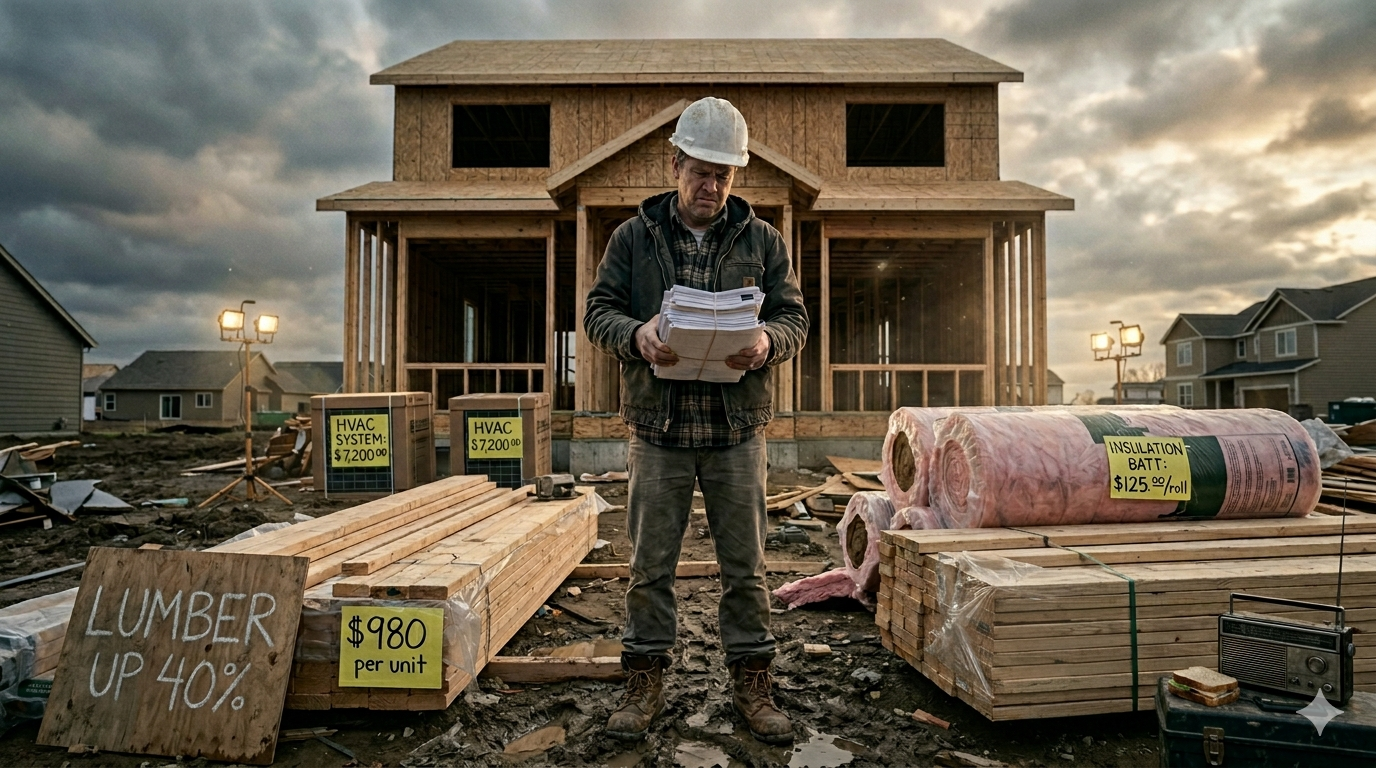
To understand why the rescission matters, you need to understand what the mandate was actually requiring and what it was going to cost you.
The 2021 International Energy Conservation Code is a national model building standard developed by the International Code Council that imposes significantly enhanced energy efficiency requirements on new residential construction. We are talking about upgraded insulation, higher-efficiency HVAC equipment, better windows and doors, advanced air sealing, and a more sophisticated thermal envelope design. Which sounds great in theory but every one of those upgrades costs money, money that the builders will bake into the price of their homes before you ever walk through the front door.
In April 2024, the Biden administration issued a Final Determination under the Energy Independence and Security Act of 2007 mandating the 2021 IECC as the minimum standard for all new construction financed through FHA or USDA programs. Builders who did not comply would lose program eligibility, meaning homes built to prior standards could not be purchased with FHA or USDA-backed financing.
Here is where it gets almost absurd. At the time of the mandate, Texas had not adopted the 2021 IECC, most states had not. Builders were being told to comply with a code that their own state government had not recognized or forfeit access to two of the most important financing programs in the country for entry-level and first-time buyers.
The National Association of Home Builders ran the numbers. Compliance with the 2021 IECC would have added between $9,600-$21,400 to the price of a new single-family home, depending on climate zone. HUD Secretary Turner himself cited figures as high as $20,000-$31,000 at the Austin announcement. The NAHB’s analysis showed that in many scenarios it would take up to 90 years for a buyer to recoup that added cost through energy savings. Ninety years. On a home people typically own for 7-10.
The U.S. District Court for the Eastern District of Texas agreed that the mandate was untenable, ruling in early 2026 that the Biden-era determination would actually decrease housing availability. That court ruling gave the Trump administration the legal foundation it needed so on April 28, 2026 they used it.
What the Rescission Actually Means: No Spin, Just Clarity

Let me break this down the way I would for a client sitting across from me.
New Construction Stays FHA and USDA Eligible Without the Cost Premium
The most direct impact: builders across Texas can continue constructing homes to the standards that were in effect before April 2024, and those homes remain fully eligible for FHA and USDA financing without the $10,000–$31,000 compliance premium the 2021 IECC would have demanded.
This matters enormously for two specific buyer profiles that are extremely common across Ellis County and the DFW suburban corridor.
FHA loans require as little as 3.5% down with a 580+ credit score. Over 80% of FHA purchase mortgages nationally go to first-time buyers. In North Texas, where entry-level new construction starts around $280,000–$320,000 in Ellis County, FHA financing is not a niche product, it is how a significant portion of this market actually functions.
USDA’s 100% financing program requires zero down payment for qualified buyers in eligible rural and suburban areas. Large portions of Ellis County, Johnson County, and Hill County qualify. This is a program that can put buyers in a brand-new home with no down payment and the rescission preserves that path without the cost added by mandatory 2021 IECC compliance.
To be completely clear: energy efficiency requirements have not been eliminated. FHA and USDA loans still require homes to meet safety, soundness, and structural standards including the pre-2024, 2009 IECC baseline. The rescission removes the mandate for the more expensive 2021 upgrade tier. The floor still exists. The government just stopped forcing buyers to pay for a premium ceiling they did not choose.
Builder Incentive Packages Have Even More Room to Move
North Texas builders were already under significant margin pressure heading into 2026. The Dallas-Fort Worth market saw new home starts fall 12.3% in 2025. DFW ended last year with over 12,300 finished vacant homes sitting in inventory. Builders have been offering $20,000–$50,000 in rate buy-downs, closing cost contributions, and design allowances just to move product.
The removal of mandatory 2021 IECC compliance reduces the per-unit cost exposure builders were anticipating in their 2026 pricing models. That margin relief flows somewhere. In a buyer’s market, which this demonstrably is, competitive pressure means it flows to you, not to the builder’s bottom line.
If you are currently under contract or actively negotiating on a new construction home, this policy change has just strengthened your hand. Builders know the IECC compliance burden is lifted, use that knowledge at the table.
The North Texas New Construction Map in 2026
Here is the inventory picture buyers need to understand. According to HBW’s Q1 2026 Texas Construction Analysis:
- Dallas County recorded 5,209 new residential permits in Q1 2026 – a 25% decrease versus Q1 2025.
- Tarrant County recorded 1,947 permits – an 18% increase versus Q1 2025.
- Collin County saw a 39% contraction in Q1 permits.
Read those numbers carefully, the northern suburbs are cooling. The southern corridor of Ellis County, Johnson County, Tarrant County, etc. is where the real new construction momentum in 2026 is concentrated. That is not an accident. That is where the land is, where the infrastructure is being built, and where the value proposition for buyers is strongest.
What This Means for Ellis County and the I-35E Corridor Specifically
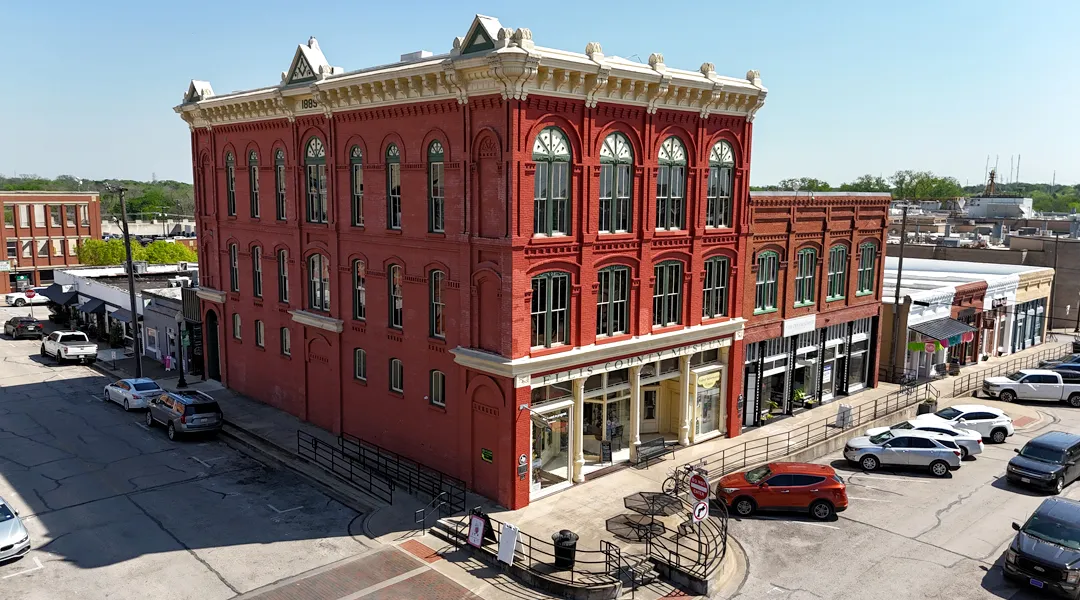
Waxahachie: The Minto Communities Game-Changer
Earlier this year I covered the 3,170-acre, 13,270-home Minto Communities USA master-planned development, the largest residential development ever approved in Waxahachie’s history. Construction on this community is projected to begin mid-2026.
Here is what that timing means in the context of this rescission: a development of this scale is going to produce an enormous volume of homes financed with FHA and USDA programs. Entry-level price points, first-time buyers and relocating families are the core buyer profile for a community like this. The elimination of the 2021 IECC cost burden directly expands the pool of financially qualified buyers for every home in that pipeline. Builders entering that project no longer have to price in a compliance cost headwind. That is money that stays in the deal for the buyer.
Mansfield: Tarrant County’s Breakout Market
Mansfield has grown 188% in population since 2000 with the median household income exceeding $116,000. Two major master-planned communities, South Pointe and M3 Ranch, are actively delivering inventory. The 18% increase in Tarrant County Q1 permits I cited above is being driven in significant part by Mansfield’s continued momentum.
Mansfield buyers are often move-up buyers and relocators from higher-cost markets and they are exactly the profile that benefits from preserved FHA accessibility at lower construction cost. The rescission keeps that momentum moving.
Midlothian: Where USDA Eligibility Is a Real Tool
Midlothian is Ellis County’s fastest-growing city, and new construction is virtually its entire market. With median home prices around $499,000 and a buyer profile that skews toward families relocating from expensive metros, USDA loan eligibility in outer Midlothian parcels is a genuine, meaningful financing tool, not just a footnote.
Zero-down-payment access to new construction in a market with Midlothian’s quality of life, school systems, and proximity to DFW employment corridors is a serious value proposition. The rescission protects that access without adding the compliance cost premium that would have moved some of those buyers to the sideline.
The Palmetto Road Development
The 75-acre Palmetto Road development in Waxahachie with its 1,065 units of multifamily and build-to-rent single-family housing, is another project that benefits directly from this regulatory change. Build-to-rent communities that eventually transition to owner-occupied housing rely heavily on FHA and USDA eligibility for that transition to work. Lower construction cost floors help developers build financially viable projects that add more affordable housing supply to this county, which is great for buyers.
Why Builders Are Genuinely Relieved Right Now

The NAHB was unambiguous in its response. NAHB Chairman Bill Owens called it “decisive action to roll back these overly burdensome energy mandates, which threatened to deepen the nation’s housing affordability crisis.”
The NAHB had fought this mandate on three simultaneous fronts; legal, legislative, and regulatory. They backed the Eastern District of Texas lawsuit. They supported Senator Barrasso’s HOUSE Act. They presented direct testimony from builders like Brian Tebbenkamp, a Kansas City home builder who documented exactly how inflexible energy code mandates were driving up his per-unit costs with no proportional benefit to his buyers.
The NAHB’s core argument was simple and they had the data to back it: the compliance costs were “greatly outweighed by the upfront costs that would have been shouldered by home buyers,” with a payback period on those added costs stretching as long as 90 years. For the average buyer in a 7-10 year ownership cycle, that math never worked.
The mandate is now off the table, builders know it and they are relieved. You should know it too and you should use that relief at the negotiating table.
The Part I Am Going to Be Straight With You About
The mandate’s advocates, including researchers at the Rocky Mountain Institute, argued that updated energy efficiency standards could reduce energy bills by up to a third and potentially pay for themselves within two years on average. HUD’s own internal modeling had estimated average lifetime energy savings of approximately $25,100 per household.
Texas energy code field data shows that residential properties built to updated standards can save homeowners approximately $179 annually, with net lifecycle cost savings averaging around $2,690. In a Texas climate where you are running air conditioning six to eight months a year, energy efficiency is not an abstract concept, it’s a real line on your monthly budget.
Here is where I land on it: the question was never whether energy efficiency matters. It does. The question was whether the federal government should attach mandatory compliance with a specific code standard(one that the majority of states, including Texas, had not adopted) to mortgage program eligibility, with no flexibility and no exit ramp for buyers in markets where that code structure does not fit.
A federal court said no, HUD and USDA said no and I think they were right.
What this means practically: if energy efficiency is important to you, and it should be in a Texas summer, you still have options. The 2021 IECC is still available as a voluntary standard and many North Texas builders are continuing to build to higher efficiency standards because the market rewards it and buyers are asking for it. The FHA Energy Efficient Mortgage program is also still fully available if you want to finance energy-saving upgrades into your purchase.
Solid energy efficiency standards are still in effect and plenty of buyers are willing to pay extra for higher energy efficiency. The difference is that now you have a choice rather than the government denying your loan over you not opting in.
The 2021 IECC Is Gone – But Energy Standards Are Not. Here Is Exactly What You Are Still Getting.
Let me get ahead of the question I know is coming.
“Bobby, if they killed the energy mandate, does that mean my new home has zero efficiency requirements now?”
No. Not even close. And I want to be specific about this, because the misinformation spreading on this topic is going to cost buyers negotiating clarity if they do not understand what the floor actually looks like.
Here is the truth: the rescission rolled back the federal requirement from the 2021 IECC to the 2009 IECC, the standard that was already in place for FHA and USDA-financed new construction from 2015 all the way through 2024. The 2009 IECC is a real, enforceable energy code with specific requirements for insulation, windows, air sealing, ducts, HVAC, and lighting. It is not a blank check for builders to put up uninsulated walls and call it done.
More importantly, and this is the part most people are missing entirely, the federal floor is almost irrelevant for buyers in DFW and Ellis County. Here is why.
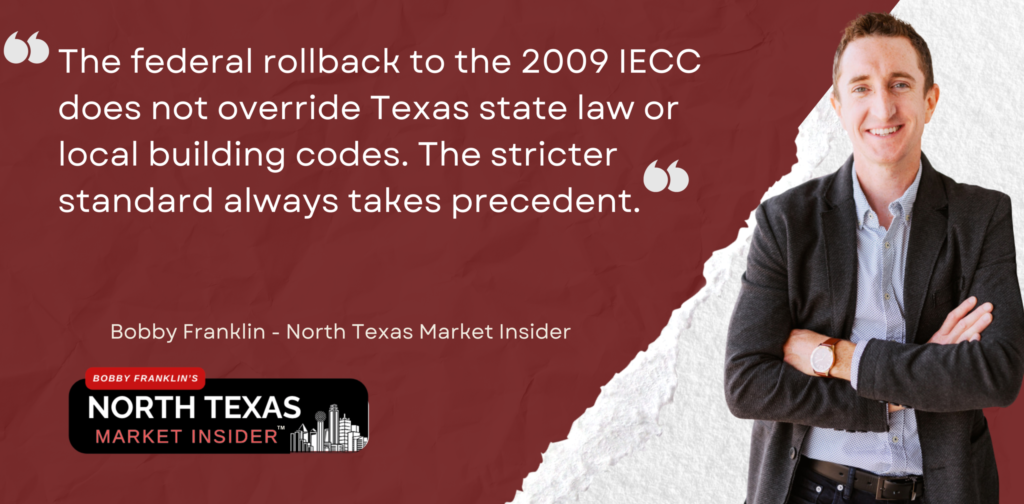
Texas state law already requires new residential construction to meet the energy chapter of the 2015 IRC statewide, a standard significantly stronger than the 2009 IECC. And virtually every incorporated city across the DFW Metroplex has adopted something even newer. Frisco is enforcing the 2024 IECC as of March 2026. Dallas, Plano, McKinney, Allen, Grapevine, Lewisville, all on 2018 or 2021 IECC with NCTCOG regional amendments. The federal rollback to the 2009 IECC does not override Texas state law or local building codes. The stricter standard always takes precedent.
What that means practically: if you are buying a new construction home in any incorporated area of North Texas with an FHA or USDA loan, you are getting a home built to 2018, 2021, or 2024 IECC standards, not the 2009 IECC, because that is what your city requires. The federal floor is almost entirely a non-issue inside DFW city limits.
The one place it genuinely matters is unincorporated rural land. Parcels in outer Ellis County, Hood County, Parker County, Hunt County, and similar areas where no local building department enforces a code. In those cases, the federal floor is your actual floor, and it is worth knowing what it requires.
What the 2009 IECC Actually Requires for a New Home in North Texas
For the Dallas-Fort Worth area, which sits in Climate Zone 3 under the 2009 IECC’s map, the prescriptive minimums look like this:
Insulation: Attic and ceiling at R-30. Wood-frame walls at R-13 cavity insulation. Floors over unconditioned space at R-19.
Windows and Doors: Maximum U-factor of 0.50 (meaning the windows resist heat transfer at a meaningful level). Maximum Solar Heat Gain Coefficient of 0.30. This is the metric that controls how much solar heat blasts through your glass in a Texas summer, and 0.30 is genuinely restrictive. You are getting Low-E dual-pane windows at minimum.
Air Sealing: Mandatory sealing of all joints, seams, penetrations, window and door rough openings, utility penetrations, dropped ceilings, and garage-to-house walls. The 2009 IECC requires either a completed air-sealing inspection checklist or a blower-door test showing air leakage at or below 7 ACH50 (air changes per hour at 50 Pascals). Recessed lighting must be IC-rated and sealed.
Ducts: Attic supply ducts insulated to R-8. All ducts outside the conditioned envelope must be sealed and tested. Leakage cannot exceed 6 cfm per 100 square feet of conditioned floor area. For context, pre-code Texas housing routinely lost 20 to 40 percent of heated and cooled air through attic ducts running through 130-degree summer air. A 2009 IECC home eliminates most of that.
HVAC Sizing: Systems must be sized using ACCA Manual J load calculations. No guesswork, no rule-of-thumb oversizing that wastes money and causes humidity problems.
Lighting: At least 50 percent of permanently installed lamps must be high-efficacy. In 2026, this means LED across the board.
HVAC Equipment Efficiency: This is where people miss something important. Federal appliance efficiency standards; SEER2 ratings for air conditioners, AFUE ratings for furnaces, are set under separate federal law and apply regardless of which IECC version the home is built to. Even if the IECC disappeared tomorrow, a builder still cannot install a central air conditioner below SEER2 14.3 or a furnace below 81 percent AFUE. These are Department of Energy appliance standards, not building code provisions. They stay in place.
How Does the 2009 IECC Compare to the 2021 IECC?
The 2021 IECC is meaningfully stronger, I am not going to pretend otherwise. But the gap is not the difference between an efficient home and an uninsulated disaster. It is a real measurable difference in monthly operating cost.
The Department of Energy’s own modeling estimated the 2021 IECC produces roughly 35 percent better energy performance than the 2009 IECC and saves an average of $25,100 in energy costs over a 30-year mortgage. That works out to approximately $70 per month in utility savings. For a well-built 2,000-square-foot home in North Texas, the realistic monthly utility cost delta between a bare 2009 IECC home and a 2021 IECC home is somewhere in the range of $30 to $80 per month, depending on equipment, installation quality, and occupant behavior.
The biggest concrete differences between the two standards:
The 2021 IECC pushes attic insulation from R-30 to R-49 which is a significant upgrade in a climate where your attic is a furnace from May through October. It tightens the mandatory air leakage limit from 7 ACH50 to 3–5 ACH50 (depending on climate zone) and makes blower-door testing non-negotiable rather than optional. It upgrades wall insulation requirements to R-20 or R-13 plus continuous insulation, and it tightens window U-factor from 0.50 to 0.30. It also requires 90 percent high-efficacy lighting versus 50 percent.
A home built strictly to the 2009 IECC minimum will typically score approximately HERS 85 on the national energy rating scale, meaning it is roughly 15 percent more efficient than a 2006-code reference home. A 2021 IECC home typically scores HERS 57 to 65. Most production builders in North Texas are currently hitting HERS 60 to 70 because local codes require it, which is well above the 2009 IECC federal floor regardless of what HUD and USDA decided.
For more on the HERS index: https://www.hersindex.com/hers-index/what-is-the-hers-index/
The Questions to Ask Your Builder – Regardless of Which Code Applies
Do not take anyone’s word for code compliance. Ask for documentation.
Request the HERS Index Rating certificate for the home. Most production builders in North Texas provide one. A score of 65 or lower is the floor under Texas law’s alternative compliance path. A score of 60 or lower is the practical norm for a well-built current-production home. If a builder cannot produce a HERS certificate, that tells you something.
Request the blower-door test report. Under the 2009 IECC, the home must test at or below 7 ACH50. Under the 2018 or 2021 IECC that most DFW cities require, the target is 5 ACH50 or lower. A well-built home today routinely tests at 2 to 3 ACH50.
Request the duct leakage test report. Under the 2009 IECC, duct leakage cannot exceed 6 cfm per 100 square feet of conditioned floor area. Under current local codes, the target is typically 4 cfm or lower. Duct performance is one of the highest-leverage efficiency factors in a Texas home, do not skip this number.
Look at the installed equipment. You want to see SEER2 15 or higher on the air conditioner (federal minimum is 14.3; ENERGY STAR-tier units run 16 to 20 SEER2). You want AFUE 90 percent or higher on the furnace if gas. And you want Low-E windows with U-factor at or below 0.30 and SHGC at or below 0.25.
If energy performance is important to you, and in a Texas summer running six to eight months of air conditioning, it should be, the FHA Energy Efficient Mortgage program is still fully available. You can finance efficiency upgrades directly into your purchase loan based on a certified HERS rating. The rescission did not touch that program.
The Bottom Line on Energy Standards
The 2021 IECC mandate is gone. The floor reverted to the 2009 IECC for FHA and USDA programs. But inside any incorporated city in North Texas, which covers the overwhelming majority of new construction in this market, your local building code already exceeds the 2009 IECC and the federal rollback changes nothing about what your builder is required to deliver.
What you are still getting in a North Texas new construction home: real insulation, Low-E dual-pane windows with restricted solar heat gain, sealed and tested ducts, a blower-door-verified tight envelope, properly sized HVAC equipment running at current federal efficiency minimums, and LED lighting. This is not a 1985 house. The floor still exists. It just is not as high as the 2021 IECC would have required and that difference, in real money, is roughly $30 to $80 per month on your utility bill.
Whether that tradeoff is worth $9,600 to $31,000 in added purchase price is the question the federal court already answered. So did HUD and USDA.
Know your HERS score. Get your test reports. And work with an agent and lender team who can help you evaluate energy performance as part of the full picture, not just the sticker price.
FHA vs. USDA in North Texas: Know Your Financing Options
Since this rescission directly affects both programs, it is worth making sure you understand exactly what each one offers, because the right tool depends on where you are buying and what your financial profile looks like.
FHA Loans
FHA-insured mortgages remain the most common path to homeownership for first-time buyers in the country. In the North Texas new construction market, they are essential.
- Minimum down payment: 3.5% with a 580+ credit score
- Mortgage insurance: Required – both upfront MIP and annual MIP
- Credit flexibility: More forgiving underwriting than conventional loans
- Property requirements: FHA Minimum Property Standards still apply at pre-2024 energy code levels
- Use: Primary residences only
For a $300,000 new construction home in Ellis County, 3.5% down is $10,500. That is an achievable number for a lot of families, especially when builders are also contributing $10,000–$20,000 in closing cost assistance. The combination is powerful enough to make homeownership possible.
USDA Guaranteed Loans
The USDA Guaranteed Loan Program offers what I consider the most underutilized financing tool in North Texas real estate: 100% financing with no down payment in eligible rural and suburban areas.
Per USDA loan specialists in Texas:
- Down payment: 0%
- Minimum FICO: 620
- Maximum DTI: 41% (exceptions to 45%)
- Mortgage insurance: Yes but lower rates than FHA
- Income limits: Based on Area Median Income
- Geographic restriction: Property must be in a USDA-eligible area
Portions of Waxahachie, Midlothian, Ennis, Corsicana, and surrounding Ellis County communities have USDA-eligible addresses. Zero dollars down on brand new construction. The rescission keeps it exactly that way, without adding $10,000–$31,000 in mandated compliance costs to the equation.
If you are not sure whether your target property qualifies, verify it at the USDA Eligibility Site. Do not assume, always check.
To talk through which loan structure fits your specific situation, I work with three preferred lending partners who know this market and know these programs like the backs of their hands: Denise Donoghue at The Mortgage Nerd (yourmortgagenerd.com), Andrew Bryan at Miramar Mortgage (miramarmortgage.com), and Ethan Hester at Midtex Mortgage (mid-texmortgage.com). Any of them can run your scenario before you ever step foot in a builder’s model home. Pro tip: always talk to at least 2(preferably 3) different lenders before moving forward.
Your 2026 New Construction Negotiation Strategy Just Got Better
Let me give you the tactical intelligence that actually changes what you do this week.
Before this rescission – builders in Texas were quietly factoring potential 2021 IECC compliance costs into their long-term pricing models. Some were even pre-emptively upgrading their construction standards. Others were pricing in a risk premium to cover potential future compliance exposure. All of that uncertainty added friction and cost that filtered down to the buyer.
After this rescission – that compliance cost risk is gone. Builders have no anticipated IECC upgrade cost to price into FHA/USDA-eligible homes. In a market where builders are already competing hard and with DFW inventory elevated, days on market stretched to 60–89 days, and rate buy-downs already eating into margins, this removes a cost headwind and improves builder flexibility.
Your move – if you are purchasing a new construction home with FHA or USDA financing, ask your builder directly whether their 2026 pricing reflected anticipated IECC compliance costs. Many will not bring it up on their own but a good buyer’s agent will make sure you ask it.
Working with a buyer’s agent who understands the new construction process is not optional. Builder contracts are written by the builder’s lawyers, for the builder’s benefit. Having experienced representation on your side, at no additional cost to you as the buyer, is how you protect yourself and maximize the value of every incentive that is on the table.
If you want to understand the full new construction process from contract to close, my complete North Texas home buyer’s guide walks through every step.
The Bigger Picture: Where This Fits in the 2026 North Texas Market

This rescission does not exist in isolation. It is just one piece of a broader federal deregulation push that has been executing systematically since January 2025 with direct consequences for new home supply and affordability across this region.
My 2026 North Texas Housing Market Forecast laid out the thesis that this market is in a genuine transition: moving from seller’s conditions toward a balanced market with real buyer leverage. The macro data supports it:
- DFW median home prices sit around $375,000–$418,000 depending on county, after declining approximately 2–3% from 2024 highs
- Active listings increased over 22% year-over-year aka buyers have real options now
- Days on market averaging 60–89 days versus 10–14 days during the 2021–2022 frenzy
- PricewaterhouseCoopers and Urban Land Institute ranked Dallas-Fort Worth the #1 market to buy, build, and finance property in 2026
The HUD/USDA rescission adds a constructive tailwind to that picture. Reduced regulatory cost burden on new construction, builder incentive programs in full effect and elevated inventory are giving buyers real negotiating power they haven’t had in years.
If you are relocating from out of state, this is the moment. My California-to-Texas relocation guide, Washington state relocation resource and other relocation pages for other states, break down the full financial comparison of eliminated state income tax, dramatically lower housing costs, and now a new construction market with even lower regulatory cost burdens. The value proposition for North Texas is as strong as I have ever seen it.
For Sellers: Does This Hurt You?

If you own an existing home in North Texas and you are watching this development, your question is reasonable: does making new construction more affordable hurt my resale value?
Short answer: no. Not materially, and probably not at all.
The rescission applies to new construction financed through FHA and USDA programs. Resale homes have always been exempt from IECC mandates, this never touched you. Appraisal standards, safety requirements, and the marketability of your existing home are completely unaffected.
What it does mean is that new construction maintains its current pricing position relative to resale, rather than facing a mandated cost increase that would have pushed new construction prices higher and potentially widened the gap in resale’s favor. In a market where builders are already discounting and offering significant incentives, new construction was already ahead of resale homes. The rescission moderates future price inflation on the new construction side, which keeps the competitive dynamic stable.
For sellers in Ellis County, Tarrant County, and across DFW, the 2026 playbook has not changed. Preparation, strategic pricing, and professional marketing are still the variables you control. If you are thinking about timing a sale, my North Texas seller pricing strategy guide gives you the data-driven framework to make that call with confidence.
Your Action List Right Now

Stop reading and start moving. Here is what you do depending on where you are in the process.
First-time buyers using FHA financing: Your path to new construction just got cleaner. Homes that builders were potentially pricing with IECC compliance built in are now priced to actual market conditions. Ask your lender and buyer’s agent which new construction communities in your target area qualify for FHA. And do not walk into a builder’s sales office alone. Connect with a buyer’s agent first.
Rural and suburban buyers using USDA: Verify your target property at the USDA Eligibility Site, then confirm that USDA 100% financing is still fully available for that address. In communities like outer Waxahachie, Ennis, and Corsicana, USDA-eligible new construction exists, use it to your advantage.
Move-up and relocation buyers: Builder incentive packages are still strong with rate buy-downs, closing cost contributions, design center credits. The energy code rescission has given builders added confidence and reduced their forward cost exposure. That creates room for you at the negotiating table. Use it.
Investors: Build-to-rent communities and entry-level new construction remain compelling asset classes in North Texas. The removal of IECC compliance cost pressure improves pro forma economics on entry-level new construction. Ellis County’s development pipeline with Minto Communities, South Creek Ranch, and Palmetto Road among others, represents billions in capital conviction. If you are evaluating investment positions in this region, now is a good time to be moving.
The 10 Questions Buyers Are Actually Asking About This

These are the questions hitting Google, Reddit, and AI search right now. Here are the straight answers.
1. Does the HUD and USDA energy code rescission mean new homes no longer have to be energy efficient?
No. The rescission removes the mandate for the 2021 IECC upgrade, but energy efficiency requirements still exist, just at the pre-2024 level. As the National Association of REALTORS® confirmed, homes financed with FHA or USDA loans must still meet energy efficiency requirements. The government just stopped requiring the more expensive 2021 tier.
2. Will new homes actually cost less to build now?
Yes, to a meaningful degree. The NAHB estimates the 2021 IECC would have added $9,600–$21,400 per home depending on climate zone. That cost burden is gone for FHA/USDA-financed new construction. In a competitive buyer’s market like DFW in 2026, competitive pressure among builders means a substantial portion of that relief flows to buyers.
3. What about homes already built to 2021 IECC standards?
Those homes are still fully FHA and USDA eligible, they just are no longer required to be at that standard. Homes built to higher efficiency specifications may actually command a market premium among buyers who value lower utility costs. That voluntary market advantage remains intact.
4. Does this affect VA loans?
Not directly. The Joint Determination applies to FHA and USDA programs. VA loans are administered by the Department of Veterans Affairs under separate standards. Talk to a VA-approved lender for the current energy efficiency requirements on VA-financed new construction.
5. Can I still get an energy efficient mortgage after this rescission?
Yes, absolutely. The FHA Energy Efficient Mortgage program is fully available and allows buyers to roll the cost of energy-saving improvements into their purchase loan. If you want a home built to 2021 IECC standards or higher, you can still finance those upgrades.
6. Will North Texas builders stop building energy-efficient homes?
Unlikely. Market forces, not just regulations, are driving energy efficiency decisions. Texas buyers who are paying $300–$500 per month in summer utility bills value efficient construction. Builders who compete on energy performance will continue to do so because buyers reward it. The rescission removes a government mandate, not a market incentive.
7. Is USDA 100% financing still available for new construction in North Texas?
Yes. The USDA Guaranteed Loan Program still offers zero-down financing for qualified buyers in eligible rural and suburban areas. The rescission does not change geographic eligibility boundaries, income limits, or any other program terms. It only removes the 2021 IECC compliance requirement. Verify your property at the USDA Eligibility Site.
8. What was the Eastern District of Texas court ruling about?
In early 2026, the U.S. District Court for the Eastern District of Texas found that the Biden-era 2024 Final Determination would actually decrease housing availability, a significant finding in the context of a national affordability crisis. The NAHB and 15 states had argued that the updated code requirements were threatening affordable new-home supply. The court agreed and HUD cited that ruling as legal alignment for the April 28 rescission.
9. Should I wait to buy new construction to see how the market responds to this?
No. This is a mistake buyers make over and over of waiting for perfect conditions that never arrive simultaneously. The policy change has already happened. Builder incentives are already in the market. Interest rates are competitive from a historical context. Supply across Ellis County and Tarrant County is robust. Waiting six months to “see how the market responds” to a development that is already fully implemented is a strategy for missing opportunity, not protecting yourself.
10. How does this affect the housing affordability crisis in North Texas?
This is the right question. The HUD/USDA rescission is not a complete solution to affordability, but it is a meaningful, concrete, measurable step. Removing $9,600–$31,000 in mandated construction costs from FHA and USDA-eligible new homes directly expands the pool of buyers who can access new construction. Combined with elevated DFW inventory, builder incentives, and the corridor’s continued population growth fundamentals, this rescission supports North Texas affordability at exactly the moment buyers need relief. For the full market outlook, read my complete 2026 North Texas Housing Market Forecast.
The Bottom Line on North Texas New Construction in 2026
Pull back and look at the full picture.
The HUD and USDA energy code rescission is one more confirmation of what the fundamentals have been telling me all year: North Texas right now is the most favorable large-market new construction environment in the United States. Not eventually. Right now.
Here is the complete picture:
- Policy tailwind: The Biden-era cost mandate is rescinded. Builder compliance uncertainty is eliminated.
- Inventory: DFW ended 2025 with over 12,300 finished vacant new homes. Buyers have options, not bidding wars.
- Incentives: Builders are still deploying $20,000–$50,000 in rate buy-downs, closing cost contributions, and design allowances.
- Market balance: 60–89 days on market. Buyers have negotiating leverage they have not had in five years.
- Financing access: FHA and USDA programs are fully intact. Lower minimum down payments than any other purchase financing option.
- Growth corridor: Ellis County’s development pipeline – Minto Communities (13,270 homes), South Creek Ranch, Palmetto Road all signal long-term capital investment in this region.
- National ranking: DFW is the #1 market for buy, build, and finance homes in 2026 according to PricewaterhouseCoopers and Urban Land Institute.
That is not a marketing pitch. That is the data. And as someone who has been tracking this market at the granular level for years by watching permit filings, builder negotiations, migration patterns and infrastructure investment, I can tell you that the combination of buyer-favorable market conditions and constructive policy environment currently in place in North Texas is genuinely rare. These windows do not stay open indefinitely.
Ready to move on a new construction purchase in Ellis County, Tarrant County, or anywhere across the DFW Metroplex?
Call me at 214-228-0003 or visit northtexasmarketinsider.com. You get real buyer consultation, real builder navigation, and market intelligence that actually changes what you do.
Bobby Franklin is a licensed REALTOR® in Texas (TREC #0805459), serving buyers and sellers across DFW and Ellis County as part of the Legacy Realty Group – Leslie Majors Team. 16 Northgate Dr. Ste 100, Waxahachie, TX 75165. This article is provided for informational purposes and does not constitute legal or financial advice. All content is produced in compliance with the Fair Housing Act, RESPA, the NAR Code of Ethics, Texas Real Estate Commission advertising standards, and applicable federal law. No steering, commission fixing, or discriminatory content. Equal Housing Opportunity.
Sources: HUD.gov, USDA Rural Development, National Association of Home Builders, National Association of REALTORS®, Scotsman Guide, The Real Deal, HBWeekly, Rocky Mountain Institute, U.S. District Court for the Eastern District of Texas, Senator Barrasso press release, Texas A&M Real Estate Center.