

By Bobby Franklin, REALTOR® | North Texas Market Insider™ | Legacy Realty Group – Leslie Majors Team | Serving Waxahachie, Ellis County, and Greater DFW
A stack of new Texas laws takes effect September 1, 2026, and the version of the story circulating on Facebook is the least useful one. The viral headline is gold. Texas is recognizing gold and silver as legal tender, and half of North Texas has decided that means you can close on a house in Midlothian with a briefcase of coins, which of course you cannot. That part is just noise.
The part nobody is putting on a graphic is the one that will decide whether your closing funds on time: as of September 1, 2026, every residential solar retailer and every solar salesperson operating in Texas has to be registered with the state, carry real insurance, and answer to real penalties. Ellis County was authorized for 2,884 new private housing units in 2023 and 2,972 in 2024, according to U.S. Census Bureau permit data. Nearly six thousand new roofs in two years, in a county where solar arrived as both a builder incentive on that new inventory and a door-to-door retrofit pitch aimed at everything already standing. That combination is why this law lands harder here than in most of the metro.
Here is what actually changes, what it does to your file, and what to do about it before your sign goes in the yard.

Why September 1, 2026 Is the Date That Matters, Not September 1, 2025
The 89th Texas Legislature wrote these bills with a fuse on them. The consumer-facing provisions lit in 2025. The enforcement lights now.
The Texas Department of Licensing and Regulation(TDLR) built that phased structure deliberately: contract and cancellation rules first, registration and penalty authority a full year later, with implementing rules required to be adopted by June 1, 2026.
Texas Legislature / 89th Session
They wrote these bills with a fuse on them
Consumer protections lit first. Registration and penalty authority a full year later. Here is the sequence that actually governs your transaction.
Sept 1, 2025
Phase One
Contract rules, no teeth. Five-business-day right to cancel. Licensed electrical contractor named in the agreement. No misleading performance or cost claims. No false utility or government affiliation.
Sept 1, 2026
Enforcement Begins
Registration required. Every solar retailer and salesperson must be registered with TDLR. Insurance floor of $1M per occurrence, $2M aggregate. Penalty provisions become enforceable. Right to Repair and gold legal tender also take effect.
Nov 1, 2026
Grace Period Ends
Full rule enforcement. TDLR temporarily suspended enforcement of certain administrative rules to give registrants time to comply. That window closes here. The statutory registration mandate was never paused.
May 1, 2027
Still Ahead
The gold rail turns on. Comptroller’s electronic payment system backed by bullion in the Texas Bullion Depository. Voluntary. No merchant is required to accept it. Not a closing mechanism.
The read: September 1, 2026 is the date that changes your file. September 1, 2025 changed the paperwork. May 1, 2027 changes nothing at your closing table.
That gap is why most homeowners think nothing happened. Something did happen. It just happened without teeth, until now.
For sellers, September 1, 2026 changes what “market-ready” means on a house with panels on it. For buyers, it changes what recourse you have when the company on your porch turns out to be operating outside the system. For everyone else, it settles the gold question with an answer you are not going to enjoy if you were hoping otherwise.
SB 1036: Texas Solar Sales Just Got a Registration, an Insurance Floor, and a Penalty Schedule

Senate Bill 1036, the Residential Solar Retailer Regulatory Act, created Chapter 1806 of the Texas Occupations Code and handed the residential solar sales channel to the TDLR. Authored by Senator Judith Zaffirini, it was a direct response to a documented surge in complaints, with solar-related consumer complaints to the Texas Attorney General’s office climbing from 154 in 2020 to 696 in 2024. Zaffirini’s framing when the bill became law was blunt about who was getting hurt: the elderly and non-English-speaking Texans were disproportionately affected.
Phase 1, live since September 1, 2025. Every covered residential solar sale or lease contract has to provide that installation will be performed by a licensed electrical contractor, has to carry a five-business-day right to cancel, and cannot make misleading statements about system performance or cost. TDLR’s release on the 2025 phase adds two provisions worth knowing: retailers cannot claim or imply affiliation with a utility or a government agency, and they cannot pitch at a residence posting a “no soliciting” sign unless the occupant invited them.
Phase 2, live September 1, 2026. Registration. The company must register as a solar retailer. The salesperson must register as a solar salesperson. No registration equals an unlawful residential solar sale or lease in Texas. The Texas Solar Energy Society, which sat on the rulemaking steering committee, puts retailer registration at $350, salesperson registration at $56, and the insurance floor at $1 million per occurrence with a $2 million aggregate, with policies required to cover consumer liability for the actions of the retailer and its sales reps.
Penalties run two tracks. A compliance breakdown from HCH Lawyers separates what most coverage has blended together: civil penalties brought by the Attorney General or TDLR’s executive director, and administrative penalties assessed by TDLR that accrue daily for as long as a violation continues. The details are in the FAQ below. What matters to you as a consumer is the practical effect: a retailer facing a daily penalty meter has a strong incentive to resolve a complaint fast rather than fight it, and TDLR can order the agreement cancelled and a refund issued outright.
What SB 1036 does not do is give you a private right of action. Enforcement will run through the state. If you want to sue directly and reach treble damages, that runs through the Deceptive Trade Practices Act, which is a separate conversation and a real one.
SB 1036 / Occupations Code Ch. 1806
There are two penalty tracks. Everyone is quoting the smaller one.
Most coverage of the new solar law reports a single fine amount. The statute creates two separate enforcement mechanisms, and they work very differently.
Track One
Civil penalties
Brought by the Texas Attorney General or TDLR’s executive director
Standard violation
$2,500
Per violation, capped at $50,000 aggregate for violations of a similar nature.
Where a person over 65 was harmed
$10,000
Per violation, with a $100,000 aggregate cap. Four times the standard exposure.
Track Two
Administrative penalties
Imposed directly by TDLR, no court required
Per violation
$5,000 / day
Each day a violation continues counts as a separate violation. This is not a one-time fine. It is a meter.
Additional remedy
Cancellation
TDLR can order the agreement voided and a full refund issued to the consumer.
Why this matters to you, not just to them: a company facing a daily accrual has a strong financial reason to resolve your complaint quickly rather than fight it. Filing early is leverage.
SB 1036 does not create a private right of action. Enforcement runs through the state. Direct consumer lawsuits, including treble damages, run through the Texas Deceptive Trade Practices Act instead.
Three Limits the Headlines Are Getting Wrong
Power purchase agreements are not covered by this Act. TDLR is explicit: the RSRRA does not regulate PPAs, because in a PPA you are not buying or leasing the panels, you are agreeing to buy the electricity they produce. If your neighbor signed a PPA, none of the registration protections attach to that transaction. Your disclosure obligation as a seller does not change one bit, but the enforcement backstop is not there. That is a gap worth knowing before you assume you are covered.
Licensed electrical contractors are exempt from registration. TDLR already regulates them under the Texas Electrical Safety and Licensing Act, so electrical contractors and their employees do not have to register as solar retailers or salespeople, though they remain subject to most other provisions of the Act including the five-day cancellation window. So if you demand a TDLR solar registration number and the person in front of you says they do not have one, that is not automatically a red flag. It means you ask a different question, which I get to below.
Part of the rule set is in a grace period. TDLR announced on August 21, 2026 that it is temporarily suspending enforcement of certain administrative rules until November 1, 2026 to give registrants time to come into compliance. The statutory registration requirement itself is live on September 1 regardless. That distinction matters, and it cuts in exactly one direction: for the first two months, there is a soft edge on parts of the rule set, which is precisely why you verify credentials yourself instead of assuming the state is catching everything in real time.
If You’re Selling a House With Panels, This Is Your Problem STILL
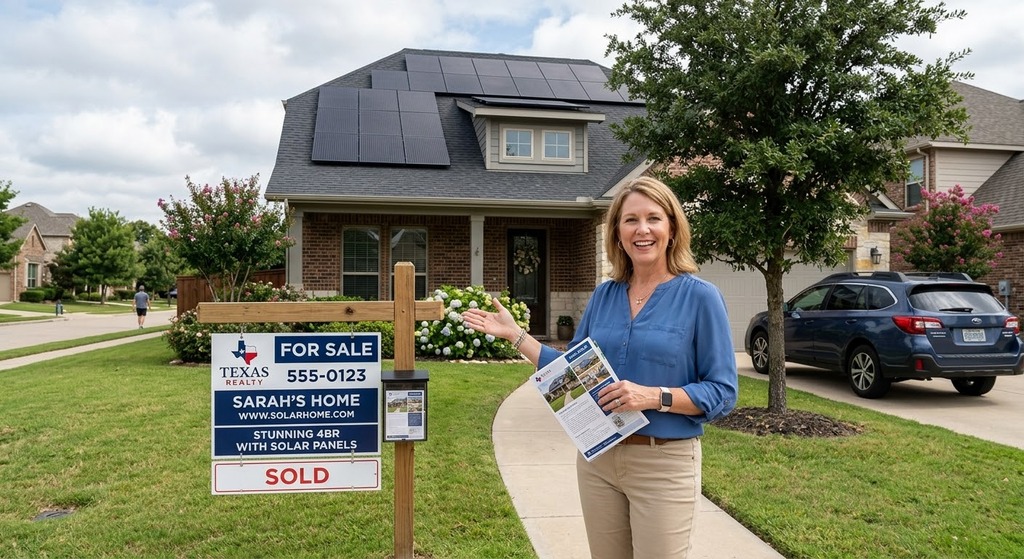
Start with the part most solar coverage leaves out: the majority of solar transactions close without drama. A buyer who qualified for a mortgage has usually already cleared the credit bar a solar company sets, and most buyers, once someone actually walks them through the monthly math, are fine assuming a lease that lowers their electricity cost. If you own your system outright with no lien on it, it is an asset, and appraisers can assign value to it when ownership is cleanly documented. None of what follows is an argument that solar sinks a sale. It is an argument that the paperwork decides whether it does.
If solar is already on your roof, September 1 did nothing for you. SB 1036 regulates retailers and salespeople. It imposes no obligation on homeowners, creates no new disclosure requirement, and does not reach backward into a contract you already signed. Your Property Code 5.008 duty is what it was in August. TREC Form 52-1 was already mandatory. The UCC-1 was already going to surface on the title commitment. Anyone selling you the idea that this law changed your obligations is selling you something.
The legislature spent a session fixing how solar gets sold to you. It did nothing about how solar gets sold with your house. That gap is the entire story, and it cuts in two directions depending on which side of September 1 your contract falls on.
Your existing contract does not get rewritten. Nothing in SB 1036 reaches backward into a system you already own, lease, or finance. What it rewrites is the environment your listing lands in. Buyers walking your house in 2027 are more educated about solar than buyers were in 2024, because a year of Attorney General investigation coverage and legislative reporting taught them to be. I broke down that investigation and what it exposed in my earlier piece on whether solar is still safe in 2026. September 1, 2026 is the date the concerns in that story became enforceable.
Texas Seller’s Reference
Four ways to own solar. Four different closings.
The panels look identical from the street. What decides whether your sale goes smoothly is which of these four arrangements you actually signed, and which instrument the transaction requires.
Leased
Most frictionWhat it is
A third party owns the equipment. You pay monthly for the right to use it, typically on a 20 to 25 year term.
Required instrument
TREC Form 52-1
Addendum Regarding Fixture Leases. Adopted by rule for mandatory use.
Your move
Buyer assumes, or you buy out before closing. Assumption approval runs 30 to 60 days. Start at listing, not at contract.
Owned, with a lien
Commonly mishandledWhat it is
The panels are yours, but a solar loan is recorded against the property.
Required instrument
Not Form 52-1
This is the error agents make most. A lien is not a fixture lease. Handle through Special Provisions or payoff.
Your move
Pull the payoff figure in writing. Expect a UCC-1 fixture filing on the title commitment that must be cleared.
Power purchase agreement
No state backstopWhat it is
You do not own or lease the panels. You agreed to buy the electricity they generate.
Coverage under SB 1036
Not regulated
TDLR is explicit that the Act does not reach PPAs. The new registration protections do not apply.
Your move
Disclosure duty is unchanged and still binding. You simply have no enforcement backstop if the arrangement was sold badly.
Owned free and clear
An assetWhat it is
Paid off, no lien, no third-party interest. The system conveys with the house.
Required instrument
Disclosure only
Still a material fact under Property Code 5.008. Still goes on the Seller’s Disclosure Notice.
Your move
Document ownership cleanly. Appraisers can assign value to an owned system when the paperwork proves it is yours.
The through line: none of these four kills a sale. Not knowing which one you have until day six of the option period does.
Texas Property Code Section 5.008 already put the disclosure obligation squarely on you. A breakdown of Texas disclosure requirements confirms that fixture leases, solar included, get disclosed so a buyer understands exactly what obligation they may be assuming. If the system is leased, that runs through TREC Form 52-1, the Addendum Regarding Fixture Leases, which is adopted by rule for mandatory use when a property is subject to a fixture lease. Not optional, not a nice-to-have. The addendum names which leased fixtures exist and which leases the buyer assumes at closing.
Where agents get this wrong is the owned system carrying a lien. If the panels belong to you outright but a solar loan is recorded against the property, the fixture lease addendum is the wrong instrument. That situation gets handled through Special Provisions language or a payoff at closing, not by checking a box on 52-1. Either way, expect a UCC-1 fixture filing to surface on the preliminary title report whether you remembered it or not, and expect to clear or transfer it before you can close cleanly. A DFW-focused explainer on solar lease disclosures walks through how that lien appears and what it takes to resolve.
Then there is qualification, which runs on two tracks that people routinely collapse into one. The solar company runs its own credit check, and minimums commonly land in the 650 to 680 range depending on the provider. Separately, your buyer’s mortgage lender counts the solar payment against debt-to-income. A buyer can clear the solar company and still fail the mortgage math, or the reverse. Assumption timelines commonly run 30 to 60 days, which is longer than your option period, so that process starts at listing, not at contract.
Here is the part I will say that most agents in this market will not. The failures I see in this corridor are rarely the solar company’s fault. They are a listing agent who never asked for the lease documents, and a buyer who was walked through a builder’s solar incentive at the design center without anyone explaining what transfers at resale in year eight. The state just raised the standard on the people selling solar. It did not raise the standard on the people selling the houses those panels sit on, and that gap is where deals die.
The full four-path decision tree for sellers carrying a solar loan, a lease, or a PPA lives in that same solar article. If you are listing a house with panels in Ellis County, read it before you sign a listing agreement, not after your title commitment comes back with a surprise on it.
Where This Actually Kills a Closing
Start with the mechanism, because it is not the one people assume. Registration status is not a title defect. An unregistered retailer’s lien is exactly as valid and exactly as enforceable as a registered one’s. No title company is checking TDLR. Nothing about that transaction is void by operation of law. What kills the closing is having no counterparty.
To close a sale on a house with financed or leased solar, you need one of three things: a payoff letter, a lien release, or a processed lease transfer. All three require a company that exists and answers the phone. When nobody can release the UCC-1, there is no workaround, no title company override, and no amount of seller motivation that fixes it. The deal dies or the closing date slides indefinitely while your buyer’s rate lock burns.
That failure is not hypothetical and it is not exclusive to fly-by-night operators. It is simply far more likely with a company operating outside the registration system, because the same operator who would not pay $350 and carry insurance is the operator without the balance sheet to still be servicing accounts in 2034. Registration does not guarantee durability. It filters for it.
Two secondary risks travel with the same profile. A company that skipped registration is more likely to have skipped permits or used an unlicensed installer, which surfaces at inspection and lands on the seller as remediation. And TDLR now has authority to order a contract cancelled outright, which leaves a mid-rescission seller with equipment and a lien in limbo.
So here is the forward-looking read. From September 1, 2026 on, the TDLR registry is not just a scam check. It is a closing-risk check. If you are adding solar to a North Texas home, or if your buyer is financing panels as part of a new build, verifying registration is the cheapest counterparty due diligence available in this transaction. Two minutes now against a lien nobody can release later.
The Four Questions Buyers Should Ask
Registration gives you something you have never had in this transaction: a credential you can check yourself, in public, before you sign anything.
Before you sign anything
The doorstep check
As of September 1, 2026, you have something Texas homeowners never had in this transaction: a credential you can verify yourself, in public, in about two minutes. Work these in order.
“What’s your TDLR registration number?”
Both the company and the individual must be registered. Under the Act, they are required to give you the name and registration number on request. Then check it against TDLR’s public registry yourself.
Not acceptable: a business card, a laminated badge, or a verbal assurance. Only the registry counts.
“If you’re exempt, what’s your TECL license number?”
Licensed electrical contractors and their employees are exempt from solar registration because TDLR already regulates them elsewhere. So “I don’t have one” can be a legitimate answer. Verify the electrical license instead.
Red flag: having neither number. That is the person the law was written about.
“Does your coverage meet the $1M / $2M floor?”
Registered retailers must carry a minimum of $1 million per occurrence and $2 million aggregate, and the policy must cover consumer liability for the actions of the retailer and its sales representatives.
Why it matters: insurance is what stands behind a bad installation two years from now.
“When exactly does my cancellation window start?”
You get five business days. The clock runs from the later of contract signing or your receipt of the required disclosures, which is frequently not the day you signed.
Get it in writing. A misremembered start date is how a cancellation right expires unused.
Four questions. Two minutes. That is the difference between a system that performs and a twenty-year obligation on your roof that the next buyer will make you pay to remove.
Four questions. Two minutes. That is the entire difference between a system that performs and a twenty-year obligation on your roof that the next buyer will make you pay to remove.
HB 2963: Texas Passed Right to Repair, and the Fine Print Does the Real Work
House Bill 2963 is the state’s first Right to Repair law for consumer electronics, passing 130 to 0 in the House and 31 to 0 in the Senate. Starting September 1, 2026, manufacturers of digital electronic equipment with a wholesale price of more than $50 must make parts, tools, and documentation available to owners and independent repair shops on fair and reasonable terms.
The limitation nobody is reporting is the one that matters. Texas Public Radio is direct about it: the law only covers equipment first offered for sale in Texas on or after September 1, 2026. Devices already on the market are not covered. The smart thermostat currently on your wall gets nothing. Home appliances, including HVAC, are carved out entirely, along with vehicles, medical devices, farm equipment, and game consoles.
For homeowners, that means the effect on the smart layer going into North Texas homes is real but slow, arriving only as thermostats, doorbells, and connected panels turn over into post-2026 models. Worth knowing when a buyer asks. Not worth changing a decision over. The Repair Association’s state tracker has the full scope.
Gold and Silver as Legal Tender: The Headline Is Doing Enormous Work

This is the one filling comment sections, so let’s be precise, because precision is the whole point of reading this instead of a screenshot.
House Bill 1056 amends the Texas Government Code to recognize gold and silver specie as legal tender when marked with weight and purity. The enrolled bill text lays out the mechanics, and the mechanics are considerably narrower than the headline.
The legal tender recognition takes effect September 1, 2026. The part that would let anyone actually transact, meaning the comptroller’s electronic payment systems backed by bullion held in the Texas Bullion Depository in Leander, does not take effect until May 1, 2027. The statute is explicit that nobody can be required to accept specie as payment. It creates an option, not an obligation. Federal Reserve notes remain fully legal tender and are not displaced by any of this.
HB 1056 / Texas Government Code
What the headline said. What the statute says.
This is the provision generating the most confusion in North Texas comment sections. Here is the gap between the two, line by line.
“Gold is money in Texas starting September 1.”
Gold and silver specie marked with weight and purity are recognized as legal tender. Recognition is not a payment system.
“I can pay with gold anywhere in the state.”
The statute is explicit that no person or business can be required to accept it. It creates an option, not an obligation.
“There’s a gold debit card now.”
The comptroller’s electronic system, backed by bullion in the Texas Bullion Depository, does not take effect until May 1, 2027.
“Texas is moving off the dollar.”
Federal Reserve notes remain fully legal tender and are not displaced or restricted by any provision of the act.
“I could buy a house with gold coins.”
Closings run through title companies, wire transfers, and lender-funded escrow, governed by federal RESPA rules and state title insurance regulation. HB 1056 does not touch any of it.
What that means for a home sale: nothing. Residential closings run through title companies, wire transfers, and lender-funded escrow, a system governed by federal RESPA rules and state title insurance regulation that this bill does not touch. You will not be paying for a house in Red Oak with bullion.
What is worth tracking is 2027, when the electronic rail turns on and the comptroller issues guidance on merchant participation, valuation, and fees. Whether that ever becomes a viable payment channel for transactions the size of a house is speculative, and I am not going to pretend otherwise to make this section more exciting than it is. It goes on the watch list for now, it doesn’t go on your closing statement.
The Disclosure Framework Underneath All of It
Two of these three laws touch home systems and consumer contracts directly, which makes this the right moment to restate the standard that governs every Texas home sale regardless of what the legislature does.
Under Texas Property Code Section 5.008, sellers of residential property with one to four units complete a written Seller’s Disclosure Notice covering property condition and material facts. Solar equipment qualifies. So does the financing arrangement on that equipment. So does any lien recorded against the property because of it. The Houston Association of REALTORS® publishes the statutory form used across the state, and TDLR maintains a separate Consumer Disclosure Statement specific to solar transactions.
The pre-listing checklist covering disclosure and everything around it, from pricing to repair negotiation, is in my Home Sellers’ Checklist Guide, which remains the most-referenced resource on the site for Ellis County sellers getting ready to list.
Why This Lands Harder in Ellis County Than Anywhere Else in the Metro

Nearly six thousand new housing units permitted across 2023 and 2024 is not an abstraction. It is Waxahachie, Midlothian, Red Oak, and Ennis absorbing an outsized share of North Texas construction, with solar following the construction into new communities and chasing every existing roof in between. That is the specific combination that makes this corridor the place where SB 1036 shows up in actual transactions first.
It is also landing in a market that is structurally stronger than the price-appreciation headlines suggest, which I laid out with the data in “This Is the Strongest Housing Market on Record.” That matters here for one reason: in a market where buyers have room to walk, an undisclosed lease obligation on your roof is not a negotiating point. It is an exit.
If you are working out whether this is the season to sell at all, Pricing Strategies for North Texas Sellers covers current median price and days-on-market behavior across the metro, the July 2026 North Texas Market Report tracks rate movement and inventory, and the DFW Market Updates page pulls live MLS data for most of North Texas. For households moving into this corridor from out of state, and that is a growing share of my client base whether they are coming from Utah or Washington, this is precisely the category of detail nobody warns you about until it costs you something. A registered salesperson and an unregistered one look identical on your porch. Only one of them leaves you with recourse.
Frequently Asked Questions
Do I have to register my rooftop solar panels with the state of Texas?
No. SB 1036 registration applies to retailers and salespeople, meaning the companies and individuals selling or leasing systems. TDLR’s guidance puts the burden entirely on the industry. Homeowners register nothing.
Does the new law affect panels I already have installed?
Not retroactively. The Act reaches agreements signed on or after September 1, 2025, which are subject to the contract and cancellation provisions. Registration and the enhanced penalty provisions apply beginning September 1, 2026. Any new agreement going forward, including repairs and transfers, should be with a registered retailer or an exempt licensed electrical contractor.
Does the law cover my power purchase agreement?
No. TDLR does not regulate PPAs under this Act, because in a PPA you neither buy nor lease the panels, you buy the electricity. You still have to disclose the arrangement when you sell. You just do not get this Act’s enforcement backstop.
Can I sell my Texas home with a solar loan or lease still on it?
Yes, and most such homes sell without incident. You pay the loan off at closing, arrange for the buyer to assume the lease, buy out the remaining balance, or in limited cases have the system removed. A dedicated breakdown of those four paths covers the process. Decide which one you are using before you list. Assumption approvals commonly take 30 to 60 days, which outruns a typical option period.
What credit score does a buyer need to assume a solar lease?
It varies by provider, commonly landing in the 650 to 680 range, with some providers requiring higher scores. A buyer who already qualified for a mortgage has usually cleared that bar. The buyer’s mortgage lender is a second gate, though, since the solar payment counts against debt-to-income. Qualify for both, early.
What are the actual penalties if a solar company isn’t registered?
Two tracks. Civil penalties, brought by the Attorney General or TDLR’s executive director, run up to $2,500 per violation with a $50,000 aggregate cap for violations of a similar nature, rising to $10,000 per violation and $100,000 aggregate where a court finds a person over 65 was harmed. Separately, TDLR may impose administrative penalties up to $5,000 per day, with each day a violation continues treated as a separate violation. TDLR can also order the agreement cancelled and a refund issued.
Can I buy a house in Texas with gold now?
No. HB 1056 recognizes gold and silver specie as legal tender starting September 1, 2026, but nobody is required to accept it, and the comptroller’s electronic bullion payment system does not activate until May 1, 2027. Closings continue to run on wire transfers and title company escrow.
What electronics does the Right to Repair law cover?
Digital electronic equipment with a wholesale price of more than $50, first offered for sale in Texas on or after September 1, 2026. Phones, laptops, tablets, cameras, and speakers are in. Video game consoles, motor vehicles, medical devices, farm and industrial equipment, and home appliances including refrigerators, ovens, and HVAC are out. Documentation retention runs three years for products priced $50 to $99.99 and seven years at $100 or more, and the law does not ban parts pairing.
Do I have to disclose solar when selling?
Yes. Under Texas Property Code Section 5.008, solar equipment and any lien or lease obligation attached to it is a material fact requiring disclosure on the Seller’s Disclosure Notice. If the system is leased, TREC Form 52-1 is adopted for mandatory use as the addendum.
Will any of these laws lower my property taxes or utility bills?
No. None of the three affects property tax rates or utility billing. If you want to reduce solar-related costs, compare utility bills before and after installation and verify system performance independently rather than accepting the projection you were sold.
Where is the official text?
Texas Legislature Online publishes all of it: HB 1056, HB 2963, and Occupations Code Chapter 1806.
The Bottom Line

September 1 does not rewrite how you buy or sell a house in Texas. It rewrites who is accountable when there are panels on the roof, and in this corridor there are panels on a lot of roofs.
If a sale is anywhere on your horizon in the next year, pull three things now: the original solar agreement, a written payoff or buyout figure from the provider, and confirmation of whether a UCC-1 is filed against your property. Assemble that while nothing is at stake. The alternative is assembling it on day six of a ten-day option period with a buyer’s agent asking questions you cannot answer yet, and that is a negotiation you will likely lose.
If you’re not sure where to start, the Getting Started guide is the next stop.
This article is general information about Texas law and real estate practice. It is not legal, tax, or financial advice, and it is not a substitute for consulting a licensed attorney or tax professional about your specific situation. Statutory provisions, agency rules, and enforcement dates are subject to change.
North Texas Market Insider™ is committed to the letter and spirit of U.S. policy for the achievement of equal housing opportunity throughout the nation. We encourage and support an affirmative advertising and marketing program in which there are no barriers to obtaining housing because of race, color, religion, sex, handicap, familial status, or national origin.
Bobby Franklin is a licensed Texas REALTOR® and founder of North Texas Market Insider™, based in Waxahachie and serving Ellis County and the greater Dallas-Fort Worth metroplex. Learn more about Bobby’s background and approach or reach him directly at 214-228-0003.







Join The Discussion