
By Bobby Franklin, REALTOR® | North Texas Market Insider™ | Legacy Realty Group – Leslie Majors Team | Serving Dallas-Fort Worth, Ellis County & Greater North Texas | 214-228-0003 | Published August 17, 2026

The Escalation
In June’s report I made the case that your mortgage rate had stopped being a war story and become a Fed story, and that Kevin Warsh flipping the dot plot from cuts to hikes had quietly closed a door the entire market assumed was still open. That was a projection, and projections are cheap. July, however turned that projection into a vote.
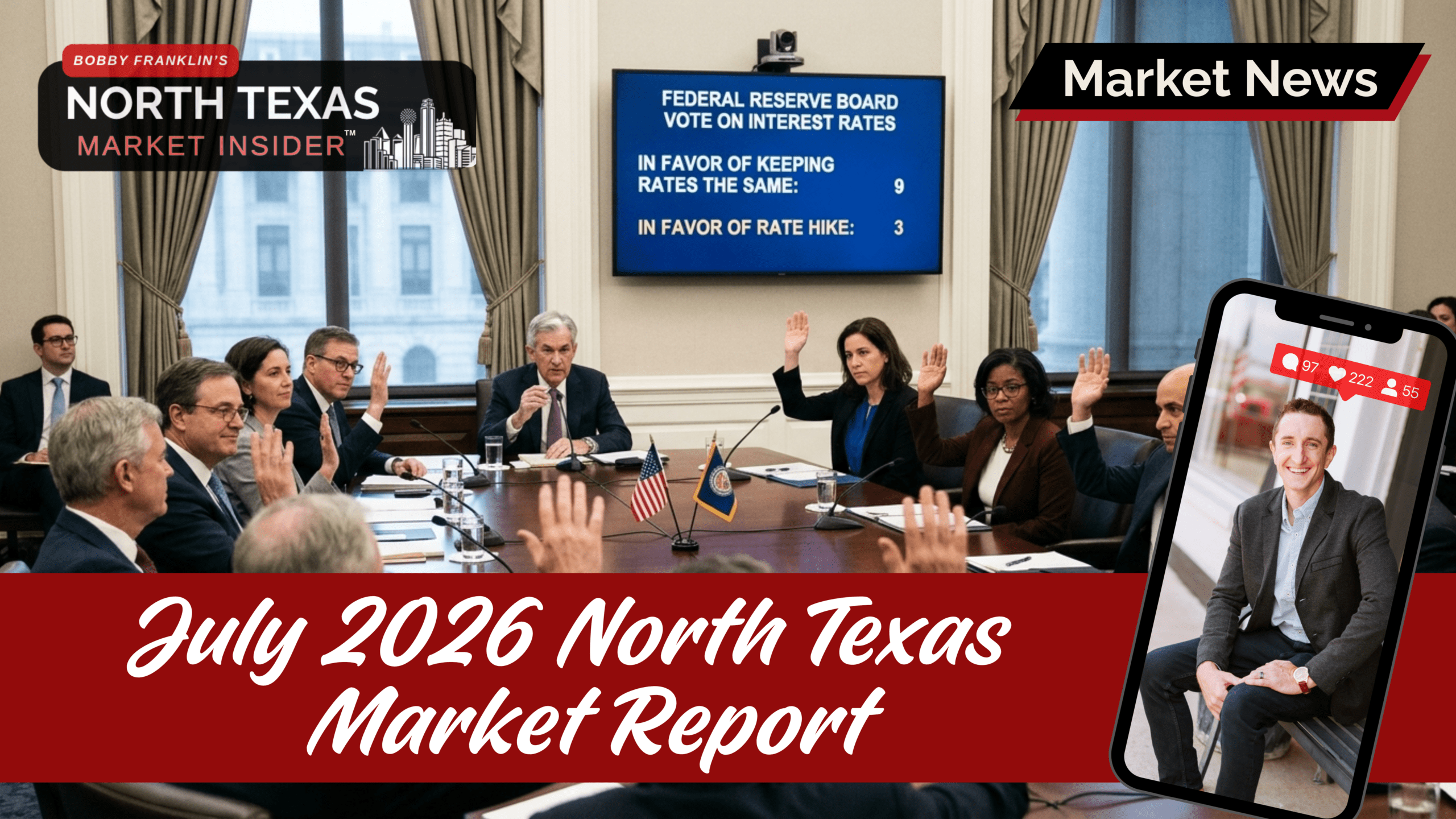
The committee met on the 28th and 29th and held the Fed rate at 3.50% to 3.75% for a fifth straight meeting, which is the part that made the headlines but remained the least interesting thing that happened in the room. The most interesting thing was the dissension. The vote came in 9 to 3. Beth Hammack of Cleveland, Neel Kashkari of Minneapolis, and our own Lorie Logan at the Dallas Fed all dissented in favor of a quarter-point increase, and all three of them run regional banks. You’d have to go back to September 2016 to find three policymakers dissenting in the same direction, which tells you something about how unusual it is for a committee that prides itself on consensus to fracture in public.
North Texas Market Insider™ · FOMC, July 28-29, 2026
The Most Divided Fed Vote Since 2016
The committee held at 3.50% to 3.75%. Three officials wanted to go the other direction.
-
9
Voted to hold
The majority sided with Chair Kevin Warsh to keep rates unchanged for a fifth consecutive meeting.
-
3
Dissented in favor of a quarter-point HIKE
Beth Hammack · Cleveland Fed
Neel Kashkari · Minneapolis Fed
Lorie Logan · Dallas Fed
- Why it is unusualAll three dissenters are regional bank presidents rather than Washington-appointed governors, and it is the first time since September 2016 that three policymakers dissented in the same direction.
- What the bond market didThe 30-year Treasury yield touched a 19-year high of 5.21% in the session that followed. Investors did not read the hold as reassurance.
- Where the odds wentSeptember hike odds ran above 57% immediately after the meeting, then fell to roughly 42% once the July CPI print landed on target.
The distinction that matters: a projection is a forecast. A dissent is a vote. In June the Fed was thinking about hiking. In July, three officials tried. September 16 is the next meeting.
Bobby Franklin, REALTOR® · Legacy Realty Group – Leslie Majors Team214-228-0003 · northtexasmarketinsider.com
Bond traders read between the lines with the vote and did not treat the hold as reassurance. The 30-year Treasury reached a 19-year high of 5.21% in the session that followed, and the mortgage market did what the mortgage market does when the long end of the curve gets nervous. Freddie Mac’s 30-year fixed climbed almost every week of the month and closed at 6.69% on August 6, a fifth consecutive weekly increase and the highest rate of 2026. Anyone shopping for a house in the back half of July was financing into a headwind that had nothing to do with their credit score and everything to do with three regional bank presidents deciding inflation was still winning.
Then, on the morning of August 7, the labor market walked into the room and ended the argument in about ninety seconds.
The Trade Changed and Nobody Announced It
The economy shed 23,000 jobs in July against an expectation of adding 83,000, and the revisions underneath the headline were uglier than the headline itself, with May cutting by 66,000 and June cutting by 37,000 for a combined 103,000 jobs that turned out never to have existed. Unemployment technically improved to 4.1%, though it improved because people quit looking rather than because they found work, with labor force participation sliding to 61.4% and its weakest level in more than five years. Six days later, Freddie Mac printed 6.67%, the first decline in six weeks.
North Texas Market Insider™ · July 2026
Five Weeks Up, Then One Jobs Report Down
Freddie Mac 30-year fixed, weekly average. The climb was an inflation story. The reversal was a labor story.
Jul 16
6.55%
Jul 23
6.58%
Jul 30
6.66%
Aug 6
6.69%
2026 highAug 13
6.67%
First drop in 6 weeks
What actually moved it: the August 6 peak came after three Fed officials formally voted to raise rates. The August 13 decline came six days after the July jobs report showed the economy shedding 23,000 positions. The Fed did nothing in between. The bond market reacted to the labor data on its own.
Source: Freddie Mac Primary Mortgage Market Survey. Weekly survey averages reflect conventional, conforming loans with 20% down and excellent credit, and will differ from an individual quote.
Bobby Franklin, REALTOR® · Legacy Realty Group – Leslie Majors Team214-228-0003 · northtexasmarketinsider.com
Sit with the mechanism there for a second, because it quietly replaced everything you were watching before. The Fed did nothing between August 6 and August 13. No meeting, no statement, no cut. Mortgage rates fell during that time because the bond market got frightened enough by the labor data to bid Treasuries up and yields down, which means the thing that helped your buyer this month was not policy, it was perceived market weakness. For four months this market traded on geopolitics, and every conversation I had with a client started somewhere in the Strait of Hormuz. As of August the bond market is trading on payrolls, and if you want a lower rate this fall, the honest version of that wish is that you are hoping for a worse economy.
The odds tell the same story. Futures had September hike probability above 57% the day after the FOMC, then watched it fall to roughly 42% once the July CPI landed on target at 3.4% headline and 2.5% core, with gasoline still running 24.6% above last year at $4.04 a gallon. I would hold that payroll number loosely, since a 50,000 drop in local government education jobs did most of the damage and several economists expect it to revise. One month at negative 23,000 is not statistically distinguishable from zero anyway. The trend and the revisions together however, are what matter, and both are pointing the same direction. What I would not hold loosely is the pairing nobody seems to be making: prices rose 3.4% while average hourly earnings grew 3.2%, so real income is going backward. Every affordability conversation that fixates on the rate is missing half of the equation, what’s happening inside your buyer’s paycheck.
All of which brings September 16 into focus as the most consequential date on anyone’s calendar. Three officials tried to hike in July. If the labor data keeps deteriorating they lose the argument and rates keep easing, and if it stabilizes they may well win it, at which point mortgage rates in the low sixes become a thing of the past.
North Texas Closed 10,701 Homes Anyway
Every macro signal in July told buyers here to sit still, but the transaction data says they did not listen.
North Texas Market Insider™ · NTREIS, July 2026
North Texas Closed 10,701 Homes in July
Every macro signal told buyers here to freeze. The transaction data says they did not.
10,701
Total closed sales, resale plus new construction
$370,000
Median resale sold price
30 days
Median resale days on market
96.8%
Resale share of original list price
-
Resale
Existing homes
Closed sales8,649
Median sold price$370,000
% of original list96.8%
Median days on market30
Months of inventory5.4
Average concession3.2%
-
New Construction
Where the negotiating room is
Closed sales2,052
Median sold priceNot pulled
% of original list95.4%
Median days on market55
Months of inventory4.3
Average concession4.6%
Read the two columns against each other. New construction carries less inventory than resale, yet it sits nearly twice as long and concedes half again as much on price. That is builders listing optimistically and negotiating on the back end, which is exactly where a prepared buyer finds room this fall.
Source: NTREIS MLS, July 2026. The NTREIS footprint spans the DFW metro and surrounding counties, so a single city can diverge sharply from the aggregate. Builder and resale months-of-supply are not calculated identically, so the inventory comparison is directional rather than exact.
Bobby Franklin, REALTOR® · Legacy Realty Group – Leslie Majors Team214-228-0003 · northtexasmarketinsider.com
The NTREIS footprint spans the DFW metro and a wide band of surrounding counties, so a single city can diverge sharply from the aggregate, and county-level figures update monthly on the live DFW market data page.
Thirty days is the number I keep coming back to. That is the median time a resale home spent before going under contract while the Fed was publicly fracturing, rates were setting yearly highs, and sellers still walked away with 96.8% of what they originally asked, meaning the market extracted an average concession of 3.2%. That is not a market absorbing a shock. That is a market that barely noticed one.
It is also tighter than what I reported to you last month, which is the part worth pausing on if you have been waiting. Resale inventory sat near six months in June and finished July at 5.4, and the typical home moved faster in July than it did in June. The buyer leverage I flagged for you thirty days ago narrowed while everyone was staring at Washington, which is the recurring cost of shopping the headlines instead of the market. For scale, the median existing home in America sold for $434,100 in July while the median resale here in Dallas/Fort Worth sold for $370,000. That $64,000 gap is the entire reason the California relocation guide stays one of the most-read pages on this site.
Where the Room Actually Is
Now look at those two earlier columns against each other, because there is something sitting in them that contradicts every national headline about builders in distress.
New construction carried 4.3 months of inventory in July against resale’s 5.4, which means the new-build side of this market is tighter on raw supply than the resale side, and that is not remotely what sixteen consecutive months of builder sentiment below 40 would lead you to expect. Then look at the other two rows, where new construction sat 55 days against resale’s 30 and closed at 95.4% of original list against resale’s 96.8%. Less inventory, nearly twice the time on market, and half again the concession on price.
My read is that builders here are listing optimistically and making the deal on the back end. The inventory is not sitting because nobody wants it, it is sitting because the ask starts high and the negotiation happens on the way down, which is a fundamentally different condition than a market with no demand. I will name the soft spot in that read before a builder’s rep does it for me: months-of-supply is not calculated identically on both sides, since a home still under construction gets counted differently than a finished spec on a lot, so treat the inventory comparison as directional rather than exact. The days-on-market and percent-of-list figures are clean, and they point the same way, which is why I am comfortable making the call.
For a buyer, that gap is the most useful thing in this entire report. The average new-construction home in North Texas closed 4.6% below its original ask in July against 3.2% for resale, so the negotiating room in this market sits on the builder side and runs roughly half again wider than it does in resale, even as builders nationally sound less panicked than they did a month ago. August sentiment actually ticked up to 35 and the share cutting prices fell to 35% from 37%, against forecasts calling for a third straight decline, so the national builder story is softening rather than collapsing.
The largest builder in the country said the operative part out loud on July 21. D.R. Horton reported $3.20 per diluted share, down 5% year over year, on 23,983 closings at an average price of $362,000 that was itself down 2%, and the forward guidance did not hedge: affordability constraints and cautious consumer sentiment continue to impact new home demand, and the company expects sales incentives to remain elevated through the fourth quarter. When a builder tells its own shareholders it plans to keep paying to move product, that is not a warning, it is an invitation, and if you are touring new construction anywhere across South DFW without asking for a rate buydown, closing cost help, and a design center allowance in the same conversation, you are declining money the builder already budgeted to hand you.
The Complication I Did Not See Coming
I have spent months in this space arguing that the capital pouring into the I-35E corridor is the structural floor under Ellis County values, and I still believe it. That thesis is why the DFW Data Center Intelligence Map exists, and it got a substantial reinforcement in April when DataBank closed a $2 billion construction loan for the first three of eight buildings at its Red Oak campus, 600,000 square feet and 180 megawatts, fully pre-leased, with Business Insider identifying Oracle as the tenant from state comptroller tax-exemption filings even though DataBank has never named it publicly.
Then Neel Kashkari explained his dissent, and said recent data center investment has added a new demand element to inflation, with his fellow dissenters making parallel arguments about demand-side pressure that monetary policy ought to answer. A sitting Federal Reserve official is now pointing at the exact category of investment I have been calling a local tailwind and calling it a reason to raise rates.
I am not going to resolve that neatly, because it does not resolve neatly. The buildout supports your land value and it contributes, at the margin, to the rate environment your buyer has to finance through, and both of those are true at the same time. What I would take from it practically is that if this argument gains traction on the committee, the corridor sitting closest to the buildout is also the corridor most exposed to a hawkish Fed, which is an argument for moving on a purchase before September 16 rather than after it, and not remotely an argument for selling.
North Texas Market Insider™ · The Complication
The Same Buildout Cuts Both Ways
A sitting Federal Reserve official just named data center investment as an inflation driver. That changes the Ellis County math.
-
↑ What it does for your land
Billions in permanent capital anchored to the I-35E corridor, funded and under construction rather than announced and pending.
Every megawatt built is jobs, rooftops, and a demand floor that does not move when the 30-year fixed does.
This part has not changed.
-
↓ What it does to your buyer’s rate
Minneapolis Fed President Neel Kashkari, explaining his dissent in favor of a rate hike, said recent data center investment has added a new demand element to inflation.
His fellow dissenters made parallel arguments about demand-side pressure that monetary policy should answer.
This part is new as of July.
$2B
DataBank construction loan, closed April 21
180 MW
First three buildings, all pre-leased
600K
Square feet in phase one
3 to 2
Red Oak P&Z vote recommending denial of a separate 800-acre project
What a homeowner does with this: stop treating the buildout as a one-directional positive in your own math. It supports your land value and it contributes, at the margin, to the rate environment your buyer has to finance through. If this argument gains traction on the committee, the corridor closest to the buildout is the corridor most exposed to a hawkish Fed. That is a reason to move on a purchase before September 16, not a reason to sell.
Sources: Kashkari and Hammack dissent statements, July 31, 2026; DataBank financing announcement, April 21, 2026; Ellis County Press coverage of the Red Oak Planning and Zoning Commission. Oracle identified as tenant by Business Insider based on state comptroller tax-exemption filings; DataBank has not publicly named the tenant.
Bobby Franklin, REALTOR® · Legacy Realty Group – Leslie Majors Team214-228-0003 · northtexasmarketinsider.com
There is a second complication closer to home, and it’s escalating. When a separate 800-acre data center development came before the Red Oak Planning and Zoning Commission, the meeting ran nearly four hours and the commission voted 3 to 2 to recommend denial of the rezoning. Residents are now organizing, and approved capital and community consent turn out to be two very different things. If you are buying land in this corridor on the assumption that every project sails through entitlement, read what I wrote about living near one of these before you write the offer.
Two things did land in your favor while all of this was happening, neither of which got much coverage. Texas Proposition 13 took effect January 1 and raised the school-district homestead exemption from $100,000 to $140,000, with the additional senior and disabled exemption climbing from $10,000 to $60,000, which on a Midlothian or Waxahachie home is real money against a monthly payment and stacks with the exemption changes I covered for married homeowners. Insurance inflation also decelerated hard, from 18.7% growth in 2024 to 4.3% in 2025 per the Texas Department of Insurance, though I would not oversell that one, since we are decelerating from a punishing base and the average Texas premium still runs near $4,585 against a national average around $2,110, with DFW homeowners typically landing between $3,800 and $5,200 because we sit in the worst hail corridor in the country.
What I Would Actually Tell You
If you are selling, thirty days should govern every decision you make between now and your list date, because a thirty-day median means the market renders its verdict on your price inside a month and the penalty for getting it wrong compounds far faster than most sellers expect. Overprice by five percent and you don’t sell for five percent too much, you sit past thirty days and then past sixty, and somewhere in there the buyers looking at your listing stop assuming the price is high and start assuming something is wrong with the house.
By the time you finally cut, you are negotiating from a tired listing instead of a fresh one, and the market still takes its 3.2% out of a number you already lowered. The sellers hitting 96.8% of original list are the ones who priced to current comps on day one, which is not a personality trait, it is a decision made before the sign goes in the yard. Run your address through the days on market calculator before you pick a number rather than after your first reduction, and pair it with my pricing strategy guide and the seller’s prep checklist.
North Texas Market Insider™ · Seller Tool
What Overpricing Actually Costs in a 30-Day Market
The July median resale sold in 30 days at 96.8% of original list. Move the sliders and watch what happens when you start above the market.
$420,000
Your list price
75
Estimated days to contract
$387,200
Likely sold price after the market corrects you
$8,100
Extra carrying cost while it sits
Priced at market, you are the 30-day seller closing near 96.8% of ask.
Illustration only, not an appraisal or a CMA. Days-to-contract scales from the July NTREIS median of 30 days; sold price applies the 96.8% median share of original list to a market-correct number; carrying cost assumes roughly 0.55% of value per month in mortgage interest, taxes, insurance, and utilities. Your street, price band, and condition will differ. Sourced from NTREIS MLS, July 2026.
Bobby Franklin, REALTOR® · Legacy Realty Group – Leslie Majors Team214-228-0003 · northtexasmarketinsider.com
If you are buying, the negotiating room is firmly on the builder side while it narrowed on the resale side, so shop accordingly. Ask for the buydown, ask for the closing costs, ask for the design center allowance, and ask for all three in the same conversation, because the worst thing that happens is somebody says no and you are exactly where you started. What I would not do is wait for a better rate without understanding what you are actually waiting on, since the path to rates in the 5’s runs through a deteriorating labor market and not through Fed generosity.
Either way, the best decisions are made with your financing already in place, because at a thirty-day median the listings worth having do not wait for you to get pre-approved. Here are the four lenders who have proved themselves with my buyers:
- Andrew Bryan, Miramar Mortgage: andrewthelender.com
- Rachael Carter, My Texas Mortgage Team: mytxmortgageteam.com
- Jennifer Nelson, Eustis Mortgage: eustismortgage.com
- Taylor Fruge, Lower Mortgage: lower.com
I recommend these lenders based on their expertise, service and past performance with my clients. I do not receive compensation for referrals.
Four Markers Heading Into September
Four things will tell me whether any of the above still holds a month from now, and I am watching each of them at a specific number rather than as a general mood.
North Texas Market Insider™ · Five Steps Ahead
Four Markers Into September
Each one carries a number, because a watch item without a threshold is just a mood.
-
1
September 16
FOMC meeting · hike odds near 42%
Three officials formally voted to hike in July, so a September increase is live. A hike pushes the 30-year back toward 7% and changes every recommendation in this report.
-
2
10-year below 4.5%
The number that sets your mortgage rate
Break that level and the 30-year fixed heads toward the low sixes and demand returns fast. Watch this more closely than any Fed statement.
-
3
Inventory above 6.0 months
Currently 5.4 in North Texas resale
We tightened from roughly six months in June. Cross back over six and buyer leverage returns, and seller strategy has to shift with it.
-
4
Brent above $100
Currently near $90
Triple digits puts energy back into the inflation print, hands the hawks their argument, and takes rate relief off the table entirely.
The through-line: in this environment the path to a lower mortgage rate runs through a weakening labor market, not through Fed generosity. If you are waiting on rates, be honest about what you are actually rooting for.
Bobby Franklin, REALTOR® · Legacy Realty Group – Leslie Majors Team214-228-0003 · northtexasmarketinsider.com
September 16 is the date of the next Fed meeting, and with three dissents already on the record, a hike is genuinely on the table. A hike would push the 30-year mortgage rates back towards the 7% range and it would invalidate most of what I just told you about buyer timing. The ten-year Treasury falling below 4.5% would be the level we need to see that would pull mortgage rates toward the low 6’s and revive demand quickly. This deserves more of your attention than any Fed statement. Seeing North Texas resale inventory rise back above 6 months, from the 5.4 where we closed July, is the point at which buyer leverage really returns and seller strategy has to change with it. Brent crude oil prices above $100, from roughly $90 now, would put energy back into the inflation calculus, hand the Fed dissenters their argument, and take rate relief off the table entirely.
The full archive of monthly market reports lives on the site, ongoing coverage of permits and developments runs through the Insider Daily News blog, and if you are still deciding which corridor fits you, start at Explore North Texas or schedule a consultation and we will build the shortlist together.
If you are weighing a move anywhere between Dallas and Waco, call me at 214-228-0003. I will tell you what the data supports, what it does not, and which parts of my read are opinion.
This article is for informational and market-education purposes only and is not financial, tax, or legal advice. Local market data reflects NTREIS closed transactions for July 2026 across the NTREIS coverage area and is not a prediction of future performance. Mortgage rate figures are national survey averages and will differ from an individual quote based on credit, down payment, loan type, and property. All references to neighborhoods, schools, and communities are made without regard to race, color, religion, sex, familial status, national origin, or disability, consistent with the Fair Housing Act. Following the 2024 National Association of REALTORS® settlement, buyer agent compensation is negotiated in a written buyer representation agreement signed before touring and is not set by law, per NAR’s settlement guidance. Bobby Franklin, REALTOR®, TREC #0805459, Legacy Realty Group – Leslie Majors Team, 16 Northgate Dr. Ste 100, Waxahachie, TX 75165.