

Last updated: October 20, 2026
Usually, yes: a short sale beats handing your house back to the bank when the home is marketable and you still have time to sell it, but the label on the deal decides far less than the written release your servicer signs. Most homeowners assume every exit is the same loss wearing a different name. They are not, and the gap between a short sale, a deed in lieu, a bankruptcy surrender, and a foreclosure shows up in real dollars, in years of credit recovery, and in whether a lender can still come after you once the keys are gone.
Distressed Home Decision Path
Five Questions That Pick Your Exit
Answer them in order. The first “yes” points to the option to investigate first, before you sign anything that gives up title.
Can you keep the home at a payment you can actually afford?
Retention: forbearance, repayment plan, or modification
Will a normal sale cover every lien and closing cost?
Traditional sale: keep your equity and your credit
Underwater, but marketable with time to find a buyer?
Short sale: you control price, buyer, and timing
One mortgage, clean title, and the sale isn’t working?
Deed in lieu: hand back title with a written release
Is the mortgage one piece of a bigger debt crisis?
Bankruptcy counsel before you transfer anything
None of the above, or out of time?
Foreclosure: the least control and the most risk
Option sequence reflects general loss-mitigation guidance and is not legal, tax, or credit advice. Sources: CFPB, Avoid Foreclosure; CFPB Mortgage Key Terms.
The stakes jumped in 2026. The federal tax break that shielded forgiven mortgage debt on a primary home expired at the end of 2025, so a North Texas homeowner who closes a short sale or deed in lieu this year can walk away from the house and still face a tax bill on the balance the lender forgave. The owner who understands the debt, tax, credit, title, and timing consequences before signing walks away with a plan, while the owner who waits for the lender to decide walks away with whatever is left.
This guide is built for Texas owner-occupants across Ellis, Dallas, Tarrant, and Johnson counties and the rest of the North Texas market. This is an educational piece, not legal, tax, bankruptcy, credit, or underwriting advice, and anyone facing this decision should put a HUD-approved housing counselor, a Texas real estate attorney, a bankruptcy attorney where it applies, and a CPA or enrolled agent on the same page before giving up title or accepting canceled debt.
3 Different Things People Call “Surrender”

The word surrender gets thrown around online as if it meant one transaction. It means at least three, and confusing them is how homeowners sign the wrong document.
A short sale is a sale to a third-party buyer for less than the total mortgage debt, completed only with every affected lienholder’s approval. A deed in lieu of foreclosure is a voluntary transfer of ownership directly to the lender so it never has to finish a foreclosure. The Consumer Financial Protection Bureau’s foreclosure-avoidance guidance treats both as ways to leave a home through loss mitigation, and neither one is automatic: both require a completed application and servicer approval.
Bankruptcy surrender is a different animal entirely. In a bankruptcy case, surrendering collateral generally means giving up possession and the right to fight the creditor’s recovery of the property, which is not the same legal event as signing a deed. A discharge can wipe out personal liability for dischargeable mortgage debt while a valid lien stays attached to the house until title actually moves through a deed or a foreclosure.
Side by Side
Five Exits Compared
What happens to the title, who finds the buyer, and what happens to the debt under each way out. Read across before you decide.
Traditional sale
Best case
Title
Transfers to a third-party buyer
Buyer
Owner and broker
The debt
Liens are paid in full at closing
Watch for
Confirm true net proceeds before assuming you’re underwater
Short sale
Most control
Title
Transfers to a third-party buyer
Buyer
Owner and broker
The debt
Lienholders accept less than payoff; what you still owe depends on the written approval
Watch for
Deficiency waiver, deadlines, every lienholder’s sign-off
Deed in lieu
Simplest exit
Title
Transfers directly to the lender or its designee
Buyer
No buyer needed
The debt
Depends on the written agreement and loan program
Watch for
Clean title, junior liens, vacancy, full release language
Bankruptcy surrender
Court process
Title
Handled through the case; may still need a deed or foreclosure
Buyer
Usually no conventional buyer
The debt
Discharge may remove personal liability, but a valid lien can survive
Watch for
The lender does not instantly own the house
Foreclosure
Least control
Title
Transfers through a trustee’s or court-ordered sale
Buyer
Trustee or authorized party
The debt
A deficiency may remain, subject to the note, law, and defenses
Watch for
Lost control, deadline pressure, credit damage
General comparison, not legal, tax, or credit advice. Sources: CFPB Mortgage Key Terms; CFPB, Avoid Foreclosure; U.S. Courts, Discharge in Bankruptcy; Tex. Prop. Code §51.003.
The CFPB mortgage glossary defines both terms the same way and goes one step further, advising borrowers in states that allow deficiency liability to get any waiver in writing and keep it. Treat that line as the single most valuable sentence in this article.
Short Sale or Give It Back to the Bank?

A short sale is usually the stronger first move when the house is marketable, there is enough runway to find a buyer, and you want a hand on the price, the contract, the move-out date, and how subordinate liens get handled. It puts the property in front of the full retail market instead of asking the lender to become a reluctant owner, and a better recovery for the lender often makes approval easier to win.
A deed in lieu earns its place when title is clean, the home has not sold, the owner wants a simpler exit, and the lender puts a complete release in writing on acceptable terms. Fannie Mae’s Mortgage Release program, governed by its Servicing Guide section D2-3.3-02, describes exactly that structure: eligible borrowers transfer the home with no further financial responsibility for the mortgage, and Fannie Mae’s servicer materials say they may qualify for up to $7,500 in relocation assistance.
Neither one beats a normal sale that pays every lien and closing cost, and the CFPB says plainly that selling normally when the home is worth more than the debt is typically better for your finances and your credit than foreclosure, a short sale, or a deed in lieu. Before anyone uses the words “short sale,” get written payoff statements, estimate realistic selling costs, identify every claim that could surface at closing, and get a real market analysis.
North Texas values swing hard by neighborhood, school boundary, condition, builder competition, and even the phase of a subdivision, so compare current inventory and recent closings through the North Texas real estate news and market intelligence hub and the city pages for Waxahachie, Midlothian, and Red Oak before you conclude the house is underwater.
How a Texas Short Sale Actually Works
A short sale runs two negotiations at once. You are negotiating a contract with a buyer while you and your authorized representatives are negotiating approval from every lienholder whose payoff comes up short, and a weak link on either side collapses both.
The practical sequence looks like this:
Two Negotiations at Once
The Short Sale Roadmap
Nine steps in three phases. You negotiate with a buyer and with every lienholder at the same time, and a weak link on either side can sink the deal.
Phase 1
Build the file
Know your exit number
Every payoff: first mortgage, second or HELOC, taxes, HOA, solar, judgments, closing costs.
Request the loss-mitigation package
Use the servicer’s official channel and log every date, name, and confirmation number.
Submit your financials
Hardship letter, income, tax returns, bank statements, budget, occupancy statement.
Phase 2
Market and submit
List at a defensible price
The lender will order a valuation and can reject any offer below its net target.
Disclose that approval is required
Build deadlines, possession, and buyer costs around the wait.
Send a complete offer package
Signed contract, estimated settlement statement, proof of funds, comps, repair evidence.
Phase 3
Negotiate and close
Negotiate every term, not just price
Deficiency waiver, any contribution or new note, deadline, relocation help, other liens, credit reporting.
Close only under written approval
The settlement statement must match each lienholder’s terms line by line.
Keep the whole file
Approvals, releases, settlement statement, deed, tax forms, and proof of correct credit reporting.
A complete application received more than 37 days before a scheduled foreclosure sale generally bars the servicer from holding that sale while it is reviewed. Treat 37 days as a hard deadline, not a comfortable starting point.
General process; requirements vary by investor, insurer, and loan type. Not legal advice. Sources: 12 CFR 1024.41 (Regulation X); CFPB, Avoid Foreclosure.
Federal servicing rules give you real procedural protection without forcing a servicer to hand you any particular outcome. Under Regulation X loss-mitigation procedures, a complete application submitted more than 37 days before a scheduled foreclosure sale can restrict the servicer from moving forward while the application is reviewed, with specific facts and exceptions controlling.
Do not read that 37-day line as a comfortable starting point. A short sale needs valuation, marketing, a willing buyer, clean paperwork, approval from potentially several lienholders, and a closing before the approval expires, so the moment the hardship becomes clear is the moment to start.
How a Deed in Lieu Works

A deed in lieu takes the retail buyer out of the picture. You offer to transfer title directly to the mortgage holder or its designee, and the lender decides whether owning your house makes financial and legal sense for it. Expect the servicer to examine:
- Whether your hardship qualifies, and whether a retention option or a short sale fits better
- The property’s value, occupancy, condition, and insurability
- Whether you can deliver vacant possession on the agreed date
- Whether property taxes, HOA claims, municipal charges, judgments, second mortgages, HELOCs, solar liens, or other encumbrances cloud the title
- Whether the transfer is voluntary and properly documented
- Whether the agreement releases only the lien or also releases you personally
Clean title is the dividing line. A first mortgage holder taking a deed has no interest in inheriting someone else’s claims, which is why a property with a second mortgage or a judgment can be workable as a short sale, where junior releases get negotiated through closing, and dead on arrival as a deed in lieu.
Mailing the keys, moving out, or telling customer service the lender can have the house accomplishes nothing. The lender has to accept in writing, title has to legally transfer, and the agreement has to address the debt, and even the CFPB says a deed in lieu could spare you a remaining deficiency, with the weight of that sentence sitting squarely on the word “could.”
Texas law adds a rule that protects the lender, not you. Under Texas Property Code Section 51.006, a lender that accepts a deed in lieu and later discovers a lien the borrower failed to disclose can void that deed before its fourth anniversary and foreclose under the original deed of trust. A deed transfer is a legal instrument and never an informal key drop, so disclose every lien up front and have Texas counsel review the proposed deed, its title consequences, releases, warranties, indemnities, occupancy promises, and any reservation of rights before you sign.
What Bankruptcy Surrender Really Means
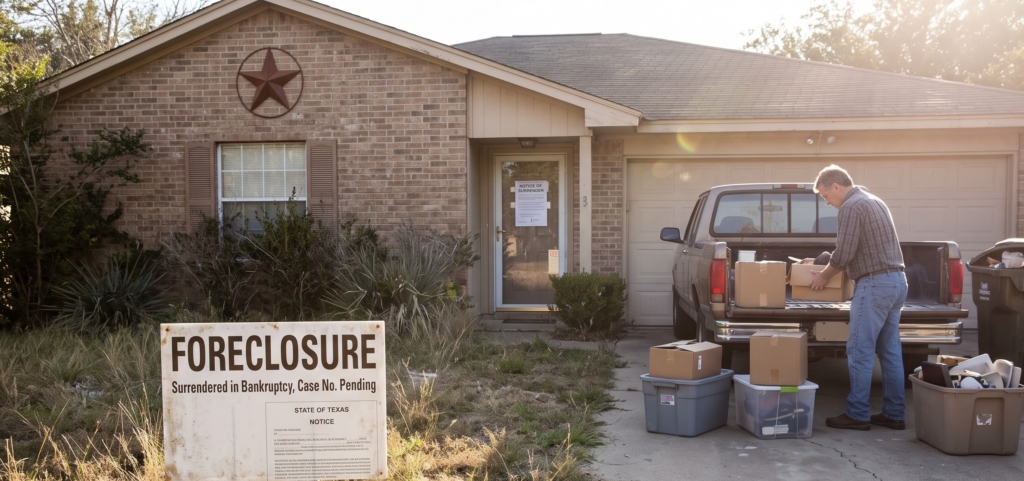
Bankruptcy surrender and a deed in lieu travel in the same neighborhood without being the same thing. In a bankruptcy case, surrender concerns how the debtor treats collateral, and courts have described it as giving up possessory rights and making the property available so the secured creditor can use its state-law remedies, which does not by itself transfer ownership.
That gap sets a trap. A homeowner can receive a discharge and move out while remaining the owner of record until the lender accepts a deed or finishes foreclosure, and during that window the questions about insurance, HOA charges, maintenance, code compliance, casualty risk, and occupancy do not disappear simply because you stopped living there.
The U.S. Courts Chapter 7 bankruptcy guide explains that a discharge removes personal liability for many debts without automatically extinguishing a valid lien, and the U.S. Courts bankruptcy discharge guide confirms a secured creditor can still enforce an unavoided lien against the property after the personal debt is gone. If bankruptcy is on the table, do not sign a short-sale approval, reaffirmation agreement, deed in lieu, promissory note, or cash-contribution agreement until bankruptcy counsel has reviewed how it affects the estate, the discharge, your exemptions, and the automatic stay.
The Deficiency Is the Whole Fight
The deficiency is the unpaid gap left after the approved proceeds or collateral value are applied to the debt. If the total mortgage debt and approved charges come to $410,000 and the lender receives $365,000 in net proceeds after commissions and closing costs, the economic shortfall sits at $45,000 before anyone accounts for the contract, credits, insurance, legal rules, or settlement terms. Run the calculator below to determine your deficiency.
Run Your Own Numbers
How Big Is Your Deficiency?
Enter your total payoff, a realistic sale price, and your selling costs. The gap is what the lender can try to collect unless the approval waives it in writing.
Net proceeds to lender
$365,000
Sale price minus costs
Deficiency
$45,000
11.0% of the debt goes unpaid
Status
Underwater
A short sale needs lender approval
Lien release only
The sale closes and the lien comes off the title, but you may still owe $45,000. In Texas, a lender generally has two years after a foreclosure sale to sue for a deficiency.
Full release plus written waiver
You owe the lender $0. The forgiven $45,000 can still count as taxable income in 2026 unless an exclusion such as insolvency or bankruptcy applies.
Illustration only, not legal or tax advice; actual deficiency depends on your note, approval terms, credits, and applicable law. Sources: Tex. Prop. Code §51.003; CFPB Mortgage Key Terms; IRS Publication 4681.
Here is where homeowners get hurt: a lien release and a debt release are not the same document. A lender can agree to release its lien so the sale closes while quietly preserving its claim against you for the balance, which is why the only approval language worth signing expressly addresses full satisfaction, release of personal liability, waiver of deficiency, collection rights, and any contribution or new note. Your servicer is negotiating for the investor who owns your loan, not for you, so the release language that protects you shows up only when you demand it.
Texas does not universally prohibit mortgage deficiencies, no matter what you read in a comment section. After a foreclosure sale, Texas Property Code Section 51.003 generally gives a creditor two years to bring a deficiency action while letting the borrower request a fair-market-value determination that can shrink the claim, and the Texas State Law Library’s post-foreclosure guide walks through that same process.
Texas does carve out one real exception. A home equity loan made under Article XVI, Section 50(a)(6) of the Texas Constitution is nonrecourse, which means that lender cannot pursue you personally for a deficiency, but the protection follows the home equity loan and not your original purchase mortgage, so confirm exactly which kind of loan sits on your title.
Section 51.003 is written around foreclosure sales, so your exposure after a negotiated short sale or deed in lieu has to be read from your note, any guaranty, the approval agreement, the deed-in-lieu documents, the loan program, your bankruptcy status, and the rest of applicable law. Anyone telling you “Texas is nonrecourse” is stretching one narrow home equity rule across every mortgage in the state, and anyone promising “the bank always forgives the rest” is selling confidence they cannot back up.
Make your attorney answer these in plain English
Before closing, the attorney reviewing your approval should be able to tell you whether the document releases only the lien or every borrower and guarantor personally, and whether the deficiency is fully waived, partially settled, preserved, or rolled into a new note. Ask who else could pursue the balance, including the lender, a mortgage insurer, an investor, a collection agency, or a subrogated party, and whether any cash contribution is due before or at closing.
Push further on whether the approval covers only the first mortgage or every lien being released, what happens if closing misses the deadline by a single day, and whether broad representations, indemnities, or survival clauses are buried in the fine print. Finish with how the account will be reported to the credit bureaus and whether the creditor will issue Form 1099-C, Form 1099-A, or both.
Texas Foreclosure Moves Fast
Texas commonly uses nonjudicial foreclosure when the deed of trust includes a power-of-sale clause, which lets the lienholder sell the property without first winning a conventional foreclosure judgment, provided it follows the loan documents and the law.
Texas Property Code §51.002
The Texas Foreclosure Clock
Texas nonjudicial foreclosure runs on statutory minimums, not on how long your short sale needs. Here is the shortest legal path from a residential default notice to the courthouse steps.
Step 1
Day 0
Notice of default
The servicer sends written notice of default and the chance to cure.
Step 2
20 days
Minimum cure window
At least 20 days to cure before a notice of sale can go out on a residence.
Step 3
21 days
Notice of sale
Posted, filed with the county clerk, and mailed at least 21 days before the sale.
Step 4
1st Tue
Foreclosure sale
Between 10 a.m. and 4 p.m., or the first Wednesday when that Tuesday is January 1 or July 4.
Minimum notice periods for a residential deed of trust; specific facts, loan documents, and exceptions control. Sources: Tex. Prop. Code §51.002; 12 CFR 1024.41 (Regulation X).
For a qualifying residential default, Texas Property Code Section 51.002 generally requires at least 20 days to cure before a notice of sale, followed by at least 21 days’ notice of the sale itself, with sales generally held between 10 a.m. and 4 p.m. on the first Tuesday of the month, or the first Wednesday when that Tuesday falls on January 1 or July 4. The Texas State Law Library’s pre-sale foreclosure guide lays out the full notice sequence.
Those minimums are a legal floor, not a planning calendar. Servicer review, buyer financing, title work, repair negotiations, valuation disputes, junior-lien approvals, and closing can eat far more time than the statute allows, so contact the servicer before you miss a payment whenever possible, get loss-mitigation instructions in writing, and calendar every default, acceleration, application, appeal, approval, and sale deadline the day you learn about it.
A pending short-sale listing or a reassuring call-center voice does not necessarily stop a foreclosure. Get written confirmation of any postponement, and when a sale date is close, have counsel verify its current status.
Credit Impact: Which Option Hurts Less?

Nobody can honestly tell you how many points a short sale or deed in lieu will cost, because the answer depends on your starting score, missed payments, balances, other negative accounts, reporting language, the scoring model, and time.
Experian explains that the words “short sale” never appear on your report; the lender will likely report the account as settled for less than the full balance, and it can stay for up to seven years. A deed in lieu is generally reported as closed with a zero balance but not paid in full, and it can likewise remain for up to seven years.
The bigger insight is that missed payments often do serious damage long before either transaction closes. If someone tells you that you are “required” to stop paying to qualify, ask the servicer in writing whether current or imminent-default borrowers are eligible, and talk to your legal and tax advisers before you change a single payment.
Buying again is its own question
How long something stays on your credit report and when you can qualify for a new mortgage are two separate clocks. Conventional, FHA, VA, and USDA programs each define these events differently, apply different waiting periods and exceptions, and individual lenders can layer their own overlays on top.
The Fannie Mae Selling Guide sets a four-year waiting period after a deed in lieu or preforeclosure sale, reduced to two years with documented extenuating circumstances. FHA generally requires three years under HUD Handbook 4000.1, though a short-sale borrower who made every mortgage and installment payment on time in the 12 months before the sale can still qualify. Under USDA’s underwriting handbook, a short sale or deed in lieu more than 36 months old is not adverse credit at all, and inside 36 months only Refer and manually underwritten files need a credit exception. VA guidance says a prior foreclosure, deed in lieu, or short sale does not by itself disqualify a borrower and may not require any waiting period when payment history was unaffected, though a loss on a prior VA-guaranteed loan can reduce the entitlement available for your next one.
Two Separate Clocks
How Soon You Can Buy Again
Standard waiting periods after a short sale or deed in lieu, measured from completion of the event. Each program has exceptions, and lenders can add overlays on top.
Conventional
Fannie Mae
4 years
Exception: 2 years with documented extenuating circumstances.
FHA
HUD Handbook 4000.1
3 years
Exception: short-sale borrowers current on every mortgage and installment payment for the 12 months before the sale can qualify sooner.
USDA
HB-1-3555, Chapter 10
3 years
Exception: after 36 months it is not adverse credit; inside 36 months, a GUS Accept file needs no credit exception.
VA
VA Pamphlet 26-7
None fixed
Possible: no wait when payment history was unaffected, though a loss on a prior VA loan can reduce entitlement.
Summaries as of October 2026; program rules change and individual lenders may impose stricter overlays. Sources: Fannie Mae Selling Guide B3-5.3-07; HUD Handbook 4000.1; USDA HB-1-3555 Ch. 10; VA Pamphlet 26-7.
If a future purchase is part of your plan, have a mortgage professional run the current handbook for your target program against your actual file before you pick an exit. These lenders know the program rules cold and can map out the your road back to good standing:
- Andrew Bryan, Miramar Mortgage: andrewthelender.com
- Jennifer Nelson, Eustis Mortgage: eustismortgage.com
- Taylor Fruge, Lower Mortgage: lower.com
- Rachael Carter, My TX Mortgage Team: mytxmortgageteam.com
I recommend these lenders based on their expertise and service. I do not receive compensation for referrals.
The 2026 Tax Trap
Forgiven debt can create taxable income even when you never see a dollar of cash. The IRS guidance on canceled debt says canceled debt is generally taxable unless an exception or exclusion applies, including bankruptcy and insolvency exclusions for those who qualify.
Under IRS Publication 4681, a foreclosure, short sale, deed in lieu, or abandonment also counts as a disposition of property, so a homeowner may be calculating gain or loss on a deemed sale and cancellation-of-debt income at the same time, with recourse and nonrecourse debt treated differently.
Federal Tax Law, 2026
The 2026 Tax Trap on Forgiven Mortgage Debt
The exclusion that shielded forgiven debt on a main home expired at the end of 2025, and the One Big Beautiful Bill Act did not bring it back. When your deal was agreed now matters as much as the deal itself.
Discharged before Jan. 1, 2026, or under a written agreement made before then
Exclusion available
Forgiven debt on a principal residence can be excluded from income under the qualified principal residence exclusion, up to $750,000 ($375,000 married filing separately).
New short sale or deed in lieu agreement made in 2026
Generally taxable
The forgiven balance is generally taxable income unless another exclusion applies, most commonly insolvency or bankruptcy.
$600
Lenders generally file Form 1099-C when they cancel this much debt or more.
$2,000
The new 2025 threshold covers contractor and miscellaneous payment forms, not canceled debt.
2 tests
A short sale or deed in lieu can trigger both gain or loss on the disposition and cancellation-of-debt income.
Law as of October 2026; Congress has revived this exclusion retroactively in the past, so confirm current status before filing. Not tax advice. Sources: 26 U.S.C. §108; IRS Publication 4681; IRS Instructions for Forms 1099-A and 1099-C.
The stakes went up this year. The federal exclusion that shielded forgiven mortgage debt on a main home, the qualified principal residence indebtedness exclusion under Internal Revenue Code Section 108, expired for debt discharged after December 31, 2025, and the 2025 One Big Beautiful Bill Act did not extend it. It now reaches only debt discharged under a written arrangement made before January 1, 2026, so a homeowner whose short sale or deed in lieu was agreed to by the lender after January 1, 2026, they may owe tax on the forgiven amount unless the insolvency or bankruptcy exclusion applies.
The IRS instructions for Forms 1099-A and 1099-C treat an agreement to discharge debt for less than full consideration as a reportable event, and lenders generally must file Form 1099-C when they cancel $600 or more. The new $2,000 reporting threshold in the 2025 tax law applies to contractor and miscellaneous payment forms, not to canceled debt. The lesson is simple and expensive to ignore: a lender agreeing not to collect a balance and the IRS agreeing not to tax it are two completely separate decisions, so never let anyone tell you a deficiency waiver is “tax free.”
Hand your tax professional the full picture before you sign
Your CPA or enrolled agent needs:
- Your original purchase closing statement and adjusted basis
- Records of capital improvements
- Current mortgage and HELOC balances, and how any loan proceeds were used
- The property’s use history, including any rental or business use and depreciation
- The estimated market value and proposed sale price
- The draft short-sale or deed-in-lieu approval
- A current asset-and-liability statement for an insolvency analysis
- Your bankruptcy status, if any
- Any expected Forms 1099-A or 1099-C
Junior Liens, HOAs, Solar, and Taxes
The first mortgage is rarely the only claim on the table. A second mortgage, HELOC, property-tax claim, federal tax lien, judgment, HOA claim, municipal lien, solar financing, divorce-related claim, probate issue, or disputed ownership interest can delay or kill the transaction outright.
In a short sale, junior lienholders may negotiate releases because money can be allocated through closing, subject to senior-lender and program limits. In a deed in lieu, those same claims can make the lender walk away from taking title, which is why ordering title work early beats discovering a lien after a buyer has waited four months.
North Texas homeowners also need to check HOA status. Association assessment-lien foreclosures follow Chapter 209 of the Texas Property Code, which generally requires an association to get a court order before foreclosing an assessment lien and bars foreclosure when the debt consists only of fines or fine-related attorney’s fees, with condominium rules running on their own track.
If the property is vacant or about to be, confirm insurance coverage in writing. The Texas Department of Insurance warns that policies typically exclude losses once a house sits vacant for the number of days the policy sets, often 60, and a lapse can breach the deed of trust and trigger force-placed insurance, which the NAIC says carries significantly higher premiums for limited coverage.
Five Owner Strategies Before You Choose
1. Prove you’re actually underwater
Comparing your mortgage balance against an automated estimate proves nothing. Build a seller net sheet with a realistic price range, liens, taxes, HOA amounts, concessions, repairs, moving costs, and negotiated brokerage compensation, because builder incentives can drag resale values down in one subdivision while low supply or a standout lot creates enough value for a normal sale in another. Pull the closed-sale trends on your own city’s page, whether that is Ennis, Mansfield, Dallas, or Fort Worth, and judge your property against its own market rather than a metro headline.
2. Separate a temporary hardship from a permanent one
If the income interruption is temporary and you want to keep the house, ask about forbearance, repayment plans, and modification before you liquidate anything. The CFPB lists all three alongside short sales and deeds in lieu as possible servicer options, and a short sale or surrender solves an unaffordable house by giving it up without touching the budget, medical debt, divorce terms, or business losses behind it, so build the post-move budget before you finalize the exit.
3. Work the options in the right order
For most owners, the rational sequence starts with whether the home can be kept affordably, then whether a normal sale can pay the debt and costs, then a short sale if you’re underwater with time to market and close. A deed in lieu comes next if title is clean and the lender offers acceptable written terms, bankruptcy advice belongs in the conversation when the mortgage is one piece of a broader debt crisis, and foreclosure preparation is the fallback if voluntary options are denied or deadlines can’t be met. That order changes when a sale date is imminent, a discharge has already happened, the property is damaged, a co-owner won’t cooperate, litigation is active, or someone’s safety is involved.
4. Negotiate the exit, not just the price
A sale price is one term in a deal with a dozen that matter. Push for:
- A full deficiency waiver and release of every borrower and guarantor
- Any available relocation assistance
- A workable move-out date and clear handling of personal property
- Approved closing costs and brokerage compensation
- Treatment of every junior lien
- Repair requirements, or an as-is sale
- Credit-reporting language and the tax documents the lender will issue
- Foreclosure postponement through closing
- Written cancellation of any pending sale once the deal closes or the deed records
Brokerage fees are negotiable, set by agreement rather than by law, and handled through the representation agreement, lender approval, and closing statement.
Read the Approval Line by Line
Before You Sign: The Release Checklist
Check each item only when you can point to the exact sentence in the written approval or deed-in-lieu agreement that covers it.
0 / 8
Confirmed in writing
A planning tool, not legal advice; have a Texas real estate attorney review every approval. Sources: CFPB Mortgage Key Terms; CFPB, Avoid Foreclosure; IRS Publication 4681.
5. Protect yourself from rescue scams
Distress attracts predators. Walk away from anyone guaranteeing foreclosure will stop, asking you to deed the house to a "rescue" company, telling you to stop talking to your lender, demanding large upfront fees, promising a leaseback after you sign away ownership, handing you blank documents, claiming government affiliation, or redirecting your mortgage payments anywhere but your servicer. Verify every professional's license, and never sign a deed, power of attorney, option, wraparound, or sale-leaseback without independent legal review.
Which Option Fits Your Situation?
| Owner situation | Investigate first | Why |
|---|---|---|
| Home can sell for enough to cover liens and costs | Traditional sale | Avoids distressed approval and can preserve equity and credit |
| Underwater, marketable, enough time, cooperative owner | Short sale | More influence over buyer, price, contract, and timing |
| Underwater with a second mortgage or HELOC | Usually short sale before deed in lieu | Closing gives a structure for negotiating junior releases |
| One mortgage, clean title, failed marketing, wants a clean exit | Deed in lieu | No buyer needed if the lender accepts title with an adequate release |
| Debt crisis well beyond the mortgage | Bankruptcy consultation before signing | Liability, estate, discharge, and liens may change the math |
| Foreclosure sale is close | Immediate legal and housing-counseling review | A marketing plan alone does not stop a scheduled sale |
| Meaningful equity | Independent valuation before surrendering anything | A deed transfer can forfeit value a normal sale would keep |
| Major damage or open insurance claim | Attorney, insurer, and servicer review | Proceeds, repairs, valuation, and disclosure affect every option |
| Co-owner, divorce, estate, or probate conflict | Title and legal review first | No servicer can cure disputed authority to sell |
Where Your Agent Helps and Where the Role Stops
A strong North Texas agent estimates market value, prepares a net sheet, reads the competing inventory, markets the home fairly, documents condition, finds a qualified buyer, manages access and contract timelines, assembles the transaction file, communicates with authorized servicer contacts, and coordinates with your title, legal, tax, and lending team.
An agent does not decide whether your debt is discharged, shape your bankruptcy strategy, give legal opinions on deficiency exposure, or determine whether canceled debt is taxable. Those calls belong to attorneys and tax professionals, and keeping every professional inside their lane is exactly what protects you.
Local knowledge still decides whether a valuation holds up, because resale versus builder inventory, subdivision phases, commute patterns, condition, school boundaries, and current buyer behavior all move the number. A short sale only works if a real buyer shows up before the approval expires, so where demand sits right now, tracked in the July 2026 North Texas market report, decides whether your listing closes or stalls.
Your 48-Hour Action Plan
If you're worried about the next payment or a default notice just landed, spend the next two days on purpose:
- Open and scan every letter from the servicer, trustee, court, tax office, and HOA.
- Call the servicer and ask specifically for loss mitigation, home retention, or home liquidation rather than general customer service, then get the application, document checklist, submission method, escalation path, and exact deadline in writing.
- Ask whether a foreclosure sale is scheduled, and verify the answer independently when it matters.
- Call a free HUD-approved housing counselor through the HOPE Hotline at 888-995-HOPE (4673), HUD's Avoiding Foreclosure page, the CFPB's counselor locator, or the Texas Department of Housing and Community Affairs; no FHA loan is required.
- Request payoffs for the mortgage and every other lien.
- Start one property-and-debt file that holds:
- Mortgage statements, payoff requests, the note, the deed of trust, and any modification or forbearance agreements
- Prior loss-mitigation decisions, foreclosure notices, and court papers
- Property-tax and HOA statements
- Divorce decrees, probate documents, leases, solar agreements, and judgments
- Insurance declarations, claim history, repair estimates, and photos
- The income and hardship documents the servicer requested
- The title commitment, your market analysis and net sheets, and a log proving every submission
- Get a condition-specific market analysis and net sheet from a North Texas real estate professional, not an automated valuation.
- Book a Texas real estate attorney if a sale date, deficiency, title defect, divorce, probate issue, lawsuit, or disputed debt is in play, and book bankruptcy counsel before transferring title if the mortgage is part of a larger debt problem.
- Have a tax professional model the canceled-debt and disposition consequences.
- Build a written decision calendar covering application, document-update, listing, approval, appeal, closing, and foreclosure dates.
Early action creates choices, and late action turns those choices into emergency requests.
The Insider Take
Distressed sales often go sideways for the same reason, and it is almost never the market. It is time. The homeowner who calls a lender, a counselor, an attorney, and an agent in the first week holds leverage, because a complete file, a defensible price, and a real buyer give a servicer every reason to say yes, while the homeowner who waits for the trustee's notice is negotiating against a calendar that does not care about their story.
The label on the deal matters far less than people think. A short sale with a sloppy approval that preserves the deficiency is worse than a deed in lieu with a clean, written release, and both are worse than a normal sale that a homeowner never realized was possible because nobody built a real net sheet. The win here is not picking the "right" option off a chart. The win is refusing to sign anything until the debt, the tax bill, the credit reporting, and the title are all answered in writing, and then moving faster than the foreclosure clock.
This is a hard season for the families living it, and it is also a negotiation, which means the prepared side has the advantage. Get prepared first.
Frequently Asked Questions

What is the difference between a short sale and a deed in lieu of foreclosure?
In a short sale, you sell the house to a third-party buyer for less than the mortgage debt after every affected lienholder approves the deal. In a deed in lieu, you transfer title directly to the lender or its designee under a written agreement, with no outside buyer involved. A short sale requires finding a buyer and closing a transaction, while a deed in lieu requires the lender to be willing to own the property, which usually means clean title and vacant possession.
Is a short sale better than surrendering the house to the bank?
A short sale is often better when the property is marketable, you have enough time, and you want control over price, timing, and how junior liens get resolved. A deed in lieu can be the stronger choice when title is clean, marketing has failed or isn't practical, and the lender offers a full written release. In either case, the written treatment of the deficiency matters more than the name of the transaction, so the best option is the one whose final documents fully resolve your personal liability.
Can the bank sue me for the difference after a short sale in Texas?
Potentially, yes, unless the debt is fully released, discharged in bankruptcy, nonrecourse by its terms (as Texas home equity loans are), or barred by the governing documents or law. A short-sale approval that releases the lien so the sale can close does not automatically waive your personal liability for the remaining balance. Have a Texas attorney confirm the final approval expressly waives the deficiency and releases every borrower and guarantor before you sign.
Does a deed in lieu erase all mortgage debt?
Not automatically. The CFPB says a deed in lieu could mean you don't owe the remaining deficiency and advises borrowers to get any waiver in writing and keep it. The agreement should expressly release personal liability and address every borrower, guarantor, lien, cash contribution, and reservation of rights, because a deed that transfers the house without releasing the debt leaves you without the property and still on the hook.
How much does a short sale hurt your credit?
There is no reliable universal point estimate, because the damage depends on your prior credit, missed payments, how the balance is reported, other accounts, and the scoring model used. Experian notes a short sale may be reported as settled for less than the full balance and can remain on your report for up to seven years. Much of the damage often comes from missed payments before closing, which is why the payment decisions you make early can matter as much as the exit itself.
How soon can I buy another house after a short sale or deed in lieu?
It depends on the loan program, the date of the event, your payment history, extenuating circumstances, any bankruptcy, and lender overlays. Published guidance ranges from no mandatory wait in limited VA circumstances to three years under FHA, with Fannie Mae identifying four years after a deed in lieu or preforeclosure sale, potentially reduced to two with documented extenuating circumstances. A current prequalification review against your real file is far more reliable than any generic timeline online.
Do I owe taxes on forgiven mortgage debt after a short sale in 2026?
Possibly. Canceled debt is generally taxable unless an exception or exclusion applies, and the federal mortgage forgiveness exclusion expired for debt discharged after December 31, 2025, unless the discharge comes under a written arrangement made before January 1, 2026. The 2025 One Big Beautiful Bill Act did not extend it. Bankruptcy and insolvency exclusions may still apply in qualifying situations, so have a tax professional model your numbers before you sign any approval.
Can I do a short sale if foreclosure has already started in Texas?
Possibly, but listing the home or submitting an application does not automatically stop a scheduled sale. Texas foreclosures can move on short statutory notice periods, and federal protections depend partly on when the servicer receives a complete loss-mitigation application relative to the sale date. Get written confirmation of any postponement and bring in legal help immediately once a sale date has been set.
Can I get a deed in lieu if I have a second mortgage, HELOC, or HOA lien?
It can be difficult, because the first mortgage holder may refuse to take title subject to other creditors' claims. A short sale often works better in that situation because junior-lien releases can be negotiated and funded through closing, subject to senior-lender and program limits. Order title work early, and never assume your first mortgage servicer has the authority to release another creditor's lien.
Does surrendering a house in bankruptcy transfer ownership to the lender?
Not necessarily. Bankruptcy surrender generally means giving up possession and making the property available to the creditor, while title may still require a deed transfer or a completed foreclosure. A discharge can eliminate your personal liability for dischargeable mortgage debt without erasing a valid lien, so until title actually moves, questions about insurance, HOA dues, maintenance, and liability on the property still need answers from your bankruptcy and real estate counsel.
Get a Confidential North Texas Sale Analysis
If you own a North Texas home and don't know whether there is enough equity for a traditional sale, start with a property-specific market analysis and seller net sheet that measures realistic market value, not a hopeful list price, against your payoffs, taxes, HOA claims, repair strategy, buyer concessions, and transaction costs. That one document tells you which conversation you're actually having.
For a confidential conversation about your marketing and sale options, contact Bobby Franklin, REALTOR® | Legacy Realty Group – Leslie Majors Team at 214-228-0003 or through North Texas Market Insider, and explore the complete DFW relocation and market guide for broader market context. Distressed owners should also retain their own attorney and tax professional for all legal and tax decisions.
Consumer and Compliance Notice
This article is general real estate education and does not replace advice from an attorney, CPA, tax adviser, bankruptcy attorney, housing counselor, credit adviser, or mortgage professional. Loan programs, investor rules, tax law, and servicer practices change, and no deficiency waiver, foreclosure postponement, credit outcome, tax treatment, or future loan approval is guaranteed.
Housing services are offered without discrimination under the Federal Fair Housing Act, which prohibits discrimination based on race, color, religion, sex, national origin, familial status, and disability, and this content follows the 2026 NAR Code of Ethics and Standards of Practice. Provider recommendations comply with RESPA's prohibition on kickbacks and unearned fees, consumers remain free to shop for any settlement service, and broker fees and commissions are not set by law and are fully negotiable. Texas Real Estate Commission information, including the Information About Brokerage Services notice and Consumer Protection Notice, is available on this site.





Join The Discussion