Is Mirabella in Prosper, TX worth it? Here’s everything you need to know about North Texas’s newest high-end gated community, from lot sizes and school zones to builder contracts and the real cost of ownership.
Disclosure:This article is original, independently written content published on North Texas Market Insider. It is not affiliated with, endorsed by, or sponsored by Highland Homes, Huntington Homes, Tellus Group, or Prosper ISD. All information is cross-checked against publicly available sources and is provided for educational purposes only. Not as legal, tax, or financial advice. All housing is presented in compliance with the Fair Housing Act.
In Prosper’s luxury corridor, genuinely scarce product with large lots, gated perimeter, preserved natural land and an elite school district, no longer sits on the market waiting for buyers to find it. It gets identified before the sales center opens, positioned before pricing is announced, and claimed by the buyers who were five steps ahead of the market while everyone else was waiting for the model home to open.
Mirabella is that product. Here’s what serious buyers need to know before late 2026 arrives and the first contract gets written.
What Mirabella Actually Is
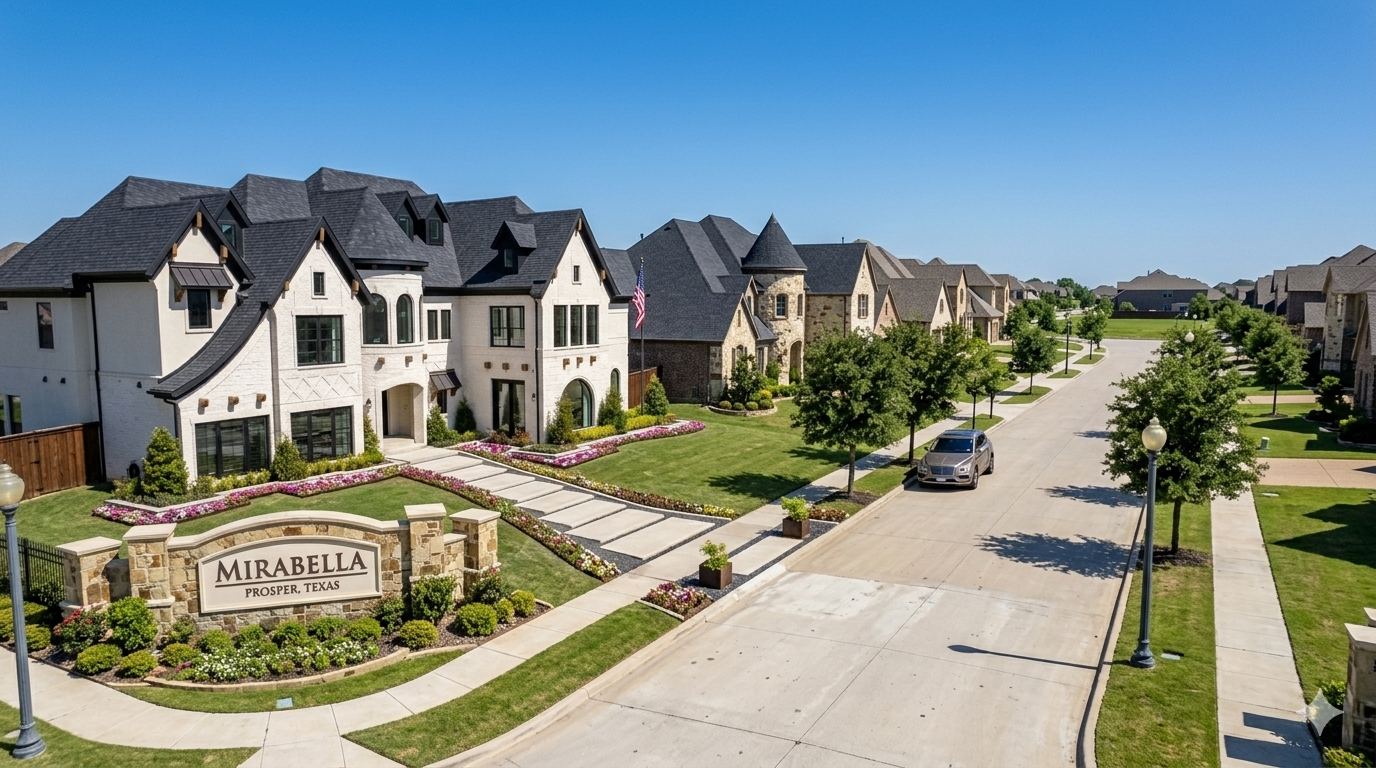
Mirabella is a planned 190-acre gated luxury residential community in Prosper, Texas, developed by Tellus Group and built out primarily by Highland Homes and their luxury arm, Huntington Homes. Public reporting from Community Impact and DFW Agent Magazine places the community at approximately 288 to 290 single-family homes total.
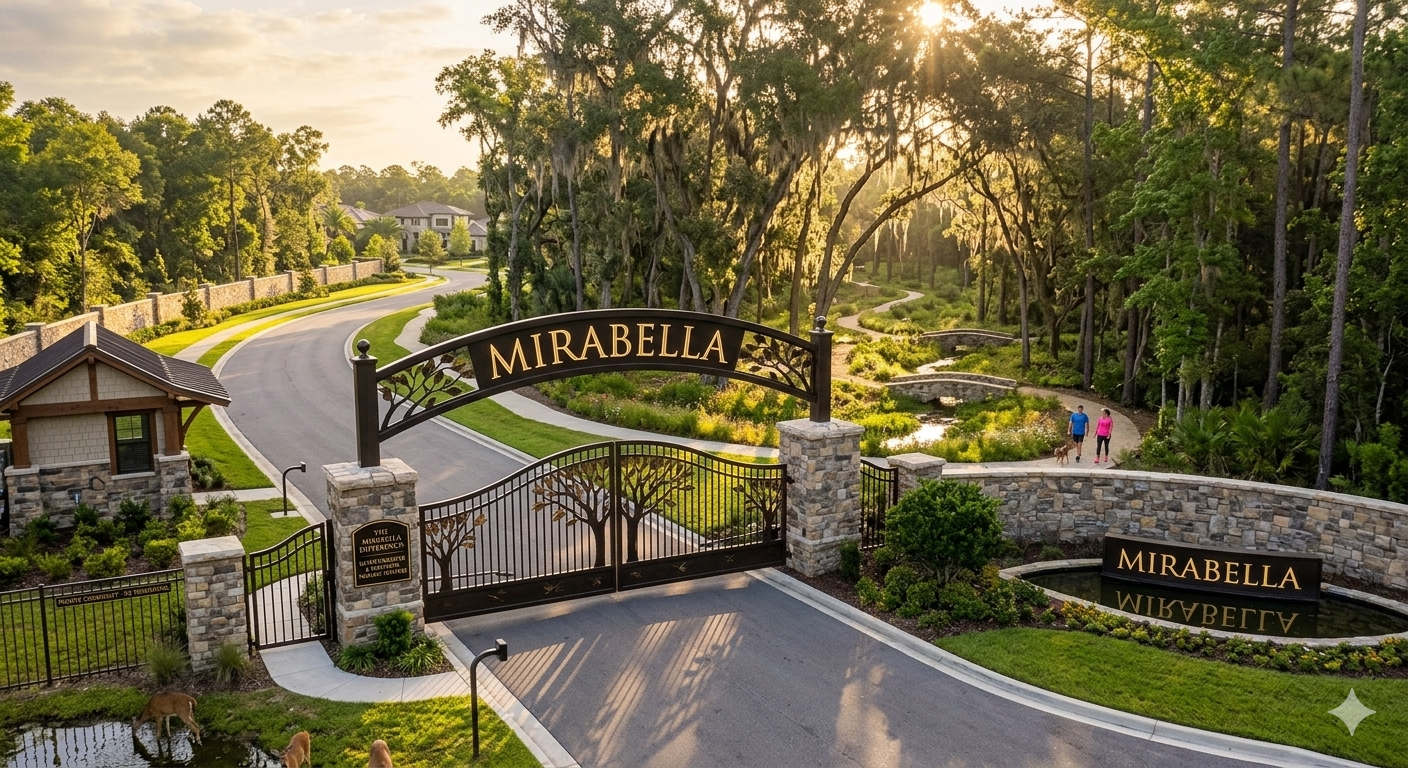
The site sits along Custer Road in Prosper just north of Highway 380 and south of First Street. Squarely in the growth corridor between Frisco, McKinney, and Celina. According to Realty News Report, the community will feature oversized lots up to 100 feet wide, preserved creek corridors, hike-and-bike trails, pocket parks, and intentionally maintained mature tree coverage.
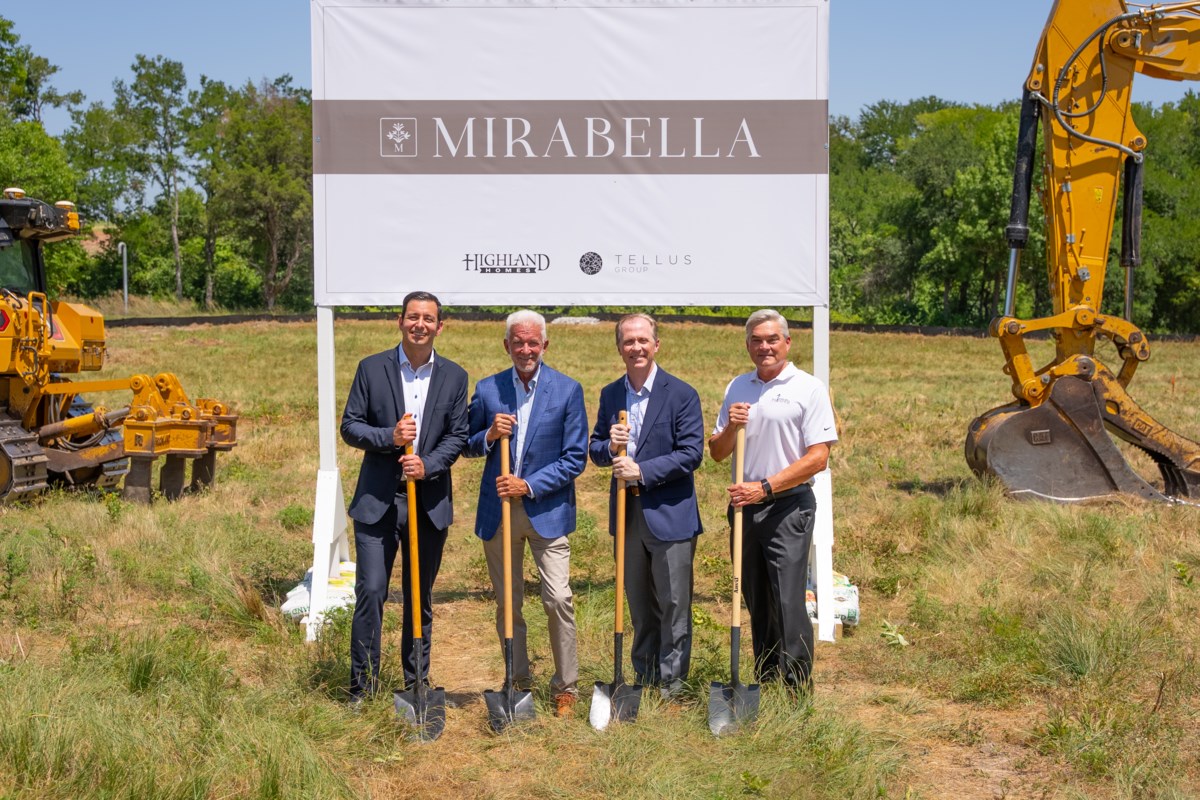
Early pricing is expected to start around the $1 million mark, with many finished homes landing materially above that once lot premiums, structural upgrades, and design-center selections are factored in. Ground broke on this community in September 2025 with home sales expected to open in late 2026.
Why Mirabella Is Different From Everything Else Being Built Right Now
North Texas has no shortage of new construction. What it does have a shortage of is new construction with meaningful lot separation, a gated perimeter, and preserved natural features. Those are hard enough to find, let alone finding all of that within one of the most sought-after school districts in the state. That combination is not accidental, and it is not easily replicated.
Understanding why requires understanding what the rest of the Prosper-Frisco-Celina corridor is actually producing.
The dominant trend in North Texas new construction over the past decade has been density optimization. Builders and developers operating in high-demand growth corridors have responded to land scarcity and buyer volume by tightening lot widths, increasing roof counts per acre, and compensating for reduced outdoor space with expanded amenity packages like resort pools, lagoons, fitness centers and lifestyle programming. The formula works and it has helped sell tens of thousands of homes across DFW.
Highland Homes will build on 60-foot and 74-foot lots, while Huntington Homes, its luxury division, will offer grand estate-style residences on 84-foot and 100-foot homesites. In practical terms, 100-foot homesites mean real separation between structures, real backyard depth, real architectural sight lines, and real outdoor living space in a market where 50-foot lots have become the norm even at luxury price points. That is a product distinction that compounds in value over time. Ten years from now, as the surrounding corridor continues to densify, the separation built into Mirabella’s lot structure will become more valuable, not less.
The community is planned for 290 homes across 190 acres or roughly 1.5 homes per acre. Many North Texas master-planned communities in this price range build at two to three times that density. The preserved creek corridor, mature trees, and trail system woven throughout the neighborhood are not just cosmetic features. They are natural infrastructure that either exists in the land or it doesn’t and this land has it.
That design philosophy of lower density, preserved natural features and deliberate lot separation has become increasingly rare in this market. Mirabella is the exception and exceptions at this quality level, in this location, in this school district, do not stay available for very long, especially once the market understands their real value.
The Developer Pedigree Matters Here
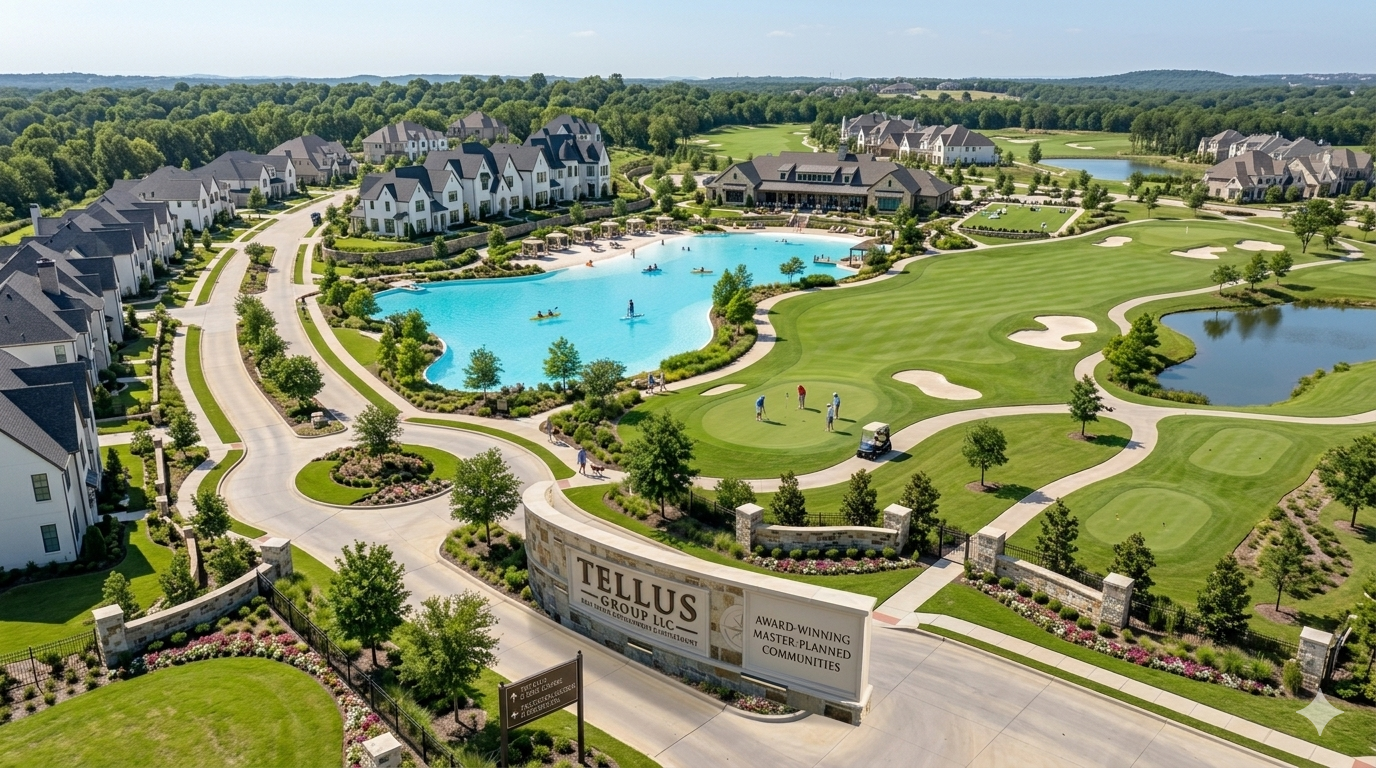
Photo courtesy of the Tellus Group
Tellus Group is not a speculative newcomer testing a concept. Tellus Group is the developer behind the wildly popular Windsong Ranch – a 2,000-acre Prosper community that ranks among the nation’s top-selling master-planned communities. They know this market at a level that matters for buyers evaluating execution risk on a new community.
When the developer behind one of North Texas’s most recognized communities partners with one of Texas’s most respected private builders on a 190-acre project, that combination doesn’t just reduce risk, it compresses the timeline between “promising concept” and “community that delivers on what it promised.” Buyers evaluating luxury new construction at this price point are betting on execution. Tellus and Highland have already cashed that bet once, at scale and in the same city.
Huntington Homes will be developing the 84-foot and 100-foot estate homesites within Mirabella. This is not a production builder offering an upgraded package. This is a dedicated luxury division with floor plans designed specifically for the estate-scale buyer with larger footprints, more architectural complexity, more outdoor living integration and more design optionality.
The partnership structure gives Mirabella something many new communities lack: Tellus handles day-to-day development management, bringing the operational expertise that turned Windsong Ranch into one of the most recognized addresses in Prosper. Highland and Huntington bring the product quality and builder reputation. The result is the buyer gets the benefit of both without absorbing the risk of either operating alone.
Location: What the Map Actually Tells You
Mirabella sits at the corner of University Drive and Custer Road in Prosper, north of Highway 380 and south of First Street. It’s positioned in one of the strongest growth corridors in North Texas.
That location is worth unpacking carefully, because “Prosper” covers a lot of geographic ground and not all of it is created equal for every buyer profile.
Buyers coming from the south, from Frisco, McKinney, Allen, or Dallas, will get access to Prosper’s still-spacious suburban character without the congestion of communities closer to the SH-121 and Preston Road corridors. Those corridors are dense, commercially saturated, and increasingly traffic-challenged. Mirabella’s location north of 380 puts real distance between the community and that congestion, while still keeping major employment nodes within a manageable commute range.
Buyers relocating from out of state get proximity to the employment concentration that defines North Texas’s economic engine like; Legacy Business Park in Plano, Toyota’s North American headquarters, the Frisco Station corridor, the Warren Parkway tech and corporate campus cluster, without living inside the density those employment nodes generate. For the California or Colorado buyer who has been priced out of a comparable suburban lifestyle at home, this location offers the distance from urban intensity that they came to Texas to find, while keeping the career infrastructure that brought them here within reach.
Mirabella is also positioned near McKinney, which matters for buyers who want access to one of DFW’s most established mid-size cities. Mckinney’s historic downtown, hospital infrastructure, mature retail and dining, offer a different character than the newer master-planned corridor to the south. That proximity adds a dimension to the lifestyle that purely suburban locations further from established cities don’t offer.
This is not a walkable urban environment, and it’s not trying to be. It’s a car-dependent suburban community with large lots and a gated perimeter. Exactly what the target buyer profile has been looking for in North Texas and struggling to find at this price point with this product quality.
Who Is Mirabella Actually For?
Let me be direct here, because the honest answer saves everyone time.
Mirabella is likely the right fit if:
You’re a household comfortable in the $1M–$2M+ range who wants new construction rather than a fully custom build on raw acreage
You want Prosper ISD but aren’t drawn to the social-event-heavy, mega-amenity identity of resort-style master-planned communities
You’re relocating from California, the Pacific Northwest, Colorado, or the Northeast and you’re accustomed to paying significantly more for significantly less square footage and land
You’re a local move-up buyer in Frisco, McKinney, Allen, or South Prosper who is ready for a longer-horizon home with more privacy, more mature landscaping, and a more permanent architectural presence on the street
You have kids who’d use trails, creeks, and pocket parks far more than a resort-style amenity center
Mirabella is probably not the right fit if:
You want dense amenity programming with robust community events and social infrastructure
You’re shopping at entry-level price points
You want walkable urban access without a car
You’re looking at a short three-to-five year hold and need to optimize purely for resale liquidity
Mirabella vs. The Competition: How It Stacks Up
This is the question serious buyers are actually asking, not “Is Mirabella nice?” but “How does it compare to what else I’m looking at?”
Community
Gated
Lot Profile
Density
Amenity Identity
Approx. Starting Price
Mirabella (Prosper)
Yes
60’–100’ wide
~290 homes / 190 acres
Trails, creek, pocket parks
~$1M+
Windsong Ranch (Prosper)
Partial
Mixed
2,000+ acre MPC
Resort lagoon, full amenity ecosystem
Broad range
Star Trail (Prosper)
Some sections
60’–80’+
Several hundred homes
Pools, trails, active amenities
High-end suburban
Phillips Creek Ranch (Frisco)
Partial
Mid-size
Established, built-out
Mature community, Frisco ISD
Broad resale range
Painted Tree (McKinney)
Partial
Mixed
Large-scale MPC
Resort-style, McKinney ISD
Mid to high-end
Competitor details are generalized from publicly available reporting and builder marketing. Individual phases and sections vary.
Mirabella vs. Windsong Ranch: Both are in Prosper ISD and developed by Tellus Group, but they are categorically different products. Windsong Ranch is built around activated lifestyle programming with their 5 acre lagoon, the events calendar and their community-scale amenity infrastructure. Mirabella is almost the opposite; built around land, privacy, and separation. Different solutions for different lifestyles. Neither is better. The key is knowing which lifestyle you’re actually after.
Mirabella vs. Star Trail: Star Trail offers luxury new construction in Prosper ISD with resort amenities and multiple pools. Lot sizes trend smaller than Mirabella’s estate homesites. For buyers who want the amenity experience within Prosper ISD, Star Trail is legitimate. For buyers choosing between a community pool and 100 feet of lot width, Mirabella answers the lot-width question more definitively.
Mirabella vs. Phillips Creek Ranch: PCR is an established luxury community in Frisco ISD, a different school district, with a more built-out surrounding environment and closer proximity to Frisco’s commercial infrastructure. Buyers who prioritize Frisco ISD and proximity to mature retail over Prosper ISD and lot size may find PCR more aligned. Mirabella offers more land and access to Prosper ISD. PCR offers more built infrastructure and access to Frisco ISD. Both are legitimate depending on which variable ranks higher.
Mirabella vs. Painted Tree: Painted Tree in McKinney draws buyers who want the activated community experience at a price point that can come in below Mirabell and is zoned to McKinney ISD. For buyers weighing community amenities heavily and who are flexible on school district, it’s worth considering Painted Tree. For buyers whose primary criteria are Prosper ISD, lot separation, and a gated perimeter, Mirabella is the more direct answer.
The through-line: Mirabella wins on lot size, density, natural land character, and gated privacy. Other communities win on amenity depth, built surrounding environment, and in some cases price accessibility. Know which variables you’re actually optimizing for before you walk a model home anywhere.
Schools: Prosper ISD and What Buyers Need to Know
Prosper ISD is consistently among the most requested school districts from the relocating buyers I work with, particularly families coming from California, Colorado, Washington, and Arizona. The district has built a reputation that shows up in buyer conversations before I ever mention it. That kind of organic reputation in a market this competitive reflects something real.
What Prosper ISD actually delivers: newer campuses built for growth rather than retrofitted for it, academic performance that holds up against the state’s most competitive districts, extracurricular infrastructure that includes athletics, fine arts, and career programs at a depth smaller districts cannot match, and a community investment in schools that reflects the income profile of the families moving into Prosper at scale.
For the California family leaving a coastal market with good schools and looking for a North Texas equivalent, Prosper ISD is on the shortlist for a reason. It competes at a level that makes the relocation conversation honest, this is not a trade-down in educational environment. It is a lateral move or better, at a fraction of the housing cost. I break down exactly how Prosper ISD compares to high-performing West Coast districts in my Top School District Choices For California Families guide.
Mirabella falls within Prosper ISD boundaries. But, buyers should independently verify campus zoning and specific assignments directly through Prosper ISD’s official site, because boundary lines shift as the district builds new campuses to absorb growth. The Texas Education Agency is where you can stay up-to-date on accountability ratings and district-level data. The National Center for Education Statistics offers comparative data for buyers who want to evaluate Prosper ISD against their origin district.
The bottom line: Prosper ISD is a real draw, Mirabella is within it, and district boundaries should be verified before, not after, a contract is signed.
The Real Cost of Buying in Mirabella
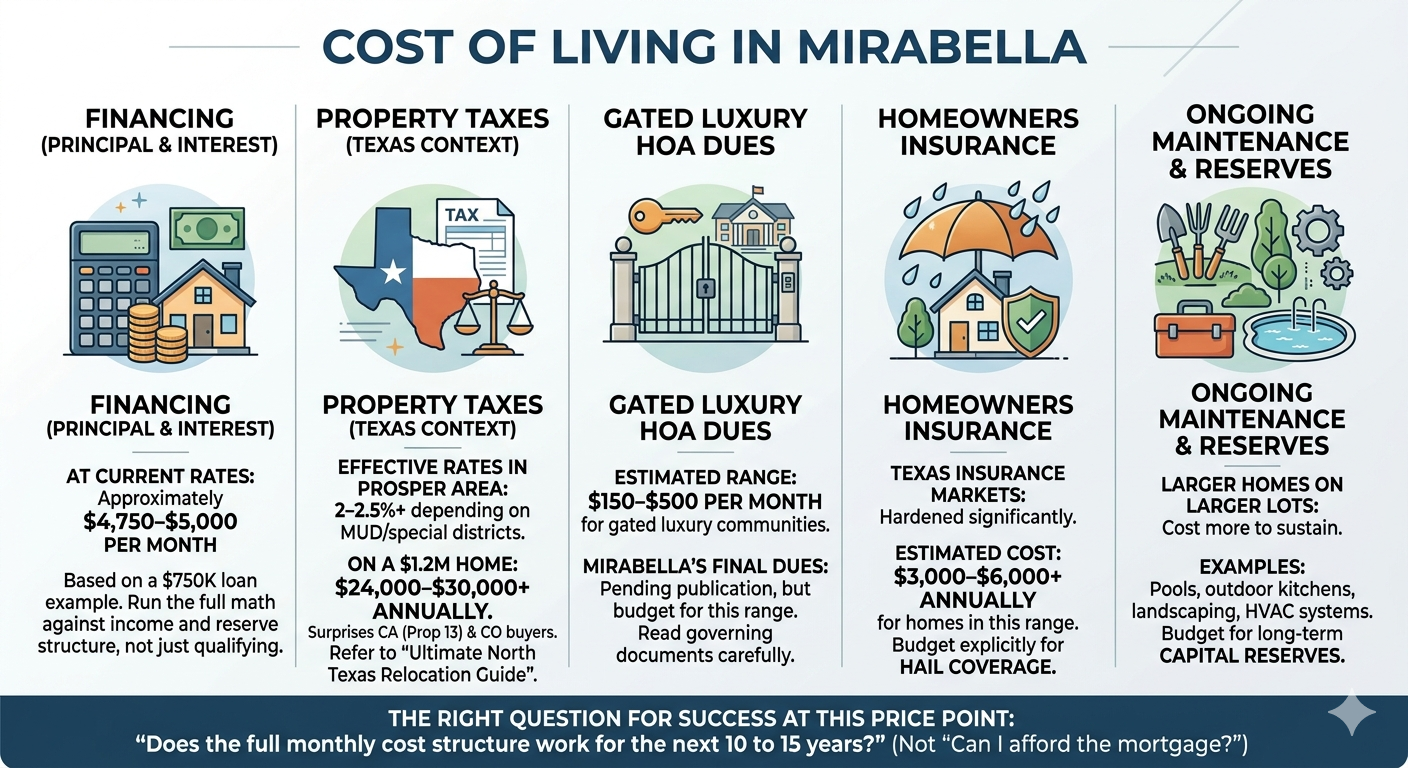
The $1M+ headline price is the starting point of the conversation, not the end of it. The buyers who get surprised after closing are the ones who ran the mortgage number and stopped there. Here’s how total cost of ownership actually breaks down at Mirabella.
Financing: At current rates, a $750K loan runs approximately $4,750–$5,000 per month in principal and interest. Run the full math against your income and reserve structure, not just whether you qualify for the mortgage amount.
Property taxes: Texas funds local government largely through property tax, and effective rates in Prosper-area communities typically run 2–2.5%+ depending on applicable MUD or special district overlays. On a $1.2M home, that’s $24,000–$30,000+ annually. This surprises California buyers accustomed to Prop 13-capped rates. It often surprises Colorado buyers too. I break down the full tax picture in my Ultimate North Texas Relocation Guide – read that section before you finalize your budget.
HOA dues: Gated luxury communities in North Texas typically carry HOA fees in the $150–$500/month range depending on what’s included. Mirabella’s final dues haven’t been published, but buyers should plan for that range and read the governing documents carefully before signing anything.
Homeowners insurance: Texas insurance markets have hardened significantly. Homes in this price range often run $3,000–$6,000+ annually. Hail coverage matters more than most out-of-state buyers know to anticipate, budget for that explicitly.
Ongoing maintenance: Larger homes on larger lots cost more to sustain. Pools, outdoor kitchens, landscaping, HVAC systems, and long-term capital reserves all need to live in your budget, not just your imagination. The buyers who thrive at this price point are the ones asking not “Can I afford the mortgage?” but “Does the full monthly cost structure work for the next 10 to 15 years?” Those are different questions with different answers.
HOA Life, Design Guidelines, and What “Gated Luxury” Actually Means Day to Day
A community that looks as good as Mirabella is going to look that way because someone is enforcing standards. That’s the HOA’s job and in gated luxury communities, those rules tend to be comprehensive. This is not a criticism, it’s what protects the value of every home in the neighborhood, including yours. Buyers need to understand what they’re agreeing to before they’re emotionally committed to the address.
Based on comparable North Texas communities at this price point and quality, plan for:
Exterior modification approval: Paint changes, additions, pools, pergolas, driveways, and landscaping modifications will likely require architectural review committee approval before you start. The timeline for that approval process matters if you’re planning work immediately after closing.
Fencing standards: Height, material, and placement are typically governed by HOA rules. What works in your current neighborhood may not be what Mirabella’s CC&Rs permit.
Short-term rental restrictions: Most luxury HOAs in Prosper prohibit or heavily restrict Airbnb and VRBO-style use. If that’s part of your investment thesis, verify before you’re under contract.
Parking and vehicle standards: Restrictions on commercial vehicles, RV storage, and street parking are common. If you have a boat, an RV, or a work vehicle, read the rules before you fall in love with the lot.
Maintenance obligations: Lawn care, exterior upkeep, and general appearance are typically subject to periodic review. The HOA enforces the community aesthetic, that’s the deal.
None of this is unusual for a community at this level. But I’ve seen buyers close on beautiful homes and discover the HOA prohibits something they were already planning. Read the CC&Rs before you sign the contract, not after. My full guide to HOA Restrictions and Neighborhood Regulations In North Texas is the playbook for evaluating any HOA document before you commit.
Mirabella for California Relocation Buyers
A significant portion of the buyers I work with are relocating from California and Mirabella fits a very specific profile of what those buyers are looking for.
If you’re coming from Orange County, the Bay Area, San Diego, or the greater LA market, here’s the mental model I walk my clients through:
What you’re trading: Prop 13 tax protection — Texas property taxes can move more aggressively with market values, and on a $1.2M Prosper home that’s a real annual number. Mild coastal weather — North Texas summers are genuinely hot and require some significant adjustment. Geographic Proximity – to mountains and coast and in some cases, walkability and urban density. Texas is spread out and mostly flat, unless you travel a fews hours South or West of DFW.
What you’re gaining: Dramatically more home and land per dollar — a $1M–$1.5M home at Mirabella would cost $2.5M–$4M+ in a comparable California suburb. Zero state income tax — which for high-earning households represents $15,000–$40,000+ in real annual savings. Newer construction — modern floor plans, and energy-efficient builds with access to a school district that routinely draws comparisons to the best schools in California. More space — more land, a genuinely different quality of life.
The equity math that California families are running right now is one of the most compelling financial moves available to high-income households in 2026: sell a $1.5M home in Orange County, buy a $1.1M home at Mirabella, reduce your monthly payment, eliminate state income tax, gain 1,000 square feet and a real yard. That math isn’t close, it isn’t even the same conversation. I document the full framework in Relocating From California To Texas. If you’re mid-research on that move, that’s the article to read before we talk.
Mirabella for Local North Texas Move-Up Buyers
You don’t have to be relocating from out of state to be a strong fit for Mirabella. Some of the best-positioned buyers I work with are families who’ve lived in North Texas for years in areas like Frisco, McKinney, Allen, Plano and South Prosper, who have accumulated enough equity and income growth to make a meaningful move-up into a longer-horizon home.
These buyers usually aren’t choosing Mirabella because of the brochure. They’re choosing it because they’ve already lived in a standard master-planned community and know exactly what they don’t want next time: the lot where you can hear your neighbor’s conversations, the neighborhood where every elevation looks identical from the street and the amenity center that sounded great in the sales office and gets used twice a year.
The Mirabella buyer at this level is making a deliberate, strategic choice toward less density, more permanence, and more thoughtful design, not just more square footage.
If the mortgage rate lock-in effect is part of your hesitation, you’re sitting on a 2.75% or 3% rate and can’t quite talk yourself into letting it go, I wrote a deep-dive on exactly that scenario: Vecna’s Curse: The Mortgage Rate Lock-In Effect. It walks through the real opportunity cost math that most locked-in homeowners aren’t calculating honestly. The answer isn’t always “move.” But it’s worth doing the math before the decision gets made by default.
New Construction Contracts: What Buyers Get Wrong
Every year, buyers walk into builder model homes, fall in love with a kitchen island, and sign a contract without fully understanding what they’ve agreed to. Here’s what I walk every client through before we step into a Highland or Huntington model home.
The purchase agreement is the builder’s document. It’s drafted by the builder’s attorneys, for the builder’s protection. At seven figures, an independent real estate attorney review isn’t a precaution, it’s the price of admission for anyone who wants to know what they’re actually signing. The builder’s sales counselor is not your attorney. They’re not even your advisor. That distinction can cost you a lot more at $1 million than it does at $400,000.
Lot premiums and design center decisions will move your number significantly from the advertised starting price. Communities that open at $1 million will often close at $1.3 million for buyers who said yes to even half the upgrades when they’re under time pressure at the design center appointment. Build your ceiling before you walk in and treat it as non-negotiable, because the design center is specifically engineered to make negotiating with yourself feel reasonable.
On-site agents represent the builder, not you. They are friendly, professionally helpful, and obligated to their employer. Having your own representation before you walk in the door is how you protect your interests, and at a new construction community it costs you nothing: the builder pays the co-broker commission regardless. One practical note: many builders require buyer agent registration on or before the first visit to recognize co-broker representation, which is one more reason to reach out before you tour, not after.
Upgrades often have uneven resale value. Kitchen packages, primary suite finishes, lot position, and elevation choices typically hold value well in resale. Anything structural that would cost significant money to add later is where you want to invest your money. Invest in the porch extension, the pot filler, the extra bedroom/media room. Those are the things that would be either impossible or financially unfeasible to do later. You can upgrade your counters and your floors anytime, but you only have one shot at most structural upgrades. Highly customized tile combinations and niche structural options don’t always translate or age well. The design center makes everything feel equally important when it isn’t.
The Long-Term Investment Case for Mirabella
I’m not in the business of promising appreciation, nobody can do that responsibly. But I can tell you what the market fundamentals look like for a community like Mirabella, and let you draw your own conclusions.
What’s working in Mirabella’s favor: Prosper continues to attract high-income households and has the school infrastructure to sustain that demand over time. The community’s lower density and larger lots create scarcity value that higher-density neighborhoods cannot replicate — once Mirabella is built out, the land that made it possible is gone. There is no adjacent Phase 2 that recreates a creek corridor and 100-foot lots in the same location. Gated communities in top-tier school districts tend to maintain demand even through normal market cycles. And North Texas as a whole continues to benefit from corporate relocations, population inflow, and relative affordability compared to major coastal metros — trends I cover in depth in my Ultimate North Texas Relocation Guide.
What buyers should watch: The new construction pipeline across Prosper and Celina continues to add luxury inventory, and resale competition will evolve as communities mature. Property tax assessments in growth corridors can be volatile. The year-to-year change on a $1.2M home is real money and needs to live in the budget. Early buyers in a phased community carry some construction-phase reality: noise, dust, and unfinished surroundings for the first few years of ownership.
The buyers who do best in communities like Mirabella are typically thinking in 10–15 year horizons, not three-to-five. If you’re buying for a lifestyle upgrade and a long-term home base, not to flip, then the fundamentals here are solid.
How Mirabella Connects to the Larger North Texas Growth Story
It would be a mistake to look at Mirabella in isolation. It’s part of a much larger pattern reshaping the North Texas real estate landscape from top to bottom.
On the southern end of the Metroplex, I’ve been tracking the Minto Communities 13,000-home development approved for Waxahachie, the largest residential project ever approved in Ellis County’s history, representing over 3,170 acres and a $4.8 billion projected tax base. That development, along with the active build-out across the I-35E corridor, tells you that institutional capital is making long-term commitments across the full north-south DFW growth arc.
Mirabella is the luxury northern tip of that same story, providing a gated, intentionally positioned product serving the highest-demand end of the Prosper market at a moment when that product type is genuinely undersupplied. Understanding both ends of the spectrum, the attainable growth story in Ellis County and the luxury positioning in Collin County, is part of how I help clients find the right entry point for their specific situation.
The corridor between Waxahachie and Prosper is where North Texas is being built. The buyers who understand that before the mainstream catches up are the ones who position with the most leverage.
The Bottom Line on Mirabella
In a market where Prosper’s growth has already made genuinely distinctive luxury land scarce, Mirabella is offering something that will not be replicated at this location: 290 homes, 190 acres, a gated perimeter, creek-lined trails, preserved mature trees, and lot widths up to 100 feet, all built by the same combination of developer and builder that delivered one of the nation’s top-selling master-planned communities, in the same city, in the same school district.
That is not the pitch. That is the data. The pitch is what every other agent in this market will give you when the model home opens, the signage goes up, and the traffic starts.
The buyers who position before that moment, who already understand the product, the lot structure, the due diligence calendar, and the total cost picture, are the buyers who have leverage. The buyers who walk in after the community opens with momentum are competing against every buyer who moved earlier. In a Prosper luxury community opening at $1 million, waiting to see how it goes is not a neutral position. It is a concession of ground to every buyer who moved on it before you did.
FAQ: The Most Searched Questions About Mirabella in Prosper, TX
Q: Where exactly is Mirabella located in Prosper, Texas?
Mirabella is situated along Custer Road in Prosper, north of Highway 380 and south of First Street. This positions it in the active growth corridor between Frisco, McKinney, and Celina with access to major employment hubs in Plano and Frisco while maintaining Prosper’s more spacious suburban character.
Q: Who is building homes in Mirabella?
Highland Homes and their luxury division Huntington Homes are the primary announced builders. Tellus Group is overseeing the land development side of the project. Coverage from Community Impact and DFW Agent Magazine confirms both builders and the developer’s involvement.
Q: How many homes will Mirabella have?
Approximately 288 to 290 single-family homes across 190 acres or roughly 1.5 homes per acre. That is a dramatically lower density profile than most North Texas master-planned communities at comparable price points, which routinely build at two to three times that density. The lot-to-acreage ratio is a core part of what makes the product distinctive.
Q: Is Mirabella a gated community?
Yes. Mirabella is planned as a gated neighborhood with controlled access. This is a relatively uncommon feature even among high-end North Texas suburban communities, where fully gated entries remain a limited subset of available luxury inventory.
Q: What school district is Mirabella in?
Mirabella is expected to be zoned to Prosper ISD. District boundaries are subject to change, and buyers should verify specific campus assignments directly with the district before making location-based decisions. Do not rely on builder marketing materials for school zoning confirmation.
Q: What will homes cost at Mirabella?
Pricing has not been formally announced. Jeff Stinson, Senior Vice President of Land for Highland Homes, stated at the April 2025 announcement that home prices are anticipated to start around $1 million. But, buyers should budget for the total exposure: lot premiums, structural options, and design-center selections will move that number materially upward for most buyers.
Q: What amenities will Mirabella offer?
Mirabella’s amenity focus is land and nature rather than resort-style activation. The community will feature a hike-and-bike trail system along a creek corridor, preserved mature tree canopies, pocket parks, and open green spaces. There is no announced lagoon, resort pool complex, or lifestyle clubhouse. Buyers who want that formula will find it elsewhere in Prosper. Buyers who want acreage, trails, trees, and separation, this is what Mirabella is designed around.
Q: Who is the developer of Mirabella?
Tellus Group, a Plano-based developer, is managing Mirabella’s development. Tellus is also the developer of Windsong Ranch, one of the nation’s top-selling master-planned communities, as well as Mosaic in Celina, Meraki in Forney, and Sherley Farms in Anna. Their track record in Prosper is directly relevant to buyers evaluating execution risk on a new community.
Q: When will Mirabella homes go on sale?
Based on Community Impact reporting and coverage of the September 2025 groundbreaking, home sales are expected to begin in late 2026. Buyers who want to be positioned before the sales center opens with their financing ready, representation established and lot priorities identified, should be working through that preparation now.
Q: How big are the lots in Mirabella?
Per Realty News Report and developer descriptions, Highland Homes will build on 60-foot and 74-foot lots. Huntington Homes will offer estate homesites on 84-foot and 100-foot lots. Multiple lot-width tiers are planned throughout the community.
Q: Do I need a real estate agent to buy at Mirabella?
You are not required to use a buyer’s agent, but not having one is a mistake at this price point. The builder’s sales counselor represents the builder, not you. They are not your advocate on contract terms, lot selection, or design-center decisions. A buyer’s agent costs you nothing on a new construction transaction since the builder pays the co-broker commission, but it gives you representation form someone whose entire job is your outcome, not the builder’s. At $1 million or more, that question should not be a close call.
Q: How does Mirabella compare to Windsong Ranch?
Both communities are in Prosper ISD and developed by Tellus Group, but they are categorically different products. Windsong Ranch is a 2,000+ home master-planned community built around resort amenities, a lagoon, and an activated lifestyle programming model. Mirabella is a 290-home gated community built around lot size, natural land features, privacy, and separation. Buyers who want the resort community experience will prefer Windsong Ranch. Buyers who want larger lots, lower density, and a quieter neighborhood character will find Mirabella to be the more direct answer.
Before You Tour Mirabella, Here’s How This Works
If Mirabella is on your radar or if you’re trying to decide whether it should be, here’s how I actually work with buyers on a community like this.
Before you tour anything: We talk about your timeline, budget, lifestyle priorities, and what the right home actually means for your family. I give you a straight read on Mirabella versus the alternatives so you’re comparing the right things, not just touring whatever has a model home open.
Before you sign anything: We review the builder contract together and I flag the sections that warrant a closer look from your attorney. We talk through design-center strategy, what adds resale value versus what just costs money and we model the full monthly cost picture including taxes, HOA, insurance, and maintenance so there are no surprises at closing or after.
After you close: I stay in your corner. My job doesn’t end at the closing table.
That’s not marketing copy. That’s how I work. Reach out directly and let’s figure out if Mirabella is the right move for your situation or if something else in this corridor serves you better. Schedule a consultation today.
This article is published in compliance with the Fair Housing Act, RESPA, and the NAR Code of Ethics. Community descriptions are based on publicly available developer announcements, verified media reporting, and third-party data sources. All housing is presented without regard to race, color, religion, sex, national origin, disability, familial status, or any other protected class.
Bobby Franklin, REALTOR® | Legacy Realty Group – Leslie Majors Team 📲 214-228-0003 | northtexasmarketinsider.com
Preferred lenders (I recommend these lenders based on their expertise and service. I do not receive compensation for referrals): Andrew Bryan — andrewthelender.com | Jennifer Nelson — eustismortgage.com | Taylor Fruge — lower.com
Contains information related to marketing campaigns of the user. These are shared with Google AdWords / Google Ads when the Google Ads and Google Analytics accounts are linked together.
90 days
__utma
ID used to identify users and sessions
2 years after last activity
__utmt
Used to monitor number of Google Analytics server requests
10 minutes
__utmb
Used to distinguish new sessions and visits. This cookie is set when the GA.js javascript library is loaded and there is no existing __utmb cookie. The cookie is updated every time data is sent to the Google Analytics server.
30 minutes after last activity
__utmc
Used only with old Urchin versions of Google Analytics and not with GA.js. Was used to distinguish between new sessions and visits at the end of a session.
End of session (browser)
__utmz
Contains information about the traffic source or campaign that directed user to the website. The cookie is set when the GA.js javascript is loaded and updated when data is sent to the Google Anaytics server
6 months after last activity
__utmv
Contains custom information set by the web developer via the _setCustomVar method in Google Analytics. This cookie is updated every time new data is sent to the Google Analytics server.
2 years after last activity
__utmx
Used to determine whether a user is included in an A / B or Multivariate test.
18 months
_ga
ID used to identify users
2 years
_gali
Used by Google Analytics to determine which links on a page are being clicked
30 seconds
_ga_
ID used to identify users
2 years
_gid
ID used to identify users for 24 hours after last activity
24 hours
_gat
Used to monitor number of Google Analytics server requests when using Google Tag Manager
1 minute
You can find more information in our Cookie Policy and .