By Bobby Franklin, REALTOR® | Legacy Realty Group – Leslie Majors Team
Serving Ellis County, DFW & Greater North Texas
Let me tell you what most real estate agents won’t.
Most of them don’t know the difference between a tiny home and a manufactured home beyond square footage and the Instagram aesthetic. And because they don’t know the difference, their buyers make expensive decisions based on vibes instead of data, and then call me six months later trying to understand why they can’t refinance, why their insurance carrier dropped them, or why their home appreciated zero percent while everything around it went up 12%.
I’m not letting that happen to you.
If you’ve been searching “tiny home vs manufactured home in Texas,” you’re asking the right question. You’re just not finding the right answer, yet. Most of the content out there gives you a lifestyle comparison and calls it a day. What it doesn’t give you is the financing reality, the zoning revolution that’s actively unfolding in Texas right now, the appreciation data that demolishes a 40-year myth, or the month-by-month cost breakdown that tells you what you’ll actually pay to live in each one.
That’s what this is. All of it.
I wrote the most comprehensive breakdown of tiny homes in North Texas a few days ago, and the response told me everything I needed to know: buyers are starving for real information. The number-one follow-up question, I got across emails, comments and DMs, was some version of: “Bobby, what about a manufactured home instead? Isn’t that basically the same thing but bigger and cheaper?”
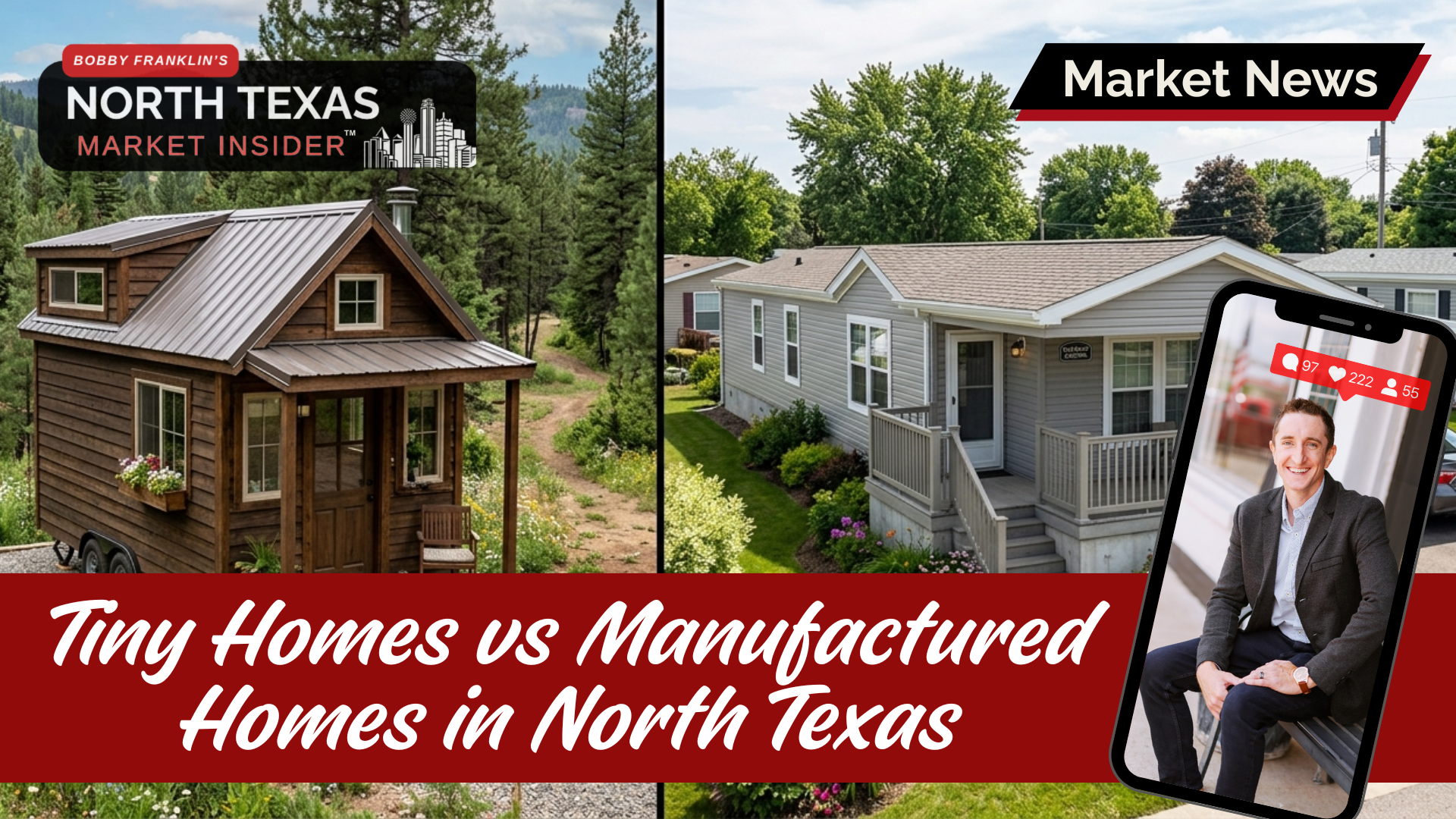
No. It is not basically the same thing. And confusing the two could cost you tens of thousands of dollars in financing costs, insurance headaches, and resale value over the life of your ownership. Let me walk you through the full picture so you can make a decision based on data, not assumptions.
The Definitions That Actually Matter — Because Your Lender, Insurer, and City Will Be Precise About Them
Before we compare anything, we need to get precise. Because the label on your home doesn’t just affect what it looks like. It determines your financing options, your insurance path, where you’re legally allowed to place it, and how it will perform as an asset.
What Is a Tiny Home?
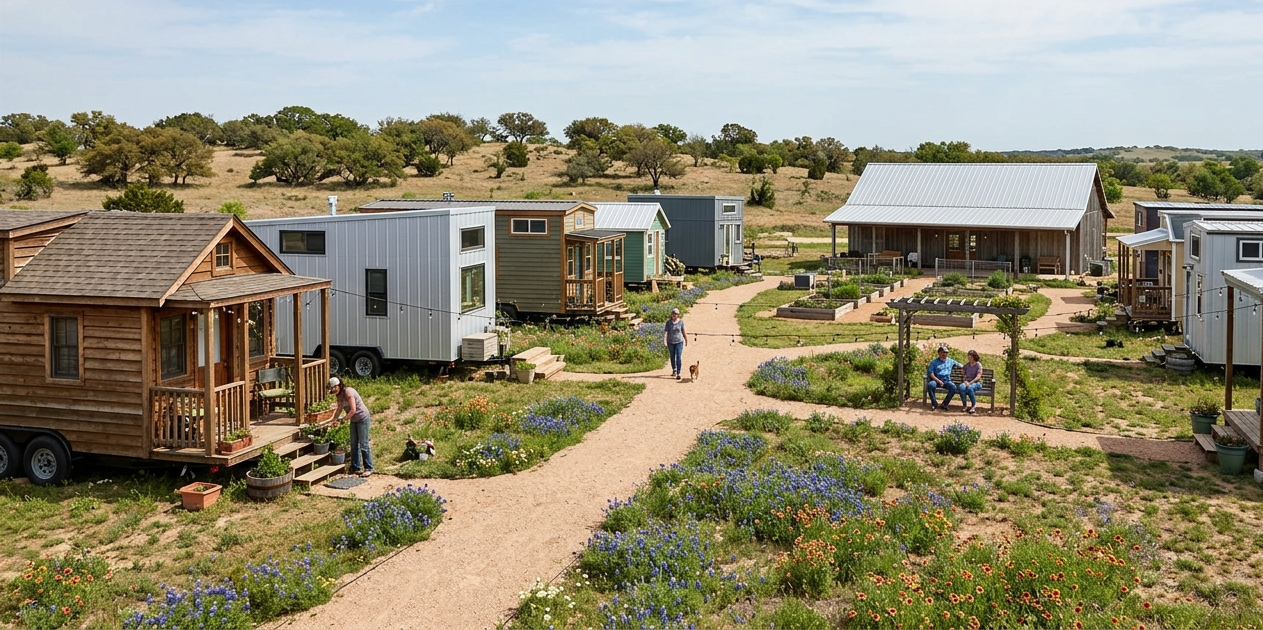
A tiny home is generally any dwelling under 400 square feet, though in practice the market has expanded to include compact homes up to 600–700 square feet when built on permanent foundations within planned communities. There is no single federal building code governing tiny homes. Depending on how and where they’re built, they may fall under IRC Appendix Q, the RVIA standard for recreational vehicles, the ANSI 119.5 standard for park models, or in some cases, no recognized standard at all.
Tiny homes come in three functionally different forms:
Tiny Homes on Wheels (THOWs): Built on trailers, legally classified as personal property. These are the homes you see on HGTV. Typically 100–400 square feet, classified as RVs when RVIA-certified.
Tiny Homes on Permanent Foundations: Affixed to land, treated as real property, subject to local building codes. This is where long-term equity potential actually lives.
Park Model RVs: Built to ANSI 119.5 standards, capped at 400 square feet, designed for placement in designated communities.
What Is a Manufactured Home?
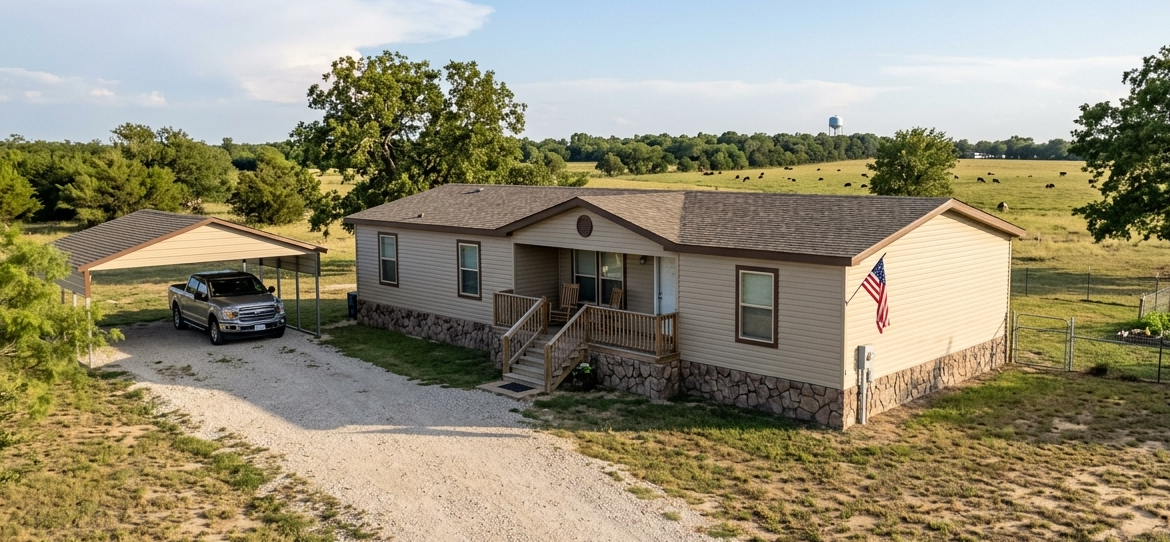
A manufactured home is a factory-built dwelling constructed entirely to the federal HUD Code, formally known as the Manufactured Home Construction and Safety Standards, established in 1976. This is the critical distinction: manufactured homes have a single, federally regulated building standard. Every manufactured home in America must pass HUD inspection, carry a HUD Certification Label on the exterior, and include a HUD Data Plate inside.
Manufactured homes are built on a permanent steel chassis, transported to a site, and can be placed on a permanent foundation. They’re categorized as:
Single-section (single-wide): Generally 600–1,300 square feet, 14–18 feet wide.
Multi-section (double-wide or triple-wide): Generally 1,000–2,400+ square feet, assembled from two or three sections on-site.
One important note: if it was built before June 15, 1976, it’s legally a “mobile home,” not a manufactured home. That distinction matters because pre-1976 units aren’t built to HUD Code and face significantly more restrictions on financing, insurance, and placement. When I say “manufactured home” throughout this article, I mean a post-1976 HUD Code home.
The Classification Confusion That’s Costing Buyers Real Money
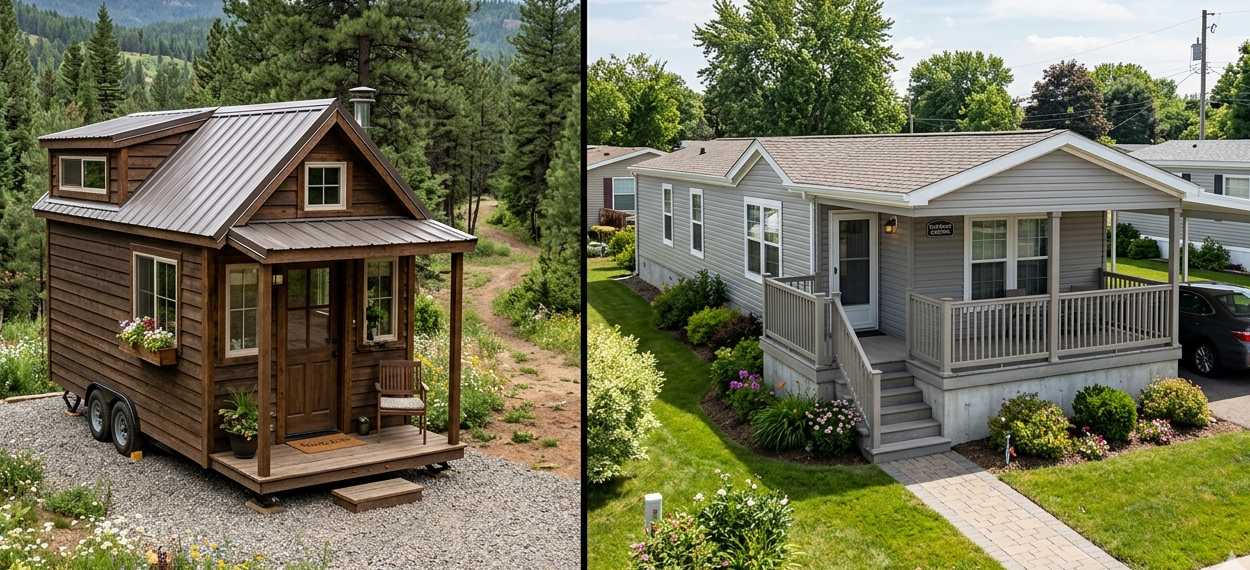
Here’s one of the most searched questions on this topic: Is a tiny home a manufactured home?
The answer is almost always no and that answer carries serious financial consequences.
Most tiny homes are not manufactured homes because they are not built to HUD Code. A tiny home on wheels built to RVIA standards is legally an RV. A tiny home on a permanent foundation built to IRC Appendix Q is classified as a site-built dwelling. A park model built to ANSI 119.5 is its own regulatory category.
This matters enormously because financing, insurance, zoning approval, and resale liquidity all flow from the regulatory classification. Two homes sitting side-by-side in a North Texas community might look identical from the street and have completely different legal identities and that identity determines everything about what you can do with them financially.
Here’s the framework that should guide every decision you make:
| Feature | Tiny Home (THOW) | Tiny Home (Foundation) | Manufactured Home |
|---|---|---|---|
| Building Standard | RVIA or none | IRC / Appendix Q | Federal HUD Code |
| Typical Size | 100–400 sq ft | 200–700 sq ft | 600–2,400+ sq ft |
| Legal Classification | Personal property (RV) | Real property | Personal or real property (depends on foundation) |
| Federal Regulation | None (RVIA is voluntary) | None (local codes apply) | Yes — HUD-regulated |
| Mobility | Towable | Permanent | Transportable, then placed |
| Average Cost | $30,000–$100,000+ | $50,000–$172,000 | $86,700 (single) – $146,900 (double) in Texas |
Texas manufactured home pricing: Freddie Mac via Stacker, February 2026
Look at that cost-per-square-foot difference. Manufactured homes in Texas average roughly $40–$65 per square foot. Custom tiny homes can run $200–$400 or more per square foot. You’re paying a significant premium for the tiny home’s design customization and aesthetic appeal. Whether that premium serves your financial goals is exactly what we’re going to figure out.
The Financing Gap: This Is Where the Real Decision Gets Made

I need you to sit with this section, because this is where most buyers make their most expensive mistake. They see a sticker price. They don’t see the monthly reality.
Manufactured Homes: A Real, Functioning Financing Ecosystem
Manufactured homes have a well-developed financing ecosystem because the HUD Code gives lenders a standardized product they can underwrite with confidence. Your options as a buyer include:
FHA Title I: Finances the home only, even on leased land. FHA updated Title I limits in March 2024 for the first time in 15 years, up to $148,909 for single-section homes and $193,719 for multi-section. That’s a meaningful expansion.
FHA Title II: Finances the home and land together as real property. Down payments as low as 3.5%, terms up to 30 years. The home must be on a permanent foundation and titled as real estate.
VA Loans: Eligible veterans can finance manufactured homes with up to 100% financing, potentially zero dollar down payment
Fannie Mae Conventional and MH Advantage®: Fannie Mae finances manufactured homes meeting specific criteria of at least 400 square feet, at least 12 feet wide, on permanent foundations, titled as real property. The MH Advantage® program offers rates and terms comparable to site-built home mortgages, with down payments as low as 3%.
Freddie Mac CHOICEHome®: Similar to MH Advantage, designed for manufactured homes meeting elevated design and construction standards.
Chattel Loans: For manufactured homes classified as personal property, not on permanent foundations. Shorter terms (15–20 years), higher rates (typically 7%–9%+), but they don’t require land ownership.
And in 2026, Fannie Mae is expanding manufactured home eligibility further by adding 2-to-4 unit manufactured homes, homes with ADUs, and multi-story structures. The financing infrastructure isn’t just established. It’s growing.
Tiny Homes: Fragmented, Expensive, and Complicated
Tiny homes, particularly those on wheels, face a financing landscape that is patchwork at best. There is no FHA program specifically for tiny homes. No VA loan program. No Fannie Mae product. What’s available:
Personal Loans: Unsecured, no collateral, terms up to 7 years, rates significantly above mortgage rates.
RV Loans: If your THOW is RVIA-certified, some lenders will finance it as a recreational vehicle. Terms can reach 20 years for amounts above $100,000. Often the best available option for homes on wheels.
Builder Financing: Some tiny home builders and communities offer in-house financing or rent-to-own. The Timbers at The Pines in Azle offers both rent-to-own and owner financing, for example.
Cash or Home Equity: Many tiny home buyers pay outright, using savings, inheritance, or equity from an existing property.
The exception worth knowing: tiny homes on permanent foundations inside master-planned communities, like Lennar’s Dream Collection at Tillage Farms in Princeton, may qualify for conventional or FHA financing because they’re treated as traditional real property. But these represent a small fraction of the market.
Here’s the number that changes everything. The difference between a 30-year FHA loan at 6.5% and a 7-year personal loan at 10% on a $100,000 home isn’t minor:
- 30-year FHA: approximately $633/month
- 7-year personal loan: approximately $1,660/month
That’s not a rounding error. That’s the difference between building wealth and treading water. If access to affordable, long-term financing is a priority, and for most buyers it should be, manufactured homes have a decisive, unambiguous advantage.
If you want to understand how current rates affect your purchasing power across all housing types, I broke down exactly what recent rate movement means for your monthly payment in a separate analysis.
The Zoning Revolution Most North Texas Buyers Don’t Know Is Happening
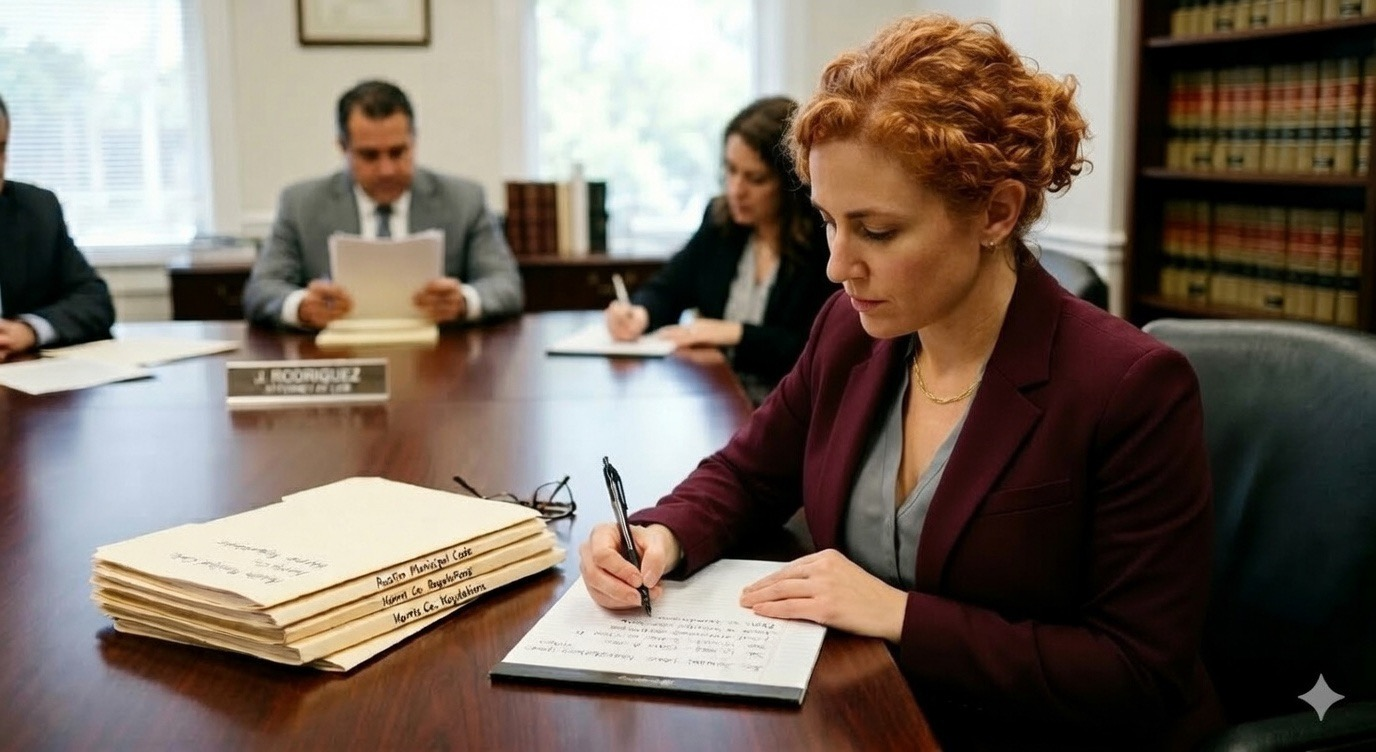
This is the part of the conversation where most agents go quiet because they haven’t done the homework. I have.
Texas Senate Bill 785: The Rule Change That Rewrites the Manufactured Home Playbook
Effective September 1, 2026, Texas Senate Bill 785 requires most Texas cities with zoning regulations to permit new HUD-code manufactured homes by-right in at least one residential zoning district.
Read that again.
Cities can no longer effectively ban manufactured homes through zoning. No more special use permits as a barrier. No more manufactured-home-free zoning maps. According to the National Zoning Atlas analysis, 44% of the 579 Texas municipalities studied will need to enact zoning reforms to comply and one-third currently don’t explicitly allow manufactured housing at all.
As Rob Ripperda of the Texas Manufactured Housing Association said: “SB 785 will expand where manufactured homes can be placed across Texas, creating more attainable housing options that the state desperately needs.”
For North Texas buyers, this means cities like Waxahachie, Midlothian, Red Oak, and Ennis will need to identify at least one residential district where manufactured homes are permitted without the red tape that previously existed. For buyers watching Ellis County and the surrounding growth corridors, this is a door opening that wasn’t open before.
Pair SB 785 with Texas Senate Bill 15(effective September 2025) limiting minimum lot sizes and setbacks for new subdivisions with the regulatory environment for compact and manufactured housing, Texas is looking more favorable than it has been in decades. That’s not my opinion. That’s legislation.
Tiny Homes: Still Fighting City Hall
Tiny homes have no equivalent legislative tailwind right now. The zoning reality remains location-specific and often restrictive:
THOWs are typically classified as RVs and cannot legally serve as primary residences in standard residential zones. They’re permitted in RV parks, approved tiny home communities, or on rural land outside city limits.
Foundation-based tiny homes may be permitted in residential zones if they meet IRC standards and local minimum square footage requirements, which often run 320–600 square feet depending on the municipality.
Unincorporated Ellis County remains one of the most accommodating areas for unconventional housing, no formal zoning in unincorporated areas, though county building and platting requirements still apply.
If placement flexibility across North Texas matters to you, manufactured homes are about to hold a significant regulatory advantage. That’s not speculation. That’s SB 785, and it takes effect in six months.
The Appreciation Myth That Needs to Die Right Now
Let me be direct about something. The “manufactured homes depreciate like cars” narrative is dead. And the buyers still operating on that assumption are leaving opportunity on the table.
The Data the Industry Doesn’t Want to Acknowledge
The Federal Housing Finance Agency published analysis showing manufactured homes appreciated 211.8% between 2000 and 2024, compared to 212.6% for site-built homes. That’s roughly 5% annually for both categories. Virtually identical.
The Urban Institute’s analysis went further: since 2014, manufactured homes have actually appreciated at higher rates than site-built homes in all but two quarters.
In Texas specifically, manufactured home prices have risen 98.2% over the past decade and 47.1% over the past five years. Nearly doubling in a decade is not depreciation. That’s appreciation.
The key variable, and the one that separates buyers who build wealth from buyers who tread water, is land ownership. Manufactured homes titled as real property on owned land behave like traditional real estate for appreciation purposes. Manufactured homes on leased land in communities face more limited resale dynamics.
Tiny homes on wheels, by contrast, generally do depreciate, often losing 15–25% of their value in year one, retaining 40–60% of original price within a few years. The resale market is thin, comps are scarce, and the buyer pool is narrow. Foundation-based tiny homes in growing markets can appreciate, particularly inside master-planned developments with professional management and comparable sales.
If long-term value retention matters to you, and it should since this is likely the largest asset you’ll own, manufactured homes on owned land have significantly stronger data behind them.
For how this fits into the broader North Texas market, see my 2026 housing market forecast.
What You’ll Actually Pay Month to Month: The Analysis Nobody Else Is Running

Sticker prices are marketing. Monthly costs are reality. Here’s what ownership actually looks like in a North Texas context.
Scenario 1: Manufactured Home on Owned Land isxd3n Ellis County
Home cost: $122,500 (Texas new manufactured home average)
Land: $50,000 (half-acre, unincorporated Ellis County)
Total financed: $172,500
Financing: FHA Title II, 3.5% down, 6.5% rate, 30 years
Monthly P&I: ~$1,052
Property taxes: ~$350/month (estimated at 2.4% assessed value)
Insurance: ~$75/month
Total monthly cost: ~$1,477
Scenario 2: Tiny Home on Wheels in a DFW Community
Home cost: $85,000 (custom THOW)
Financing: RV loan, 15% down, 8% rate, 15 years
Monthly P&I: ~$690
Lot rent: $500–$950/month (range across DFW communities)
Insurance: ~$65/month
Total monthly cost: ~$1,255–$1,705
Scenario 3: Single-Section Manufactured Home in a Community
Home cost: $86,700 (Texas single-section average)
Financing: Chattel loan, 10% down, 8% rate, 20 years
Monthly P&I: ~$652
Lot rent: $400–$700/month
Insurance: ~$50/month
Total monthly cost: ~$1,102–$1,402
Here’s what those numbers are telling you: the tiny home on wheels has a comparable or higher monthly cost than either manufactured home scenario, despite being dramatically smaller. Lot rent plus shorter loan terms plus higher interest rates erodes the perceived affordability advantage fast.
And here’s the wealth-building difference hiding in plain sight: in Scenario 1, every payment builds equity in both the home and the land. In Scenarios 2 and 3 with lot rent, you’re building equity only in the structure while your lot payment builds nothing for you.
For buyers who’ve been delaying homeownership for three or more years, understanding this monthly math is the difference between choosing the right path and the photogenic one.
Build Quality and Daily Life: The Honest Comparison
Numbers tell you what it costs. This tells you what it’s like to live there.
Space and Layout
A single-wide manufactured home at 900–1,100 square feet gives you two or three bedrooms, a full kitchen, separate living area, and standard bathrooms. A double-wide at 1,400–1,800 square feet provides a layout functionally equivalent to many same size site-built homes but in a lower price range.
Tiny homes require genuine lifestyle adaptation. At 200–400 square feet, you’re working with lofted sleeping areas, combination cooking and living spaces, and storage solutions that demand ongoing discipline. For a single professional or a couple who thrives on minimalism, this works. For buyers with children, pets, or work-from-home requirements, the constraints become real quickly.
Construction and Quality
Tiny homes, particularly custom builds, often feature higher-end materials per square foot: solid wood framing, premium finishes, custom cabinetry. Part of what drives the higher per-square-foot cost.
Manufactured homes are built to HUD safety and construction standards with factory-controlled quality. Modern manufactured homes include drywall interiors, energy-efficient windows, and standard HVAC. More cost-efficient materials than a custom tiny home, but greater consistency and regulatory oversight.
The MH Advantage® program from Fannie Mae is specifically designed for manufactured homes that meet elevated standards like higher-pitched roofs, attached garages or carports, energy-efficient construction, site-built exterior finishes. These homes are virtually indistinguishable from traditional construction on the street.
Utility Setup
Manufactured homes come with standard utility hookups: municipal water, sewer or septic, electricity, HVAC. Setup is straightforward, nearly identical to traditional homes.
Tiny homes on wheels often require adapted solutions. Composting toilets, propane, solar, and water storage. Foundation-based tiny homes in communities typically have standard hookups, but standalone THOWs can require significant additional investment for full-time livability.
Who Actually Buys Which One: Real Buyer Profiles from Real Conversations
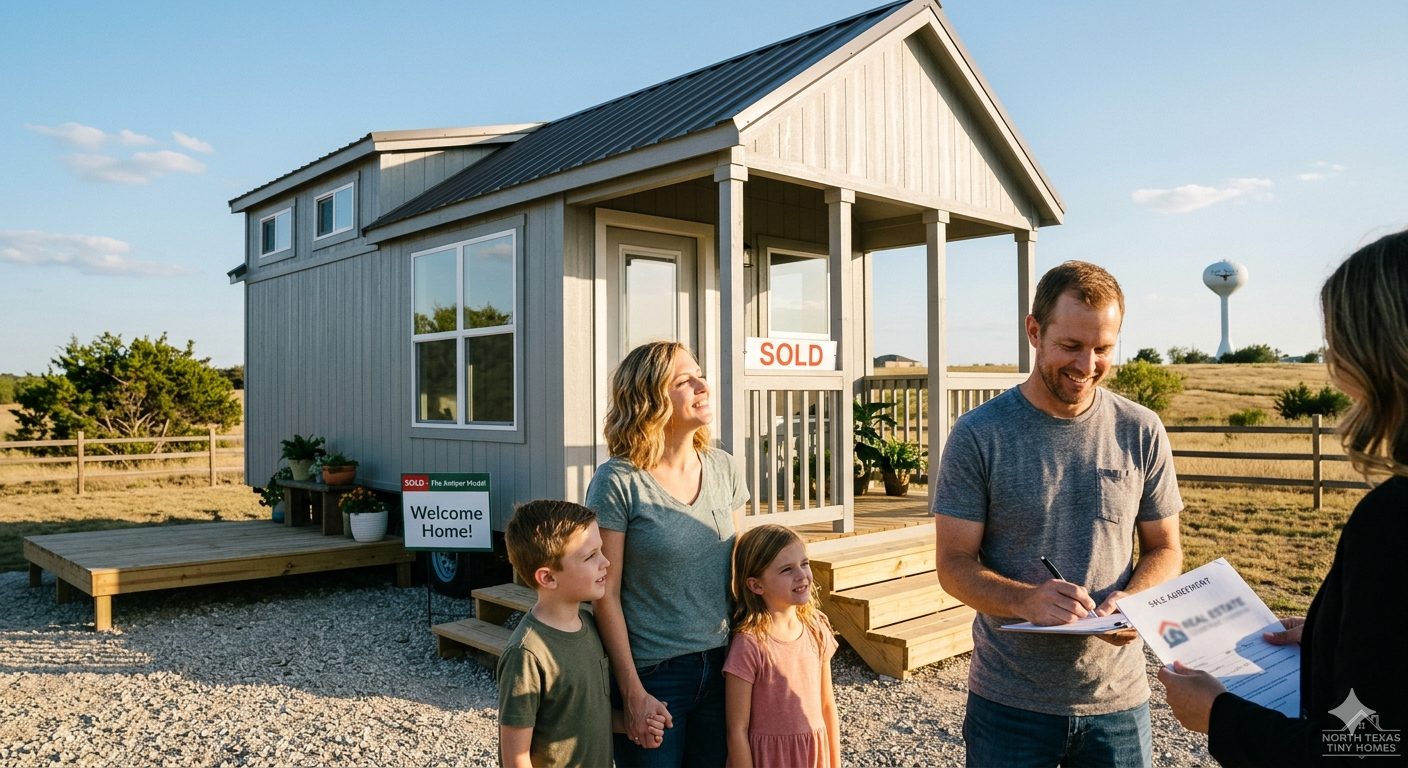
After thousands of buyer conversations across North Texas, here’s who each path actually serves best.
A Manufactured Home Likely Fits You Better If You:
Need two or more bedrooms, or have a family. Want access to FHA, VA, or conventional financing with 3%–3.5% down. Plan to own land and build long-term equity. Value standard utility connections and low-maintenance living. Want the strongest possible resale position, particularly after SB 785 expands placement options in September 2026. Are a first-time buyer looking for the most financing-friendly path to ownership. Want to position in growth corridors like Red Oak, Ennis, or the I-35E corridor where land plus manufactured home creates the best value equation in the market right now.
A Tiny Home Likely Fits You Better If You:
Are single or a couple without children and have minimal space needs. You value design customization, portability, and the minimalist lifestyle above square footage. Can pay cash or secure an RV loan and are comfortable with shorter financing terms. Want to live in a dedicated tiny home community for the social and lifestyle experience. Are an investor exploring short-term rental income, THOWs qualify for 100% bonus depreciation as business personal property, a meaningful first-year tax advantage. Are comfortable navigating a more complex zoning and insurance landscape.
Either Could Work If You:
Are a retiree downsizing who prioritizes low overhead. Explore both categories and compare monthly costs and lifestyle. Are exploring options under $150,000 in North Texas and want to understand the full menu, including new construction under $350,000 in South DFW. Work remotely and want maximum flexibility on where and how you live.
Why This Matters Right Now in North Texas
Here’s the context that ties everything together.
The Ellis County median home value sits around $368,032. Fort Worth’s median fell 6.3% year-over-year to $318,495 as of late 2025. Meanwhile, 67% of millennials report delaying their home purchase, with nearly a quarter waiting five or more years. And the mortgage lock-in era is finally ending, with rates breaking below 6% and buyer activity accelerating.
In that environment, both tiny homes and manufactured homes represent real pathways to ownership that weren’t in mainstream conversation five years ago. Texas SB 15 is making smaller-lot development viable. SB 785 is breaking down manufactured home zoning barriers across the state. And the buyers who move with conviction on accurate information are going to win this market.
Whether that’s a THOW in a DFW community, a manufactured home on a half-acre in Ellis County, or a Lennar compact home in Princeton, the right answer is the one that matches your financial reality, your lifestyle, and your long-term goals. What’s never the right answer is the choice made on incomplete information.
Your Biggest Questions, Answered Directly

Is a tiny home considered a manufactured home?
No. Most tiny homes are not classified as manufactured homes because they are not built to federal HUD Code. Tiny homes on wheels are typically classified as RVs when RVIA-certified. Foundation-based tiny homes are classified under local building codes. Manufactured homes must meet HUD standards, carry HUD Certification Labels, and be built on a permanent steel chassis. The classification drives your financing, insurance, and zoning options, everything downstream flows from it.
Can you finance a tiny home with an FHA loan?
Generally, no. Not for homes on wheels. However, if a tiny home is on a permanent foundation, meets minimum size requirements (typically 400+ square feet), and is classified as real property, it may qualify for FHA financing. Manufactured homes have dedicated FHA programs in Title I and Title II. For most tiny homes, the practical financing paths are personal loans, RV loans for RVIA-certified homes, or cash.
Do manufactured homes appreciate in value?
Yes, when on owned land. FHFA data analyzed by the Urban Institute shows manufactured homes appreciated 211.8% between 2000 and 2024, virtually identical to site-built homes at 212.6%. In Texas specifically, manufactured home prices have risen 98.2% over the past decade. The depreciation narrative is outdated. What you’re really asking is whether the home is titled as real property on owned land, because that’s what determines appreciation behavior.
What is the average cost of a manufactured home in Texas?
As of 2026, the average sale price of a new manufactured home in Texas is $122,500. Single-section homes average $86,700; double-section homes average $146,900. These figures don’t include land, site preparation, foundation, or utility connections. Which typically add $20,000–$60,000 depending on location and site conditions.
How much does it cost to insure a tiny home vs a manufactured home?
Tiny home insurance generally runs $200–$1,000 per year but can be difficult to obtain, often requiring specialty carriers. Manufactured home insurance typically costs $300–$1,500 per year with more widely available coverage from major carriers. Both are significantly below the national average of approximately $2,490 per year for traditional homeowners insurance coverage.
What does Texas Senate Bill 785 mean for buyers?
SB 785, effective September 1, 2026, requires most Texas cities with zoning to allow new HUD-code manufactured homes by-right in at least one residential district. Cities can no longer effectively ban manufactured homes through zoning. An estimated 44% of Texas municipalities will need to update their zoning codes. This is the most significant expansion of manufactured housing rights in Texas in decades and it’s only six months away.
Can you put a tiny home or manufactured home on any land in Ellis County?
In unincorporated Ellis County, there is no formal zoning, which creates significantly more flexibility for both housing types. County building, engineering, drainage, and platting requirements still apply. Inside city limits (Waxahachie, Midlothian, Red Oak, Ennis), you must comply with municipal zoning codes. Always verify with your local planning department before purchasing land for alternative housing. This is exactly the conversation I walk buyers through before they make a land purchase.
Which is better for rental income, tiny home or manufactured home?
Both work, but for different strategies. THOWs qualify for 100% bonus depreciation as business personal property, creating significant first-year tax advantages for investors. They can generate strong short-term rental income in unique or tourist-accessible locations. Manufactured homes offer more conventional rental income with stronger long-term appreciation and easier financing for investment purchases. Verify local short-term rental regulations before purchasing either for income purposes.
What’s the difference between a manufactured home and a modular home?
Manufactured homes are built to federal HUD Code on a permanent steel chassis. Modular homes are built to the International Residential Code, the same state and local codes as traditional site-built homes. Modular homes require permanent foundations, are classified as real property, and are treated identically to site-built homes for financing, insurance, and zoning. Modular homes typically cost more but face fewer regulatory barriers.
Should I buy a tiny home, a manufactured home, or wait for a traditional home?
If homeownership now is the goal and budget is the primary constraint, a manufactured home on owned land in Ellis County offers the strongest combination of financing access, appreciation potential, and livability. If the minimalist community lifestyle is the priority and you can pay cash or secure RV financing, a tiny home in a DFW community could fit. If your budget reaches the $280,000–$368,000+ range, exploring new construction in growing communities remains the most established path. If you want to explore the full spectrum, that’s exactly the conversation I have with buyers every week.
What Comes Next
I’m not here to push you toward one path. I’m here to make sure you have the complete picture, because the right answer depends entirely on your financial reality, your lifestyle priorities, and your long-term goals.
What I can tell you is this: the buyers who win in the current North Texas market are the ones who move with conviction on accurate information. They understand their financing options before they fall in love with a home. They know where zoning is changing before everyone else does. They see manufactured housing on owned land not as a consolation prize but as a legitimate wealth-building vehicle, because the data says it is.
If you’re ready to run your own numbers, explore your options in Ellis County, Johnson County, Tarrant County, or anywhere across the DFW Metroplex, whether that’s a tiny home community, a manufactured home on land, or new construction in one of the fastest-growing corridors in North Texas, text or call me directly. Schedule a buyers consultation.
The conversation is free. The intelligence you leave with isn’t.
Bobby Franklin, REALTOR® | Legacy Realty Group Leslie Majors Team
📲 214-228-0003 | northtexasmarketinsider.com
Preferred Lender Partners (RESPA Disclosure — All Three Listed for Compliance):
- Denise Donoghue — The Mortgage Nerd | yourmortgagenerd.com
- Andrew Bryan — Miramar Mortgage | miramarmortgage.com
- Ethan Hester — Midtex Mortgage | mid-texmortgage.com
This article is for informational and educational purposes only and does not constitute legal, financial, or tax advice. All information is believed accurate as of the publication date and is subject to change. Zoning regulations, financing options, and market conditions vary by location and individual circumstances. Consult qualified professionals before making real estate or financial decisions. All content complies with the Fair Housing Act, RESPA, the NAR Code of Ethics, Texas Real Estate Commission advertising policies, and applicable federal and state regulations. Commission structures are always independently determined and individually negotiated.
Bobby Franklin | Legacy Realty Group – Leslie Majors Team
16 Northgate Dr. Ste 100, Waxahachie, TX 75165