

Here’s what the data is screaming at us right now: 67% of millennials have delayed buying a home because of market conditions, with 56% waiting at least three years and 23% postponing for FIVE YEARS OR MORE.
Let me say that again: nearly a quarter of an entire generation has been sitting on the sidelines for half a decade, watching rents climb, watching home prices appreciate, watching equity build in properties they could have owned, all while waiting for “perfect” conditions that never arrive.
If you’re a millennial in North Texas feeling stuck in this exact trap, I’m going to give you something different than what you’ll read anywhere else. Not generic national advice. Not cheerleading about “just believe in yourself.” Not doom-and-gloom predictions designed to get clicks.
I’m going to give you market intelligence. Real data. Strategic thinking. And most importantly, the exact playbook buyers are using RIGHT NOW to break through the affordability wall in Ellis County and the DFW metroplex while everyone else is still complaining about how hard it is.
Because here’s what I know after years of helping first-time buyers navigate this exact situation: the market doesn’t care about your feelings, your timeline, or your political opinions about what housing “should” cost. The market is a game of supply, demand, capital flows, and human psychology. Either you learn the rules and play strategically, or you spend another five years waiting while other people build wealth.
Let’s talk about what’s really happening, why waiting usually backfires, and how to actually win in 2026.
The Brutal Reality: Your Parents’ Housing Market Doesn’t Exist Anymore
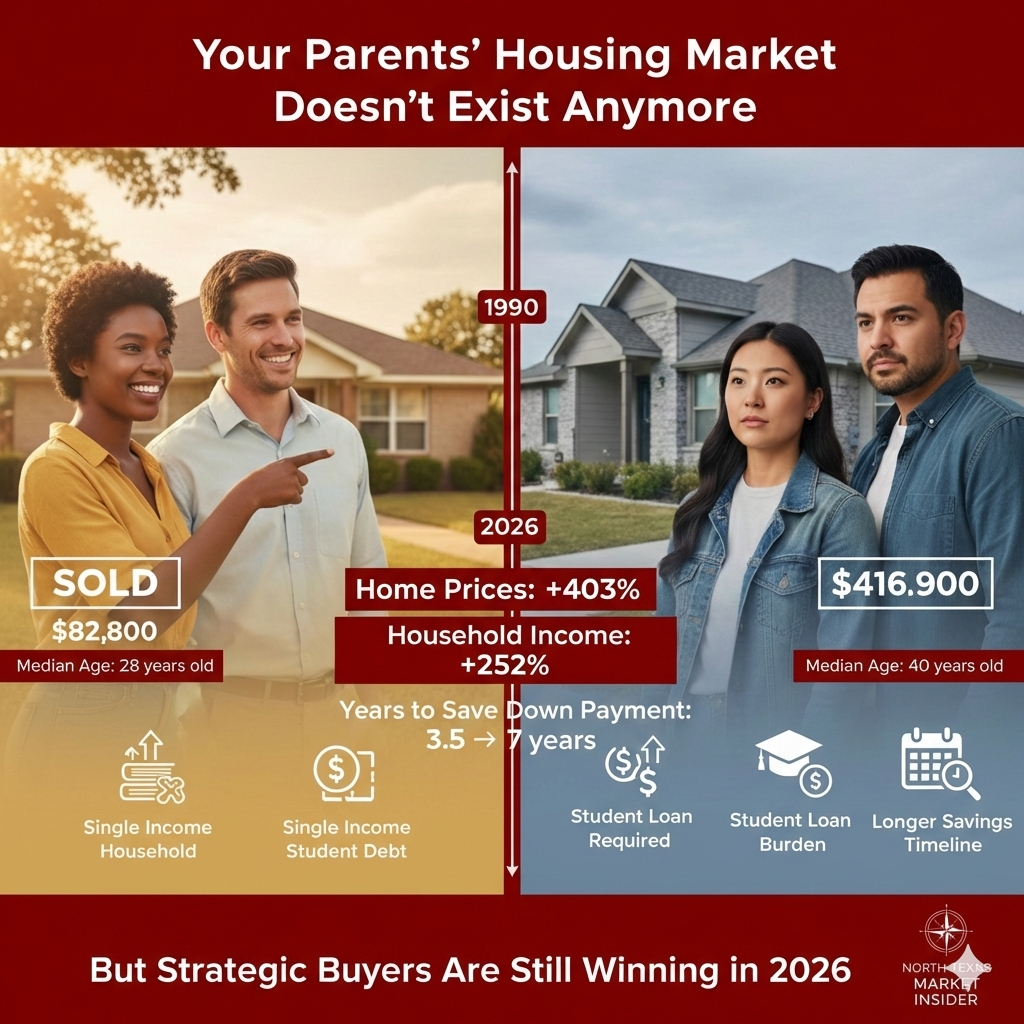
The viral social media posts are essentially correct, even if the exact numbers vary by source: home prices have massively outpaced income growth since the 1990s, and it’s not even close.
From 1985 to 2025, the median U.S. home price jumped from roughly $82,800 to $416,900, a 403% increase. Over the same period, median household income rose from about $23,620 to $83,150, a 252% increase.
Translation: home prices grew nearly twice as fast as incomes.
The price-to-income ratio climbed from roughly 3.5× income in the mid-1980s to 5.0× income by 2025, not adjusting for inflation. What that means in practical terms is that if your parents bought a house when it cost 3.5 times their annual household income, you’re looking at properties that cost 5 times yours, a 43% higher multiple of what you actually earn.
Even after adjusting for inflation since 1960, home prices have risen 121% while household incomes increased only 29%. In Texas specifically, a supposed “affordable” state compared to California or New York, home prices have consistently outpaced wage growth for most of the past decade.
This isn’t a conspiracy. This isn’t price gouging. This is what happens when you have:
- Decades of restrictive zoning limiting new construction
- A Federal Reserve that kept interest rates at historic lows for years, inflating asset prices
- Institutional investors flooding residential markets
- A millennial generation significantly larger than Gen X competing for housing
- NIMBY local politics blocking density in desirable job centers
Understanding why this happened doesn’t make it easier to afford a house, but it does help you stop waiting for a “return to normal” that isn’t coming.
Your parents’ housing market, where a typical family could buy a decent starter home on one income with minimal savings, is gone. That reality sucks. But denial doesn’t help you build wealth.
The Mortgage Math That Breaks Millennial Brains

Here’s the statistic that goes viral every few months: “In 1990, a typical mortgage payment was about one week’s pay. Today it’s closer to two weeks.”
Is that actually true? Let’s run the numbers.
Around 1990:
- Median monthly mortgage payment: roughly $856
- Median household income: about $63,800/year ($5,300/month)
- Mortgage as percentage of monthly income: about 16%
- Mortgage payment as proportion of gross income: 1.6 weeks
In 2024-2025:
- Average monthly mortgage payment: about $2,200
- Median household income: closer to $83,000/year ($6,900/month)
- Mortgage as percentage of monthly income: close to 35%
- Mortgage payment as proportion of gross income: 2.3 weeks
So yes, the meme is directionally accurate, but here’s what makes it even more painful:
Interest rates in 1990 were around 10%. Today they’re 6-7%.
Wait, what? If rates are LOWER today, why is affordability so much worse?
Because home prices have exploded so dramatically that even with lower rates, you’re borrowing WAY more money.
- Median home price in 1990: under $100,000
- Median home price in 2025: over $410,000
You’re borrowing 4× as much money even though rates are lower. And here’s the strategic insight most people miss: much of the home price appreciation from 1990-2020 was actually driven by falling mortgage rates making homes “affordable” on a monthly payment basis.
As rates fell from 10% to 7% to 5% to 3%, buyers could afford to buy more house for the same monthly payment, which pushed prices up. Sellers captured that rate-driven affordability improvement through higher prices.
Now that rates have moved back up to 6-7%, we’re living in the worst of both worlds: prices inflated by nearly a decade of ultra-low rates, but qualification requirements based on today’s higher rates.
This is the mathematical trap most millennials are stuck in and why waiting for rates to drop often backfires (more on that in a minute).
The Three Walls: Why Most Millennials Feel Completely Stuck
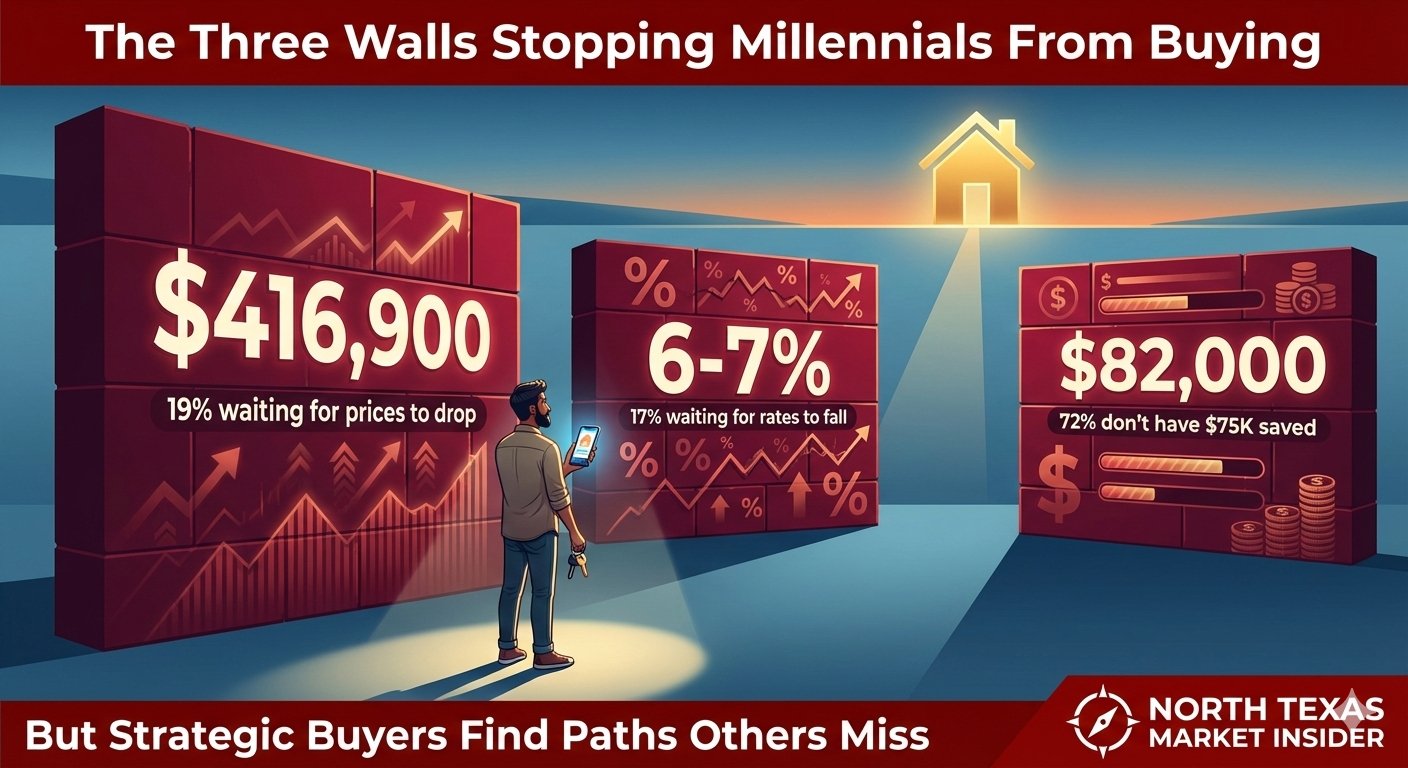
Based on recent national surveys and data I track daily for North Texas, here’s what’s actually stopping millennial buyers:
Wall #1: Home Prices That Won’t Crash
19% of delayed buyers say they’re waiting for home prices to come down.
I get it. It feels insane to pay $350,000-$450,000 for a starter home when you know someone who bought the same house for $180,000 in 2012.
But here’s what the data actually shows about price corrections:
- Yes, some markets saw meaningful price drops from 2022-2024, including parts of Texas
- Dallas median prices fell about 5.8% from $398K in 2024 to $375K in 2025
- But prices are still 30-50% higher than pre-pandemic levels in most DFW neighborhoods
Even after corrections, we’re nowhere close to 2019 prices, let alone 2012 prices. And here’s why betting on a major crash is usually a losing strategy:
Major price crashes require:
- Oversupply of inventory (we’re still undersupplied in most markets)
- Forced selling due to economic catastrophe (unemployment is relatively low)
- Credit collapse making mortgages unavailable (lending standards are rational, not loose)
- Massive new construction flooding the market (we’re not building enough to meet demand)
Could we see modest price declines or flat appreciation for a few years? Absolutely. Many forecasters expect slow growth or slight declines in 2025-2026.
Could we see a 2008-style 30-40% crash? Extremely unlikely without a major recession and credit crisis.
Waiting for prices to crater while paying $1,800-$2,400/month in rent is a bet with poor odds.
Wall #2: Interest Rates That Won’t Go Back to 3%
17% of delayed buyers are waiting for interest rates to drop.
This is the trap I see most often with smart, financially literate millennials. The logic seems sound: “Rates were 3% two years ago. They’ll come back down eventually, and THEN I’ll buy.”
Here’s why that strategy usually fails:
When rates drop, competition surges.
During the ultra-low-rate era of 2020-2021:
- Over one-third of successful buyers paid ABOVE list price
- Bidding wars were intense on any decent property
- Buyers waived inspections, appraisals, and financing contingencies
- Sellers had all the leverage
Current forecasts for 2025-2026 suggest rates may edge down to mid-5% to low-6%, not back to 2-3%.
And here’s the kicker: when rates drop even slightly, more buyers qualify and re-enter the market simultaneously, which drives prices UP through increased demand.
You save $150/month on a lower rate, but you pay $30,000 more for the house because you’re competing with 12 other offers. Net result? You’re worse off than if you’d bought when competition was lighter, even with a slightly higher rate.
The strategic play: Buy when you have negotiating leverage and fewer competing buyers, then refinance later if rates drop significantly. Trying to time the rate market perfectly usually means you miss the opportunity entirely.
Wall #3: The Down Payment That Feels Impossible
This is the wall that stops more millennials than anything else and it’s where the statistics get truly depressing:
- The median U.S. down payment has more than doubled from about $14,000 in 2019 to roughly $30,400 in 2025
- On a $410,000 home, a traditional 20% down payment is $82,000, basically a full year of median household income
- It now takes about 7 years for the typical household to save a down payment, compared to 3-4 years pre-pandemic
For millennials specifically:
- Only 28% have enough savings for a 20% down payment
- Fewer than half have enough for even 10% down
- 47% have been saving for FIVE YEARS OR MORE and still haven’t hit their target
And if you’re carrying student loans, which most millennials are, this hill gets even steeper:
- Average millennial student loan debt: roughly $40,000
- About 27% of borrowers say student loans delayed homeownership by 10 years
- 70% of millennial homeowners with student debt say it postponed their purchase
- Those who did buy with student debt typically spent 39% less on their home than buyers without loans
This is the real affordability crisis: Not that monthly payments are impossible, but that the upfront cash required creates a multi-year delay that costs tens of thousands in lost equity and rising rents.
Why Waiting for “Perfect” Conditions Usually Costs More Than Buying Strategically

What if I told you that the delay itself is often more expensive than buying in an “imperfect” market?
Here’s the math nobody talks about:
The Rent Trap
At $1,800/month in rent (which is low for DFW right now):
- Year 1: $21,600 in rent payments that build ZERO equity
- Year 2: Another $21,600 (probably $22,500 with rent increases)
- Year 3: Another $22,500+
Three years of waiting = $65,000-$70,000 in rent payments that could have been building equity through principal paydown and appreciation.
Even if a $350,000 home only appreciates at a modest 3% annually, that’s:
- Year 1: $10,500 in appreciation + principal reduction
- Year 2: $10,800+ in appreciation + principal reduction
- Year 3: $11,100+ in appreciation + principal reduction
You’re looking at $35,000-$40,000 in equity accumulation over three years that you completely miss by waiting, while also paying $65,000 in rent.
Net opportunity cost of waiting three years: $100,000+
Now, is every market going to appreciate 3% annually? No. Could we see a year or two of flat or negative appreciation? Sure. But you know what also has zero appreciation? The rent check you write every month.
The Competition Surge Problem
I mentioned this earlier, but it’s worth hammering home: the moment conditions feel “perfect” to you, they feel perfect to everyone else too.
Market dynamics show that when rates drop significantly:
- Buyer demand increases 15-25% within weeks
- Inventory gets absorbed faster
- Days on market decrease
- List-to-sale price ratios increase
- Sellers regain negotiating leverage
You thought you were being smart by waiting. So did 50,000 other DFW buyers.
Strategic buyers do the opposite: They buy when conditions are tough, competition is light, and sellers are motivated. Then they benefit when the market improves.
The Qualification Standard Tightening
This one surprises people, but it’s absolutely real:
Buyers today need roughly $120,000-$130,000 in household income to “comfortably” afford a typical first-time buyer home in most metros, once you factor in principal, interest, taxes, insurance, and HOA fees.
In DFW specifically, the typical millennial homebuyer’s income was about $142,000 in 2024.
That’s not because DFW is uniquely expensive, it’s because housing costs relative to income mean dual-earner households with strong incomes are becoming the baseline expectation.
And here’s the strategic insight: Lenders don’t get more lenient over time in high-price environments. They get MORE conservative.
After 2008, lending standards tightened significantly. Post-pandemic, with inflation concerns and economic uncertainty, underwriting remains cautious. Debt-to-income limits, credit score requirements, and cash reserve expectations aren’t likely to loosen—they’re more likely to tighten further if economic conditions deteriorate.
Waiting for qualifying to get easier is betting against historical patterns.
What’s Actually Happening in North Texas Right Now (The Local Intel Nobody Else Is Giving You)
Generic national housing advice is useless. What matters is what’s happening in YOUR market, in YOUR price range, in YOUR specific situation.
Here’s the North Texas market intelligence as of January 2025:
DFW Millennial Buying Activity
- DFW ranked near the top of all U.S. metros for millennial mortgages in 2024, with over 55,000 mortgages issued to millennials
- Despite that volume, those loans represented only about 2.3% of the metro’s millennial population, meaning the vast majority are still renting or living with family
- The median home purchased by millennials in DFW was around $455,000, and median income for those buyers was about $142,000
What that tells me strategically: The barrier to entry is HIGH, but tens of thousands of buyers ARE finding ways through. The difference between the 2.3% who bought and the 97.7% who didn’t often comes down to strategy, not just income.
Price Adjustments and Market Balance
- Dallas saw one of the steepest price drops in the country from 2024-2025, with median prices slipping from about $398,000 to $375,000 – a 5.8% decline
- That’s helpful for buyers, but it only partially reversed the massive run-up from 2019-2023
- Regional experts expect more balanced conditions in 2025-2026, with slightly better inventory and more “normal” negotiation dynamics
What that means for buyers:
- More opportunity to negotiate on price and terms
- Less likelihood of extreme bidding wars on every listing
- Ability to be more selective without waiving every contingency
- Actually getting inspection periods and financing contingencies
What that means for sellers:
- Proper pricing and property preparation matter more than ever
- Days on market are extending for overpriced listings
- Buyers have more options and will walk if terms aren’t reasonable
Ellis County and Suburban Growth Corridors
This is where the opportunity really lies for strategic millennial buyers:
Major developments creating long-term value:
- 5,200-acre development project in Ferris bringing thousands of homes and businesses
- Infrastructure improvements along I-35E corridor
- Corporate relocations continuing to drive job growth
- School district expansions in Midlothian, Waxahachie, Red Oak
What smart buyers are doing:
- Buying 20-30 minutes south of Dallas in Ellis County where prices are $100K-$150K lower
- Getting into new-construction communities with builder incentives
- Positioning ahead of infrastructure and development completion
- Building equity during the growth phase rather than buying after appreciation has already occurred
This is classic Insider thinking: Be five steps ahead. Buy where the smart money is going, not where it’s already been.
The Strategic Playbook: How Millennials Are Actually Breaking Through in 2026

Enough about the problems. Let’s talk about solutions, real strategies that real buyers are using RIGHT NOW in North Texas.
Strategy #1: Stop Waiting for 20% Down (Nobody Does That Anymore)
The single biggest myth holding millennials back: “I need 20% down to buy a house.”
Reality: Most first-time buyers put down significantly less than 20%, and many put down 3-5%.
Here are the programs smart North Texas buyers are actually using:
FHA Loans (3.5% Down)
- Down payment: as little as 3.5% with credit scores around 580-620
- On a $350,000 home: $12,250 down payment
- PMI required but often still cheaper than rent
- Flexible credit guidelines make qualification easier
Conventional 97 Programs (3% Down)
- Programs like HomeReady and Home Possible allow 3% down for qualified buyers
- Better PMI rates than FHA in many cases
- Income limits apply but are generous in many DFW areas
- On a $350,000 home: $10,500 down payment
VA Loans (0% Down)
- Available to eligible veterans and active-duty service members
- Zero down payment required
- No PMI
- Often the absolute best financing available if you qualify
USDA Loans (0% Down)
- Available in qualifying suburban and rural areas
- Parts of Ellis County and outer DFW suburbs qualify
- Zero down payment
- Income limits apply but are surprisingly high for many areas
Down Payment Assistance Programs
- State, city, and county programs providing grants or low-interest loans for down payments
- Forgivable loans in some cases (you don’t pay back if you stay in the home X years)
- Many programs target first-time buyers and moderate-income households
- Can stack with FHA/conventional loans to reduce out-of-pocket cash even further
The strategic move: Stop saving for 20% down. Use a 3-5% down program, get into a home, start building equity, and refinance out of PMI later when you hit 20% equity through appreciation and principal paydown.
On a $350,000 home:
- 20% down: $70,000 (takes most buyers 5-7 years to save)
- 3% down: $10,500 (achievable in 12-18 months for many households)
Opportunity cost of waiting 5 years to save $70,000:
- Rent paid: $120,000+
- Equity missed: $40,000-$60,000
- Total cost: $160,000-$180,000
That’s literally the cost of waiting to be “perfectly ready.”
Strategy #2: House Hacking and Creative Ownership Models
This is where millennial buyers are getting genuinely creative and building wealth faster than traditional buyers:
House Hacking:
- Buy a property with a separate unit, rent out bedrooms, or add an ADU (accessory dwelling unit)
- Rental income offsets 30-50% of your mortgage payment
- You live essentially “for free” while building equity
- Many lenders allow rental income to count toward qualification
Co-Buying with Friends or Family:
- Structured correctly through tenants-in-common or LLC arrangements
- Combine incomes to qualify for properties individually out of reach
- Split costs and build equity together
- Proper legal agreements are critical but doable
Starter Home Strategy:
- Buy a smaller or “less perfect” home in a strong appreciation area
- Live in it 3-5 years while building equity
- Sell or convert to rental and use equity for your “forever home”
- The goal is equity accumulation, not finding your dream home on purchase #1
Geographic Arbitrage:
- Move 20-30 minutes further out from Dallas into Ellis County, Kaufman County, or growth corridors
- Save $75,000-$150,000 on purchase price
- Build equity during infrastructure/development buildout
- Leverage appreciation to move closer later if desired
Here’s what this looks like in practice:
Traditional Approach:
- Wait 5 years saving for 20% down on a $400,000 home in Plano
- Total time to ownership: 5+ years
- Rent paid during wait: $120,000+
- Starting equity: $80,000 (your down payment)
Strategic Approach:
- Buy a $300,000 home in Waxahachie with 3% down ($9,000) in Year 1
- Rent out a bedroom for $700/month to offset costs
- After 5 years of 3% annual appreciation: home worth $348,000
- Equity position: ~$65,000 (appreciation + principal + bedroom rent savings)
- You spent 5 years building equity instead of paying rent
- Sell or keep as rental, use equity for next purchase
The difference: $180,000+ in financial position over 5 years.
Strategy #3: Optimize Your Personal Financial Profile
Whether you buy this year or next, your qualification profile determines how much house you can afford and what rate you’ll get.
The three levers that matter most:
1. Credit Score Optimization
- Most first-time buyer programs accessible at 620-640
- Significant rate improvements at 660+, 700+, 740+
- Focus on: paying down credit card balances, fixing errors, avoiding new credit inquiries
- Free resources: AnnualCreditReport.com for reports, dispute errors with bureaus
2. Debt-to-Income Ratio Reduction
- Lenders typically want debt payments under 43-50% of gross income
- Paying down high-interest credit cards and auto loans increases buying power
- Every $500/month in debt you eliminate = ~$80,000-$100,000 more home you qualify for
- Student loans: Consider income-driven repayment plans to lower monthly payment for qualification purposes
3. Cash Reserves and Emergency Funds
- Lenders like to see reserves (2-6 months of mortgage payments in savings after closing)
- Real financial security comes from having a true emergency fund beyond your down payment
- Better qualification terms and rate pricing with reserves
Strategic priority: Focus on credit score and DTI ratio FIRST, then save for down payment using low-down-payment programs rather than waiting for 20%.
Strategy #4: Get Full Pre-Approval (Not Just Pre-Qualification)
Here’s a mistake I see constantly: Buyers think “pre-qualification” = ready to make offers.
Pre-Qualification: Soft estimate based on what you tell a lender about income/assets. Not verified. Almost useless.
Pre-Approval: Full documentation review including pay stubs, tax returns, bank statements, credit report. Underwriting analysis. Actual commitment letter.
Why this matters:
- Sellers take fully pre-approved buyers seriously
- You know EXACTLY what you qualify for (no surprises)
- Faster closing timeline (underwriting already done)
- Stronger negotiating position
Strategic move: Before you tour a single house, get fully pre-approved with a local mortgage professional who specializes in first-time buyers and knows all the low-down-payment and assistance programs.
Who should you talk to? I work with two fantastic lenders who know every program available:
- Denise Donoghue at The Mortgage Nerd
- Andrew Bryan at Miramar Mortgage
Both specialize in helping North Texas first-time buyers navigate exactly these situations. (I mention both to stay compliant with RESPA/NAR rules and recommend you talk to both, pick who’s the best fit for your situation.)
Why Working with a North Texas Agent Matters More After Industry Changes

Let’s talk about something that’s changed recently that most buyers don’t fully understand: the NAR settlement and new buyer representation rules.
What changed in 2024:
- Listing brokers are no longer required to publicly advertise buyer agent compensation in MLS
- Buyer-broker agreements are now more explicit and required before touring homes
- Full transparency about how your agent gets paid and what services you receive
- Increased focus on Fair Housing compliance and preventing steering
What that means for you:
- Complete transparency: You’ll know exactly how your agent is compensated, what they’re doing for you, and what your obligations are
- Written agreements: Clear contracts you can review and negotiate before committing
- Fair Housing protection: Your agent must NEVER steer you toward or away from neighborhoods based on race, religion, national origin, sex, gender identity, sexual orientation, familial status, or disability
- Higher professional standards: Agents who were cutting corners or providing minimal service are getting exposed; agents who provide real value are thriving
Why local expertise matters more than ever:
National advice doesn’t help you: Generic content about “the housing market” doesn’t tell you anything about Ellis County vs. Frisco vs. Fort Worth. You need someone who knows:
- Which new developments are launching and which builders offer the best incentives
- Where infrastructure improvements are happening that will drive appreciation
- Which neighborhoods have strong school districts and community investment
- What price points are competitive and where you have negotiating leverage
Lending program knowledge: Most buyers have never heard of HomeReady loans, don’t know about local down payment assistance, and don’t understand how to structure offers with low down payments to compete against conventional buyers.
Fair Housing and ethical compliance: The real estate industry has a problematic history of discrimination and steering. A professional REALTOR® who follows the NAR Code of Ethics and Fair Housing law protects YOU from predatory practices and ensures you’re treated fairly regardless of your background.
Strategic market positioning: Knowing when to push, when to walk away, how to structure offers, and what properties offer the best long-term value, that’s the difference between building wealth and making expensive mistakes.
Final Thoughts: The Market Is Hard, But the Dream Is Still Within Reach
Here’s what I know to be true:
Homeownership is still part of the American Dream for about 75% of Americans, including the vast majority of millennials and Gen Z. That hasn’t changed.
What HAS changed is that the path is harder, the math is more complicated, and the timeline is longer than it was for previous generations.
But here’s where Insider strategic thinking comes in: When everyone else is paralyzed by difficulty, that’s when the opportunists make their move.
Over 50% of millennials have delayed buying for 3+ years. That’s a MASSIVE pool of buyers sitting on the sidelines, watching, waiting, hoping conditions improve.
What if you’re one of the people who decides to stop waiting and start executing?
What if you:
- Use a 3% down program instead of waiting for 20%
- Buy in a strategic growth corridor instead of waiting to afford your dream neighborhood
- Get creative with house hacking or co-buying
- Work with professionals who actually know the local market and lending landscape
The math is harder. But math doesn’t beat strategy + execution + education.
“You don’t need perfect conditions. You need a perfect PLAN and imperfect ACTION.”
“Everyone else is panicking about market conditions, but chaos is your competitive advantage. While they’re frozen with fear, you’re MOVING.”
The door isn’t closed. It’s just narrower. And you need better intelligence and better strategy to get through it.
Ready to Stop Waiting and Start Building Wealth?
If you’re tired of sitting on the sidelines, tired of watching rents climb, tired of feeling like homeownership will never happen, let’s have a real conversation.
Not a generic email. Not a chatbot. An actual strategic planning session where we:
- Analyze your current financial profile (income, credit, debts, savings)
- Identify which loan assistance programs you might qualify for RIGHT NOW
- Map out realistic purchase targets in North Texas growth corridors
- Build a 6-12 month game plan to get you from renting to owning
This isn’t a sales pitch. This is strategic coaching. If you’re not ready to buy, I’ll tell you exactly what you need to do to GET ready. If you ARE ready but don’t know it yet, I’ll show you the path forward.
The only thing I won’t do is let you waste another 3-5 years waiting for “perfect” conditions that aren’t coming.
For more resources for homebuyers visit our Homebuyers Page
To schedule a buyers consultation fill out our Buyers Consultation Form
Bobby Franklin, REALTOR®
Legacy Realty Group – Leslie Majors Team
📲 214-228-0003
📍 northtexasmarketinsider.com


This article represents the professional opinions and market analysis of Bobby Franklin, REALTOR® with Legacy Realty Group – Leslie Majors Team. All data cited is sourced from publicly available reports and research. This content is for informational purposes and does not constitute financial, legal, or tax advice. All buyers should consult with licensed professionals including real estate agents, mortgage lenders, attorneys, and tax advisors before making homebuying decisions. This content complies with Fair Housing laws, RESPA, and NAR Code of Ethics standards as currently understood.