

Episode 1 of 5: The Market Intelligence Series You Can’t Afford to Miss
If you’ve been trying to make sense of the housing market over the past five years, I’ve got news for you: you’ve been living in the Upside Down, and most agents won’t tell you how we got here or how we’re getting out. I’m giving you the intelligence you actually need to make smart decisions in 2026.
Consider this your definitive guide to what happened, why it happened, and what it means for your next move in the North Texas market. And if you’re a Stranger Things fan? You’re about to see the housing market in a whole new light.
This is Episode 1 of a 5-part series that breaks down the most volatile housing market in modern history through the lens of Hawkins, Indiana. Over the next few weeks, we’ll explore Vecna’s mortgage rate curse, the Mind Flayer’s economic control, Hawkins Lab’s development experiments, and your strategic game plan for closing the gate on uncertainty.
But first, let’s talk about how the portal opened.
2020-2021: Welcome to Hawkins: The Golden Age Before Everything Changed

Picture the housing market in early 2020 as the quiet, seemingly normal town of Hawkins, Indiana. Sure, there were challenges, but the fundamentals worked. Inventory existed. Prices made sense. Buyers and sellers operated within understood parameters.
Then March 2020 hit, and like when Eleven accidentally opened the gate to the Upside Down in Hawkins Lab, the entire reality of the housing market flipped.
The Federal Reserve slashed interest rates to near-zero in an emergency response to pandemic uncertainty. Mortgage rates followed, plummeting to historic lows that had never been seen in modern lending history. Suddenly, borrowers were locking in 30-year fixed rates below 3%, some even securing rates in the 2.5% range.
This wasn’t normal. This was otherworldly.
But the rate environment was only part of the equation. Remote work emerged as our new superpower, fundamentally changing how Americans viewed housing. Homes weren’t just shelter anymore, they were offices, schools, gyms, and sanctuaries. Space became currency. Location restrictions dissolved when your commute became a walk down the hallway.
The result? A buying frenzy that made the Demogorgon’s feeding habits look restrained.
Home prices surged by approximately 45% from early 2020 through 2024, with annual increases hitting 19.3% by mid-2021 according to the S&P CoreLogic Case-Shiller Index. Houses were being snatched up within days. Multiple offers became the norm rather than the exception. Buyers competed with the urgency of teenagers racing through the Upside Down to escape certain doom.
Here in North Texas, we experienced this phenomenon intensely. The Dallas-Fort Worth metroplex saw some of the nation’s strongest price appreciation, driven by corporate relocations, population growth, and our business-friendly environment. Ellis County, where I operate, transformed from a sleepy commuter region into a hot destination market practically overnight.
The Inventory Apocalypse
But here’s where the story gets interesting, and where most people misunderstand what happened.
Inventory collapsed, but not because sellers stopped listing. In fact, new listings remained relatively stable throughout 2020-2021. The problem was that demand was devouring supply faster than the market could replenish it.
Sales volume skyrocketed 25% above typical rates, creating a net outflow that drained the market dry. Think of it like the Upside Down consuming parts of Hawkins, the supply existed, but it was being pulled into another dimension faster than it could be replaced.
Research from the Federal Reserve later revealed that stay-at-home behaviors explained nearly half of the price surge in 2020, while ultra-low mortgage rates contributed about one-third of the increase. The combination created a perfect storm that fundamentally reset housing market baselines.
And just when homeowners thought they were safe in their low-rate fortress, the monsters arrived.
2022-2023: The Demogorgon Emerges: Federal Reserve Rate Hikes Unleash Chaos
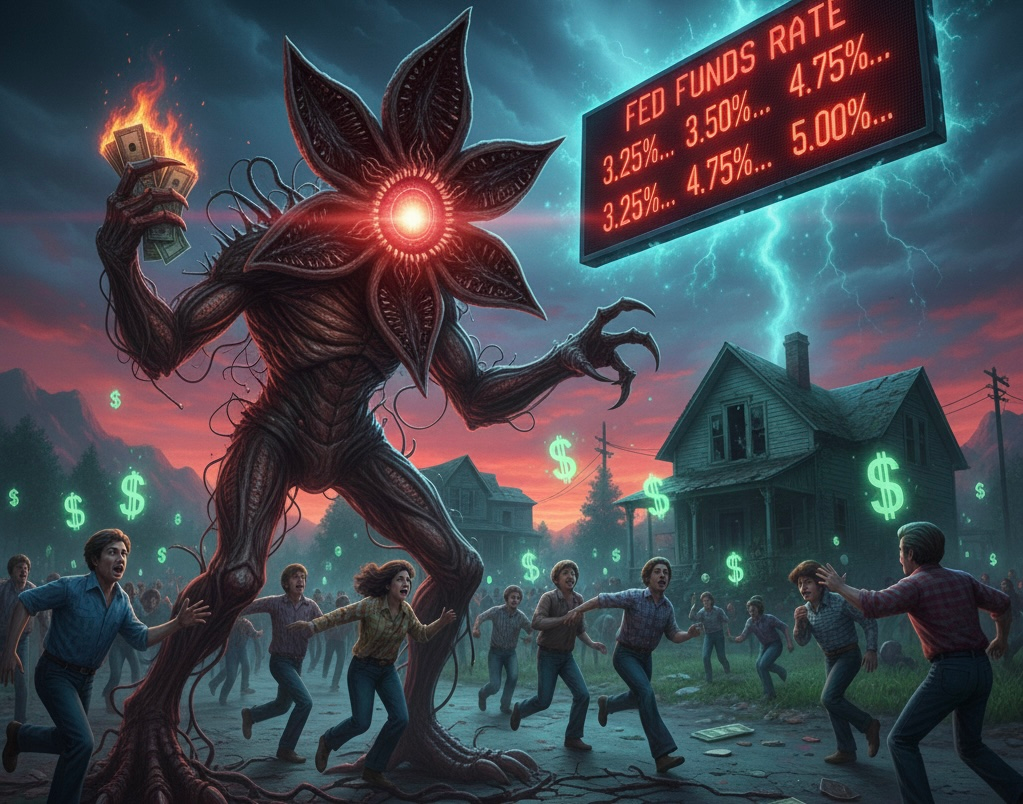
Every good horror story has a turning point where the heroes realize they’re not safe. For the housing market, that moment came when inflation reared its ugly head.
By late 2021, consumer prices were surging at 7% annually, the highest inflation rate in four decades. The Federal Reserve, which had created the ultra-low rate environment to stabilize the economy during COVID uncertainty, now faced a different crisis entirely.
They had to slam the brakes. Hard.
Between March 2022 and July 2023, the Fed raised interest rates eleven times in one of the most aggressive monetary tightening campaigns in modern history. The federal funds rate climbed from near-zero to 5.25%-5.50%.
Mortgage rates followed with terrifying speed, climbing from the low 3% range to a peak of 7.79% in October 2023, the highest level since the year 2000. For context, that meant a buyer’s monthly payment on a $400,000 home more than doubled compared to what someone paid just 18 months earlier.
Vecna’s Curse: The Mortgage Lock-In Effect

But the real monster wasn’t just high rates, it was what those high rates created: the mortgage lock-in effect, a curse that trapped homeowners in their current properties like Vecna’s victims frozen in time.
Here’s how the curse works: 93% of all outstanding mortgages carry rates below 6%, with millions locked in below 4%, and a substantial portion in the 2-3% range. Selling your home meant abandoning affordable housing costs to remortgage at double or triple your current rate.
The math is brutal. A homeowner with a $300,000 mortgage at 3% pays roughly $1,265 per month in principal and interest. That same $300,000 mortgage at 7% costs $1,996 monthly, an extra $731 every single month, or $8,772 annually. That’s not a housing decision; that’s a financial prison.
Academic research found that lock-in reduced the probability of listing a home by 21-23%. The market didn’t just slow down, it froze like Hawkins in the dead of winter.
Home sales plummeted 20.2% year-over-year by August 2023, and new listings dropped 9.3% as sellers stayed paralyzed. The psychological impact was profound: homeowners with rates below 3% were the most trapped, with 41% saying they wouldn’t consider buying again at any rate.
The lock-in effect prevented an estimated 1.7 million transactions and increased home prices by 7% on average, with tight markets seeing price increases as high as 11%. This wasn’t just affecting housing, it reduced geographical mobility, preventing workers from relocating for better job opportunities and creating labor market inefficiencies across the entire economy.
In Episode 2 of this series, we’ll explore Vecna’s Curse in detail, how it’s affecting North Texas specifically, and the strategic approaches for breaking free in 2026. Because unlike Vecna’s victims, you’re not powerless here.
2024-2025: Fighting Back: The Market Begins Its Escape
Here’s where our heroes, buyers, sellers, and yes, the Federal Reserve, started fighting back against the monsters they’d created.
By late 2024, inflation had finally cooled enough for the Fed to pivot. They began cutting rates in September 2024, delivering three cuts totaling 100 basis points by year’s end, bringing the federal funds rate to 4.25%-4.50%.
Mortgage rates responded, dropping from their October 2023 peak to average around 6.69% as of December 2024, still elevated compared to the pandemic era, but noticeably improved from the 7%+ territory that had paralyzed the market.
The Inventory Recovery Begins
After hitting historic lows in late 2022, inventory finally started recovering. We saw 18 consecutive months of year-over-year gains through mid-2024, with active listings surpassing April 2020 levels for the first time since the pandemic began.
But here’s the nuance most agents miss: recovery hasn’t been uniform.
The Southern and Western regions have nearly achieved full inventory recovery, while the Midwest and Northeast continue to lag significantly. This matters because it creates regional opportunity disparities that smart buyers and sellers can exploit.
In North Texas specifically, we’ve outperformed national trends substantially. Dallas, San Antonio, and Austin are among just eight major metros that surpassed pre-pandemic norms for new listings. The South leads the nation in new housing starts and is nearing full inventory recovery, making it one of the most balanced markets in the country.
That’s intelligence, not hype. That’s why location matters in 2026.
Despite recovery, national inventory still remains approximately 16.3% below pre-pandemic norms. The nation reached a 4.6-month supply by late 2024, considered balanced territory compared to the sub-3-month supply that defined the 2020-2021 frenzy.
Price Growth Moderates
Home price appreciation, which had been running at double-digit annual rates, finally moderated dramatically. After years of explosive growth, appreciation slowed to just 2.7% by April 2025 according to Case-Shiller data.
The median home price still hit an all-time high of $422,800 in May 2025, but the pace of growth decelerated significantly, a critical distinction for understanding market dynamics. Sellers increasingly reduced asking prices, and days on market ticked slightly higher, signaling that the frenzied seller’s market was transitioning toward equilibrium.
But don’t mistake “moderation” for “collapse.” This isn’t 2008. This is normalization.
2026: The Return to Hawkins: A New Normal Emerges

So what does 2026 look like? The forecast represents not a full return to the old Hawkins, but rather a stabilized reality where both worlds exist in balance.
Think of it as the market learning to coexist with the remnants of what happened, like Hawkins residents going about their lives while knowing the Upside Down still exists somewhere beneath the surface.
Mortgage Rates: The New Normal
Mortgage rates are projected to average around 6.3% in 2026, with some economists predicting they could dip below 6% by year’s end as the Fed continues its gradual easing cycle. This represents meaningful improvement, enough to unlock some pent-up demand without triggering another buying frenzy.
Here’s the strategic reality: 6% is the new “good rate.” Anyone waiting for 3% mortgages to return is waiting for something that’s likely gone forever. Those were pandemic-era anomalies created by unprecedented economic disruption, not sustainable long-term norms.
Sales Volume: Modest Growth Ahead
Home sales are expected to rise modestly in 2026. Forecasts range from conservative 1.7% gains to more optimistic 14% increases, though most credible economists cluster around 3-9% growth.
Why the range? Because 2026 sales depend heavily on how quickly the lock-in effect eases and how aggressively the Fed continues cutting rates. But even optimistic projections put 2026 sales volume below the pre-pandemic baseline, this is recovery, not boom.
Price Appreciation: The Slowdown Continues
Home price appreciation will remain muted in 2026, with forecasts ranging from 1.2-4% nationally, and most projections clustering in the 1-2% range. This slowdown reflects a market finding equilibrium rather than experiencing distress.
For sellers, this means the days of automatic double-digit equity gains are over. For buyers, it means home prices will likely continue rising, but at a pace closer to historical norms and more aligned with wage growth.
Inventory: The Recovery Continues
Active inventory is anticipated to increase by approximately 8.9% in 2026, continuing the recovery trend from 2024. However, levels will still remain roughly 12% below pre-pandemic norms by year’s end.
This is where North Texas has a strategic advantage. Our region’s aggressive new construction pipeline and pro-growth policies mean our inventory recovery is outpacing most of the nation. For buyers, this translates to more options and negotiating leverage. For sellers, it means pricing strategy matters more than it has in five years.
In Episode 4, we’ll explore Hawkins Lab, the new construction and development landscape in North Texas, including the massive South Creek Ranch development and what these “experiments” mean for market dynamics.
The Reset Year
Economists describe 2026 as “a reset year, not a rebound year.” The market is recalibrating after unprecedented volatility, finding new equilibrium points that reflect changed fundamentals.
The lock-in effect will gradually ease as homeowners either adjust to the new rate environment or find their locked-in mortgages aging out. First-time buyers will find slightly more breathing room as inventory grows and competition moderates. Negotiating power will shift modestly toward buyers after years of seller dominance.
But affordability remains the defining challenge. Households need to earn approximately $114,000 annually to afford the median-priced home, well above the national median household income. The silver lining? Income growth is finally beginning to outpace home price appreciation, a critical shift that will gradually improve accessibility over the next several years.
The Lessons From the Upside Down: What This Means for Your Strategy

Like the kids of Hawkins who emerged from their ordeal changed but wiser, the housing market carries permanent scars from this journey. Understanding these scars is essential for making smart decisions in 2026 and beyond.
Lesson 1: The Era of 3% Mortgages is Over
This is the hardest truth for many people to accept, but it’s the most important one: 3% mortgages were pandemic-era anomalies, not sustainable norms. They existed because the Federal Reserve needed to prevent economic collapse during unprecedented global disruption.
A 6% mortgage rate, once considered high in the post-2008 era, may become the new “good deal.” Historical context matters here, from 1971 to 2000, the average 30-year fixed mortgage rate was approximately 9.25%. By that standard, 6% is actually reasonable.
Strategic Implication: Anyone delaying purchase decisions while waiting for 3% rates to return is making a strategic error. The opportunity cost of waiting, both in terms of continued rent payments and potential appreciation, likely outweighs the benefit of a lower rate that may never materialize.
Lesson 2: Home Prices Won’t Return to Pre-Pandemic Levels
The 45% price increase since early 2020 has fundamentally reset the market’s baseline. Home values in most markets won’t retreat to 2019 levels barring an economic catastrophe on par with 2008, and even experts predicting flat or negative appreciation in some markets are forecasting at most a few percentage points of decline.
Strategic Implication: For buyers, this means adjusting expectations to current market realities. For sellers, it means your home’s value has legitimately increased, but continued rapid appreciation is unlikely. The equity you’ve gained is real, but so is the new price baseline.
Lesson 3: The Market Can Function in a Higher-Rate Environment
One of the market’s biggest surprises in 2024-2025 was that it didn’t collapse when rates hit 7%. Sales slowed, sure, but the market continued functioning. Buyers adjusted their budgets, sellers adjusted their expectations, and transactions continued happening.
This resilience matters because it demonstrates that the housing market isn’t dependent on artificially low rates to exist. It just needs rates that are predictable and aligned with income growth, exactly what we’re moving toward in 2026.
Strategic Implication: Don’t wait for “perfect” conditions. The market is normalizing, and normalized markets favor those who act strategically over those who wait for ideal circumstances.
Lesson 4: Location and Supply Dynamics Matter More Than Ever
Not all markets are experiencing the same trajectory. Regions with aggressive pro-growth policies, robust job markets, and construction-friendly environments (like North Texas) are recovering faster and offering more opportunities than constrained coastal markets with strict development limitations.
Strategic Implication: National market data is useful context, but local market intelligence is what actually matters for your decision-making. This is why working with an agent who understands regional nuances isn’t just helpful, it’s essential.
The North Texas Strategic Advantage

Let me bring this home to what matters for my readers in the Dallas-Fort Worth metroplex and Ellis County.
While the national market struggles with 16.3% inventory deficits, our region is among the leaders in recovery. We’re seeing robust new construction activity, continued population growth, and a business environment that keeps bringing jobs and people to Texas.
The Dallas Fed’s research shows North Texas is positioned for continued moderate growth, with our diverse economy and pro-business climate providing stability that many other metros lack. Our inventory recovery is outpacing most of the nation, giving buyers more options while still maintaining enough demand to support seller equity.
Ellis County specifically has transformed from a sleepy bedroom community into a strategic growth corridor. With developments like South Creek Ranch and continued expansion of DFW corporate footprints southward, we’re seeing investment and infrastructure improvements that will define the next decade.
This is intelligence others are missing. This is why North Texas isn’t just surviving the market transition, we’re positioned to thrive in it.
What’s Coming in This Series
Over the next four episodes, we’re going deeper into the strategic intelligence you need:
Episode 2: Vecna’s Curse – The psychology and economics of the mortgage lock-in effect, with specific data on North Texas and actionable strategies for breaking free if you’re trapped.
Episode 3: The Mind Flayer’s Web – How Federal Reserve policy controls housing market dynamics, what their 2026 trajectory means for local markets, and how to position yourself ahead of policy shifts.
Episode 4: Hawkins Lab Experiments – The new construction and development landscape in North Texas, including deep dives on major projects and what they mean for existing home values and buyer opportunities.
Episode 5: Closing the Gate – Your comprehensive strategic game plan for navigating the 2026 market, whether you’re buying, selling, or investing.
The Gate May Never Fully Close: And That’s Okay

The housing market, like Hawkins after the events of Stranger Things, will never return to exactly what it was before. The portal opened, monsters emerged, and reality changed fundamentally.
But that doesn’t mean the future is bleak, it’s different. And different creates opportunity for those who understand the new landscape.
Buyers and sellers are adapting to the new normal. Inventory is rebuilding. Extreme volatility is subsiding. The market is finding balance in a higher-rate, higher-price environment that looks more like historical norms than the anomalous pandemic era.
The key to success in 2026 and beyond is accepting that we’re in a transformed market. The monsters are retreating, the lock-in curse is weakening, and opportunities are emerging for those strategic enough to see them.
For those trying to navigate this complexity, understand this: waiting for 3% rates is like waiting for the Upside Down to disappear completely. The 3% rates were a response to a global emergency, not a long-term strategy. It’s not happening. The opportunity lies in adapting to current reality, not yearning for an impossible past.
Welcome to the new Hawkins. It’s different, it’s stabilized, and for those with the right intelligence and strategy, it’s time to make your move.
For more winning buyer strategies (click the image below)

Disclaimer: This article uses Stranger Things as a cultural reference point for educational and commentary purposes. Stranger Things is a trademark of Netflix. This content is not affiliated with, endorsed by, or sponsored by Netflix or the creators of Stranger Things. All analysis and opinions are solely those of the author.
Ready for Episode 2? Subscribe at northtexasmarketinsider.com so you don’t miss Vecna’s Curse next week.
Bobby Franklin, REALTOR®
Legacy Realty Group – Leslie Majors Team
📲 214-228-0003 | northtexasmarketinsider.com