

Here’s something most agents won’t tell you upfront: the Texas Attorney General just opened a formal investigation into residential solar companies and if you own or are buying a home with solar panels in North Texas, that changes the conversation you need to have before you sign anything.
I’m not writing this to scare you out of solar. I’m writing this because the buyers and sellers I work with across Ellis County, DFW, and the I-35 corridor deserve to know what’s actually happening in this market before they make a six-figure decision. So let’s get into it.
What The Texas AG Solar Investigation Actually Covers

In April 2026, the Texas Attorney General’s Office launched a broad, formal investigation into residential rooftop solar companies and it didn’t come out of nowhere. CBS News Texas’s I-Team had been documenting widespread consumer complaints for years: deceptive marketing, broken warranties, systems that never performed as promised, and predatory financing contracts buried under high-pressure sales tactics. The AG’s office issued civil investigative demand letters to multiple major solar companies operating in Texas, which is a significant escalation. You can read the original CBS News Texas reporting here: Texas is investigating the rooftop solar industry – CBS News Texas I-Team report.
What is the investigation specifically targeting? How companies advertise energy savings, how they structure and disclose long-term financing, how their sales reps are compensated(which matters enormously because commission structures can create serious incentive misalignment), how they handle warranty claims and service requests, and whether the bill-reduction promises made at the kitchen table were ever based on accurate production projections in the first place.
The state’s core concern is this: tens of thousands of Texas homeowners were sold solar systems under promises that don’t match reality, and they’re now trapped with both elevated utility bills and long-term payment obligations they didn’t fully understand when they signed on the dotted line. Texas isn’t the only state dealing with this. Attorneys General in over a dozen states have already filed suits or reached settlements with major solar companies over consumer deception, which is why Solar United Neighbors documents these patterns so clearly for homeowners and why the picture that emerges is of a systemic national problem, not just a few bad actors in isolated markets.
Here’s the direct implication for North Texas real estate: this investigation is not political background noise. It affects how buyers perceive risk when they walk through a solar-equipped home, how lenders and appraisers evaluate those properties, and it puts new urgency on seller disclosure obligations that experienced agents should already be taking seriously. The good news is that if you understand the landscape, you can navigate it strategically and informed sellers don’t get ambushed at the closing table. That’s exactly what this guide is designed to help you do.
How Solar Panels Actually Affect Home Value In DFW Right Now

The question every North Texas seller asks me is some version of: “Are my solar panels going to help me or hurt me?”
The honest answer is that it depends almost entirely on how the system is owned, how it’s financed, and whether it has actually performed as advertised. National research from the U.S. Department of Energy’s Lawrence Berkeley National Laboratory consistently shows that fully owned solar systems with documented production history can add real, measurable value to a home at resale, but the key phrase there is fully owned with documented production history. Which is a very different situation from a 25-year lease from a company that stopped returning calls two years ago.
In North Texas specifically, buyers are more cautious about solar today than they were five years ago, and that’s not my opinion, it shows up in how deals flow. In a market where buyers are already balancing some of the highest property taxes in the country, rising insurance premiums, and competitive pricing pressure across Ellis County and southern DFW. Any added complexity around a solar contract gets scrutinized hard. A well-documented, seller-owned system with clean title and verified utility savings is a genuine differentiator. Something I’ve seen function like a premium appliance upgrade or a newer roof, that buyers account for favorably in a side-by-side comparison with other homes. A mysterious 20-year lease from a company currently facing state scrutiny is a different conversation entirely, and it can quietly kill deals or force last-minute price concessions that eat directly into your net proceeds.
The Federal Trade Commission has also published guidance on what solar companies are and are not legally permitted to promise consumers, and the gap between what some companies promised and what homeowners actually received is exactly what created the environment the AG’s investigation is now addressing. For the most comprehensive independent resource for understanding how to evaluate a solar agreement before buying or selling in Texas: solar energy agreement scams and red flags in Texas — what homeowners need to know in 2026.
Owned vs. Leased vs. PPA – The Chart Every North Texas Seller Needs Before Listing

Before you list, you need to know exactly how your solar system is classified, because this isn’t a technicality, it determines how buyers, lenders, and appraisers respond to your property from the first showing all the way through closing.
| Solar Setup Type | How Buyers View It | Impact On Your Sale | Lender/Appraiser Treatment |
|---|---|---|---|
| Owned, Fully Paid Off | Strong positive, like a premium upgrade | Can support higher price; fewest obstacles; cleanest transfer | Treated as real property; can be appraised as part of home value |
| Owned, Solar Loan Outstanding | Neutral to positive if payoff is clear and disclosed | Loan must be paid off at closing or assumed; any lien must clear title | Lender requires payoff statement; may affect buyer’s debt-to-income |
| Leased System | Often a red flag; buyers worry about obligation transfer | Can limit buyer pool; may require price concessions; lease assumption must be company-approved | Often excluded from appraised value; treated as personal property |
| Power Purchase Agreement (PPA) | Complex; buyer pays contracted rate per kWh, not a simple monthly | Requires careful review by buyer, lender, and title; frequently delays closing | Varies widely; some lenders will not lend on PPA properties without extensive documentation |
If you’re not certain which category applies to you, look in your contract for a section titled “Ownership,” “Title to Equipment,” or “Upon Sale or Transfer” and if that section is missing, vague, or contradictory, that’s a significant red flag on its own, and you should seek independent review before you list. The Texas AG’s office has issued new resources for homeowners in response to the investigation, and that’s a solid starting point for understanding what you may be entitled to if your situation involves deceptive practices.
Things To Consider Before Listing Your Home

Do I Have To Disclose Solar Panels When I Sell My House In Texas?
Yes and this is non-negotiable under Texas law. Texas sellers are required to disclose all material facts on the Texas Real Estate Commission Seller’s Disclosure Notice, and a rooftop solar system with an active contract, ongoing payment obligation, unresolved service dispute, or any form of third-party ownership is absolutely a material fact. Experienced listing agents will attach the full solar agreement as an exhibit to the disclosure package before the home goes to market, not after a buyer asks for it.
Failing to disclose known issues like a non-performing system, unresolved service tickets, a solar company that has filed for bankruptcy or an active complaint with the AG’s office creates serious legal exposure under the Texas Deceptive Trade Practices Act as well as common-law fraud. If you have a known problem with your system, the time to surface it is before listing, not during the option period when the buyer’s inspector finds it and your deal craters.
Can Solar Problems Kill My Home Sale Or Cause A Buyer To Back Out?
Yes, but only when they come as surprises. The deal-killers I see in solar-related transactions are almost always documentation failures: unexpected liens from a solar finance company showing up on the title commitment that nobody knew about, lease payments the buyer was never informed existed, performance disputes that become the buyer’s leverage to terminate, leases that can’t be assumed because the buyer’s credit doesn’t meet the solar company’s threshold, or buyout costs that blow up the seller’s net proceeds math at the closing table.
Every single one of those issues can be managed if it’s surfaced early, documented clearly, and disclosed proactively. Radical transparency isn’t just the ethical move here, it’s the strategic one. Buyers and their agents are far more comfortable buying problems they can see and quantify than discovering problems they weren’t told about.
Do Solar Panels Affect My Buyer’s Loan Approval?
They can, and lenders are paying closer attention to this than ever. Many underwriting teams now routinely request the full solar contract during the underwriting process because they want to confirm ownership structure, outstanding balances, transfer restrictions, and whether any liens need to be cleared at closing. When a solar company is slow to respond to documentation requests, or when the company has dissolved entirely and there’s nobody to call, the paperwork delays push closing timelines out, and in some cases buyers are forced to switch lenders mid-transaction, which resets the clock entirely. Getting ahead of this process at least 60–90 days before you list isn’t overcautious, it’s the move that protects your closing timeline and your buyer’s rate lock.
The U.S. Department of Energy’s Office of Energy Efficiency and Renewable Energy has a thorough breakdown of how solar affects property values and financing that’s worth reading whether you’re navigating this as a seller or evaluating a solar-equipped property as a buyer.
The Solar Scams Targeting Texas Homeowners And How To Spot Them
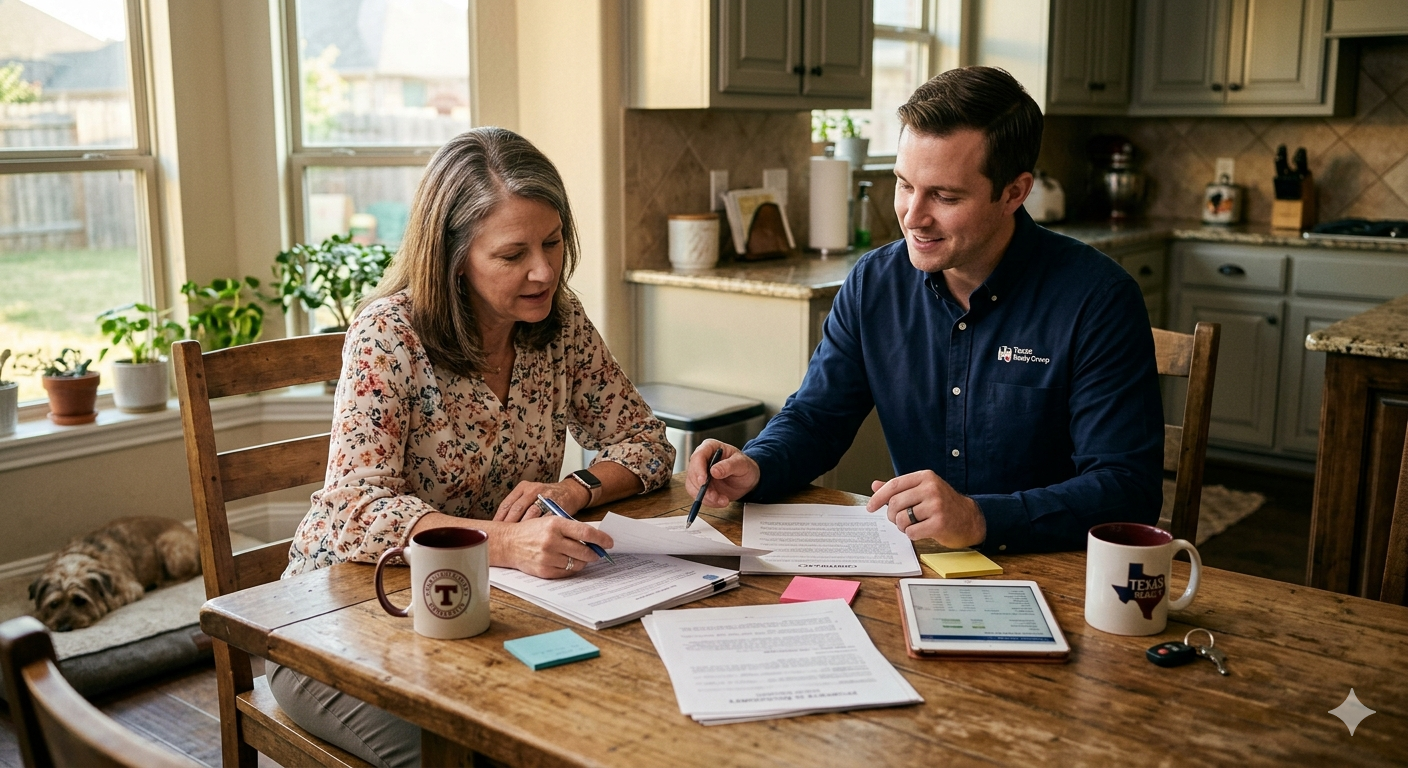
The Texas AG’s investigation and years of CBS News Texas I-Team reporting have identified consistent patterns in how bad actors in the residential solar industry operate, and knowing what to look for, whether you’re evaluating a contract you already signed or considering a new installation, is what protects you from a situation that becomes a major obstacle at resale.
Solar United Neighbors provides one of the clearest guides available for spotting solar scams in Texas, and here’s what their research and the AG’s investigation have consistently flagged as the most documented red flags:
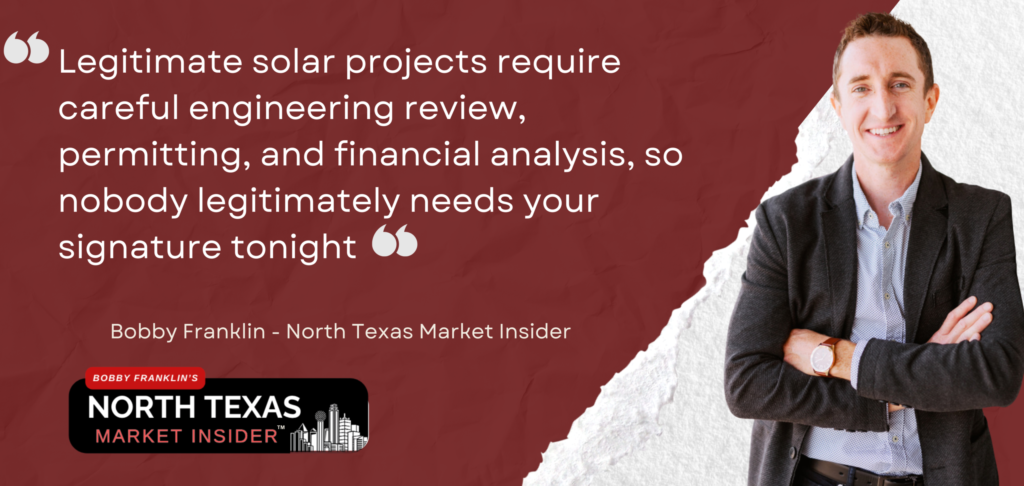
High-pressure door-to-door sales with “today only” deadlines. Legitimate solar projects require careful engineering review, permitting, and financial analysis, so nobody legitimately needs your signature tonight and if someone is telling you the offer expires at midnight, they’re counting on you making an emotional decision rather than an informed one.
“Free solar” or “zero electric bill” guarantees. There is no such thing as free solar in Texas, because grid connection fees, annual payment escalators, and realistic production curves based on your specific roof orientation and North Texas weather patterns are almost never factored into the sales pitch. If someone told you your bill would be zero, you need to go back and read what you actually signed.
Misrepresentation of federal tax incentives. The federal solar tax credit is real, it’s a credit against your federal tax liability, not a rebate check mailed to your house and sales reps who described it otherwise, or who claimed a particular incentive program was “ending this week,” were deploying pressure tactics, not providing accurate information.
Buried annual payment escalators. Contracts with 2–5% annual payment increases mean a payment that felt manageable in year one can nearly double by year fifteen, so if your contract has an escalator clause and nobody explained it to you at the time of signing, you need to understand what that full obligation looks like over the entire term before you try to sell.
Dealer fee inflation. Some solar finance contracts add $10,000–$30,000 in undisclosed dealer fees on top of the actual equipment cost, meaning the total obligation on paper bears little resemblance to the equipment’s real value and the Federal Trade Commission has documented this pattern at scale in its residential solar industry reporting.
Company dissolution after installation. Homeowners across Texas have been left with defective systems and no recourse because their installer closed, rebranded, or was absorbed into another entity after the contract was signed and a warranty means nothing when there’s nobody to call to honor it.
How Do You Know If Your Contract Is Predatory Before You Try To Sell?
Texas consumer-rights attorneys recommend reviewing your contract specifically for a term exceeding 20 years, annual escalators above 2%, transfer restrictions requiring the solar company to approve any new buyer, liquidated damages clauses triggered by early payoff, and warranty language that passes repair obligations to a third-party manufacturer rather than your original installer. If you have any of those provisions and they were not clearly explained to you at signing, you may have grounds to challenge enforceability and for legal analysis of how Texas courts have treated these situations: Texas homeowners versus misleading solar companies – legal analysis and contract red flags. The Better Business Bureau’s Solar Energy category is also a practical first stop for checking complaint histories on specific companies before you take any action.
Step-By-Step: What Every North Texas Solar Seller Should Do Before Listing

Most solar-related deals don’t fall apart because the system is bad, they fall apart because the seller walked into the listing process without a strategy, and the buyer’s agent found the problems first. That’s the scenario we eliminate before we go to market, and here’s how we do it.
Step 1: Pull every piece of solar paperwork you own…. all of it. Original contract, every amendment, financing agreement, warranty documentation, service and maintenance records, every email and text with the company. If you managed your account through a web portal, download or screenshot every document in that account today, because you want the complete paper trail assembled and ready before your listing agent, lender, title company, or buyer’s attorney asks for it. You don’t want to be scrambling for it in the middle of option period.
Step 2: Contact the solar company in writing and request a formal transfer or payoff packet. Ask specifically for the current payoff amount if you have a loan, a lease assumption packet if you’re leased, a PPA transfer process overview if applicable, and a list of any liens currently filed against the property. Here’s what most sellers don’t know: many of these companies take two to four weeks to respond, some take longer, and a few won’t respond at all. Which, in and of itself, is useful data about what your buyer is going to be dealing with. Start this process at least 60 days before you plan to list, not 60 days before closing, sixty days before the sign goes in the yard.
Step 3: Pull 24 months of utility bills and build a real before-and-after comparison. Oncor, Texas-New Mexico Power, whatever your local distribution company is, they can produce your full billing history and once you have it, lay it next to your post-solar bills and build a simple documented comparison. In a market where buyers have been reading about the AG’s investigation and solar over-promises, “trust me, I save money every month” isn’t going to move a serious buyer, but documented numbers will.
Step 4: Commission a third-party performance evaluation if production has been anything less than consistent. If your system has underperformed or you’ve had unresolved service disputes, hire an independent licensed electrician or solar technician to evaluate current output before we list, because a professional third-party report transforms a potential liability into a disclosed, documented, manageable fact. Undisclosed problems become deal-killers; disclosed problems become negotiating points.
Step 5: Have a strategic conversation before making any financial decisions unilaterally. Whether to pay off the loan before listing, structure a seller’s credit at closing, negotiate a lease buyout, or pursue a consumer-rights attorney about a predatory contract. None of those decisions should be made in a vacuum, because they all impact your equity position, the buyer demand in your specific submarket, and what the appraisal environment looks like in your price range right now. For context on how I approach complex listings in this market: Ultimate North Texas Relocation Guide — how Ellis County and DFW submarkets compare for buyers and sellers.
Step 6: Build your Solar Transparency Packet and put it in front of buyers before they ask for it. Contracts, utility history, performance report, transfer documentation — compiled, organized, and ready to go. This single move — radical, proactive transparency — is the most powerful de-risking tool available on a solar-equipped listing, because buyers will negotiate problems they can see and quantify, and they’ll walk away from problems they discover on their own. The National Renewable Energy Laboratory has published best practices guidance for exactly how solar systems are evaluated during real estate transactions including; what appraisers look for, what underwriters request, and what documentation actually changes outcomes. It’s worth reading before you assume your system will be treated like any other home improvement.
Real Scenarios – How Solar Issues Play Out In North Texas Transactions
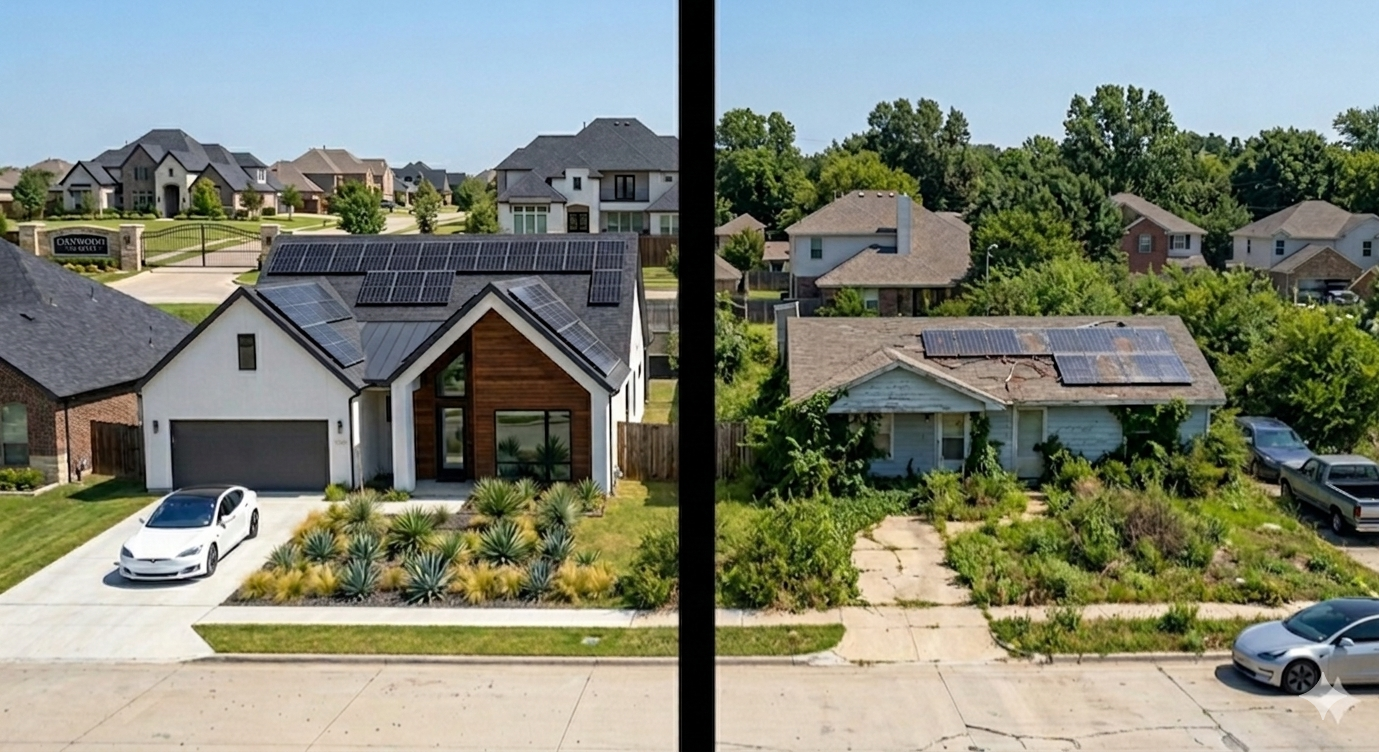
Scenario 1: Waxahachie Seller With A Fully Owned, Performing System
Picture a five-year-old home in Waxahachie ISD with a ten-panel solar array purchased outright for cash. No loan, no lease, no third-party ownership of any kind. The homeowner has 24 months of utility bills showing a consistent $90–$130 per month reduction compared to pre-solar usage, the system carries a clean manufacturer’s warranty that transfers to the new owner, there are no outstanding liens, no unresolved service tickets, and the installation was done by a licensed Texas electrician with a current building permit on file.
That’s a listing I can work with. We market the system as a premium feature, similar in positioning to a new HVAC or high-end appliances. We build a Solar Transparency Packet from the utility history and system documentation, and use factual, verifiable language in the marketing: “Seller-owned solar array with documented utility savings, performance history available upon request.” We price based on comparable sales and let the documentation serve as the differentiator for serious buyers comparing this property to identical homes without solar. That listing resonates strongly with buyers relocating from California, where utility costs are dramatically higher and the value of a fully owned solar system is already understood at a visceral level. For relocation-specific strategy in the Waxahachie market: Ultimate North Texas Relocation Guide — how Ellis County competes with Frisco, Plano, and McKinney.
Scenario 2: Midlothian Home With A Troubled Long-Term Solar Lease
Now consider a Midlothian home where the solar company has stopped responding to service requests, the system is producing inconsistently, and the original contract is a 25-year lease with a 2.9% annual payment escalator that the homeowner didn’t fully understand when they signed, because the sales rep described the whole arrangement as “basically free energy.” That’s exactly the pattern the AG’s investigation was built to address.
Listing this property requires a fundamentally different strategy. The first step is collecting every document, running a detailed review of the contract’s transfer and early-termination provisions, and checking whether this company appears in current AG inquiries or BBB complaints. From there, the options could include negotiating a lease buyout before listing, structuring concessions for a buyer willing to assume the lease, documenting the performance issues explicitly in the disclosure, or consulting with a Texas consumer-rights attorney about whether the misrepresentation elements in the original sales process provide grounds for contract cancellation.
Sellers in Midlothian and surrounding Ellis County communities who are moving north into Frisco, McKinney, or Allen should be thinking about broader equity strategy and market timing alongside the solar issue. For context on the North Texas development landscape and its affect on values across those markets: How Stream Data Centers Are Redrawing the North Texas Real Estate Map — development intelligence for investors and sellers.
FAQ: The 10 Most-Searched Questions About The Texas AG Solar Investigation
These are the exact questions buyers and sellers across North Texas are typing into Google, Reddit, Nextdoor, and AI search tools right now. All answered directly, without the filler.
1. “Is it safe to buy a house with solar panels in Texas right now in 2026?”
Yes, but only with due diligence. Buying a Texas home with solar panels is a safe decision if you verify the ownership structure, financing terms, and performance history before closing, which means asking the seller for a Solar Transparency Packet covering the contract, utility history, and transfer procedure.It means involving your lender early to confirm underwriting requirements, and having your inspector evaluate the system’s physical condition. The AG’s investigation does not mean all solar is bad, it just means you need to verify before you trust, and those are very different things.
2. “Will the Texas AG investigation cancel my solar contract or get me out of my payments?”
Possibly, but definitely not automatically. The investigation is focused on building an evidentiary record, stopping ongoing deceptive practices, and pursuing enforcement actions or relief for affected consumers through litigation or settlement. Tt does not unilaterally void existing contracts. If you believe you were misled, document your situation thoroughly, file a complaint with the Texas AG’s consumer protection division, and consult with a Texas consumer-rights attorney about your specific options.
3. “Do I legally have to disclose solar panels when selling my house in Texas?”
Yes, the TREC Seller’s Disclosure Notice requires disclosure of all material facts, and a solar system with an active contract, payment obligation, or service dispute is unambiguously material. Experienced listing agents attach the full solar agreement as part of the disclosure package before going to market, because non-disclosure of known problems creates liability under the Texas DTPA and common-law fraud, and that’s a risk no seller should be carrying into a transaction.
4. “Can I remove solar panels before selling my house in Texas?”
If you own the system outright, removal is generally possible. But run the full math first on removal costs, roof repair, and potential changes to insurance and property tax treatment before you make that call. If your system is leased or under a PPA, your contract almost certainly prohibits unilateral removal and imposes significant financial penalties for attempting it. So don’t act on this without reading what you actually signed and confirming the process with the solar company in writing, because surprises on this front are expensive.
5. “Should I pay off my solar loan before listing my home for sale?”
Not necessarily and don’t make that call unilaterally. Paying off the loan clears the lien and simplifies the transaction, but depending on your equity position and remaining balance, there may be a smarter play: negotiating a payoff credit at closing keeps your cash reserves intact pre-sale and puts the math in front of the buyer rather than absorbing it yourself. The right answer lives in your specific numbers and your specific submarket, so get the analysis before you write the check.
6. “Do solar panels affect my home’s appraised value in Texas?”
They can, in either direction, depending on ownership structure and performance documentation. Fully owned, well-documented systems are most likely to receive favorable treatment, potentially through an income approach based on verified utility savings. While leased systems are frequently excluded from appraised value entirely because they represent a continuing obligation rather than equity. NREL’s best practices guide for solar home sales and appraisal is the most authoritative reference for what appraisers and lenders actually look for, and it’s worth reading before you make assumptions about how your system will be treated.
7. “What solar companies are being investigated by the Texas AG in 2026?”
The AG’s office has not publicly named all companies subject to civil investigative demand letters, because investigations are typically conducted confidentially until formal actions are filed. For the most current named parties, monitor the Texas AG’s official press releases and the CBS News Texas I-Team’s ongoing coverage of the rooftop solar investigation, and check your company’s BBB complaint history and public Texas court records for additional context.
8. “How do I file a complaint against a solar company in Texas?”
File directly through the Texas Attorney General’s consumer protection division, through the Better Business Bureau, and with the Federal Trade Commission. Document your complaint with the original contract, all marketing materials you received, records of verbal and written promises made, and a clear timeline of events. The strength of your submission, and any potential legal action that follows, depends directly on how thoroughly that documentation is organized.
9. “Do solar panels void my roof warranty or cause home insurance issues in Texas?”
Some roofing manufacturers do limit their warranties when panels are installed by non-approved contractors or with non-approved mounting hardware, so that’s worth verifying against your current roofing warranty documentation before listing. On the insurance side, most standard Texas homeowners policies cover rooftop solar as part of the dwelling once properly disclosed, but carriers may ask questions about installation age, hail exposure, and roof condition given North Texas’s severe weather profile, so contact your carrier before listing and get the coverage terms confirmed in writing.
10. “How do I find a real estate agent who actually understands solar contracts and the AG investigation?”
Find someone who can walk you through the investigation, DTPA protections, and what lenders and appraisers actually do with solar documentation, without reading from a script, and who will sit down with your contract and build a strategy around what it actually says rather than handing you off to a generic referral. Agents who regularly handle relocation clients, new construction, and complex investment transactions tend to be most comfortable navigating layered contracts and extended due-diligence timelines. If you’re in North Texas, reach me directly through North Texas Market Insider and we’ll start with your specific situation, not a template.
Ready To Navigate Your Solar Sale The Right Way? Let’s Talk.

Whether you’re a North Texas homeowner preparing to list a solar-equipped property, a buyer trying to determine whether a solar lease is a deal-breaker, or someone who received a door-to-door pitch and wants a second opinion before you sign, the right next move is a direct conversation about your specific situation, not a generic answer pulled from a website.
Here’s how I approach it: we start with an initial consultation where we review your goals, timeline, and the specific facts about your property and solar system. Buying or selling a home, both situations get a strategic framework. From there, I help you organize your solar documentation, identify the gaps, and map out your actual options, whether that’s payoff scenarios, lease assumption logistics, concession structures at closing, or a conversation with a consumer-rights attorney if the contract has serious problems. If you’re listing, we build a marketing and negotiation strategy centered on transparency and strong documentation, positioning your home as the clear, well-documented choice in a market where buyer caution about solar has never been higher. If you’re buying, we build contingency language and due-diligence timelines that protect your earnest money and your closing date.
I work with clients throughout Waxahachie, Midlothian, Red Oak, Ennis, Palmer, Mansfield, Whitney, Grandview, Desoto, Lancaster, Rio Vista, and across the greater DFW Metroplex. Reach out directly through North Texas Market Insider — schedule your consultation with Bobby Franklin.
Disclaimer: This article is for informational purposes only and does not constitute legal, tax, or financial advice. All real estate transactions involve variables specific to your individual property, contract, and financial situation. Consult a licensed Texas attorney and/or CPA for guidance specific to your circumstances. Bobby Franklin is a licensed Texas REALTOR® with Legacy Realty Group — Leslie Majors Team. All content complies with the Fair Housing Act, RESPA, the NAR Code of Ethics, and Texas Real Estate Commission advertising rules. Content does not constitute steering toward or away from any protected class, community, or service provider.
Bobby Franklin, REALTOR® | Legacy Realty Group – Leslie Majors Team | 214-228-0003 | northtexasmarketinsider.com