

By Bobby Franklin, REALTOR® | North Texas Market Insider™ | Legacy Realty Group – Leslie Majors Team
Serving Ellis County, Waxahachie, Midlothian, DeSoto & Greater North Texas DFW
Updated: April 2026 | Reading Time: ~15 minutes
Here’s what I know about social media real estate content: most of it is designed to get shares, not to protect your money.
And when a post blows up with 9,000 shares claiming that married Texas homeowners no longer owe property taxes, my job, as someone who actually studies this market every single day, is to stop what I’m doing and give you the real story. Not the headline. The truth.
Because here’s what’s at stake: if you make a financial decision based on that viral post and it’s wrong, the consequences land on you. Not on the account that shared it. Not on the algorithm that spread it. On you, in the form of a tax bill you weren’t expecting, a penalty you didn’t see coming, or a home purchase budget that’s suddenly off by hundreds of dollars a month.
That’s not acceptable to me. Not for the people who follow this channel. Not for the buyers, sellers, and homeowners who’ve trusted me with the most significant financial decisions of their lives.
So let’s go through this the right way. All of it. What the viral claim actually says, what Texas law actually changed, what’s coming next, and exactly what you need to do before April 30 to protect your money.
The Post That Has North Texas Homeowners Talking

You’ve probably seen it. A sleek graphic, a stunning luxury home in the background, bold white text: “Property taxes will no longer be required from Texas homeowners who are married.”
The post, which has since been removed, racked up over 3,300 likes, 400 comments, and nearly 9,000 shares. That kind of engagement doesn’t happen by accident. It hit a nerve because Texas property taxes are genuinely painful, among the highest in the nation, and anything that promises relief gets attention fast.
I get it. I work in this market. I see what property taxes do to monthly payment calculations. I watch buyers sticker-shock themselves right out of otherwise perfect homes because they forgot to factor in the tax line. So when a post comes out saying married homeowners might be off the hook entirely? Of course it spreads.
But viral doesn’t mean verified. And in real estate, the difference between a rumor and reality can cost you thousands of dollars.
Here’s everything we’re going to cover in this article:
- What the viral claim actually says and where it breaks down
- What Texas genuinely changed about property taxes in 2025 and 2026
- What HB 1243 actually does for married homeowners and what it doesn’t
- How much money you can realistically save right now
- Exactly how to file your homestead exemption before the April 30 deadline
- What Governor Abbott’s school property tax elimination proposal really means
- Why all of this matters if you’re buying, selling, or relocating to North Texas right now
Grab your coffee. This one earns the read.
The Verdict: False – But the Real Story Is Still Worth Your Attention
Let’s not bury the lead. The claim that married Texas homeowners no longer owe property taxes is false.
Property taxes in Texas have not been eliminated for married homeowners. They haven’t been waived, suspended, dramatically reduced, or restructured in any way that would remove the obligation from married couples as a class. Texas still has property taxes. They still fund your public schools, your city services, your county roads, and your special districts. Every property owner in this state still owes them whether you’re married, single, divorced, or somewhere in between.
The Texas Comptroller’s Office is unambiguous on this point: there is no state-level property tax in Texas, but local property taxes are alive, active, and mandatory. The 2025 reforms, as significant as they genuinely are, did not change that fundamental structure.
So how does a claim like this get 9,000 shares?
Because it’s a collision of several real events, mashed together into one misleading headline:
- The passage of Texas HB 1243 (89th Legislature), which allows married spouses living in separate homes to each claim a homestead exemption
- The voter-approved increase of the homestead exemption from $100,000 to $140,000 in November 2025
- Governor Abbott’s ongoing campaign proposal to eventually eliminate school district property taxes
- The never-passed HB 2889 from 2023, which proposed tax credits for large, never-divorced heterosexual couples and which generated massive controversy before dying in committee
Each of these is real. None of them mean that married Texas homeowners no longer owe property taxes. Let’s break each one down, because understanding them correctly could literally save you thousands of dollars.
What Texas Actually Changed: The Real Property Tax News of 2025–2026
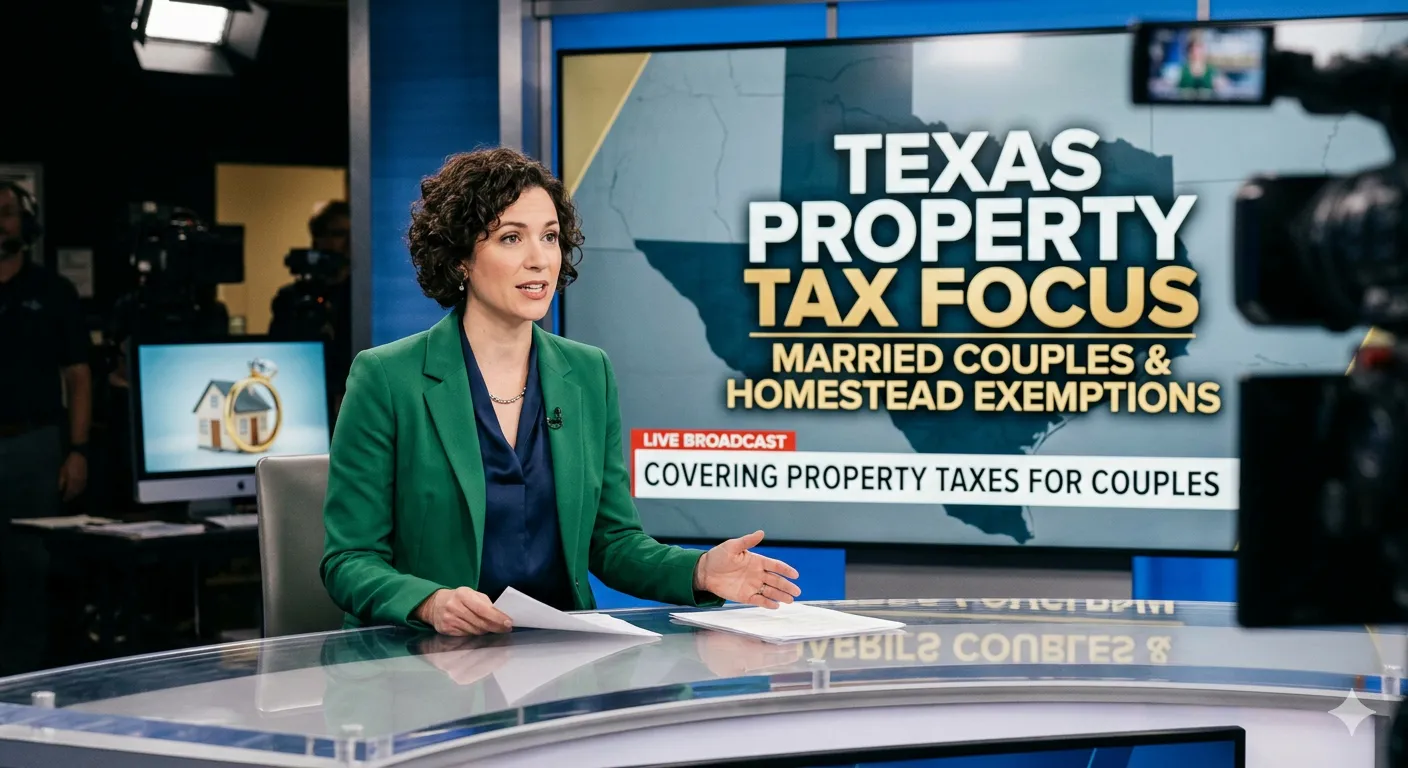
The Homestead Exemption Jumped From $100,000 to $140,000
Here’s the headline that actually deserves to go viral, because it’s both true and genuinely significant.
On June 16, 2025, Governor Greg Abbott signed Senate Bill 4 and Senate Bill 23 into law, increasing the mandatory homestead exemption for school district taxes from $100,000 to $140,000. Texas voters ratified this as a constitutional amendment in the November 2025 election.
In plain terms: if your home is appraised at $350,000, you now pay school district property taxes on $210,000 of that value instead of $250,000. According to Kiplinger’s analysis of the 2025 Texas reforms, the average Texas homeowner saves approximately $484 per year from this change alone and in many North Texas counties, that figure runs higher.
The savings apply retroactively to the 2025 tax year. According to Resolute Property Tax Solutions, if your homestead exemption is already on file with your county appraisal district, you’re already receiving this benefit. No additional action required, unless you haven’t filed yet. In that case, the clock is running. The deadline is April 30.
North Texas Market Intel: In Ellis County, property tax rates typically range between 1.8% and 2.5% depending on your specific taxing jurisdiction. On a $350,000 home, that $40,000 increase in your exemption translates to roughly $720 to $1,000 in additional annual savings. That’s not a rounding error. That’s a car payment. That’s a full month of groceries. That’s real money staying in your household instead of going to the tax collector.
If you’re evaluating homes in this corridor, the Waxahachie housing market and Midlothian market data pages on this site break down how these exemption changes affect your true cost of ownership at different price points. That context matters, know what you’re getting into before you sign anything.
The Senior and Disabled Homeowner Exemption: Up to $200,000
Senate Bill 23 also included a dramatically expanded exemption for homeowners 65 or older or those with qualifying disabilities. The additional exemption for this group increased from $10,000 to $60,000, meaning that when combined with the standard $140,000 exemption, qualifying seniors and disabled homeowners can now exempt up to $200,000 of their home’s school district taxable value.
According to Mortgage Law Insights, the Texas Senate estimates that older and disabled homeowners will see average annual savings of approximately $454 from this provision alone, on top of the savings from the base exemption increase. At least two million Texas households are expected to benefit.
One important clarification: you can claim either the over-65 exemption or the disability exemption but not both simultaneously. If you qualify for both, evaluate which provides greater savings in your specific jurisdiction and choose accordingly. When in doubt, contact your county appraisal district directly or consult a qualified tax professional.
What HB 1243 Actually Does And Doesn’t Do — For Married Texans

This is likely the legislation most closely connected to the viral claim. And if you understand exactly what it does and doesn’t do, you’ll be five steps ahead of everyone who shared that post without reading the actual bill.
Texas House Bill 1243, filed during the 89th Regular Legislative Session, addresses one very specific situation: married spouses who live in separate homes. Under prior Texas Supreme Court precedent, a married couple could only claim one homestead exemption, even if both spouses owned separate properties and used them as their primary residences.
The bill amends Section 11.13 of the Tax Code to clarify that married spouses living in genuinely different homes may each claim a homestead exemption on their own principal residence, provided each spouse is otherwise qualified. Introduced by Representative Guillen, the bill was designed to take effect September 1, 2025.
According to Texas Law Help’s homestead exemption guide, this creates a narrow exception to the single-exemption rule for married couples, not a blanket exemption for all married homeowners.
Here’s the breakdown of what this bill does and doesn’t do:
What HB 1243 does:
- Allows a married spouse who genuinely lives in a different home from their partner to claim a separate homestead exemption on their own primary residence
- Provides relief for couples in complex living arrangements such as spouses who maintain separate residences for work, caregiving, medical reasons, or other personal circumstances
What HB 1243 does NOT do:
- Eliminate property taxes for married homeowners
- Allow a married couple living together to claim two exemptions on the same home
- Reduce anyone’s property taxes to zero
- Create any new exemption that applies broadly to married Texas homeowners as a class
The bottom line: HB 1243 is a targeted, meaningful piece of legislation for a specific group of Texans navigating non-traditional living arrangements. It is not, and was never intended to be, a property tax elimination bill. Anyone who read the headline without reading the bill is working with incomplete information. Now you’re not.
What About HB 2889 — The Controversial “Married Couples Tax Credit” Bill?
While we’re clearing the confusion, let’s address the 2023 bill that keeps resurfacing in these social media cycles.
Texas HB 2889, introduced by State Rep. Bryan Slaton, proposed property tax credits (not eliminations) for qualifying married couples based on number of children. The proposal included a 10% credit for any qualifying couple, scaling up to 100% elimination for couples with ten or more children, with “qualifying” defined as a man and a woman, neither of whom had ever been divorced, with children born or adopted after the marriage.
As The Hill reported, the bill drew immediate and widespread criticism for excluding LGBTQ couples, divorced individuals, and blended families sparking significant civil rights concerns that eventuallty contributed to its defeat.
Most importantly: HB 2889 never passed and never became law. It has no bearing on your current property tax obligations. It surfaces periodically in viral social media content and creates confusion, which is exactly why it belongs in this article as a named, identified piece of misinformation to recognize and dismiss.
Abbott’s Bold Move: Could Texas Actually Eliminate School Property Taxes?

Here’s where things get genuinely interesting and where the strategic thinker in me leans forward.
In his 2026 reelection campaign, Governor Greg Abbott has made eliminating school district property taxes for homeowners his signature proposal. School taxes represent roughly 50 to 60 percent of most Texas property tax bills. If this ever becomes law, we’re talking about potentially the largest property tax reduction in Texas history.
As The Texas Tribune reported in December 2025, Abbott’s platform includes eliminating school district property taxes for homeowners, local spending limits, two-thirds voter approval requirements for tax increases, rollback elections on significant rate hikes, and property appraisal caps with assessments every five years.
According to O’Connor & Associates’ fiscal analysis, replacing school property tax revenue would require substantial restructuring, likely through increased sales taxes or other state funding mechanisms. That’s a complex fiscal architecture requiring legislative action, constitutional amendments, and voter approval.
Abbott himself has stated plainly: “When that is done, everyone’s property tax bill is going to be more than cut in half,” as reported by KERA News in April 2026.
Here’s the critical distinction every homeowner needs to hold: this is a campaign proposal, not current law. It would require multiple layers of action before taking effect. There is no guarantee. There is no timeline. Anyone telling you Texas has already eliminated school property taxes for homeowners is either misinformed or deliberately misleading you.
That being said, this is genuine political momentum in a direction that benefits Texas homeowners. And if you’re making long-term real estate investment decisions in North Texas, the potential for dramatically lower carrying costs in the coming years is a real variable worth factoring into your analysis. That’s what strategic buyers do. They look at the trajectory, not just today’s snapshot.
Want help thinking through how this could affect your total cost of ownership calculations in Waxahachie, Midlothian, or Ellis County? That’s exactly the kind of conversation I have with buyers every week. Reach out to the North Texas Market Insider team and let’s run the numbers together.
What This All Means Right Now for North Texas Homeowners
Let’s make this concrete and local. If you own a home, or are actively buying one in Waxahachie, Midlothian, DeSoto, Ennis, Mansfield, or anywhere else in the Southern Dallas Corridor, here is your actionable 2026 property tax checklist:
| Action Item | Deadline | Potential Savings |
|---|---|---|
| File/confirm homestead exemption (Form 50-114) | April 30, 2026 | $484–$1,000+/yr |
| File over-65 or disability exemption if qualified | April 30, 2026 | Additional $454+/yr |
| Review appraisal notice for errors | When received (March–April) | Varies |
| File property tax protest if overvalued | May 15 or 30 days after notice | $500–$2,000+/yr |
| If married, living separately: Verify HB 1243 eligibility | April 30, 2026 | $484–$1,000+ per property |
| Check late filing eligibility if missed prior years | Up to 2 years late allowed | Retroactive savings |
Understanding North Texas Property Tax Rates
According to Home Tax Solutions’ 2026 county rate analysis, effective property tax rates across the North Texas region vary significantly by county:
| County | Effective Tax Rate (Approx.) | Notes |
|---|---|---|
| Tarrant County | ~2.37% | Includes Fort Worth suburbs |
| Dallas County | ~2.18% | Varies widely by city |
| Collin County | ~2.19% | Plano, McKinney, Frisco area |
| Ellis County | ~1.8–2.1% | Waxahachie, Midlothian, Ennis |
Ellis County has historically offered some of the most competitive combined tax rates in the DFW metroplex and that’s not by chance. It’s one of the structural reasons why strategically-minded buyers have been relocating to the Southern Dallas Corridor instead of competing for overpriced inventory in markets farther north.
For complete property tax context alongside our full local market intelligence, visit our property taxes resource hub and our Explore North Texas market page.
How to File Your Texas Homestead Exemption Before April 30
The most powerful thing you can do right now is simple: make sure your homestead exemption is filed and current. This is one of the rare situations in real estate where doing nothing literally costs you money.
Here’s the exact process, per the official guidance from Rainbolt & Co.’s 2026 Texas homestead exemption filing guide:
Step 1: Gather Your Documents
- A copy of your Texas driver’s license or state-issued ID showing your homestead address
- Your property account number (found on your appraisal notice or your county appraisal district’s website)
- If applying for the over-65 exemption: proof of age (your driver’s license usually suffices)
- If applying for the disability exemption: your Social Security Administration disability determination letter
Step 2: Complete Form 50-114
The official application is the Application for Residence Homestead Exemption (Form 50-114), available directly from the Texas Comptroller’s Office. Fill it out completely and accurately. Every blank matters.
Step 3: Submit to Your County Appraisal District
Three options, all legitimate:
- Online: Most county appraisal districts now accept online applications with a scanned copy of your ID. Fastest option, strongly recommended.
- Mail or in person: Print Form 50-114, attach a copy of your ID, and deliver it to your county appraisal district office.
- Mobile app: Some districts offer mobile filing options, check with your specific county.
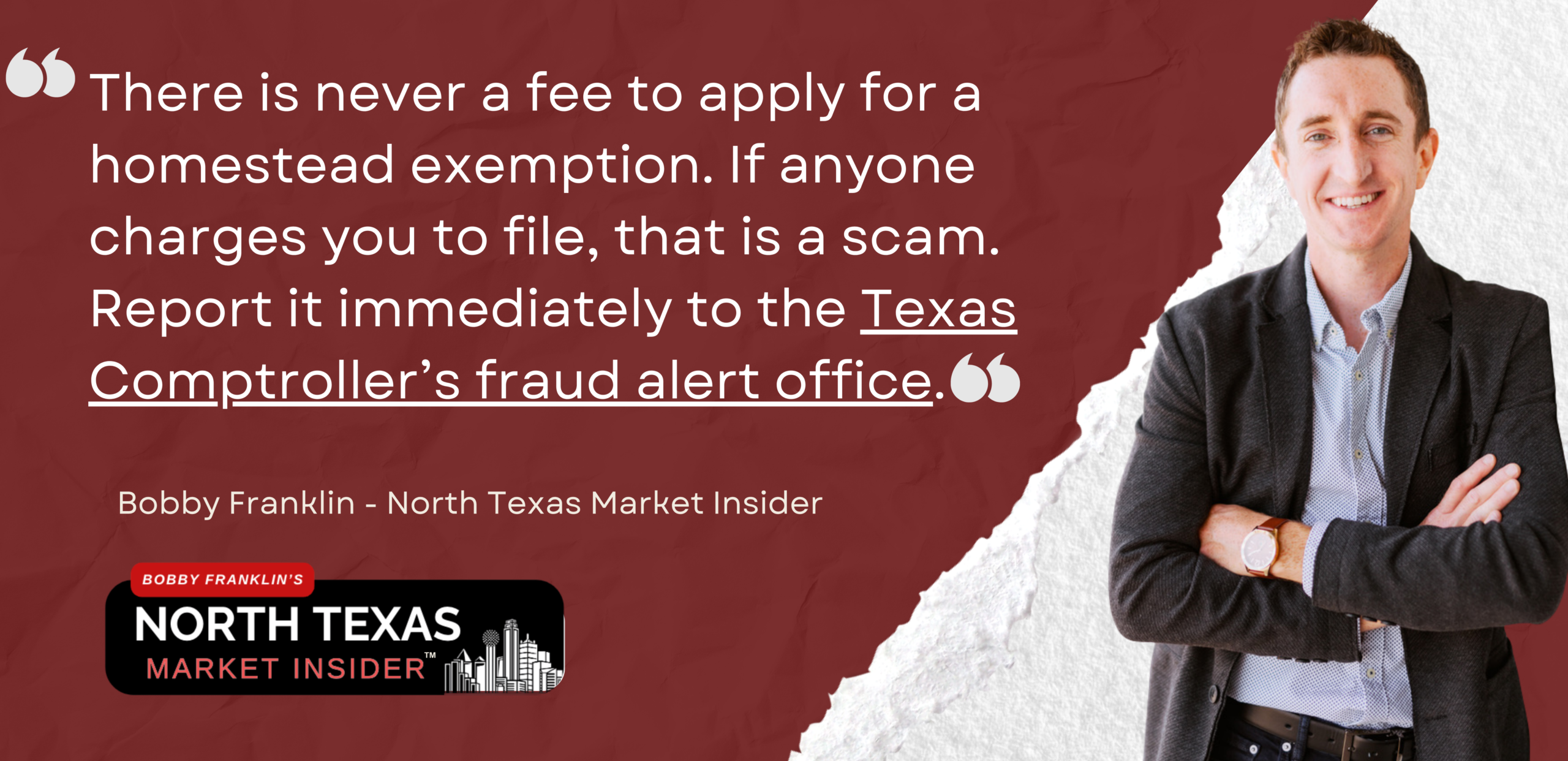
Critical: There is never a fee to apply for a homestead exemption. If anyone charges you to file, that is a scam. Report it immediately to the Texas Comptroller’s fraud alert office.
Step 4: Verify Your Exemption
After submission, confirm your exemption status through your county appraisal district’s website:
- Ellis County: Ellis Central Appraisal District (elliscad.net)
- Dallas County: Dallas Central Appraisal District (dallascad.org)
- Collin County: Collin Central Appraisal District (collincad.org)
- Tarrant County: Tarrant Appraisal District (tad.org)
Missed Prior Years? Don’t Write It Off.
Texas Law Help’s homestead exemption guide confirms that Texas allows late homestead exemption applications for up to two years after the filing deadline. If you’ve owned your home for multiple years without filing, you may be eligible for retroactive savings that could amount to thousands of dollars. Contact your county appraisal district directly to explore your options. This is not a situation where patience serves you, file sooner than later.
Beyond the Exemption: How to Protest Your Property Tax Assessment
Even with your exemption filed, your actual tax bill is still determined by your home’s appraised value. In a rising market, appraisal districts sometimes overvalue homes and the difference comes directly out of your pocket.
Every Texas homeowner has the legal right to protest their assessed value. According to Texas Tax Protest’s expert protest guide, a successful challenge can save homeowners $500 to $2,000 or more per year and that savings compounds every subsequent year the lower value holds.
Key 2026 Protest Deadlines:
- File your protest by: May 15, 2026, OR within 30 days of receiving your Notice of Appraised Value, whichever comes later
- Appraisal notices typically arrive: March through April
What Makes a Strong Property Tax Protest?
According to O’Connor & Associates’ property tax protest guide, strong evidence includes:
- Recent comparable sales data for similar homes in your neighborhood
- Photos documenting property defects, deferred maintenance, or condition issues
- Contractor estimates for needed repairs
- Evidence that the appraisal district’s records about your property are factually incorrect. Ex: wrong square footage, wrong bed/bath count, wrong year built
- A professional appraisal or Comparative Market Analysis
As a licensed REALTOR® serving Ellis County and the DFW metroplex, I provide professional CMAs that reflect current market value with precision. The exact same data used to win property tax protests. Contact the North Texas Market Insider team to request one before your protest window closes.
Why Property Taxes Are a Transaction Variable, Not an Afterthought

Whether you’re a buyer calculating your true cost of ownership or a seller trying to position your home competitively, property taxes in Texas are not background noise. They are a front-line financial variable in every transaction.
For Buyers: True Cost of Ownership
Most buyers focus on the mortgage payment. That’s understandable, it’s the biggest number. But in Texas, property taxes can add hundreds to over a thousand dollars per month to your real housing cost, and that number shifts dramatically based on where you buy and what exemptions are active.
On a $400,000 home in Tarrant County with a 2.37% effective rate, you’re looking at approximately $9,480 per year in property taxes or about $790 per month before exemptions. With the new $140,000 homestead exemption, your taxable value drops to $260,000, reducing that annual bill to approximately $6,162. That’s a savings of over $3,300 per year. That changes your affordability calculation. It changes your debt-to-income ratio. It changes which homes are actually within reach.
This is why working with an analytically-grounded real estate advisor in Texas isn’t a preference, it’s a financial protection strategy.
If you’re relocating to North Texas from out of state, our comprehensive relocation guide walks through property taxes, total cost of living comparisons, school district profiles, and the market dynamics that shape long-term value in every community we serve. We also serve international buyers through our dedicated international relocation program, because buyers coming from Germany, the UK, or even California need the same quality of intelligence, not a watered-down version of it.
For Sellers: Why Exemption Changes Expand Your Buyer Pool
Lower property taxes expand the universe of buyers who can comfortably afford a given home. The 2025 exemption increases effectively make every home in Texas more affordable to own, which means more qualified buyers can hit your price point without straining their budget.
For sellers in Waxahachie, Midlothian, and Ellis County broadly, this is a genuine demand tailwind heading into 2026 and beyond. Buyers who were previously priced out of your price range are now in range. That’s an expanded pool. That’s competition for your listing. That’s upward pressure on your terms.
Our team tracks these dynamics in real time. The Explore North Texas market intelligence hub has the latest data on days on market, closed sales, and price trend lines across every community we serve.
The Real Danger of Real Estate Misinformation
The viral post that started this conversation may seem harmless in isolation, just a shareable graphic on Instagram. But real estate misinformation has real financial consequences that land on real people.
Here’s what can actually happen when bad information spreads unchecked:
Homeowners who believe they’re covered might not file. If someone sees that post and thinks they no longer owe taxes because they’re married, they may skip the homestead exemption filing entirely and then receive a tax bill that’s $484 to $1,000+ higher than it needed to be.
Buyers might budget based on non-existent savings. If a buyer factors in tax elimination that doesn’t exist when calculating what they can afford, they’ll arrive at closing with a monthly payment calculation that’s structurally wrong.
Sellers might price based on a buyer pool that doesn’t exist. If sellers assume buyers are getting massive tax relief that isn’t actually in effect, they may price in a premium the market won’t support.
People may attempt to claim two exemptions illegally. A married couple living together who reads that claim and tries to file two homestead exemptions on a shared home is breaking Texas law. Penalties include repayment of all improperly claimed exemptions plus interest and potentially fraud charges.
As a North Texas real estate professional bound by the NAR Code of Ethics and regulated by the Texas Real Estate Commission, accurate information isn’t just my professional standard, it’s the foundation of the trust my clients place in me. One of the biggest financial decisions of a person’s life shouldn’t be made based on a viral post that no one fact-checked.
Before you make any financial or legal decisions based on something you saw on social media, verify it with a primary source: the Texas Comptroller’s Office, your county appraisal district, or a licensed real estate or tax professional. That’s not being overcautious. That’s protecting your money.
Thinking About Moving to North Texas? Here’s the Financial Case, Unfiltered.

Texas has been a top relocation destination for years, and the property tax reforms of 2025 only strengthen the argument. If you’re currently paying state income tax in California, New York, Washington, or Illinois while also managing a high property tax burden, the Texas math is increasingly compelling.
No state income tax. Significantly higher homestead exemptions. A governor actively campaigning on cutting school property taxes in half. That combination doesn’t exist in many places, and it’s attracting smart capital, both residential and investment.
Our Moving to Texas resource center covers everything from how the homestead exemption compares to what you’re used to in other states, to school district rankings, community profiles, commute realities, and the hidden costs and occasional advantages of Texas living that people discover after they’re already here.
For a complete breakdown of every community in our market area, from school ratings and commute times to new construction pipelines and market trend data, visit our Explore North Texas page. It’s the most comprehensive free market intelligence resource covering Ellis County and the Southern Dallas Corridor.
Frequently Asked Questions: Texas Property Taxes, Homestead Exemptions & Married Homeowners

1. Do married couples in Texas no longer have to pay property taxes?
No. This claim, which has spread widely on social media, is false. Texas property taxes have not been eliminated for married homeowners. What did change is that the homestead exemption was increased from $100,000 to $140,000 in 2025, saving the average homeowner approximately $484 per year on school district taxes. All Texas property owners, married or not, still owe property taxes on 2026.
2. What is the Texas homestead exemption and how much does it save me in 2026?
The Texas homestead exemption removes a set dollar amount from your home’s taxable value for school district tax purposes. In 2026, that amount is $140,000. For the average Texas home valued around $302,000, this saves approximately $484 to $930 per year depending on your local school district tax rate.
3. Can a married couple in Texas claim two homestead exemptions?
Generally no, with one new exception. Under Texas law, a married couple living together in the same home can only claim one homestead exemption. HB 1243 (effective September 1, 2025) created an exception allowing each spouse to claim a separate exemption if they genuinely live in different primary residences. Attempting to claim two exemptions on a shared home is illegal and can result in penalties, back taxes, and fraud exposure.
4. What is the deadline to file a homestead exemption in Texas for 2026?
The standard filing deadline is April 30, 2026. Texas allows late applications for up to two years after the deadline, so prior-year savings may still be recoverable. New homeowners can file as soon as they close, no need to wait for an appraisal notice.
5. Will Texas really eliminate school property taxes?
Governor Abbott has made this his signature 2026 campaign proposal. If enacted, it would reduce most Texans’ property tax bills by 50 percent or more. However, this is a campaign proposal, not current law. It requires legislative action, a constitutional amendment, and voter approval before taking effect. There is no confirmed timeline.
6. How do I file a homestead exemption in Texas?
Complete Form 50-114 and submit it to your county appraisal district with a copy of your Texas driver’s license or state ID showing the property address. Most counties accept online submissions. There is never a filing fee.
7. How do I protest my property taxes in Texas?
File a Notice of Protest with your county appraisal district by May 15 or within 30 days of receiving your appraisal notice, whichever is later. Gather comparable sales data, photos of property defects, and repair estimates as your evidence package. You’ll first attend an informal meeting with a staff appraiser; unresolved disputes will proceed to the Appraisal Review Board.
8. Do seniors get a bigger property tax exemption in Texas?
Yes. As of 2026, homeowners 65 and older receive an additional $60,000 school district exemption on top of the standard $140,000 fo a combined exemption of up to $200,000. Approved by Texas voters in November 2025 via Proposition 11. Disabled homeowners now qualify for the same additional amount but you cannot claim both the over-65 and disability exemptions simultaneously.
9. What happens if I don’t file a homestead exemption in Texas?
Without it, you pay taxes on your full appraised value for school district purposes, losing $484 to $1,000+ per year. You also lose the 10% appraisal cap (which limits annual value increases), the over-65 or disability exemption if applicable, and certain creditor protections that come with homestead designation. This is one of the most costly mistakes Texas homeowners make. Don’t make it.
10. Does Texas have a property tax exemption for veterans?
Yes, and it’s substantial. A 100% service-connected disabled veteran can receive a total property tax exemption on their primary residence, meaning zero property taxes. The exemption scales based on disability rating for partial disabilities, and surviving spouses may qualify under certain conditions. Contact your county appraisal district or the Texas Comptroller’s Office for full eligibility details.
11. Can I claim a homestead exemption on a rental or investment property in Texas?
No. The homestead exemption applies only to your principal residence, the home where you actually live as of January 1 of the tax year. Investment properties, rentals, vacation homes, and second homes do not qualify. You cannot claim a homestead exemption on any other property while claiming one on your primary residence. Each resident is limited to 1 homestead exemption at a time.
12. What is the 10% appraisal cap in Texas and how does it protect me?
Texas law limits how much the appraised value of a homestead can increase each year to a maximum of 10% over the prior year’s certified value. In a rising market like North Texas, this protection is significant as it prevents sudden or dramatic increases in your tax bill. The cap applies only to properties with an active homestead exemption, which is yet another reason to make sure yours is on file. Note: market value can still exceed the cap; only the taxable value is limited.
The Bottom Line: What Every North Texas Homeowner Should Do Right Now

The viral claim that married Texas homeowners no longer owe property taxes is false. Full stop. Don’t make financial decisions based on a post that has more shares than accuracy.
What is true is that 2025 and 2026 represent a genuine, meaningful shift in the Texas property tax landscape. The increase to a $140,000 homestead exemption, the expanded protections for seniors and disabled homeowners, and the growing political momentum toward eliminating school property taxes entirely are all real developments that deserve your serious attention.
Here is your action list for right now. No ambiguity, no delays:
- File or verify your homestead exemption before April 30, 2026. Every day you wait is money you’re leaving on the table.
- Review your appraisal notice when it arrives and compare it to recent comparable sales in your area.
- Protest your assessment if your home appears overvalued. You have until May 15.
- Check your eligibility for over-65, disability, or veteran exemptions – these are stacked on top of the base exemption and compound the savings.
- Talk to a local real estate expert before making any major buying or selling decisions based on projected future tax laws that haven’t passed yet.
As North Texas’s market intelligence specialist serving Ellis County, Waxahachie, Midlothian, Ennis, DeSoto, and the broader DFW metroplex, I’m here to help you navigate every dimension of the Texas real estate market, including the tax landscape that directly affects your bottom line.
Whether you’re a first-time buyer trying to understand your true monthly cost, a homeowner evaluating whether now is the right time to sell, or an out-of-state relocator figuring out where your housing dollar goes furthest in North Texas, North Texas Market Insider has the answers you need.
📞 Call or text Bobby Franklin directly at (214) 228-0003
🌐 Explore the full market intelligence library
📍 Serving Waxahachie, Midlothian, Ennis, Red Oak, Ferris, DeSoto, and the Southern Dallas Corridor
Need a Lender Who Understands the Texas Market?
If you’re buying or refinancing in North Texas, connect with one of our preferred lending partners. Each of them works regularly in this market and understands how property taxes, exemptions, and total cost of ownership factor into your qualification picture:
- Denise Donoghue — The Mortgage Nerd | yourmortgagenerd.com
- Andrew Bryan — Miramar Mortgage | miramarmortgage.com
- Ethan Hester — Midtex Mortgage | mid-texmortgage.com
Disclaimer: This article is for informational and educational purposes only. It does not constitute legal or tax advice. Please consult a qualified tax professional or attorney regarding your individual situation. Bobby Franklin is a licensed Texas REALTOR® (#0805459) and provides this content as a public educational resource in compliance with the NAR Code of Ethics, the Fair Housing Act, and all applicable Texas Real Estate Commission advertising policies.
Bobby Franklin, REALTOR® | Legacy Realty Group – Leslie Majors Team
📲 214-228-0003 | northtexasmarketinsider.com