
Here’s what I’m watching while other agents are still asking if AI matters:
While most real estate professionals are debating whether data centers will affect their business, I’m tracking forty billion dollars in capital commitments that are already reshaping where smart money flows in North Texas. Google’s massive AI campus announcements in Armstrong and Haskell Counties, OpenAI’s half-trillion-dollar “Stargate” project outside Abilene, and the explosive growth corridor from Midlothian through Red Oak to Dallas aren’t just tech news, they’re the biggest redistribution of infrastructure investment and property value potential that North Texas has seen in a generation.
The question isn’t whether AI data centers matter to homeowners and buyers. The question is: Are you positioned to benefit from what’s already in motion, or are you going to react after everyone else figures it out?
This is your strategic briefing on what’s actually happening, what it means for property values and quality of life in Ellis County and the DFW metroplex, and how to make intelligent decisions while staying fully compliant with every federal and state real estate regulation that matters.
Let’s get into it.
Why Texas Became Ground Zero for the AI Infrastructure Boom (And Why North Texas Won)

Here’s the reality that most people miss: Texas didn’t stumble into becoming one of the world’s top three data center markets. This was engineered through a decade of strategic policy decisions, infrastructure investments, and business development that created the perfect conditions for what we’re seeing now.
By the end of 2024, Texas had nearly 41 million square feet of data center capacity, with the overwhelming majority concentrated in Dallas-Fort Worth. CBRE and other market trackers are projecting that DFW’s data center inventory will more than double by the end of 2026, not because of organic growth, but because hyperscale AI providers need specific conditions that only a handful of metros can deliver at scale.
What made North Texas the winner:
Massive capital commitments are already locked in. Google’s 40-billion-dollar investment in new AI data center campuses across Armstrong County, Haskell County, and expansions around Midlothian, Red Oak, and Dallas represents the largest single tech infrastructure commitment in Texas history. This isn’t speculative, construction is already underway.
The Stargate mega-project is real. OpenAI, Oracle, and SoftBank are backing Stargate, a proposed 500-billion-dollar AI infrastructure initiative. One of the world’s largest AI data center campuses is now under construction outside Abilene, with direct implications for labor markets, housing demand, and infrastructure planning across West and North Texas.
State incentives are extremely aggressive. Texas offers state sales tax exemptions on qualifying data center equipment and electricity for 10 to 15 years for projects investing at least 200-250 million dollars and creating a minimum number of high-paying jobs. Local governments can layer on property tax abatements for up to 10 years under Chapter 312 of the Texas Tax Code.
Infrastructure advantages are real. Competitive electricity prices, abundant developable land, existing fiber routes, proximity to major airports, and a business-friendly regulatory environment have made DFW what industry analysts call a “top-tier global data center hub.”
For Ellis County residents and North Texas homeowners, this means more large, windowless facilities, new substations, and high-voltage transmission lines are coming to your communities over the next decade. The only question is whether you’re strategically positioned to benefit, or whether you’re going to be caught off guard.
The Power Grid Reality That Nobody’s Explaining Correctly
Here’s the question everyone’s asking the wrong way: “Will AI data centers overload the Texas power grid and raise my electric bill?”
That’s a yes/no question in a world that doesn’t work in yes/no answers anymore. Here’s what’s actually happening:
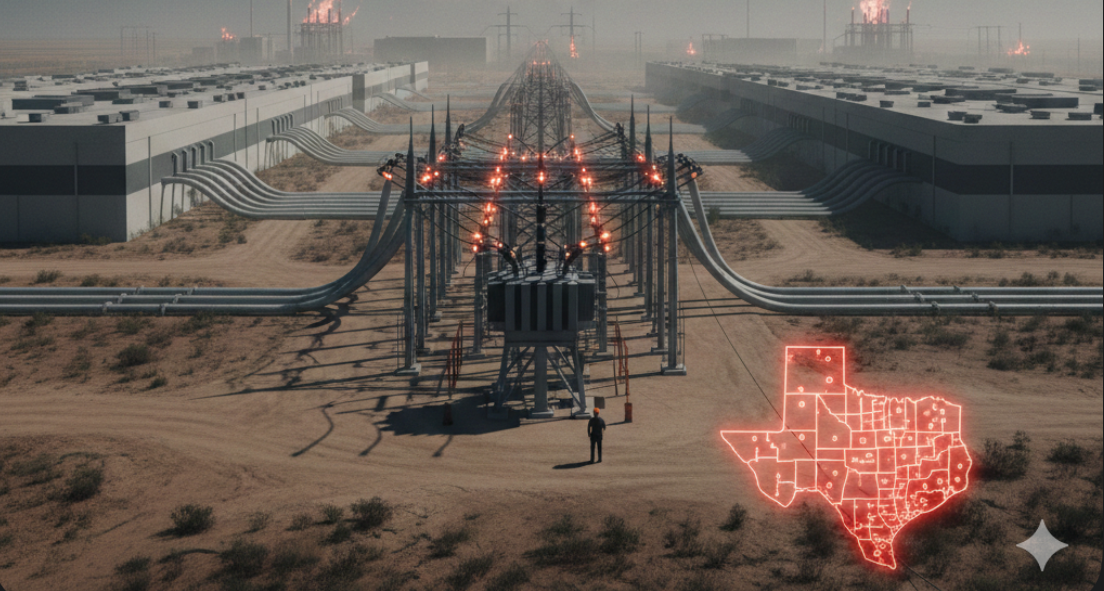
Texas’ grid operator, ERCOT, is tracking an unprecedented wave of large-load interconnection requests. In just over a year, large-load interconnection requests exploded from 56 gigawatts to about 205 gigawatts, more than twice ERCOT’s all-time peak demand of 85.5 gigawatts recorded in August 2023.
More than 70% of those new large-load requests are from data centers, with another 10% from cryptocurrency mining operations. Texas reliability monitors now describe the “disorganized integration” of large loads(especially AI data centers) as the single biggest growing reliability risk on the state’s grid.
What this means in plain English:
AI facilities run 24/7 at near-constant load, which is fundamentally different from how residential and most commercial customers use power. Energy analysts and the North American Electric Reliability Corporation (NERC) warn that this is reshaping when Texans use power, flattening the nightly demand valley and stretching peak demand into longer, more expensive windows before sunrise and after sunset.
While not every proposed project will actually get built, the scale of demand is so large that Texas is preparing for power demand that could approach double today’s levels by the early 2030s, with data centers as a primary driver.
For homeowners, this translates into three things:
- Higher baseline electricity demand during more hours of the day, which puts upward pressure on wholesale prices even during traditionally low-demand periods.
- Increased strain on local distribution infrastructure, especially in communities near large campus developments where substations and transmission upgrades become necessary.
- A stronger push toward new generation sources, including solar, battery storage, and in some cases, small modular nuclear reactors dedicated to powering AI facilities.
The strategic play here isn’t to panic about the grid. It’s to understand that energy efficiency, backup power options, and utility cost management are becoming more important components of home value in North Texas and that homes positioned near new generation sources and upgraded transmission corridors may actually see appreciation advantages.
The Water Conversation That Should Concern Every North Texan
This is where the numbers get truly eye-opening, and where most coverage stops short of telling you what’s actually at stake.
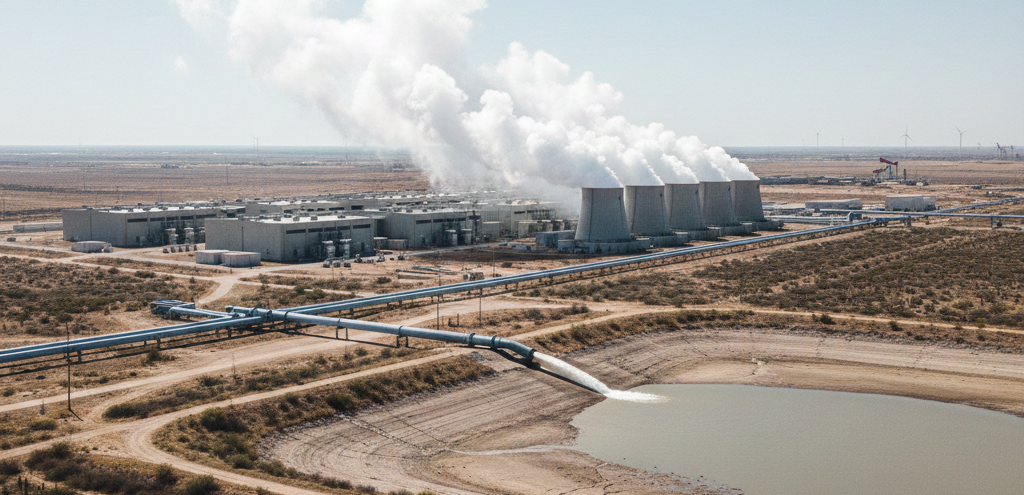
A policy brief from the Houston Advanced Research Center (HARC) and University of Houston Energy projects that Texas data centers will use 46-49 billion gallons of water in 2025. By 2030, that number could rise to around 399 billion gallons per year, equaling roughly 6-7% of the state’s total water use.
Let me put that in perspective: Mid-sized data centers often use 300,000 gallons of water per day, similar to the daily use of about 1,000 homes. The largest AI-optimized facilities can need 4.5-5 million gallons per day, comparable to towns with populations between 10,000 and 50,000 people.
Here’s what researchers are warning about:
More than 400 data centers already operate in Texas, with about 70 new projects in the pipeline. Locating very large water-cooled centers in smaller or drought-prone communities, such as parts of the Panhandle, West Texas, or the Edwards Plateau, can push local water systems to the brink during extended dry periods.
In Abilene, the first phase of the Stargate campus will use about 8 million gallons of city water just to fill its closed-loop cooling system, with additional water needed over time for maintenance and refills. While city officials say this is small compared with daily municipal use, independent hydrologists argue that statewide projections point to a dramatic rise in cumulative water demand from AI infrastructure.
For Ellis County and North Texas homeowners, here’s the strategic takeaway:
Your tap isn’t going to suddenly run dry, but long-term water planning, rate structures, and drought restrictions are increasingly influenced by where and how data centers are approved in your community. Communities that negotiate strong water-conservation requirements and infrastructure investments as part of development agreements will be better positioned than those that don’t.
Smart buyers are asking about local water sources, conservation plans, and infrastructure capacity before making offers on properties in growth corridors. This is the kind of due diligence that separates strategic buyers from reactive ones.
The Ethics Question That Texas Needs To Answer
Here’s a conversation that most real estate professionals won’t touch, but that I think you deserve to understand because it affects how these deals get structured and how public support for future projects will evolve.
An estimated 500,000 people live in colonia communities along the Texas-Mexico border, aka subdivisions that historically developed without formal infrastructure. Many still lack running water, sewer systems, paved roads, or reliable electricity.
Despite decades of state and federal investment, more than 1,300 colonias continue to live without basic services; hundreds are classified as having “high health risk” due to inadequate water, sanitation, and drainage.
At the same time, Texas is offering hundreds of millions of dollars in state semiconductor and tech incentives through the Texas CHIPS Act and the Texas Semiconductor Innovation Fund, sales tax exemptions on critical data center hardware and electricity for qualifying projects, and local property tax abatements that can dramatically reduce tax bills on new facilities for up to a decade.
This contrast, between billions in incentives for AI infrastructure and families waiting years or decades for safe running water, is at the heart of the “at what cost?” conversation that many Texans are now having.
I’m not here to tell you whether this is right or wrong. I’m here to tell you that this tension will increasingly shape local political debates, zoning decisions, and public attitudes toward large-scale tech development projects in your community. Understanding that dynamic helps you anticipate how future projects will be received and negotiated.
Do Data Center Tax Deals Actually Help Your Local Schools and Services?
Let’s talk about Fort Worth as a case study, because it illustrates the complexity of these arrangements better than almost any other Texas example.
City leaders have been weighing a 2.1-billion-dollar hyperscale data center campus that is projected to create only 37 full-time jobs with average salaries around $150,000 by 2034. Similar deals across Texas rely heavily on state sales tax exemptions, city and county property tax abatements on new improvements, and “deal-closing” grants such as the Texas Enterprise Fund for select high-profile projects.
Supporters argue that large campuses:
- Generate substantial construction jobs and contracting opportunities during build-out phases that can last several years
- Eventually contribute significant property tax revenue once abatements phase out
- Attract related tech employers and raise a region’s overall economic profile
Critics counter that:
- Permanent employment at individual sites is often limited, dozens of jobs rather than thousands
- Data centers place outsized demands on power and water systems while contributing to relatively few of the services used by ordinary residents
- When property tax revenue is reduced for a decade, schools, roads, and basic infrastructure can feel the pinch, especially in rapidly growing communities
For North Texas homeowners, this means the debate is less about whether AI will arrive and more about how the benefits and burdens are shared, and how that balance may influence long-term affordability in your specific community.
The strategic question you should be asking: What’s your city or county’s track record on negotiating community benefits, infrastructure improvements, and reasonable timelines for tax abatements? Communities with strong negotiating positions and clear public-benefit requirements tend to see better outcomes than those that compete primarily on who can offer the biggest tax break.
Will a Data Center Behind Your House Hurt or Help Your Property Value?

This is the question that gets the most emotional reactions, so let’s deal with it based on actual research rather than speculation.
The honest answer: It depends on distance, design, and buyer perception.
One of the most detailed studies comes from Northern Virginia, often called “data center alley.” A 2023-2025 analysis by George Mason University’s Center for Regional Analysis found that homes closer to data centers actually sold for higher prices on average than those farther away, even after controlling for other factors. The study concluded there was no statistical evidence that proximity to a data center systematically drags down housing values.
Real-world experience from agents paints a more nuanced picture:
Texas brokers report that homes directly adjacent to a new data center site or substation can take longer to sell, as buyers ask more questions about noise, construction disruption, and future expansion plans. When they are a few blocks away(especially when landscaping, walls, and setbacks buffer the view) buyers’ focus tends to shift back to schools, commute times, and the home itself.
Nationally, data center projects have been linked to rising land prices in areas with strong power and fiber connections, higher demand from incoming tech workers and contractors in certain submarkets, and localized concerns over noise from cooling equipment, truck traffic during construction, and visual impact.
For sellers near a planned or existing facility in Ellis County or North Texas, the key is to understand how buyers are likely to perceive your specific location, not to assume that all data centers automatically hurt (or help) values.
Properties within direct line of sight or immediately adjacent to heavy industrial infrastructure typically see some discount or extended marketing time. Properties a quarter-mile away with mature trees, sound barriers, or natural topography buffers often see little to no impact. Properties within a two-mile radius of major employment centers with improved roads and upgraded utilities can actually see appreciation benefits.
The strategic play is to work with a real estate professional who understands micro-market dynamics and can position your property based on what’s actually happening in your specific neighborhood, not based on generic assumptions about data centers.
Is It Actually Safe To Live Next To a Data Center?
Current research and industry practice suggest that data centers are generally among the quieter and cleaner types of industrial or commercial neighbors, especially compared with refineries, heavy manufacturing, or major highways.
Key considerations:
Noise. Most municipalities in North Texas enforce noise ordinances, typically around 55 decibels at the property line. The primary sources are cooling fans and, more rarely, backup generators during testing or outages. Modern facilities use sound-dampening walls and strategic equipment placement to minimize impact.
Traffic. Once operational, data centers typically employ 40-100 on-site workers and generate modest day-to-day traffic compared with distribution centers or retail hubs. Construction phases, however, can significantly increase truck activity for months or years.
Emissions. Modern data centers rely mainly on electricity; diesel backup generators emit pollutants during test runs or emergencies, but total runtime is usually limited by air quality permits.
From a quality-of-life standpoint, the biggest concerns for nearby residents tend to be visual impact, nighttime lighting from security systems, and long-term noise from cooling equipment, more than direct health hazards.
The strategic question you should ask: What are the specific noise-mitigation requirements in the development agreement? Are there sound studies available? What’s the timeline for landscaping and buffer installation?
How Data Centers Will Affect Your Electric Bill in Ellis County
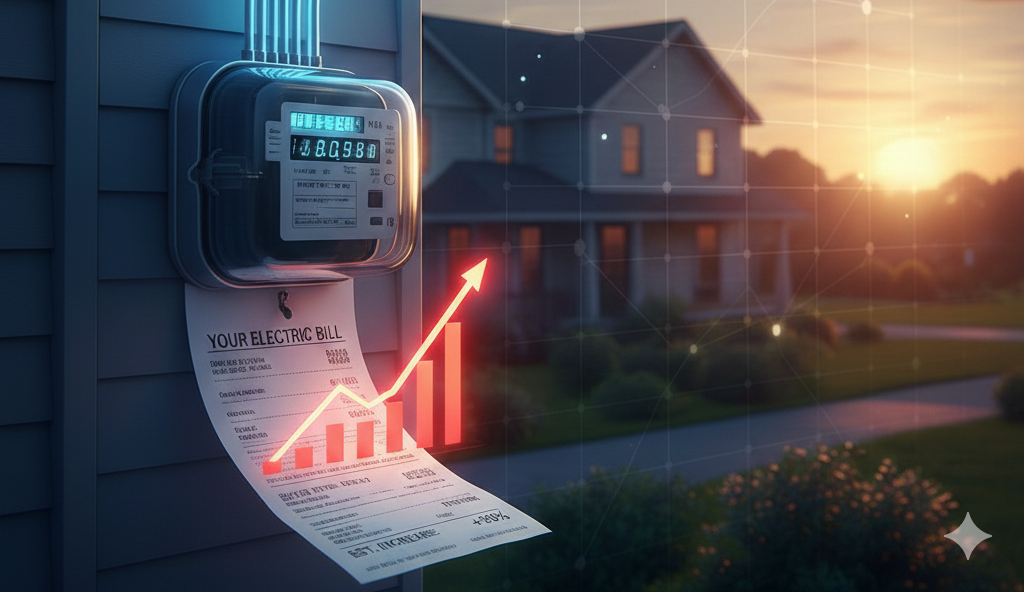
There is growing evidence that heavy around-the-clock demand from data centers and crypto mines has already contributed to higher wholesale electricity prices in Texas.
Large 24/7 facilities flatten the load curve and extend high-demand periods into early morning and evening hours, which can raise overall system costs. Reports from NERC and Texas reliability entities indicate that the rapid addition of large loads is increasing winter and summer reliability risks, prompting more investment in backup resources and grid upgrades that ultimately flow into consumer rates.
Analysts point out that when new demand enters a market faster than supply, prices tend to rise for everyone, at least in the short to medium term.
On the other hand, some AI companies are beginning to co-locate their own renewable generation and battery storage or sign long-term power purchase agreements that bring new generation onto the grid. Google, for example, has contracted more than 6,200 megawatts of new energy generation and capacity in Texas and plans to pair at least one of its Haskell County facilities with an on-site solar-and-storage plant.
For North Texas households, the most realistic scenario is:
- Continued upward pressure on base electricity prices, especially during peak hours
- More volatile wholesale markets, which can affect variable-rate retail plans
- Increasing importance of energy-efficient homes, insulation, and HVAC systems as selling points in a high-demand grid environment
The strategic move: Energy-efficient homes with high-quality insulation, modern HVAC systems, and smart thermostats are becoming more valuable in a market where utility costs are rising. If you’re selling, these upgrades matter more than they did five years ago. If you’re buying, factor energy efficiency into your offer strategy.
What This Means for Electric Vehicle Owners in North Texas
If you’re driving an EV or considering one, the AI data center explosion in Texas is creating both challenges and opportunities that most people aren’t connecting yet.
Here’s the reality: Heavy around-the-clock demand from data centers is putting upward pressure on electricity prices during peak hours, which means your home charging costs and public fast-charging station prices will likely increase over time. Reports from the Texas Tribune show that large loads are extending high-demand periods into hours that used to be cheap for overnight charging. ERCOT data confirms that the traditional overnight demand valley is flattening as 24/7 industrial loads reshape the grid’s load profile.
But here’s the strategic angle most agents won’t tell you:
This same demand is forcing utilities and private companies to invest heavily in new generation capacity, grid-scale battery storage, and smarter load-management technology, upgrades that will ultimately support more reliable EV charging infrastructure and a broader, faster-growing charging network across North Texas. Texas’ grid modernization efforts include billions in transmission upgrades and battery storage projects that directly benefit EV infrastructure.
The charging cost equation is changing:
According to Department of Energy data, the average cost to fully charge an electric vehicle at home ranges from $8-$15 depending on your electricity rate and vehicle battery size. But in Texas’ deregulated market, that cost can vary dramatically based on when you charge and which retail electricity provider you choose. With data centers increasing baseline demand, the spread between peak and off-peak rates is likely to widen, making smart charging strategies even more valuable.
For homeowners considering an EV, timing and strategy matter:
Overnight home charging on a Level 2 charger (240-volt), especially on a time-of-use or “EV-friendly” rate plan, can significantly reduce your exposure to the higher-priced peak hours that large data centers help create. TXU Energy, Reliant, and other Texas providers now offer specialized EV plans with super off-peak rates as low as $0.02-$0.06 per kWh during overnight hours, compared to peak rates that can hit $0.15-$0.25 per kWh or higher during summer afternoons.
Charging when demand is lower and rates are cheaper is exactly the kind of strategic thinking that saves money long-term. For a typical EV with a 75 kWh battery, that’s the difference between paying $12 for a full charge overnight versus $22 during peak hours.
And here’s where this gets interesting for smart buyers:
As Texas adds more solar capacity, battery storage, and even small modular nuclear plants dedicated to AI facilities, there’s growing interest in using EVs and bidirectional chargers as flexible grid resources. The Ford F-150 Lightning already offers home backup power capability, and GM’s Ultium platform is building bidirectional charging into future models.
Some utility pilots are already exploring programs that could eventually reward homeowners who allow their vehicles to help balance the grid during critical hours, essentially turning your EV into a strategic asset that pays you back. Vehicle-to-grid (V2G) pilot programs in California and other states have already demonstrated that EV owners can earn $500-$1,500 annually by participating in demand response programs during peak events.
The infrastructure question most buyers aren’t asking:
Tesla’s Supercharger network now has over 60 locations across the DFW metroplex, with new sites opening regularly in Ellis County and surrounding areas. Electrify America and EVgo are rapidly expanding fast-charging coverage along I-35, I-45, and I-20 corridors. But the real strategic advantage comes from home charging capability, which depends entirely on your home’s electrical infrastructure.
Most modern homes built after 2015 have 200-amp electrical service, which is generally sufficient for Level 2 EV charging. Older homes, especially those in established Ellis County neighborhoods with 100-amp or 150-amp service, may need panel upgrades costing $2,000-$5,000 before you can safely add EV charging. That’s a question smart buyers are asking during inspections now, before it becomes a $5,000 surprise later.
What this means for North Texas homebuyers:
Homes with garage space, existing 240-volt outlets (or space to add them), and good electrical panel capacity are going to look more attractive in the years ahead, especially as AI data centers, grid modernization, and EV adoption all accelerate together.
According to Kelley Blue Book, EV sales in Texas increased 61% year-over-year in 2024, with the Dallas-Fort Worth area leading the state. As EV adoption continues climbing and charging infrastructure expands, homes positioned to support this transition will have a competitive advantage.
If you’re buying in Ellis County or DFW, asking about electrical capacity and charging readiness isn’t just about convenience anymore. It’s about positioning yourself for a market where energy efficiency and grid flexibility become real financial advantages.
The strategic buyer’s checklist for EV-ready homes:
- 200-amp or greater electrical service panel
- Garage or covered parking with nearby electrical access
- Space in the electrical panel for a 240-volt, 40-50 amp circuit
- Proximity to highway corridors with fast-charging infrastructure
- Retail electricity plans offering time-of-use or EV-specific rates
While other buyers are still figuring out if EVs matter, strategic buyers are asking: “Does this home have the electrical infrastructure to benefit from what’s coming?”
That’s the difference between reacting to the market and being positioned ahead of it.
How To Evaluate a Home Near a Current or Future Data Center

For buyers and homeowners in Waxahachie, Midlothian, Red Oak, Ennis, and outlying Ellis County communities, thoughtful due diligence can turn anxiety into confidence.
Key questions to ask city staff, developers, and your real estate professional:
Where exactly will the data center sit relative to my home? Look for site plans showing building footprint, substation locations, and truck access routes. Distance and line-of-sight matter dramatically.
What kind of cooling technology will it use? Closed-loop or air-cooled systems typically require far less water than large evaporative cooling towers, which can be a major concern during droughts.
What are the noise-mitigation plans? Ask about sound walls, berms, setbacks, and whether independent noise studies have been required as part of the permitting process.
How will the project affect local roads and drainage? Large campuses can change runoff patterns and truck routes. Understand what road improvements are planned and on what timeline.
What is the timeline for any tax abatements? This helps you gauge when schools and city services may start receiving full property tax revenue from the facility.
What kind of community benefits are included? Some projects contribute to local training programs, wetland restoration, infrastructure improvements, or energy-efficiency funds.
A knowledgeable North Texas real estate professional can help interpret this information, clarify zoning implications, and compare your property to similar homes that have already navigated nearby infrastructure changes.
For more information on home buying visit our Guides for Homebuyers page
How Your Agent Can Avoid Violating Fair Housing or Steering Rules
This is critical, so let me be very clear about the regulatory framework that governs how real estate professionals discuss neighborhoods, infrastructure, and future development.
Any discussion must strictly comply with federal and state law and avoid discriminatory or anti-competitive practices.
The Fair Housing Act requires that all information be provided on a neutral, geographic, and infrastructure basis, not tailored to or discouraging any protected class. Housing services are available on an equal-opportunity basis without regard to race, color, religion, sex, disability, familial status, national origin, or any other protected characteristic.
RESPA (Real Estate Settlement Procedures Act) prohibits kickbacks and referral fees for settlement-service business involving federally related mortgages. Compliant professionals avoid “pay-to-play” arrangements that direct consumers based on compensation rather than neutral criteria.
Recent NAR settlements have focused on eliminating anti-competitive practices such as blanket commission offers and steering clients toward listings with higher broker compensation. Consumers must be free to choose their agents, lenders, and neighborhoods without pressure based on commissions or fees.
The NAR Code of Ethics requires REALTORS® to present a true picture in advertising and avoid exaggeration, misrepresentation, or concealment of pertinent facts.
Texas Real Estate Commission (TREC) advertising rules require truthful, non-misleading advertising that clearly identifies the license holder and the sponsoring broker.
No statement in this article suggests or encourages steering buyers toward or away from any specific neighborhood, class of people, or property type. All market insights are generalized and intended to help consumers ask better questions and make informed decisions with the guidance of their own legal, financial, and real estate advisors.
How the NAR Settlement Changes Conversations With Texas Buyers and Sellers
The recent class-action settlements involving NAR are reshaping how compensation is discussed and documented:
- NAR has agreed to end the practice of requiring that offers of compensation to buyer’s agents be posted in MLS listings, increasing transparency and negotiation over how each side is paid
- Buyers and agents in many markets are now entering written buyer-broker agreements earlier in the process, clearly outlining services, duties, and how the agent will be compensated
- Regulators have emphasized that commission amounts must be negotiable, not fixed, and that steering clients to homes with higher commissions is an antitrust concern
For North Texas consumers, this means:
- Expect more upfront conversations about agency representation and compensation
- You are free to negotiate how your agent is paid, so long as agreements are in writing and comply with state law and brokerage policies
- High-quality agents will focus on advising you about objective issues, such as infrastructure, zoning, and long-term risk, rather than pushing you toward any property because of commission differences
How a North Texas Real Estate Professional Can Help You Navigate This

A local real estate professional who understands both regional infrastructure trends and neighborhood-level market data can provide critical value:
- Property-specific pricing analysis that reflects how buyers in your micro-market are reacting to nearby industrial development
- Guidance on disclosures and inspections for example: verifying noise-mitigation plans, utility easements, or future road projects
- Coordination with local planners and utility providers to understand timeframes and potential impacts on traffic, drainage, and school capacity
- Marketing strategies that emphasize energy efficiency, resilience, and lifestyle benefits to stand out in a more resource-constrained future
All services should be delivered in a manner consistent with equal-housing opportunity standards under the Fair Housing Act, RESPA’s prohibition on kickbacks or referral fees, NAR’s Code of Ethics and current settlement-driven practice changes, and TREC’s strict rules for honest, non-misleading advertising.
What This Really Means For Ellis County and North Texas
Let me bring this back to what matters for you:
AI data centers are here to stay in Texas. Tens of billions of dollars are committed, construction is underway, and Dallas-Fort Worth is already one of the country’s top data center markets.
These facilities will reshape Texas’ power and water systems. Long-term demand is increasing, which will likely contribute to higher utility costs, even as some operators invest in new renewable and nuclear resources to offset the load.
Property values do not automatically fall near data centers. In some markets, they have risen, especially where infrastructure and employment access improve. Though, some homes immediately adjacent to heavy infrastructure may still see discounts or longer marketing times.
The fairness of tax-abatement packages is an open public-policy question that will continue to affect local politics, school funding debates, and infrastructure planning.
Smart buyers and sellers focus on clear information, careful due diligence, and transparent agency agreements, not fear or hype, to make the best possible decisions for their families and financial futures.
The Strategic Question You Should Be Asking
Here’s the question that separates strategic thinkers from reactive ones:
“Where are the infrastructure investments and employment centers going to be in five years, and how am I positioned relative to that?”
While other agents are telling you whether data centers are “good” or “bad,” I’m tracking where Google is building, where ERCOT is upgrading transmission, where water districts are investing in capacity, and where school districts are planning expansions.
That’s the difference between reacting to the market and positioning yourself to benefit from what’s already in motion.
If you want to understand how the AI data center boom affects your specific property, your neighborhood, or your buying strategy in Ellis County and North Texas, that’s exactly the kind of strategic conversation I have with clients every day.
If you’d like to start a conversation about purchasing your next home, click here to schedule a free buyers consultation where we will take an in-depth look at your needs and how to best meet them.
Bobby Franklin, REALTOR®
Legacy Realty Group – Leslie Majors Team
📲 214-228-0003 | northtexasmarketinsider.com