

An “Active” license means someone passed a background check at some point in the past. It does not mean anyone has checked on them since.
Last updated: July 2026
I am a TREC licensed real estate agent in Texas and I want you to know why you shouldn’t treat a TREC license as your only measuring stick of an agent’s trustworthiness. The people best positioned to show you where this system stops protecting you are the ones operating inside it, and most agents don’t have any incentive to expose the lax licensing requirements. I keep my license number and media record in public view for this very reason, because consumers deserve to see transparency.
The sad truth is, a Texas license holder can be convicted of a disqualifying offense in the first month of a renewal cycle (2 years), decline to report it, and go on displaying “Active” on the state’s public website for up to twenty-three more months after that. Section 1101.652(a)(7) of the License Act obligates them to disclose that conviction to the Commission by the 30th day, and TREC states plainly that criminal backgrounds are otherwise rechecked only at renewal. The duty is real and carries a penalty of $500 to $3,000 per failure to report. Nothing in the system though independently checks whether anyone honored it.
Start By Being Honest About What You Are Handing Over

Consider what a buyer’s agent actually receives from you inside the first two weeks of working together. They might get your lockbox code. They definitely get your pre-approval letter, which means they know your income, your debt load, and the exact number where your financing quietly falls apart. They get your calendar, including the Saturday afternoons when your current house sits empty because you are out touring somebody else’s. They often get your children’s names, your commute tolerance, your school preferences, and the address where you sleep. Somewhere around the fourteenth showing, you will tell that person something you have never told your accountant.
Most buyers across Ellis County and the I-35E corridor hand all of that to a stranger they found on a yard sign or online, and the entire extent of the background work is a glance at a five-star rating on a website or a quick check of their Instagram account.
There is a better version of this available to you, it costs nothing, and it takes about ten minutes. The Texas Real Estate Commission maintains a public, no-login database of every licensed agent in the state. It will tell you whether the person you are about to hire is legally permitted to represent you, who is legally responsible for supervising them, and whether the state has disciplined them in the last decade. That is real information, and almost nobody pulls it.
The part my industry does not enjoy saying out loud is that a clean TREC record functions as a floor rather than a recommendation. Licensure only confirms that a person sat through 180 hours of coursework, passed a multiple-choice exam, and cleared a one-time fingerprint check somewhere in their past. It does not confirm they are good at this. It does not confirm they have ever closed a transaction. It does not mean anyone is watching them now. Most brokers are hands-off and reactive, meaning they only check on their agents’ progress when something goes wrong.
So we are going to work through both halves of the problem, starting with the ten-minute verification and moving to the harder question of what that verification actually proves once you have it.
Part One: The Ten-Minute Check

Step 1: Run the license (three minutes)
Go to trec.texas.gov, open the Public menu, and select License Holder Search. If you want to skip the navigation, go straight to the TREC License Holder Search.
Enter the agent’s name or license number, choose Broker or Sales Agent from the license type dropdown, click Search Licenses, then click the agent’s name.
There is no account to create, no fee to pay, and nothing to wait on.
What loads is the agent’s regulatory identity: license number, license type, current status, expiration date, sponsoring broker, and business address. If you want the full history, there is a Print License History button that generates a free Certified License History showing the original issue date, every status change, the education record, and disciplinary history. It will not run on licenses that have been expired more than four years, which is its own kind of answer.
One note on the address line before you draw conclusions from it: for a sales agent, the address displayed is typically the sponsoring broker’s office rather than anywhere the agent personally works or lives, so a mailing address three counties away tells you nothing at all.
Here is an html rendering of my license status as of July 21, 2026:
Texas Real Estate Commission · Public License Record
Bobby Franklin
Real Estate Sales Agent · State of Texas
Sponsored by Legacy Realty Group – Leslie Majors Team
- Original license date
- May 19, 2023
- Expires
- May 31, 2027
- State exam passed
- May 13, 2023
- Disciplinary actions, past 10 years
- None located (TREC database search, July 21, 2026)
Real estate education on file 283 hours · 14 courses
- 180 Qualifying education
- 90 Sales Apprentice Education
- 13 Continuing & legal update
View the full 283-hour education transcript
| Completed | Course | Provider | Hrs |
|---|---|---|---|
| Qualifying education — 180 hours required for licensure | |||
| 01/28/2023 | Principles of Real Estate I | Real Estate U Online LLC | 30 |
| 02/14/2023 | Principles of Real Estate II | Real Estate U Online LLC | 30 |
| 03/14/2023 | Law of Contracts | Real Estate U Online LLC | 30 |
| 03/18/2023 | Law of Agency | Real Estate U Online LLC | 30 |
| 04/02/2023 | Promulgated Contract Forms | Real Estate U Online LLC | 30 |
| 04/25/2023 | Real Estate Finance | Real Estate U Online LLC | 30 |
| Sales Apprentice Education — 90 hours required before first renewal | |||
| 04/24/2025 | Real Estate Brokerage | AceableAgent | 30 |
| 04/24/2025 | Real Estate Law | AceableAgent | 30 |
| 04/24/2025 | Real Estate Marketing | AceableAgent | 30 |
| Continuing education and legal updates | |||
| 06/27/2023 | Surveys: A Picture Is Worth A 1000 Words | Westcor Land Title Insurance Co. | 1 |
| 01/01/2024 | This House Was Made for You and Me: A Guide to Fair Housing | AceableAgent | 3 |
| 01/02/2024 | Legal Update I (2024–2025) | AceableAgent | 4 |
| 01/03/2024 | Legal Update II (2024–2025) | AceableAgent | 4 |
| 02/25/2025 | Straight Outta Austin: Contract Updates | Acrisure Title of Texas, LLC | 1 |
| Total documented hours | 283 | ||
This card reproduces public record data from the Texas Real Estate Commission’s Certificate of License History, generated July 21, 2026. It is published by Bobby Franklin and is not an official TREC document, and TREC does not endorse or verify this page. License status can change. Confirm current status directly through the TREC License Holder Search before relying on it.
Step 2: Read the status correctly (one minute)
This is where most people skim past the entire point of the exercise. TREC uses precise terms, and only one of them means what you need it to mean.
Active. The agent is sponsored by a broker and current on continuing education. This is the only status under which a person may legally practice real estate in Texas. If you see anything else, stop reading and start over with a different agent.
Inactive. The license is valid, but the holder has no sponsoring broker. They either left a brokerage or chose inactive status deliberately. They cannot legally engage in brokerage activity. Newly licensed agents sit here until a broker registers the sponsorship.
Expired. They missed a renewal deadline through an unpaid fee, incomplete education, or both. They cannot practice. The rehabilitation path scales with the delay: under six months late, they renew with a penalty; six months to two and a half years, reinstatement; past that, they start over with full coursework and the exam. Since October 2023, an active license that expires flips to inactive and terminates existing sponsorships automatically.
Suspended. A disciplinary order has temporarily barred them from practice.
Revoked. TREC terminated the license through disciplinary action. This is the most serious sanction the agency issues.
Surrendered or relinquished. They voluntarily gave up the license. Sometimes that is a retirement. Sometimes it is how a disciplinary matter gets resolved without a revocation landing on the record. The distinction is worth a follow-up question.
Probation. They may practice, but under conditions imposed by an order.
You may also see current versus delinquent, which refers narrowly to whether fees and education obligations are up to date.
The practical rule reduces to one word, which is Active, because everything else on that list describes a conversation you should not be having with the person about to negotiate the largest purchase of your life.
Step 3: Find the sponsoring broker, then understand why you care (two minutes)
The license page names a sponsoring broker. Most consumers skip that line, and it may be the most important line on the page.
In Texas, a sales agent cannot operate independently. Ever. They work under a sponsoring broker who holds legal responsibility for their conduct and supervision. When you sign a buyer representation agreement, you are contracting with the brokerage, and the agent signs on the broker’s behalf. Under TREC Rule 535.141, a complaint filed against a sales agent is simultaneously a supervision matter for that broker.
Translated into plain terms: the broker is your escalation path when something goes wrong, and the entity with real assets when something goes badly wrong. It is a fair question to ask any agent, including the broker standing behind my own license.
Know the tiers you are looking at.
- A Sales Agent completed 180 hours and must be sponsored. This is the majority of the license population.
- A Broker completed 270 qualifying hours plus a documented experience-and-points requirement. They can operate independently and sponsor others.
- A Broker Associate holds a broker license but chooses to work under another broker.
- A Designated Broker is the individual accountable for a business entity’s real estate activity, meaning an LLC or a corporation.
While you are in the database, search the brokerage itself. A business entity conducting brokerage in Texas must hold its own license and name a designated broker. If the brokerage does not appear, that is not a clerical oversight.
Names deserve a caveat of their own, because TREC permits “team” and “group” in licensed and assumed business names and requires those names to be registered under Rule 535.154, which sounds like oversight and functions as paperwork. Registration confirms that a name was filed, not that it describes anything real, so a team name can carry the weight of an independent brokerage while describing three agents working inside a much larger firm. The sponsoring broker line is where the truth lives. The marketing is where it goes to get dressed up.
Step 4: Press the disciplinary button (two minutes)
At the top of every license holder’s page since 2022, there is a Disciplinary Actions button. Press it.
If there is nothing, you get a message confirming no disciplinary history in TREC’s records for the past ten years. If there is something, you get the actions, and you can download the actual order as a PDF including the findings of fact.
Read the order rather than the headline. There is a meaningful difference between an agreed order over an advertising violation and a final order over converted escrow funds, and the document will tell you which one is sitting in front of you.
You can also search discipline independently through the TREC Disciplinary Actions search, filtered by city, date range, and violation type. That view is useful if you are evaluating several agents at once, or if you are simply curious what enforcement looks like in your market.
Two limits belong in your head before you trust a clean result. The published window is ten years, so older matters and out-of-state discipline will not surface. TREC publishes outcomes rather than accusations, which means an open investigation does not appear on that page. Neither does an arrest.
Step 5: Check for the REALTOR® distinction (one minute)
Every REALTOR® is a licensed agent. Not every licensed agent is a REALTOR®.
The trademark signals dues-paying membership in the National Association of REALTORS® through a local and state association, which in this market runs through the MetroTex Association of REALTORS®. Membership binds the member to the NAR Code of Ethics with mandatory periodic ethics training.
For you, it functions as a second door. If something goes wrong, you can file an ethics complaint with the local association, and you have access to mediation and arbitration under Article 17. The local association enforces the Code and can sanction its members. It cannot award you damages or rule on legal violations, which remains the province of TREC and the courts.
If your agent is not a REALTOR®, that second door does not exist. TREC or a lawsuit. That is the entire list.
Part Two: What TREC Actually Screens For, and What It Never Touches

This is where the article stops being a checklist and starts being useful, because everything above verifies compliance and nothing more, which means it answers exactly one question: has this person satisfied the state’s minimum conditions for holding a license? That is worth confirming, and it is also a far narrower question than most buyers believe they are asking when they run the search. The distance between the question people think they asked and the one the database actually answered is where nearly everyone who gets hurt in this process gets hurt.
So it is worth being precise about what the State of Texas actually inspected before it handed this person a license, and equally precise about what it left alone.
What the state does check
Education, 180 hours across six courses. Principles of Real Estate I and II, Law of Agency, Law of Contracts, Promulgated Contract Forms, and Real Estate Finance, at thirty hours each. Before the first renewal, a sales agent adds 90 more hours of Sales Apprentice Education to reach 270 total, including a 30-hour Real Estate Brokerage course that became mandatory in October 2023, plus Legal Update I and II.
Examination. A state exam administered by Pearson VUE, satisfying the competency requirement under TRELA §1101.354(3).
Fingerprints and a criminal background check. Under TRELA §1101.3521, applicants submit fingerprints through IdentoGO for an FBI and Texas DPS criminal history check, at a vendor fee of roughly $38.25. No license issues until those results clear.
Character. TRELA §1101.354(2) requires an applicant to demonstrate honesty, trustworthiness, and integrity. There is no automatic-disqualification list. TREC Rule 541.1(a) instead enumerates the offense categories the agency considers directly related to a license holder’s duties: fraud and misrepresentation; forgery, falsified records, and perjury; bribery and kickbacks; offenses against another’s property; offenses against the person; offenses against public administration; unauthorized disposition of another’s property; crimes of moral turpitude; sexual offenses; sex-offender registration violations; felony controlled-substance manufacture or delivery; attempt and conspiracy; aiding and abetting; repeated violations; and felony DWI.
TREC then weighs the factors in Texas Occupations Code §53.023: the nature and extent of the conduct, the applicant’s age at the time, elapsed time, behavior before and after, evidence of rehabilitation, compliance with supervision, and letters of recommendation. Chapter 53 is deliberately built so that a conviction is not a permanent bar.
That framework is the right one, and I will defend it. A twenty-year-old felony followed by two decades of clean conduct and a documented rehabilitation record should not lock a person out of a livelihood, and a licensing regime built to pretend otherwise would be cruel without being any better at predicting who behaves badly. Where the system actually fails you is not in granting the second chance, but in what it does with the information afterward, because TREC weighs an applicant’s entire history at the point of entry and then publishes to you only the last ten years of its own disciplinary orders. The state sees the file. You see a status word.
The Fitness Determination. Before spending money on courses and the exam, someone carrying a criminal history, unpaid judgments, prior discipline, or a record of unlicensed activity can request a Fitness Determination under §1101.353 and TREC Rule 541.2, which is an advance ruling on eligibility. TREC responds within 30 days. It is optional, it rests solely on what the applicant submits rather than a full background investigation, and it does not replace the fingerprint check. It was formerly called the Moral Character Determination, and as of December 15, 2025 it runs through TREC’s REALM Portal.
Continuing education. Eighteen hours every two-year renewal cycle: four hours of Legal Update I, four of Legal Update II, three contract-related hours, and seven electives. Brokers and supervisors add the six-hour Broker Responsibility Course. Miss the deadline and there is a $200 deferral fee for a 60-day extension, or renewal in inactive status.
That is the whole screening. Now the other side of the ledger, which is the side nobody puts on a listing presentation.
What the state does not check
Nobody is monitoring your agent between renewals.
This is the single most misunderstood fact about real estate licensure in Texas, and it deserves to be stated flatly. The fingerprint check happens once. Backgrounds are re-examined at renewal, every two years.
In between those checkpoints, TREC relies on the license holder to report on themselves. Under §1101.652(a)(7), a license holder who is convicted of a felony or any criminal offense involving fraud, including a misdemeanor, or who enters a plea of guilty or nolo contendere to one, must disclose it to the Commission no later than the 30th day after that conviction or plea becomes final. Failing to report is itself a violation carrying a penalty between $500 and $3,000, and TREC is explicit that a background recheck at renewal does not excuse the missed deadline.
Follow that logic all the way to the end. A license holder could be convicted of a qualifying offense in month one of a renewal cycle, decline to report it, and remain in TREC’s database as “Active” for up to twenty-three more months. The self-reporting obligation is real and it is enforceable. It is also, by construction, dependent on the honesty of the person being screened for honesty. Compounding that, TREC’s Enforcement Division can only open an investigation when someone files a complaint, which means the agency is not scanning for problems in the background. It is waiting to be told.
A pending charge is not a status change. TREC’s authority under §1101.652(a)(1) attaches to a conviction, or to a guilty or no-contest plea, for a felony or a fraud offense. Not an arrest. Not an indictment. Not a headline. An agent can be under active criminal indictment and still show “Active” on the state’s website, because the presumption of innocence is a feature of the system rather than a bug in the database.
Licensure Is Not A Competence Rating
Passing a multiple-choice exam and logging classroom hours measures neither negotiation skill nor market judgment nor diligence nor the willingness to tell a client something they do not want to hear. There is no state assessment of any of that.
There is no experience minimum. An agent licensed last Tuesday and an agent with twenty-five years and four hundred closings display the identical word on that page: Active. TREC’s database has no field for competence and no consumer-facing measure of volume.
None of that is an argument against hiring a newer agent. It is an argument for asking about experience directly instead of assuming the state asked on your behalf. Ask what they actually track, then compare the answer against a published record like the monthly North Texas market reports. A first-year agent with an engaged, experienced sponsoring broker behind them will outperform a coasting veteran on most days of the week. You simply have to know which situation you are standing in.
TREC does not vet marketing claims. Number one agent in the county. Top producer. Luxury specialist. No state agency reviewed any of those before they went on the sign. This matters most for out-of-state buyers, who have no local reference point at all, which is why the relocation guides start with verifiable data rather than superlatives. TREC’s advertising rules govern disclosure, meaning whose name appears and at what size, rather than the accuracy of superlatives.
After licensure, the disciplinary hook narrows. TREC can act on felonies and fraud offenses. Lesser misdemeanors generally do not reach the threshold.
Putting it Together
The Texas licensing regime is designed to screen out people with disqualifying histories at the point of entry and to punish specific misconduct after the fact. It was never designed to continuously certify that every one of the state’s hundreds of thousands of license holders remains, today, a person you should trust with your financial life. No professional licensing body in any state does what consumers imagine it does, and the gap between the imagined screen and the actual one is the whole reason this article exists.
The verification burden does not end at the license lookup. It starts there.
The Mayra Velasquez Case and What a License Status Cannot Tell You
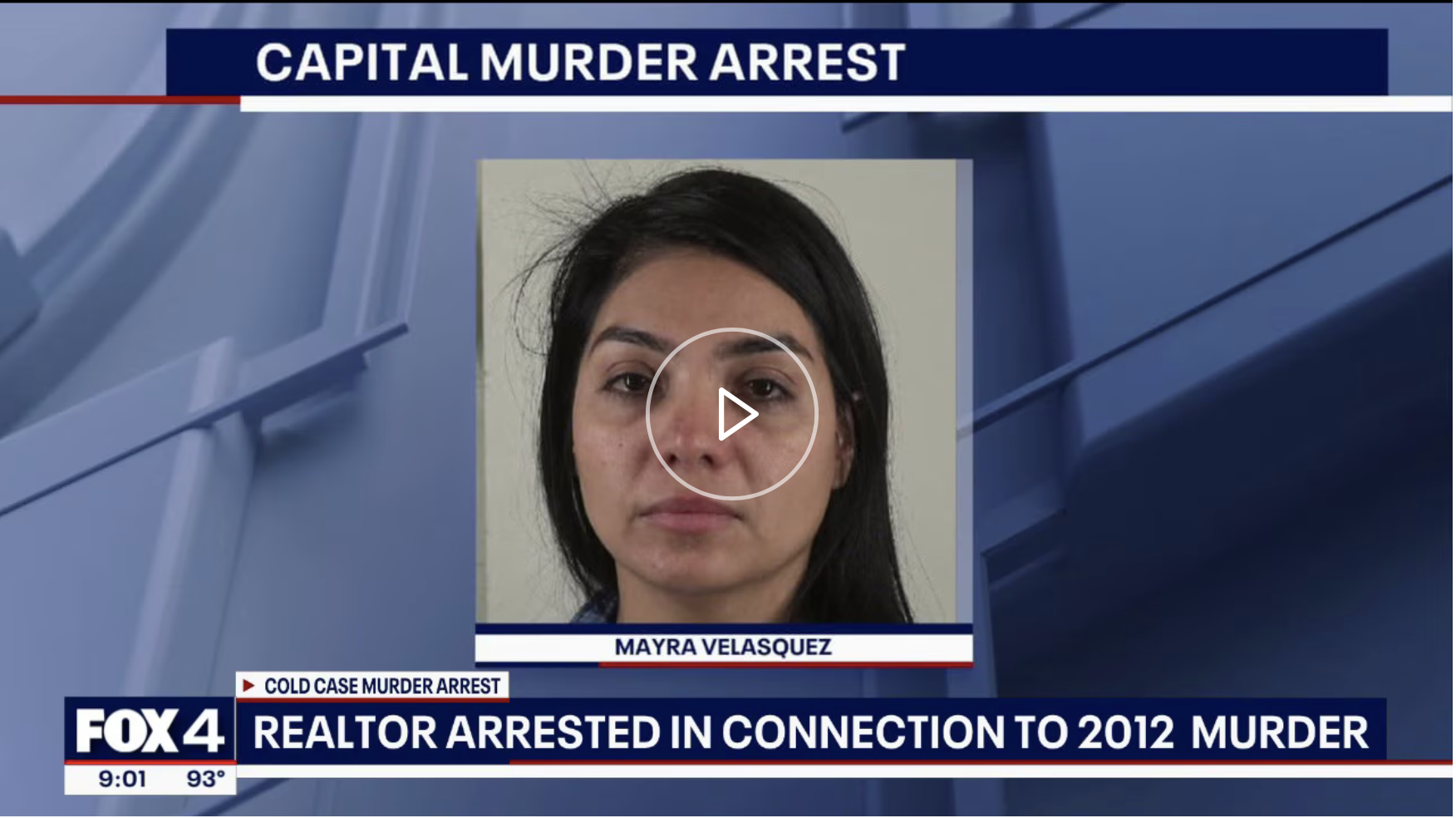
This section describes events as of July 21, 2026
On July 16, 2026, Arlington police arrested Mayra Velasquez, a 42-year-old North Texas real estate agent, and charged her with capital murder by terroristic threat in connection with the January 2012 killing of Irasema Chavez Sanchez, a 32-year-old woman found stabbed to death in an apartment on South Collins Street. Velasquez is held in the Tarrant County Jail without bond and is represented by attorney Vincent Carrizales. She has been convicted of nothing, and every sentence that follows should be read with that firmly in place.
The detail that belongs in this article rather than in a crime blotter is what FOX 4 found when it checked her credentials while reporting the arrest. Velasquez held an active Texas real estate license.
That is not an error, an oversight, or a failure by anyone at the Commission. It is the system running exactly as designed. TREC’s authority under §1101.652(a)(1) attaches to a conviction or a plea, never to an arrest, an indictment, or a booking photo. A person is presumed innocent until the state proves otherwise, and a licensing agency that stripped livelihoods on accusation alone would be a considerably worse agency than the one Texas has. Should Velasquez be acquitted, the presumption will have done precisely the work it exists to do.
Sit with the same fact from the buyer’s side of the table, though. On the morning of that arrest, someone in North Texas could have run the exact ten-minute check this article recommends, seen the word Active, found no disciplinary history, and walked away believing the state had vouched for their agent. They would have read the database correctly. The database simply does not carry that information and was never built to.
The case is fourteen years old and moved only after Arlington detectives brought the file to the FBI’s Dallas field office. Whatever a jury eventually concludes about Velasquez, the gap this exposes does not depend on the verdict. A license status is a record of what the state has already adjudicated. It is not a report on what the state currently suspects.
Part Three: The Second Layer

Ten minutes buys you compliance. The next twenty are not for everybody, so here is the trigger.
Run the deeper check if any one of these is true: the ten-minute check surfaced anything you had to think about, including a gap in license history or a disciplinary order of any size. The agent found you rather than the other way around, through a cold call, a door knock, or an unsolicited message about your equity. They are asking you to sign anything today. They will be handling earnest money, option fees, or lease deposits directly rather than through a title company. Or the transaction is large enough relative to your net worth that a bad outcome would genuinely reset your life.
If none of those apply and the license came back clean, spend the twenty minutes on the sponsoring broker conversation instead. That is a better use of the same time. If any of them do apply, here is where to look.
The statewide conviction search. The Texas Department of Public Safety operates a public Criminal History Conviction Search through its secure portal. Register, purchase credits at roughly $3 per search after fees, and run the name.
The limits matter as much as the result, so absorb them before you act on what comes back. The search returns convictions and deferred adjudications reported to DPS for adults 17 and older, which leaves out dismissals, out-of-state records, and anything still pending. Matching runs on a name-based Soundex algorithm rather than fingerprints, so it can just as easily surface a stranger who shares your agent’s name and miss your agent entirely. A clean result should reassure you without persuading you that you have proof.
County records. For pending charges and local detail, the district and county clerk records where the agent lives and works are the actual source. That is where a case that has not reached conviction would appear.
The advertising audit. This one costs nothing and tells you more than people expect, because TREC’s advertising rules are specific and violations are visible to anyone who knows the shape of them.
Under Rules 535.154 and 535.155, an advertisement must include the name of the license holder or team placing it and the broker’s name, displayed at no less than half the size of the largest contact information in the ad. “Advertisement” is construed broadly to include signs, business cards, websites, email, text messages, and social media. Separately, under Rule 531.20(b), a brokerage or sales agent website must link to the Information About Brokerage Services form in at least 10-point font. If a referral to a service provider is compensated, the ad must disclose it.
The red flags worth noticing:
- No broker name anywhere, or a broker name rendered in microscopic type beneath a billboard-sized agent name.
- A team name engineered to read as an independent brokerage when it is not one.
- A sales agent using “owner,” “CEO,” or “president” in a way that implies they run the brokerage, which is expressly prohibited under TRELA §1101.652(b)(23).
- No IABS link on the website.
None of those individually means you are dealing with a bad actor. TREC generally allows a 14-day window to cure advertising violations, and plenty of these are genuine oversights. An agent whose public marketing ignores the rules governing public marketing is still telling you something about their relationship to the rulebook generally. It is a cheap signal, but you should take it.
The reviews. Read them, then discount them. Online reviews on agent-controlled profiles are unverified and can be solicited selectively, which means you are reading a curated sample rather than a record. Sold history visible through the MLS or public portals is the better signal, because closed transactions are documented by third parties and cannot be selectively displayed the same way.
Part Four: When It Goes Wrong
Verification is prevention. Here is the remedy side, because knowing what recourse exists changes how much that prevention is worth.
Filing a complaint with TREC. Complete the complaint form on TREC’s site. It must be signed, because the Commission does not accept anonymous complaints. Submit by mail, fax, email, or hand delivery with your documentation. You have four years from the alleged incident.
TREC confirms receipt, assigns a case number, determines jurisdiction, notifies the license holder, and investigates. Timelines vary, and six months to an initial determination is common. Cases resolve through no action, an advisory or warning letter, an agreed order in which the license holder accepts sanctions, or, if contested, a Notice of Alleged Violation leading to a hearing at the State Office of Administrative Hearings where an administrative law judge issues a proposal for decision and the commissioners enter a final order. Administrative penalties run from $100 to $5,000 per violation.
Know the ceiling on all of this before you invest hope in it, because TREC regulates conduct rather than compensating victims of it. The Commission cannot award you damages, cannot order a commission refund beyond a limited amount capped at what you actually paid, and cannot resolve the far more common complaint that an agent was not dishonest so much as they were just bad at their job.
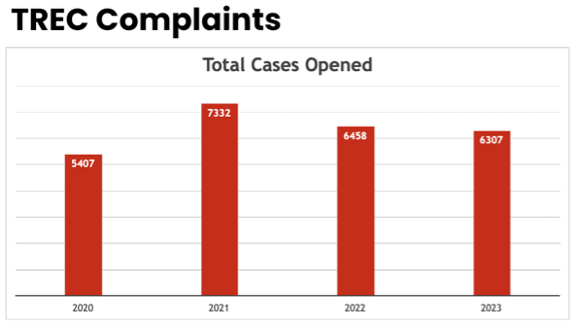
For scale, TREC’s Enforcement Division runs 37 people including ten attorneys, and it opened 6,307 enforcement cases in 2023 The recurring categories are unlicensed activity, misrepresentation and failure to disclose, commingling or conversion of trust funds, advertising violations, failure to respond to the Commission, and leasing fraud, which the agency flagged as a rising problem across 2022 through 2024.
The Real Estate Recovery Trust Account. Texas maintains a fund of last resort for consumers holding uncollectable judgments against license holders. On January 1, 2024, Senate Bill 1577 raised the caps for the first time since 2003, moving from $50,000 to $125,000 per transaction and from $100,000 to $250,000 per license holder in the aggregate, a 150 percent increase.
The path to collecting is demanding by design. You must sue within two years, win a final civil judgment for a covered act such as fraud, negligence, or conversion of trust funds, obtain an abstract of judgment and a writ of execution, and demonstrate that the license holder cannot pay. Filing a TREC complaint is not a prerequisite. Attorney’s fees can be reimbursed, but only inside the cap. Once the fund pays, TREC is subrogated to your judgment, and the license holder’s license stays revoked until they repay the fund with interest.
As of TREC’s May 2023 staff report on the account, summarized by the Texas Real Estate Research Center, the fund had paid out nearly $17 million since its creation in the mid-1970s, with the average paid claim landing around $20,417. Those two figures together tell you what this is: a real backstop for catastrophe rather than just a customer service department.
Part Five: What Changed, and What to Ask
The rules governing your relationship with a buyer’s agent have been rewritten twice in the last two years. Any agent you hire should be able to explain both changes without reaching for a script.
The NAR settlement, effective August 17, 2024. Buyer-broker compensation came out of the MLS, and MLS participants must have a signed written buyer agreement in place before touring a home. Texas REALTORS updated its forms in June 2024 and retired the transitional forms that December.
Texas Senate Bill 1968, effective January 1, 2026. State law now requires a written, signed agreement before a license holder provides brokerage services to a prospective residential buyer, which includes giving advice or presenting an offer. Every agreement must state specific compensation rather than “to be determined,” a termination date, and whether the representation is exclusive. SB 1968 amended §1101.652 to make noncompliance a disciplinary matter, which TREC walks through in its own guidance, and it eliminated the old default under which an agent working without a buyer agreement was presumed to represent the seller.
SB 1968 also tightened the supervision side. Every broker and broker applicant must now complete the Broker Responsibility Course whether or not they sponsor agents. If the broker standing behind your agent renewed after January 1, 2026, they sat through it.
That last piece matters more than it sounds. The ambiguity that used to let a buyer wander through an open house assuming they had an advocate is gone by statute. You either have a written agreement or you do not have representation. What that agreement should actually say is covered in the Texas buyer’s guide.
Questions You Should Be Asking Your Agent

“What is your license number, and who is your sponsoring broker?”
An agent who cannot answer both instantly is a problem before you have verified anything.
“Are you a REALTOR®, and with which association?”
You are asking whether the second recourse door exists.
“Which school district is this address actually zoned to?”
In Ellis County a Midlothian mailing address can sit inside Waxahachie ISD, and the agent who answers from the mailing city rather than the zoned campus is guessing. The school district breakdown shows where those lines fall.
“How many transactions have you closed in this area since August 2024?”
Not how long they have been doing this. The settlement reset the mechanics of buyer representation, and deals closed under the new rules are the ones that demonstrate current fluency.
“Will you put your fee in the buyer representation agreement as a specific number or percentage, with a termination date?”
This is now the law. Their answer tells you whether they know it.
“If the seller offers a concession toward my closing costs, how does that interact with your compensation?”
This is the single most common source of post-settlement confusion. A good agent answers it in plain English without breaking eye contact.
“Has TREC ever taken disciplinary action against you or your broker?”
Ask it, then verify independently. The point is not the answer. The point is whether the answer matches the record.
The Thresholds
Strip all of it down to decision rules you can use tonight.
Hard stop, walk away. A status of suspended, revoked, or surrendered. A recent order involving conversion of trust funds, fraud, or misrepresentation. These are not misunderstandings.
Cannot proceed. Expired or inactive status. Whatever the explanation, that person cannot legally represent you today.
Yellow flag, have the conversation. An advertising violation standing alone. A team name that oversells the operation. A gap in the license history. Ask about it. The response is the real data point.
Not disqualifying. Zero experience, provided the sponsoring broker is experienced and genuinely engaged. Ask specifically how the broker will supervise your transaction, and whether you can meet them.
Frequently Asked Questions

Is the TREC license lookup free?
Yes. The License Holder Search at trec.texas.gov requires no account, no fee, and no login. The Certified License History and the disciplinary action records are also free to download.
How long does it take to verify a Texas real estate agent?
About ten minutes for the full license, status, sponsoring broker, disciplinary history, and REALTOR® membership check. A deeper review including a DPS conviction search and an advertising audit adds roughly twenty minutes.
What does an “Active” TREC license actually mean?
It means the license holder is currently sponsored by a broker and current on continuing education requirements. It is the only status under which a person may legally practice real estate in Texas. It does not indicate experience, transaction volume, or competence.
How far back does TREC disciplinary history go?
TREC publishes disciplinary actions covering the past ten years. Older matters and discipline issued by other states will not appear.
Does TREC run ongoing background checks on agents?
No. Fingerprints are submitted once at application, and backgrounds are re-examined at each two-year renewal. Between renewals, the license holder is required to self-report a final felony conviction or any fraud-related conviction within 30 days. Between renewals, §1101.652(a)(7) requires the license holder to self-report a felony conviction or any fraud-related conviction, including a misdemeanor, within 30 days, with a $500 to $3,000 penalty for failing to do so. But they can easily not until the next renewal and defer their consequences.
Is Mayra Velasquez still a licensed Texas real estate agent?
As of reporting on July 20, 2026, Mayra Velasquez held an active Texas real estate license while jailed in Tarrant County on a capital murder charge. Under Texas Occupations Code §1101.652(a)(1), TREC may suspend or revoke a license only after a conviction or a plea of guilty or nolo contendere, not after an arrest or indictment. License status can change, and current status should be confirmed through the TREC License Holder Search.
Does a Texas real estate license show pending criminal charges?
No. TREC’s public license record reflects convictions and completed disciplinary actions only. An agent under active criminal indictment can display “Active” status, because the Commission’s disciplinary authority attaches to adjudicated outcomes rather than accusations.
Can TREC get my money back if my agent defrauds me?
No. TREC issues administrative penalties from $100 to $5,000 per violation and can sanction or revoke a license, but it cannot award damages. Consumers with an uncollectable civil judgment may pursue the Real Estate Recovery Trust Account, capped at $125,000 per transaction and $250,000 per license holder since January 1, 2024.
Do I have to sign a buyer representation agreement in Texas?
Yes, for residential buyers. Texas Senate Bill 1968, effective January 1, 2026, requires a written, signed agreement stating specific compensation, a termination date, and whether representation is exclusive before a license holder provides brokerage services.
What is the difference between a real estate agent and a REALTOR® in Texas?
A licensed agent is regulated by TREC. A REALTOR® is a licensed agent who also holds membership in the National Association of REALTORS® through a local association, is bound by the NAR Code of Ethics, and is subject to a local association complaint and arbitration process in addition to TREC oversight.
The Part the State Never Checked
Ten minutes at trec.texas.gov will tell you whether the person across the table is permitted to do this job. It is free, it is public, and almost nobody bothers.
Hold on to what that check cannot do. The State of Texas verified this person’s history at a specific point in the past and confirmed they sat through the coursework. It did not vouch for their judgment, their diligence, or their conduct since the last renewal. That assessment belongs to you, and your tools are the questions above, the broker standing behind them, and your own read on whether you are talking to someone who tells you what you want to hear or someone who tells you what you need to know.
Go back to where this started. The garage code. The pre-approval letter with your debt-to-income ratio printed on it. The empty house on Saturday afternoon. Your children’s names, your school preferences, and the fourteen showings that end with you saying something out loud you have never said to anyone who bills you by the hour.
You are not verifying a license. You are deciding who gets all of that precious information about you. Ten minutes at trec.texas.gov tells you the state let them in the door. The next hour is the part where you decide whether to hand them the key.
Bobby Franklin, REALTOR® | Legacy Realty Group – Leslie Majors Team | TREC #0805459
📲 214-228-0003 | northtexasmarketinsider.com
This guide reflects TREC rules, fee schedules, and Texas statutes current as of the last updated date above. Requirements, fees, and recovery caps change. Confirm specifics at trec.texas.gov before relying on them. Nothing here is legal advice.