

By Bobby Franklin, REALTOR® | North Texas Market Insider™ | Legacy Realty Group – Leslie Majors Team | Serving Ellis County, DFW & Greater North Texas
Published: March 2026 | Reading Time: ~15 minutes
Let me tell you something that most agents in this market haven’t figured out yet and by the time they do, the window will already be closing.
Frisco, Texas, one of the fastest-growing cities in the entire United States, is running out of land.
Not slowly. Not theoretically. According to the Dallas Business Journal, confirmed by WFAA News and backed by officials at the Frisco Economic Development Corporation, Frisco could reach full residential buildout within the next decade. Ten years. Maybe less.
Here’s what that means if you’re a buyer, a seller, or an investor watching this market: the calculus just changed. And if you’re waiting for this to “feel more certain” before you act, you’re already behind.
I publish market intelligence specifically so my clients are never in that position. Let’s break down what’s actually happening, why it matters, and what the smart move looks like from here.
The 500% Growth Story: How Frisco Got Here
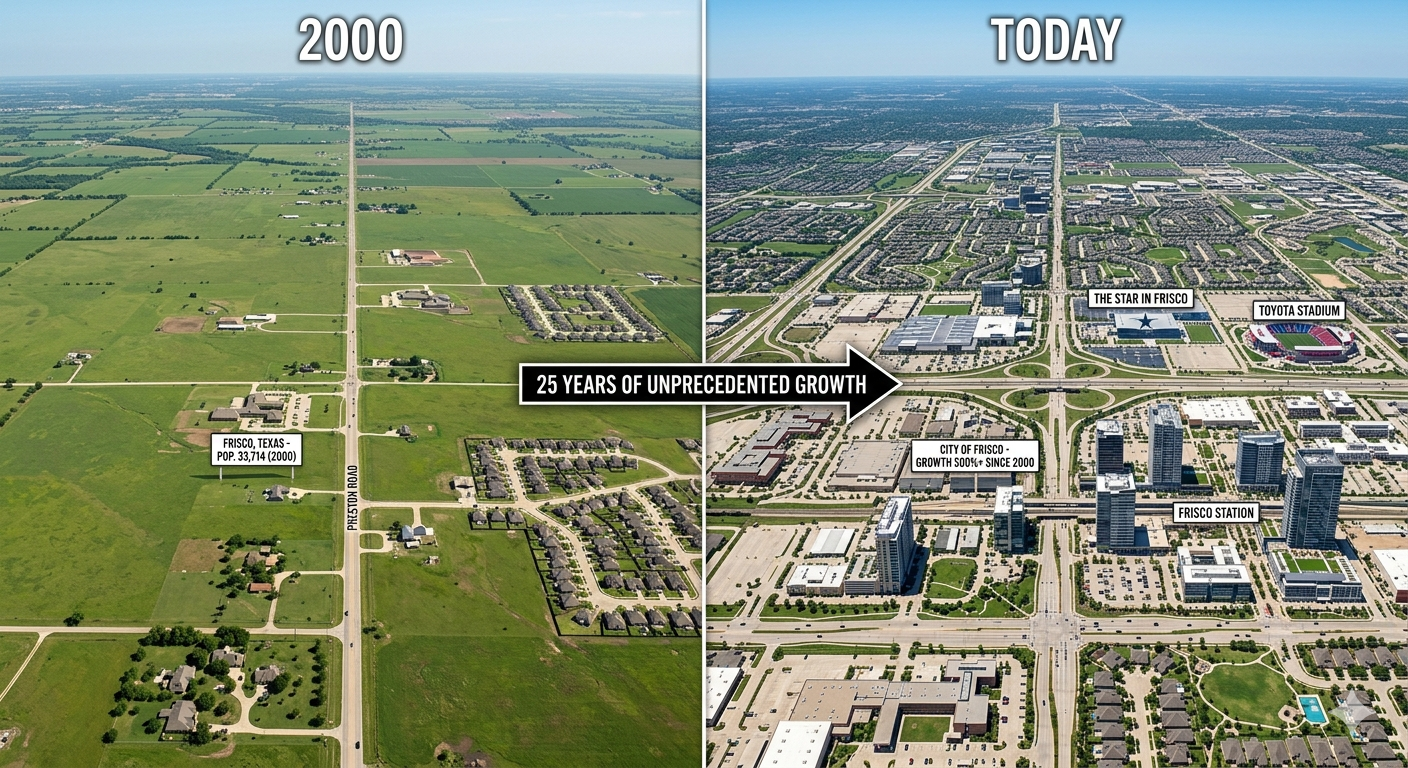
You have to understand the trajectory before you can understand the warning.
In 2000, Frisco had 33,714 people. Today, the city sits at an estimated 251,430 residents, more than 500% growth in just over two decades, per the Frisco Economic Development Corporation. Between 2010 and 2019 alone, Frisco’s population jumped 71.1%, earning it the title of the fastest-growing large city in the United States for that entire decade, according to U.S. Census Bureau data. Even from 2020 to 2024, the city grew more than 17%, during a period when most of the country was pumping the brakes on housing.
That’s not momentum. That’s a force of nature.
And now, for the first time, that force is approaching a hard physical limit.
What “Full Residential Buildout” Actually Means
When planners say “full buildout,” they mean the city is out of raw, undeveloped land that can be converted into traditional residential subdivisions. According to Frisco’s own population projections, the city’s maximum population at full buildout is approximately 365,000 people. With roughly 251,000 residents today, Frisco is already at 69% of its theoretical maximum capacity.
Here’s what that actually means on the ground:
- Greenfield subdivision development — the kind that built Frisco’s neighborhoods over the last 25 years, becomes increasingly rare inside city limits
- New housing requires rezoning commercially-designated land, which is expensive, slow, and politically complex
- The era of affordable new-construction entry-level homes inside Frisco is ending
- Demand doesn’t disappear — it migrates north and south into Prosper, Celina, McKinney, and Little Elm
This is the dynamic shift that’s already in motion. Per WFAA’s reporting, Frisco is approaching this milestone as large mixed-use developments continue to absorb what was previously commercially zoned land. Thhe last significant inventory of buildable acreage left inside the city.
What’s Driving Demand: The $5 Billion Mile and World-Class Development
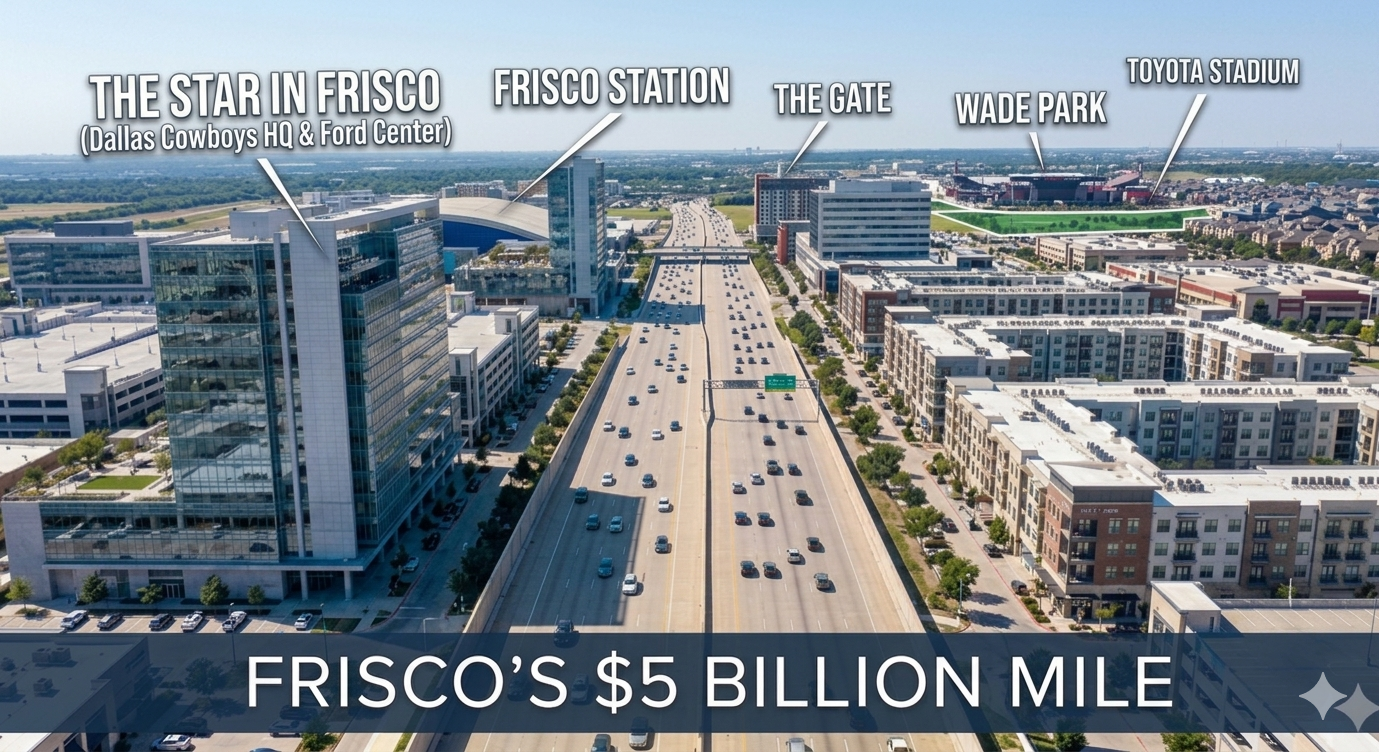
Here’s the thing about Frisco that separates it from every other fast-growing suburb in Texas: this city didn’t just attract people. It attracted transformational, billion-dollar anchor institutions that permanently elevated its economic floor.
The Star in Frisco – Dallas Cowboys World Headquarters
The centerpiece is The Star – a $2-billion, 91-acre mixed-use development along the Dallas North Tollway that serves as the world headquarters of the Dallas Cowboys. We’re talking over 1.5 million sq. ft. of office space, 225,000 sq. ft. of retail and dining, the 12,000-seat Ford Center at The Star, a 300-key Omni Hotel, and the Baylor Scott & White Sports Therapy and Research Center which is a 300,000 sq. ft. world-class sports medicine facility.
And it’s still growing. As of February 2025, the Frisco Planning and Zoning Commission approved a preliminary site plan for an additional 12-acre expansion that includes 158 urban living units, a 200-key hotel, a 17-story office tower, and an 11-story office building.
The Star is expanding while Frisco’s residential land is shrinking. That’s not a coincidence, it’s the compression play. Less land for homes, more demand from high-earning professionals working in those towers.
PGA of America Headquarters – A 600-Acre Golf and Entertainment Campus
The PGA of America left Palm Beach County, Florida for Frisco, Texas, anchoring a $600-acre, $550 million mixed-use development that opened in 2022. The complex includes a $33.5 million, 106,600 sq. ft. headquarters building, two championship 18-hole golf courses, a 510-room Omni PGA Frisco Resort, a 30-acre practice facility, and The PGA District entertainment area.
The PGA campus alone is projected to generate more than $2.5 billion in economic impact over 20 years, including six nationally televised PGA Championship events. When a national governing body pulls up roots and relocates its headquarters to your city, it doesn’t just bring jobs — it signals to every corporate site selector in America that this is where serious organizations want to be.
Fields Frisco — 10,000 Homes, 18 Million Sq. Ft. of Commercial Space
Fields Frisco is one of the last mega-developments being built on remaining land inside the city’s northern boundaries — a master-planned community calling for roughly 10,000 homes, 12 parks, and 18 million square feet of commercial space. Sections like Brookside South are already approaching sellout. That’s not a sales pitch, that’s what happens when limited inventory meets persistent demand. The math is straightforward.
The 2026 FIFA World Cup: Frisco’s Global Moment
I want you to think about the timing here, because it’s almost cinematic.
Right as Frisco approaches its land limitation ceiling, the world is about to watch it. The Dallas-Fort Worth region, with Frisco at its epicenter, is one of the 16 host cities for the 2026 FIFA World Cup. DFW will host nine World Cup matches, including a semifinal making it the most game-heavy host city in the entire tournament.
The North Texas FIFA World Cup Organizing Committee projects 100,000 visitors per day during the tournament, with an estimated total regional economic impact between $1.5 billion and $2.1 billion.
Here’s the strategic read: global visibility drives corporate relocation interest. Corporate relocation drives job creation. Job creation drives housing demand. Housing demand in a market approaching buildout drives appreciation. You don’t need a PhD in economics to follow that chain.
If you’ve been sitting on the sideline waiting for a signal, this is one of them.
Frisco Real Estate Market in 2026: What the Numbers Actually Say

Let me give you the honest market picture, not the cheerleader version.
Home Prices and Inventory
According to Zillow’s Home Value Index, the average Frisco home value sits at approximately $653,858 as of early 2026, down about 5% year-over-year from the 2022-2023 peak. Homes are taking around 64 days to go pending, significantly longer than the 2021-2022 frenzy.
Other data points paint a slightly different picture depending on product type: a late 2025 snapshot showed a median sale price near $694,500 with homes averaging about 60 days on market, while a 2026 update pegs the median closer to $580,000 with homes selling in about 28 days, the range reflects the difference between entry-level townhomes and luxury custom estates.
Here’s what I take from those numbers: Frisco’s market is more balanced today than it has been in years. That’s not a warning sign, that’s a buying window. The National Association of REALTORS® forecasts a 14% increase in existing home sales nationally for 2026, and DFW consistently outperforms the national average. The window where buyers have negotiating leverage and sellers are realistic about pricing is not permanent. Land shortage closes it.
Property Taxes: The Honest Breakdown for Frisco Homeowners
I get this question constantly from relocation clients, so let me lay it out clearly. Here’s the 2025 breakdown:
- City of Frisco: $0.425517 per $100 of assessed value (flat year-over-year), per Community Impact reporting
- Frisco ISD: $1.0194 per $100 of assessed value (slight decrease from prior year)
- Collin County: $0.149343 per $100 valuation
- Combined effective rate: Approximately 1.5–1.7% of assessed value, depending on taxing entities
Texas has no state income tax. That single fact changes the entire financial picture for high-income professionals relocating from California, Colorado, Washington, or Utah. On a $700,000 Frisco home, your all-in tax burden is typically a fraction of what you’d pay in a comparable situation on the West Coast.
I’ve run this math in detail in our relocation guides, read them before you make any assumptions about the “high property tax” objection:
- Relocating from California to North Texas: The Complete Financial Picture
- Relocating from Utah to North Texas: What You Need to Know
- Relocating from Washington State to North Texas: Market Intelligence Brief
Why Frisco’s Schools Are Driving Demand And Why That Won’t Change
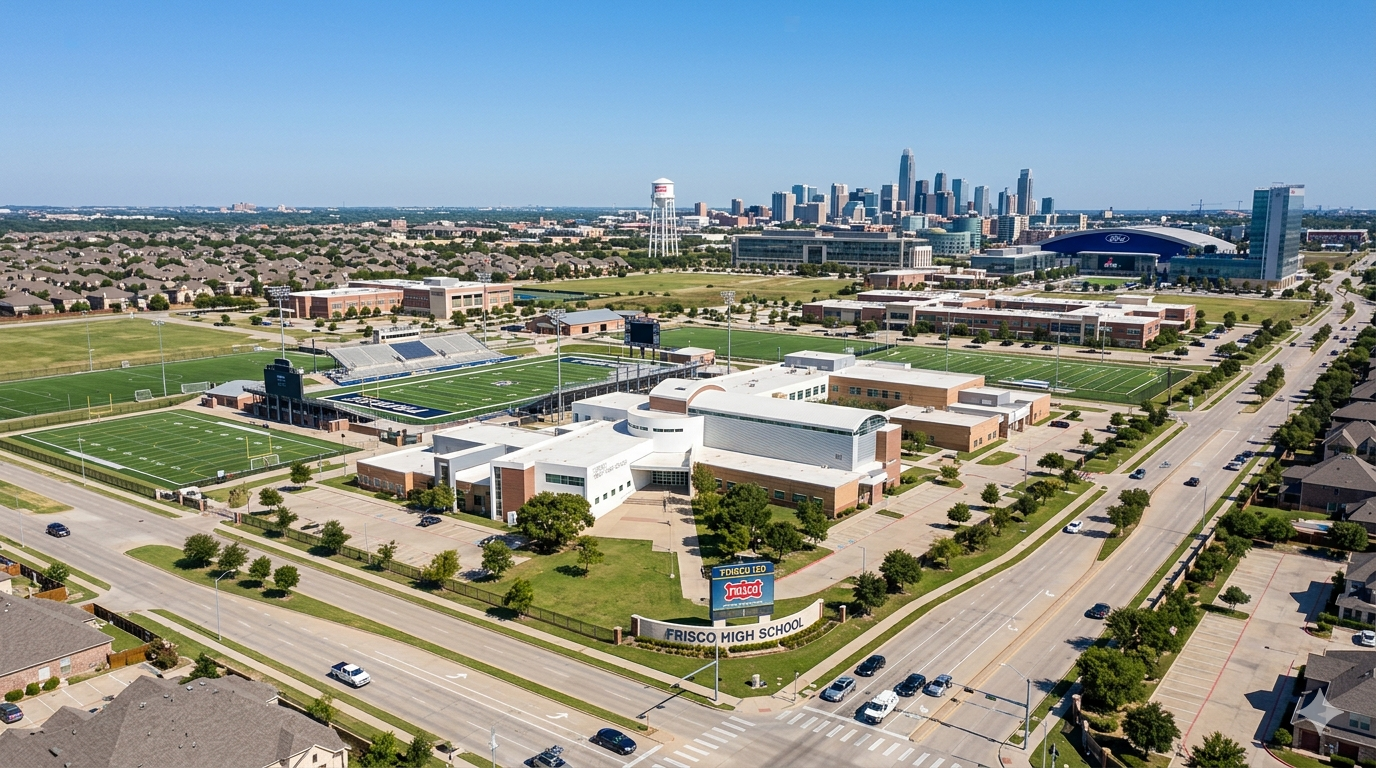
If there’s one factor that explains why Frisco commands a premium over nearly every comparable suburb in Texas, it’s Frisco ISD.
Frisco ISD earned an A+ overall rating on Niche.com in 2025, ranking #7 out of 88 DFW-area school districts, #12 in Texas, and #165 in the entire country. The district also received an “A” accountability rating from the Texas Education Agency for the 2024-25 school year, making it the largest school district in Texas to earn an A rating. Out of 77 campuses, 72 received an A or B.
Here’s what this means strategically: great school districts protect home values even when everything else softens. When land disappears and new construction options narrow, buyers concentrate their demand into the best-quality existing inventory and “best quality” in residential real estate always includes the school district. Frisco homeowners are holding a long-term asset that only gets more defensible as land becomes scarce.
The Ripple Effect: Where Frisco Buyers Are Going Next
The land shortage isn’t just a Frisco story. It’s a North Texas story. Demand doesn’t evaporate when supply tightens, it simply migrates. And right now, it’s migrating in predictable directions.
Prosper, Texas
Just north of Frisco, Prosper is the premium destination for buyers who want more space or are priced out of Frisco’s most competitive submarkets. Median home values hover around $780,000–$790,000 as of early 2026, with master-planned communities, generous lot sizes, and Prosper ISD.
Celina, Texas
Celina is what Frisco looked like 20 years ago and buyers who understand the historical parallel are moving accordingly. According to a StorageCafe analysis, Celina ranked #3 fastest-growing city in the entire United States from 2014-2023, with 300%+ population growth. The city had approximately 64,726 residents as of January 2025, up from just 16,739 in 2020. Median home prices near $550,000 make Celina one of the best value propositions in North Texas for buyers with a 5-10 year horizon.
McKinney, Texas
McKinney blends established historic character with continued master-planned new construction and continues to attract buyers who want Frisco-quality amenities at a lower entry price point. Collin County cities are dominating national growth rankings as a group, and McKinney is a core reason why.
For a comprehensive look at your options across the region, explore our Relocating to North Texas resource library and our North Texas Market Intelligence daily insights.
Corporate Relocations: The Engine Beneath It All
Frisco’s growth, and North Texas’ growth, isn’t luck or weather. It’s the product of a sustained corporate relocation wave that shows no meaningful sign of reversing.
According to DFW economic data, Dallas-Fort Worth has secured over 100 corporate headquarters relocations since 2018, drawing Oracle, Tesla, Capital One, Charles Schwab, and the PGA of America. The DFW area added an estimated 40,000 to 50,000 jobs last year, with new expansions continuing into 2025 and 2026 across advanced manufacturing, aerospace, life sciences, and corporate services.
The Federal Reserve Bank of Dallas projects Texas will add approximately 155,000 new jobs in 2026. Every new job in the DFW metro represents a potential new household seeking housing and in a market approaching buildout, that demand has nowhere convenient to go.
Frisco is described as a “business hub within a business hub”, a suburb that attracts Fortune 500 corporate parks alongside residential growth, meaning the next wave of professional relocatees will specifically target Frisco and its adjacent communities. That’s not a future trend. That’s already the present reality.
What This Means If You’re Buying a Home in or Near Frisco in 2026
Here’s my actual read on the buyer opportunity right now, not the hedged version, the real one.
“Window Markets” Are Real – And This Is One
Right now, Frisco is in a rare window: the market has cooled from its 2021-2022 peak, giving buyers negotiating leverage that simply won’t exist once inventory tightens further. The buildout warning isn’t a reason to panic, it’s a reason to buy strategically while you still have options.
Mortgage rates hovering around 6%–6.3% in 2026 aren’t ideal by historical standards, but they’re meaningfully better than the 7%+ peak rates of late 2023. Combined with sellers who are more realistic about pricing today than they were at peak, qualified buyers have more leverage in 2026 than they’ve had in years. That combination of balanced market, retreating rates and land shortage accelerating is a time-stamped opportunity.
New Construction Is Still Available – But the Clock Is Running
Master-planned communities like Fields Frisco are still actively building. But entire phases like Brookside South are approaching sellout, and available lots are disappearing. If new construction is your preference, acting in 2026 while builders still have inventory and incentive programs, is significantly smarter than waiting until 2027 or 2028 when options will be dramatically reduced.
Read our strategic guide: Why Smart North Texas Buyers Always Use an Agent for New Construction (And What Builder Reps Won’t Tell You)
And before you walk into any model home, read the full New Construction Buyer’s Playbook for North Texas. Every thing you don’t know in that conversation costs you money.
What This Means If You’re Selling a Home in or Near Frisco in 2026
For current Frisco homeowners, the land shortage forecast is fundamentally good news for your long-term equity position. Here’s the seller intelligence that matters.
You Have More Leverage Than You Think
Yes, the market has balanced since 2021-2022. But balanced is not broken. With inventory constrained by geography, you literally cannot build new subdivisions where there’s no available land. Demand driven by corporate relocations, job growth, and the World Cup spotlight putting DFW on a global stage means well-positioned Frisco homes are still selling. The sellers who get hurt are the ones who price like it’s still 2022. Price to the current market and your house moves.
Strategic Timing Is Everything
Historically, the best seller windows in North Texas are spring (March–May) and early summer. As the land shortage narrative becomes more widely understood, especially after this wave of media coverage in early 2026, seller psychology will shift. The homeowners who act on this intelligence now, before it becomes fully priced into market expectations, will capture the most favorable terms.
The NAR Settlement and What It Means for You
Effective August 17, 2024, new rules from the NAR’s $418 million settlement changed how buyer agent compensation is handled. Sellers are no longer automatically required to pay both agents through the MLS. Instead, buyer agent commissions are now negotiated separately and can be offered as seller concessions in the purchase contract.
One year in, data from Clever Real Estate’s 2025 commission survey shows the average total combined commission nationally is approximately 5.44%, slightly higher than the post-settlement dip, as the market has found its equilibrium. In high-value markets like Frisco, commissions are often negotiated on a lower percentage basis given higher home prices. The key point: everything is disclosed, everything is negotiated, nothing is bundled invisibly.
In compliance with the NAR Code of Ethics and RESPA guidelines: All commission structures are fully negotiable and will be disclosed to all parties in writing prior to any transaction. This article does not constitute steering, commission fixing, or any other prohibited practice under federal real estate regulations or Texas Real Estate Commission rules. All services are provided in accordance with the Fair Housing Act.
The Infrastructure Question: Let’s Be Honest About It
I’m not going to gloss over this. As Frisco grows toward its limits, traffic is a real quality-of-life consideration and any agent who doesn’t tell you that upfront isn’t giving you complete intelligence.
The city is actively working on it with expansions of the Dallas North Tollway and U.S. Highway 380, plus partnerships with data analytics firms like INRIX for smarter traffic signal management. But, peak-hour congestion on major corridors is real. Build that into your neighborhood selection and commute planning before you buy.
This is one of the reasons why communities in outer-ring cities continue to offer attractive value for buyers who work remotely or don’t need to commute into Frisco’s core. Explore our city intelligence pages:
- Mansfield, TX: Market Stats and Community Intelligence
- Arlington, TX: Market Intelligence and Housing Data
Beyond Frisco: Landmark by Hillwood and the Broader North Texas Growth Story
Frisco is the most visible chapter in North Texas’s growth narrative, but it’s not the only one. As the land runs out in established markets, massive master-planned developments are absorbing displaced demand across the entire region. One of the most significant is Landmark by Hillwood – Ross Perot Jr.’s $10 Billion community that is reshaping what’s possible in North Texas real estate at scale.
Understanding where the major capital is flowing and what it means for home values in adjacent areas, is exactly the intelligence that separates strategic real estate decisions from reactive ones. That’s what our North Texas Market Insider daily intelligence briefings exist to deliver: the signal before the market prices it in.
Frequently Asked Questions: Frisco Texas Running Out of Land

Is Frisco, Texas really running out of land for new homes?
According to reporting by the Dallas Business Journal and confirmed by WFAA News in March 2026, analysts and city officials indicate that Frisco could reach full residential buildout, meaning no more raw land available for traditional subdivision development, within approximately 10 years. The city’s population has grown more than 17% since 2020 and is currently around 251,000 people, approaching its projected maximum of 365,000 at full buildout. This doesn’t mean home construction stops overnight. It means future residential development will increasingly rely on rezoning commercially-designated land, which is more complex and expensive than greenfield development.
What will happen to Frisco home prices when the land runs out?
Basic supply and demand economics tell the story: constrained land supply combined with sustained population and job-driven demand supports home values over the long term. Cities that reach buildout, like established suburban markets in the Northeast or California, typically experience above-average appreciation once new inventory becomes structurally limited. The current balanced market with moderate price adjustments from the 2022-2023 peak represents a potential strategic entry point before that long-term supply tightening plays out fully.
What are the best alternative cities to Frisco for North Texas homebuyers in 2026?
The primary communities absorbing Frisco overflow demand are Prosper (premium master-planned communities, approximately $780-790K median), Celina (one of America’s fastest-growing cities, approximately $550K median), McKinney (established community with strong schools and diverse inventory), and Little Elm (lake-access community with more affordable entry points). Each offers different trade-offs on price, lot size, commute, school district quality, home age and amenity access. For a personalized analysis of which market fits your specific situation, reach out directly.
Is now a good time to buy a home in Frisco, Texas?
The current market (2026) presents a more balanced environment than the 2021-2022 peak with median home values down approximately 5% from peak levels and homes taking longer to sell. Mortgage rates have retreated from 8%+ peaks to approximately 6-6.3%. For qualified buyers with a long-term horizon of 5+ years, the combination of current market balance, the long-term land shortage thesis, top-rated school districts, and continued corporate relocations to DFW creates a compelling case. That said, every real estate decision depends on personal financial circumstances. Get pre-approved and work with an agent who understands the specific Frisco submarket before you make any moves.
How do Frisco property taxes compare to other North Texas cities?
Frisco homeowners pay a city rate of $0.425517 per $100 assessed value and a Frisco ISD rate of $1.0194 per $100 valuation (2025 rates). Combined with Collin County’s rate of approximately $0.149343 per $100, the effective combined rate runs between 1.5–1.7% of assessed value, lower than many Dallas County cities due to Collin County’s lack of a hospital district. And remember: Texas has no state income tax, which fundamentally changes the total burden calculation for relocators from income-tax states. Run the actual math before you let the property tax line item scare you.
What is Frisco ISD’s current school rating?
Frisco ISD earned an overall A+ rating from Niche.com in 2025 and received an “A” rating from the Texas Education Agency for the 2024-25 school yea making it the largest school district in Texas to earn an A rating. The district ranks #7 out of 88 DFW-area school districts, #12 in Texas, and #165 nationally. Out of 77 campuses, 72 received an A or B designation.
What major developments are happening in Frisco that will affect real estate values?
Key active and planned developments include: The Star expansion (158 residential units, 200-key hotel, 17-story office tower); Fields Frisco (10,000 homes, 12 parks, 18M sq. ft. commercial); PGA Frisco campus ($550M, 600 acres, two championship golf courses, Omni PGA Frisco Resort); and the 2026 FIFA World Cup bringing an estimated $1.5-2.1 billion in economic activity to the DFW region. Each of these individually would move the needle. Together, they represent a compounding demand story.
How is the 2026 FIFA World Cup affecting North Texas real estate?
Dallas-Fort Worth is hosting nine World Cup matches in summer 2026, including a semifinal, the most games of any host city in the tournament. The North Texas organizing committee projects 100,000 visitors per day with a regional economic impact between $1.5 billion and $2.1 billion. The direct short-term impact is hospitality and tourism. The long-term impact is global visibility that accelerates corporate relocation interest, international investment attention, and sustained housing demand for years after the final whistle.
What does the NAR settlement mean for buyers and sellers in Frisco?
Since August 17, 2024, sellers are no longer required to offer buyer agent compensation through the MLS. Buyers must have a written buyer representation agreement specifying their agent’s fee before touring homes, and compensation can be negotiated as a seller concession in the purchase offer. One year after the settlement, average combined commissions nationally are approximately 5.44%. In high-value markets like Frisco, percentage rates are often lower. The key: all commission arrangements are now explicitly negotiated, fully disclosed, and never bundled invisibly into transactions.
Should I use a real estate agent when buying new construction in Frisco?
Yes and it costs you nothing extra. In virtually all new construction transactions in North Texas, the builder pays the buyer’s agent commission. The sales consultants at model homes represent the builder’s interests, not yours. A buyer’s agent provides fiduciary duty to your interests, and can negotiate upgrades, lot premiums, extended rate lock periods, closing cost concessions, and contract contingencies that a builder’s rep will never volunteer. In Frisco’s narrowing new construction market, where each available lot is more valuable than the last, the stakes of getting this wrong are higher than ever.
Your Next Step: Get Market Intelligence That Works for You
The Frisco land shortage story is the kind of macro trend that creates real, actionable opportunities for people who understand it early, and creates regret for people who wait until it’s obvious.
Whether you’re a relocating professional researching your target neighborhood before moving to DFW, a current Frisco homeowner wondering if now is the time to leverage your equity, a buyer looking for the best-value entry point before land scarcity drives prices higher, or an investor evaluating long-term appreciation potential in North Texas, the decisions you make in 2026 will look very different in 2031 when this buildout thesis has fully played out.
I publish weekly market intelligence specifically for North Texas buyers, sellers, and investors. No recycled headlines, no hype. Just data-driven analysis of the deals, the developments, and the decisions that matter. Subscribe to the North Texas Market Insider Intelligence Reports and follow me on Instagram and LinkedIn for daily market updates.
Ready to talk strategy? I’m Bobby Franklin, REALTOR® with Legacy Realty Group on the Leslie Majors Team, serving Ellis County, Frisco, DFW, and all of the greater North Texas area. Reach out directly for a no-pressure, data-first consultation about your specific situation.
📍 16 Northgate Dr. Ste 100, Waxahachie, TX 75165
Bobby Franklin, REALTOR® | Legacy Realty Group – Leslie Majors Team
📲 214-228-0003 | northtexasmarketinsider.com
For financing, I work with three preferred lenders and I recommend consulting all three to find the best fit for your situation:
- Denise Donoghue — The Mortgage Nerd | yourmortgagenerd.com
- Andrew Bryan — Miramar Mortgage | miramarmortgage.com
- Ethan Hester — Midtex Mortgage | mid-texmortgage.com
Disclaimer: This blog post is for informational and educational purposes only and does not constitute legal, tax, financial, or real estate investment advice. All statistical data is sourced from publicly available reports and is accurate as of the publish date; market conditions change and readers should verify current data before making decisions.
Bobby Franklin is a licensed Texas REALTOR® operating in compliance with the Texas Real Estate Commission, the NAR Code of Ethics, the Fair Housing Act, RESPA, and all applicable federal and state advertising regulations. Commission structures are fully negotiable and are never fixed. Content is original and uniquely authored for North Texas Market Insider.




Join The Discussion