By Bobby Franklin, REALTOR® | North Texas Market Insider™ | Legacy Realty Group – Leslie Majors Team
Serving Ellis County, DFW & Greater North Texas | 214-228-0003 | northtexasmarketinsider.com
“Is the Dallas Zoo expansion going to raise home values near Oak Cliff?” “What neighborhoods will benefit from the Dallas Zoo’s new African Shorelines habitat?” “Is now a good time to buy near the Dallas Zoo before construction is complete?”
These are the questions hitting my inbox right now, and for good reason. Dallas just made one of the most significant civic and real estate announcements of the decade and most people are only seeing the surface story about penguins and flamingos.
Oak Cliff in 2026 is the documented “before” picture, sitting three confirmed construction phases ahead of the repricing. The neighborhoods around the Dallas Zoo are priced today on what they are, not on what $300 million in concentrated civic investment is turning them into. That gap is the window, and it closes one news cycle at a time between now and 2030.
This is the full intelligence brief.
What Just Happened: The Dallas Zoo African Shorelines Announcement
In late June 2026, the Dallas Zoo unveiled plans to break ground this fall on African Shorelines, a $26 million first phase of its landmark Safari Trails project. Per Local Profile’s coverage of the announcement, it will run more than 13,000 square feet across five new buildings, anchored by immersive habitats for African penguins and lesser flamingos.
But, African Shorelines is only the opening move. This is just Phase One of a $119 million capital campaign, the most ambitious transformation in the Zoo’s 138-year history, and by the time it’s finished it will have reshaped 15 acres of underused city parkland and shifted the gravitational pull of Southern Dallas real estate along with it. Here’s the part the headlines skipped.
The Full Scope: Inside the $119 Million Wild Horizons Capital Campaign
Pull the lens back and the full Wild Horizons master plan comes into view. The zoo’s Vice President of Marketing and Communications Kari Streiber framed it this way:
“The Zoo’s current Wild Horizons capital campaign is the most ambitious undertaking in its history, a $119 million, multi-phased effort that will transform the Zoo into a leading destination for conservation, education, and community connection.”
The Dallas City Council signed off on the three-phase timeline in December 2025, and it breaks down like this:
| Phase | Budget | Completion Target | Key Features |
|---|---|---|---|
| Phase 1 – African Shorelines | $25–26 million | March 1, 2028 | African penguin habitat, lesser flamingo habitat, café, canopy, viewing shelter |
| Phase 2 – Safari Trails Core | $45 million | April 30, 2029 | Cheetah habitat, rhino return, mixed-species experience |
| Phase 3 – Safari Trails Completion | $20 million | May 1, 2030 | Final 15-acre activation, Wild Earth Discovery Center |
That’s $90 million in hard construction, with the remaining $29 million of the campaign covering design, preconstruction, and additional campus work. The City selected Linbeck Group, LLC as general contractor, among the four firms that bid, and authorized the Construction Manager at Risk agreement in early 2026 at a 3.75% management fee. The reason those details matter is what they add up to: this is approved, contracted, and already moving, not a wish list a board is still debating.
The Bond Funding Story
There’s a funding detail that social posts are skipping entirely, and it’s the one that should matter to anyone betting on the neighborhood: Dallas taxpayers voted for this. In May 2024, voters approved a $30 million allocation from the 2024 General Obligation Bond earmarked for the Dallas Zoo Partnership Project, and that public money is pulling roughly $70 million in private donations in behind it, a $100 million public-private engine aimed at a single civic asset. Per the City of Dallas development agreement authorization, the bond pays out in three annual installments of about $10 million beginning November 2025, the City takes ownership of everything built on the campus, and the Zoo carries operations and maintenance on each finished phase. Public capital, public ownership, private fuel: that structure is what makes this durable rather than speculative. Councilmember Chad West put it plainly: “The Safari Trail is a major new attraction that’s going to be funded through this and will activate several additional acres of campus that are currently underutilized.”
African Shorelines: What You’ll Actually See
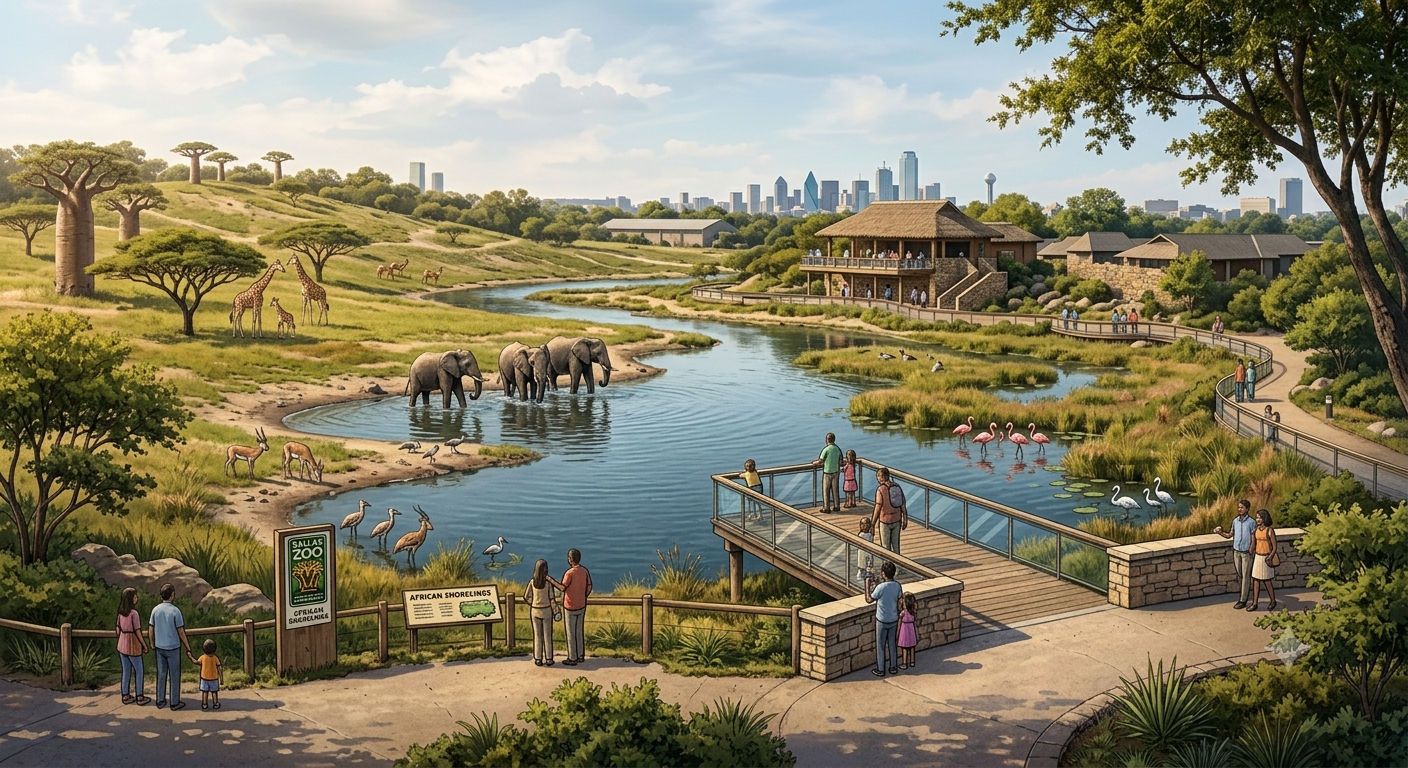
Picture five structures across roughly 13,000 square feet, built to move a visitor through one continuous experience rather than past a row of cages. A 1,726-square-foot covered canopy handles the arrival and threads people toward the habitats. A 5,160-square-foot café sits in the middle of the walk, because the design assumes families will linger rather than pass through. The flamingo habitat runs 2,721 square feet, shaped to mimic the estuaries where lesser flamingos actually live, and the penguin habitat beside it covers 3,046 square feet and carries the headline: one of the largest African penguin flocks in the nation. A 528-square-foot viewing shelter closes the loop, staffed by zoologists for the kind of close encounter that turns a casual visit into a return trip.
That last detail is the one that matters commercially. Safari Trails adds roughly 10 acres of hands-on habitat and stretches the average family visit by about 45 minutes on top of the current 3.5 hours. More time on campus means more dining spend, more repeat trips, and a longer tourism draw, which is precisely the kind of sustained foot traffic that lifts the businesses and the housing around it.
Why African Penguins Matter Beyond Entertainment
The Dallas Zoo isn’t just building a pretty exhibit. African penguins are classified as Endangered by the IUCN, with wild populations having declined more than 70% since the 1980s due to commercial overfishing, ocean plastic pollution, and nesting habitat destruction. According to the Dallas Zoo’s African Penguin conservation page, the Zoo’s Associate Curator Kevin Graham has designed artificial nests and travels to South Africa annually to install them. Since January 2018, his team has installed nearly 1,700 artificial nests in six penguin colonies across South Africa, a direct conservation intervention tied to the Zoo’s in-house expertise.
This is a facility that will be operating at the absolute frontier of penguin conservation science, right here in Dallas, Texas.
Lesser flamingos, the second anchor species for African Shorelines, face similar pressures, with their populations concentrated at just a handful of breeding sites across East Africa. Their inclusion reflects the Zoo’s Protecting the Twelve initiative, a conservation framework that focuses the Zoo’s resources on twelve critically endangered species where its intervention can make a measurable difference.
The Bigger Picture: The Safari Trails Superproject
The Safari Trails build-out planned for 2028 through 2030 is where the Dallas Zoo makes history, and the centerpiece is the return of the rhinos. CEO Gregg Hudson confirmed that rhinos, which have been gone from the campus since 2012, will come back as the anchor of Phase 2 and will be housed in a dedicated habitat carved out of the 15-acre reactivation. What makes that habitat remarkable isn’t the rhinos alone, it’s who they live beside. Per FOX 4’s coverage of the City Council briefing, Dallas will be the only zoo in the country with rhinos and cheetahs sharing a mixed habitat.
What makes that habitat remarkable isn’t the rhinos alone, it’s who they live beside. Per FOX 4’s coverage of the City Council briefing, Dallas will be the only zoo in the country with rhinos and cheetahs sharing a single mixed habitat.
The natural question is the obvious one: doesn’t that put a predator in with prey? It doesn’t, and the reason is biology. A cheetah is the savanna’s specialist sprinter, built to chase down small, fast animals like gazelle, impala, and hares. It avoids anything large enough to hurt it, and a rhino, an animal that can weigh more than two tons, is neither food nor a fight a cheetah would ever pick. Out on the African grasslands the two species move through the same country all the time without conflict, and a mixed-species habitat is built to recreate exactly that: the real dynamics of a shared ecosystem instead of a row of separate cages.
That is also why this reads as a genuine milestone rather than a stunt. Dallas already pioneered the approach with Giants of the Savanna, the first exhibit in the country to let elephants share ground with other large African species, so the cheetah-rhino pairing is the Zoo extending a discipline it already leads, not gambling on a novelty. Milestones like that pull national press, national press pulls visitors, and that attention lands straight on the neighborhoods at the gate.
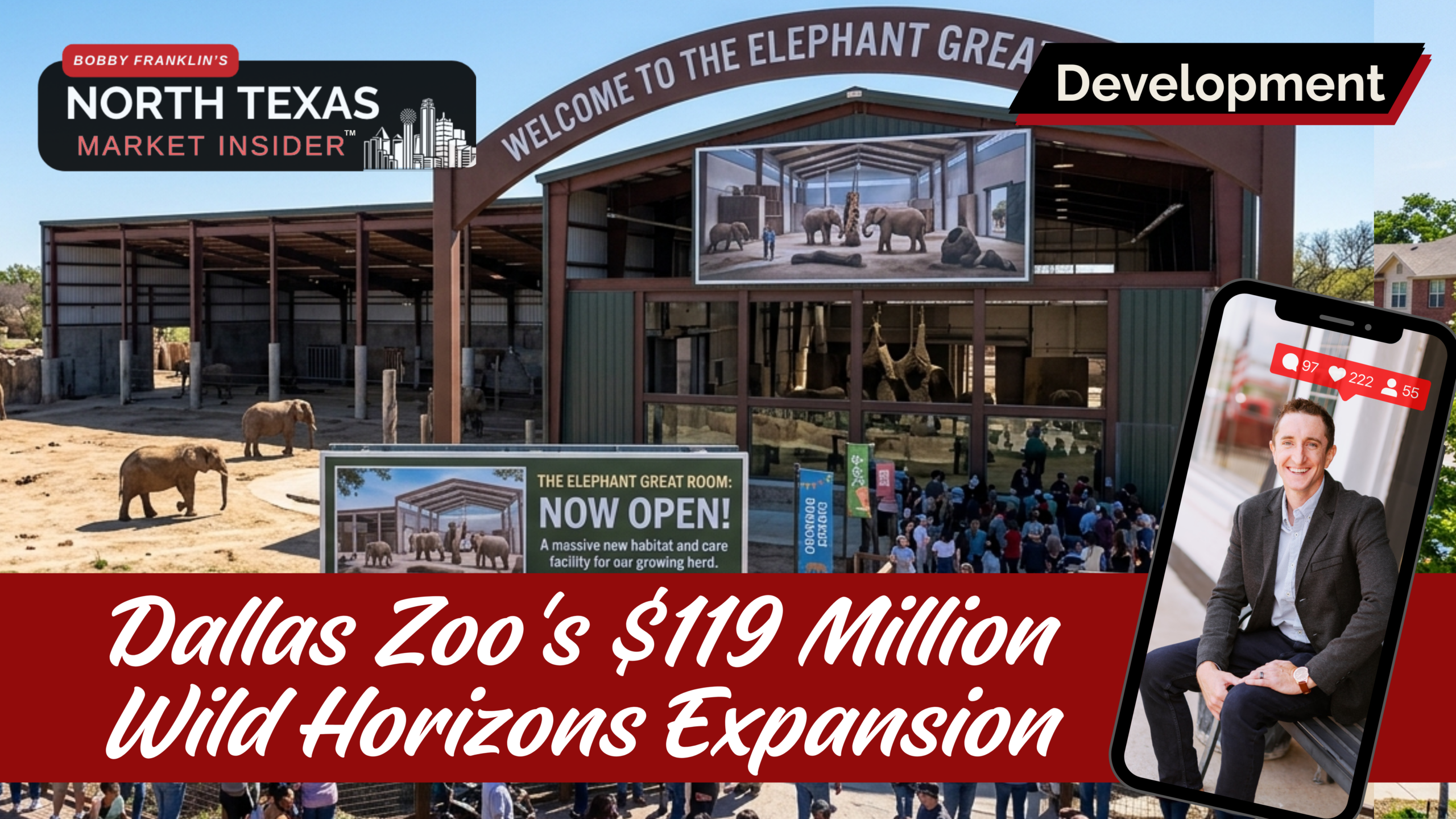
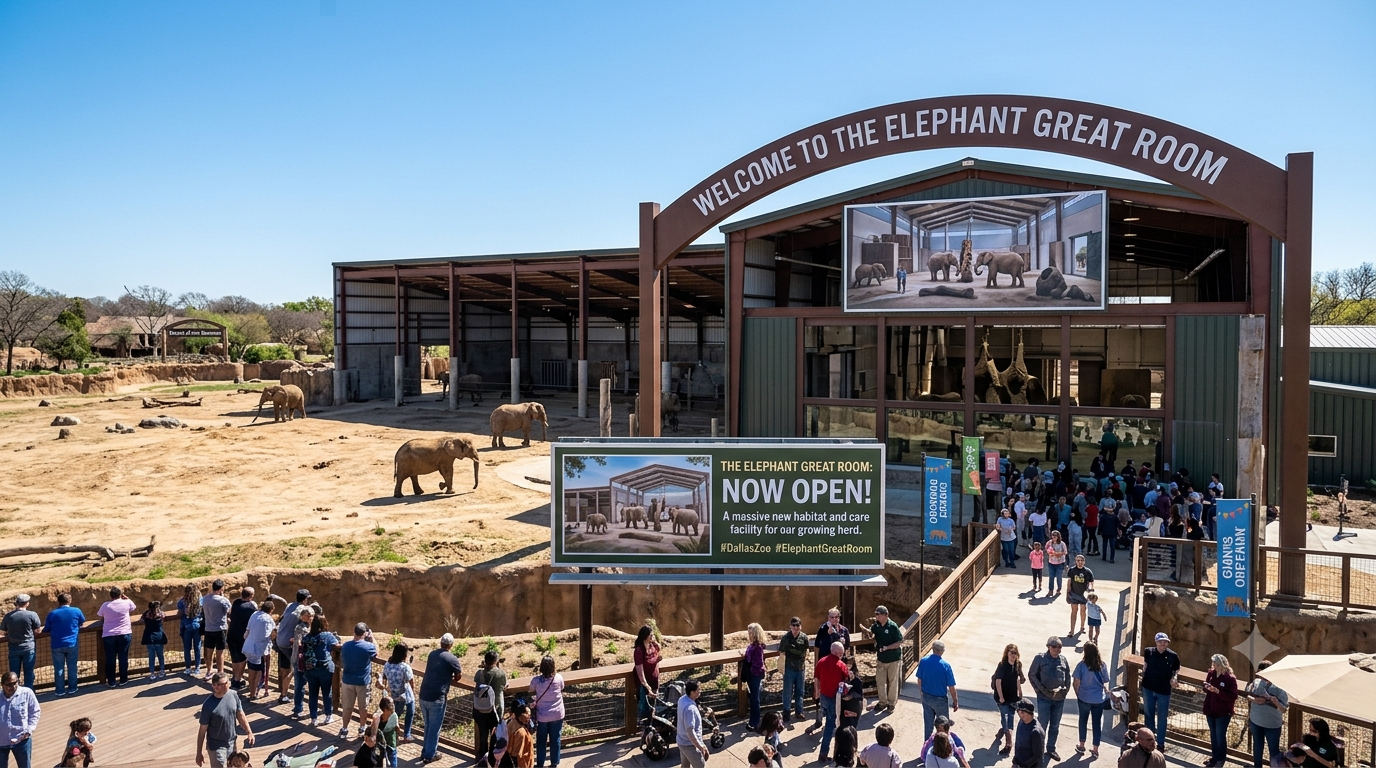
The Elephant Great Room
The Elephant Great Room answers a problem every Texas zoo has to solve: heat. An enclosed, climate-controlled indoor space gives the Zoo’s elephant herd somewhere comfortable to be when North Texas summers turn punishing, and that matters because elephants are intelligent, deeply social animals whose welfare depends on staying active rather than retreating from the weather. A space built to keep them moving, engaged, and healthy through a 105-degree North Texas summer is a real upgrade in care, not just a cosmetic one.
It also solves a problem the Zoo has as a business. Elephants are the marquee animal, the one families come to see, and for half the Texas year, the heat works against showing them off. An indoor Great Room turns the herd into an all-weather attraction, viewable in July as easily as October, which steadies gate numbers across the seasons. A zoo that draws year-round instead of only in spring and fall is a stronger, steadier engine for the dining, tourism, and foot traffic that lift everything around it.
Texas Heat Vs. Savanna Heat
There’s a reason an indoor space matters here specifically, and it cuts against the easy assumption that an African animal just shrugs off a Texas summer. The heat alone isn’t the problem. The humidity is. Elephants don’t cool off by sweating the way people do; they shed heat through their enormous ears, through mud and water, through shade, and by doing most of their moving in the cool of dawn and dusk. Every one of those strategies is tuned to the dry, open savanna they evolved on. North Texas pairs its heat with thick Gulf humidity, and that humidity blunts evaporative cooling, which makes a 100-degree afternoon here harder on the herd than the same number would be back on the savanna. In the wild, an elephant answers heat with range of walking to water, to shade, or to higher ground across territory measured in square miles. A zoo simply cannot hand them that range, so a climate-controlled Great Room becomes the engineered version of the relief the landscape would otherwise provide.
Wild Earth Discovery Center
The Wild Earth Discovery Center is the piece aimed most directly at families, and it’s the one most likely to move a relocation decision. It grows out of the existing Wild Earth Preschool at the Dallas Zoo into a full campus and education center. Nature-based early education, the kind built around outdoor, hands-on, play-driven learning rather than a classroom and a worksheet, is one of the fastest-growing approaches in early education, and a licensed full-day version of it is genuinely rare. That is why the Zoo’s program is currently the only one of its kind in Southern Dallas, and the Discovery Center turns that single program into a full campus.
That scarcity is exactly why it matters to the neighborhood. Families choose where they live around schools and childcare more than around almost anything else, and Southern Dallas has historically been short on standout options. A one-of-a-kind early-childhood program embedded in a major civic institution is the kind of amenity that pulls in the engaged, invested family that plants roots and stays, the same resident profile that turns a neighborhood’s appreciation from a spike into a long, slow compound. The Center is built to serve the wider community too, not just the enrolled families, which makes it an educational anchor for the whole corridor rather than a perk for a few.
The Dallas Zoo’s 138-Year Foundation
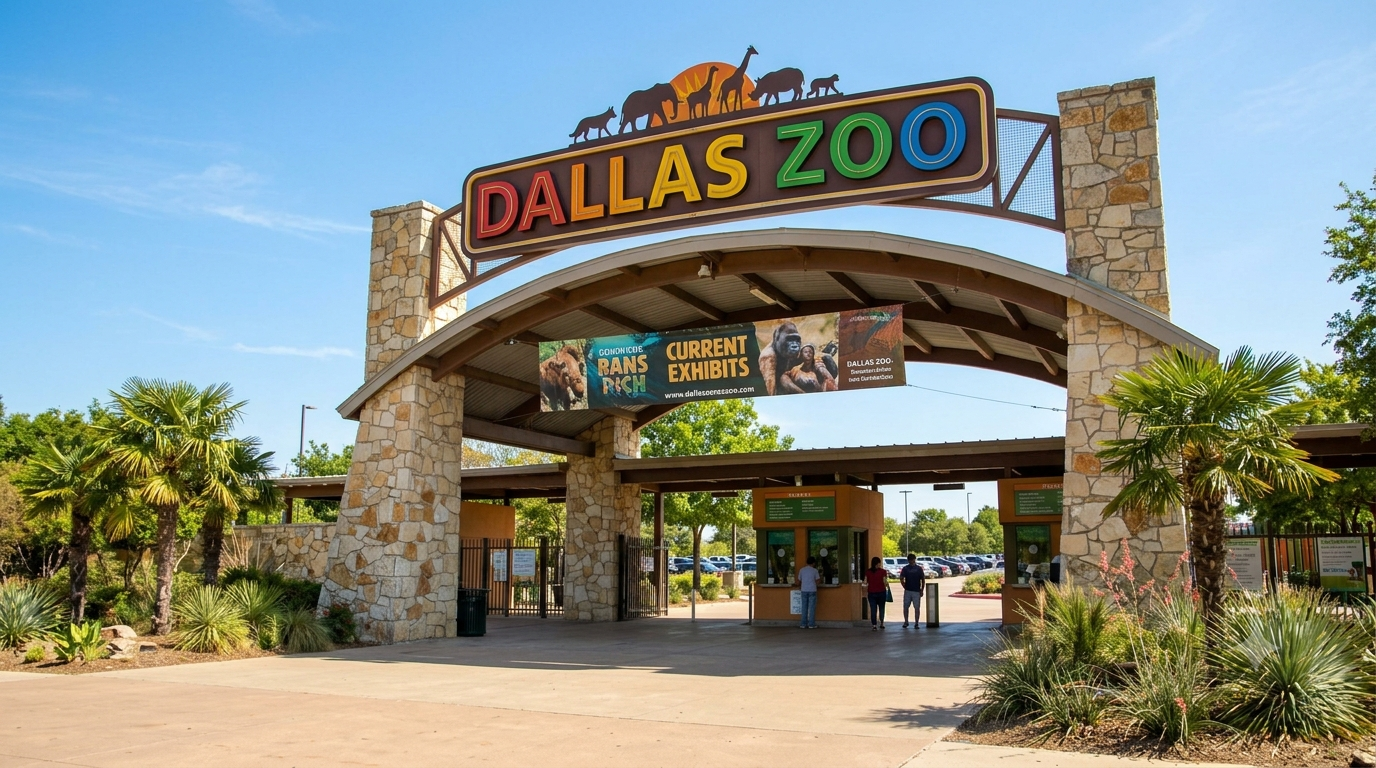
Ground this in context before we talk real estate. The Dallas Zoo isn’t some mid-tier attraction upgrading to compete. It is the oldest and largest zoo in Texas, with a track record that makes this expansion a continuation of sustained institutional excellence.
According to the Dallas Morning News’s deep dive into the Zoo’s history, it traces to 1888, when a resident sold two deer and two mountain lions to the City of Dallas for $60. Today, that $60 investment has grown into a 106-acre institution with more than 2,000 animals spanning 400 species, employing roughly 350 full-time staff and 750 total workers, and drawing over one million visitors annually.
The Dallas Zoo is nearly twice the size of Fort Worth, San Antonio, and Houston’s zoos combined in acreage. It is an accredited member of the Association of Zoos and Aquariums (AZA), the highest accreditation standard in North American zoology.
The Giants of the Savanna, already the first exhibit in the United States to allow elephants and other large African species to share habitats simultaneously, put the Dallas Zoo in the conversation with the world’s elite zoological institutions. Wild Horizons doubles down on that leadership.
The Real Estate Intelligence You’re Not Reading Anywhere Else
Here’s what this means for buyers, sellers, and investors, because this is where the opportunity lives and most real estate content is completely missing it.
The Halperin Park Effect: The Piece That Changes Everything
African Shorelines doesn’t exist in isolation. It is part of an unprecedented convergence of capital investment around the Dallas Zoo campus that creates one of the most compelling neighborhood transformation stories in North Texas right now.
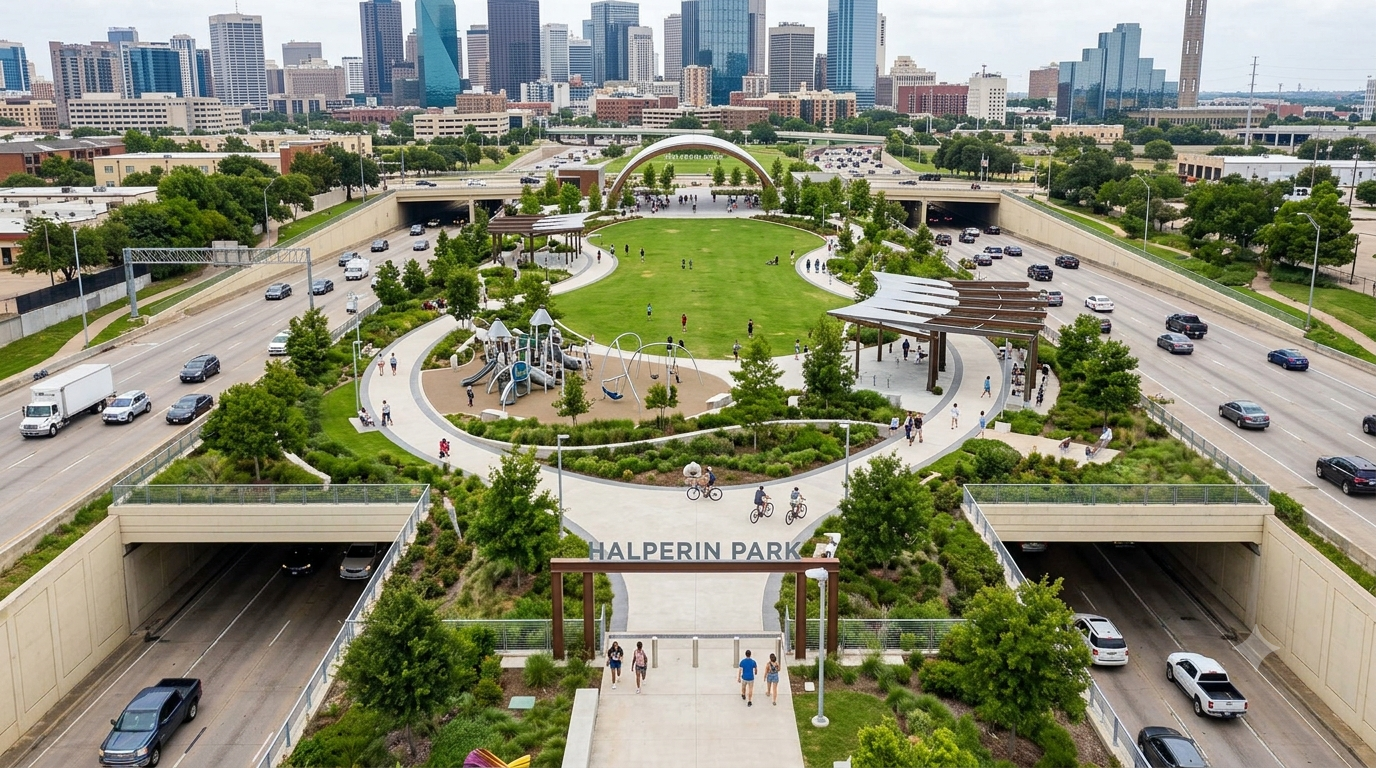
On May 9, 2026, just weeks before the African Shorelines announcement, Dallas opened Halperin Park, its second deck park, built directly over I-35E adjacent to the Dallas Zoo. According to Halperin Park’s official opening announcement, the five-acre green space spans I-35E between South Ewing and Marsalis Avenues, reconnecting Oak Cliff neighborhoods divided by highway construction in the 1950s.
The scale is the part that should stop you. Halperin Park is a $300 million public-private partnership, seeded by a $23 million naming-rights gift from the Halperin Family Foundation, and it’s projected to draw more than 2 million visitors a year. A University of North Texas Dallas analysis estimates roughly $1 billion in economic impact within its first five years. On the ground that becomes a children’s playground, a great lawn, a performance shell, water features, an outdoor amphitheater, and skyline overlooks, turning it into a real destination built on top of the highway that used to divide these neighborhoods.
As KERA News reported on the Halperin Park opening, the park joins Klyde Warren Park as the city’s second major deck park, and it sits walking distance from the Dallas Zoo, with shared parking now accessible from the Zoo’s new garage.
Dallas Mayor Eric Johnson stated at the opening: “Halperin Park bridges long-divided communities and brings beauty, utility and opportunity to Southern Dallas. As a powerful economic driver and symbol of our commitment to a greener, greater city, Halperin Park embodies the lasting impact that intelligent, thoughtful public investments can have on families, businesses and the future of our city.”
Now add the African Shorelines announcement. Together, the collective capital investment around the Dallas Zoo campus exceeds $300 million, making this one of the largest concentrated civic investment zones in Southern Dallas in modern history, according to Halperin Park’s own documentation.
The “Proximate Principle”: Why Park Investment Moves Real Estate
This is the academic concept that real estate professionals need to understand and that most buyers and sellers don’t know about.
Research published in the Journal of Leisure Research analyzing approximately 30 studies on park-to-property value relationships found that proximity to parks consistently increases nearby property values. Studies suggest a positive impact of 20% on property values abutting or fronting a passive park area is a reasonable baseline. Heavily used parks may generate a 10% premium on properties two to three blocks away.
A separate study through North Carolina State University for the U.S. Fish and Wildlife Service found that proximity to wildlife refuges and related open space increases metro-area home values by an average of 2.8%, with the highest premium in the Southeast United States ranging from 7 to 9%.
The City of Dallas Economic Value of Parks study found that Dallas parks return $1.2 billion to the local economy every year, a 15:1 return on public investment, with community and neighborhood parks creating the most significant real estate “park premium” value. The Dallas Zoo plus Halperin Park plus the Wild Horizons expansion creates a compounding amenity concentration that is historically associated with material appreciation in surrounding zip codes.
A precise read matters here, because it’s where most agents overpromise. The 20% premium documented in the research applies to properties that directly abut or front a park, not to an entire zip code. A home eight blocks from Halperin Park does not capture the same lift as one across the street from it. What the research does establish is the direction and the mechanism: concentrated, heavily used amenities pull property values up, and the closer the property, the larger the effect.
What makes the Dallas Zoo corridor unusual is not a single park premium. It’s the density. A 138-year zoo undergoing a $119 million transformation, a $300 million deck park, DART rail access, and an established appreciation engine in Bishop Arts, all stacked inside roughly two zip codes. That concentration is rare, and concentration is what turns a modest park premium into a neighborhood-wide repricing.
Oak Cliff and South Dallas: The Setup
The neighborhoods immediately surrounding the Dallas Zoo, including North Oak Cliff, Winnetka Heights, the Bishop Arts corridor, and South Dallas, are already demonstrating appreciation momentum that predates the African Shorelines announcement.
The pricing already tells half the story. According to 2026 Dallas real estate market data, North Oak Cliff carries a $445,000 median with a “strong demand” designation, while the Bishop Arts area sits at a $460,000 median and a “rapid growth” label. In the Bishop Arts core and adjacent Winnetka Heights, price per square foot runs $250 to $350, well north of the roughly $180 to $200 metro median. Those blocks have already repriced.
For context on the broader Oak Cliff market, Realtor.com’s Oak Cliff market data pegs the neighborhood’s overall median listing price at approximately $294,200, with approximately 1,010 properties for sale. That underscores the significant spread between the established Bishop Arts premium zone and the broader Oak Cliff inventory. That spread is the opportunity window.
The 75203 and 75208 zip codes, the primary zones benefiting from the Dallas Zoo, Halperin Park, and Bishop Arts proximity, sit in the middle of their appreciation curve, not at the top. Entry costs per door remain meaningfully lower than comparable urban Dallas submarkets like Lakewood or M Streets, while the pipeline of catalytic public investment keeps accelerating.
Visit our Oak Cliff City Page on North Texas Market Insider for current listings, market intelligence, and neighborhood analysis.
The DFW Market Context in 2026
Here’s the honest 2026 market backdrop, because context matters.
The DFW housing market in 2026 is balanced, with real leverage sitting on the buyer’s side of the table, a clean reversal from the feeding frenzy of 2021 and 2022. The 2026 DFW Housing Forecast analysis puts the metro median around $355,000, with Dallas County holding up better than most at a modest 1.5% gain. Homes are taking 72 to 73 days to sell across the broader metro, though the right neighborhoods move much faster. Active inventory is pushing 30,000 units, the highest in years, while mortgage rates have settled into the 6.1 to 6.3% range, back under the 7% line that spooks buyers. Nationally, 78% of buyers closed below asking in April 2026. The short version: the buyer holds cards right now that didn’t exist three years ago.
Here’s what that means in the context of the Zoo expansion. When neighborhood-transforming public investment arrives into a balanced market rather than a frenzied seller’s market, the appreciation effect compounds more cleanly. There’s a reason timing matters this much, and it’s in the research itself: the proximate-principle premiums documented in the Journal of Leisure Research are measured on parks that already exist and are already in heavy use. The premium attaches to the finished, activated amenity, not to the announcement. That means today’s Oak Cliff pricing reflects a zoo and a deck park that aren’t finished yet.
Dallas already ran this exact play once: Klyde Warren Park opened in 2012 and the Uptown and Arts District blocks around it slowly repriced as the park matured, there wasn’t a big spike on the day it was announced. Halperin Park is the second deck park, sitting beside a zoo mid-transformation, and the activated value those assets will carry by 2030 is not in the comps today. By the time rhinos return in 2029 and the Safari Trails are complete, the “before” pricing window in adjacent neighborhoods will be a distant memory.
For a complete 2026 DFW market analysis, visit our Live DFW Market Updates page.
The Ripple Effect: Southern Dallas Investment Ecosystem
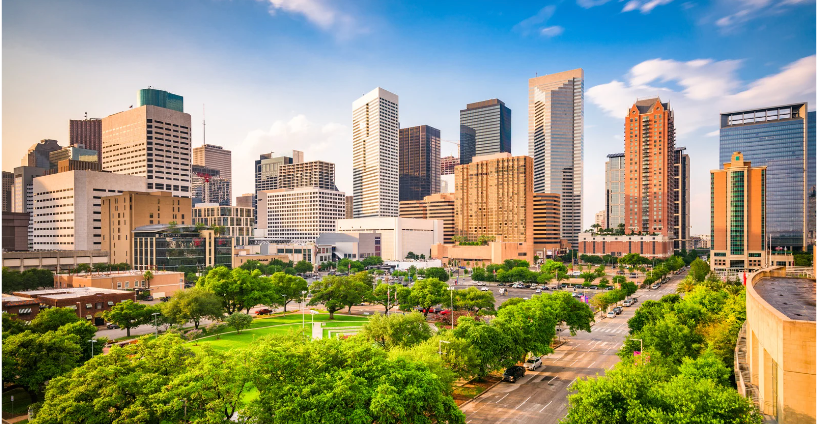
The African Shorelines groundbreaking doesn’t happen in a vacuum. It’s one node in a Southern Dallas investment ecosystem that has been quietly accelerating for years, and the pieces around it are what turn a single project into a trend.
Start with the demand side. DFW added 178,000 residents between 2023 and 2024, the fourth-largest numeric gain of any metro in America, and more than 100 companies announced relocations here between 2018 and 2024, more than anywhere else in the country. That much population and payroll has to land somewhere, and increasingly it lands in redeveloping urban cores like Oak Cliff that offer downtown proximity at prices still anchored to an older reputation.
Access amplifies it. The Dallas Zoo sits directly on the DART Red Line, so African Shorelines, Halperin Park, and every future Safari Trails phase are reachable by rail from across the metroplex without a car, which is a genuine draw for the growing share of buyers and renters who want a car-light or car free life in Dallas. As KERA News put it in its Halperin Park coverage, you can skip parking altogether and ride the Red Line straight to the zoo.
The fundamentals are filling in underneath all of it. Even before the expansion, East Oak Cliff’s food desert started closing with a new hydroponic Fresh Market breaking ground in 2026, and essential retail like that usually shows up right before a neighborhood takes a visible step up in desirability. If you want the template for how this ends, look across the metroplex at Fort Worth’s Panther Island Riverwalk, where the same loop of public infrastructure pulling private capital pulling appreciation is already running. Southern Dallas is now running that loop, at a scale Fort Worth hasn’t yet matched.
What This Means If You’re Selling a Home Near the Dallas Zoo
Price your home around the trajectory, not just the current snapshot. Sellers in the 75203, 75208, 75211, and adjacent zip codes routinely underprice, and the reason is almost always stale comps. Those comps predate the Halperin Park opening in May 2026, the African Shorelines groundbreaking this fall, the $300 million-plus of investment density now ringing the Zoo campus, and the Phase 2 rhino return landing in 2029. A comp from eighteen months ago is describing a different neighborhood than the one you’re selling into today.
A skilled buyer’s agent will absolutely attempt to use the “balanced market” narrative to negotiate down, and in many DFW submarkets, that’s legitimate. In neighborhoods sitting directly in the investment shadow of $300M+ in civic infrastructure, that narrative doesn’t apply uniformly.
The bottom line: sellers in Oak Cliff and South Dallas who understand the transformation underway have a compelling story to tell, and a buyer pool that increasingly includes young professionals, urban investors, and families who understand what the Zoo campus is becoming.
For a strategic consultation on what your specific property is worth in the current trajectory, not just the current snapshot, visit our Sellers page on North Texas Market Insider.
What This Means If You’re Buying Near the Dallas Zoo

You are buying ahead of three confirmed catalysts, each with a due date attached. African Shorelines finishes in March 2028 and delivers the penguin and flamingo habitats, the café, and the canopy, the Zoo’s establishing the first physical transformation of the Wild Horizons era. Safari Trails Phase 2 finishes in April 2029 with the rhino return and the only cheetah-rhino mixed exhibit in the country, the kind of attraction that earns national coverage. Phase 3 wraps in May 2030, activating the full 15 acres and expanding the Wild Earth Discovery Center into a complete reimagining of the Zoo’s southern gateway.
Each completed phase will generate a news cycle. Each news cycle will pull new buyer interest into adjacent neighborhoods. The pattern is the one Dallas already lived through with Klyde Warren Park: the repricing tracks the delivery of the finished amenity, not the announcement, which is exactly why the buyer who closes in 2026 pays the pre-catalyst price while the buyer who waits for the penguins and the rhinos pays more for value that’s already materialized.
Now the part no other agent will say out loud. Buying next to a zoo mid-transformation and a freshly capped highway means living next to active construction from 2026 through 2030. Cranes, detours, noise, phased closures. That’s real, and it’s precisely your source of leverage. The discount you negotiate today exists because the finished picture isn’t here yet. You are being paid, in a lower entry price, to tolerate the years that scare off the buyer who only moves once everything is pretty. By 2030 the construction is gone and the prices will reflect it. The disruption isn’t the risk in this trade. It’s the reason the window is open.
Start your search on our Dallas City Page or our Oak Cliff City Page for current inventory and market intelligence.
The Broader North Texas Investment Picture
The Dallas Zoo expansion is significant on its own but it becomes even more compelling when you zoom out to the full North Texas investment landscape.
At North Texas Market Insider, we track every major development catalyst across the region, because real estate intelligence means understanding not just where value is today, but where it’s being created for tomorrow.
Related developments we’re tracking:
- Rowlett / Lake Ray Hubbard: The billion-dollar Sapphire Bay development transforming the lakefront. Read our full analysis on our Rowlett City Page.
- Waxahachie / Ellis County: New 75-acre Palmetto Road mixed-use development, Bloomfield Homes communities, and the strategic “30 miles south at 40% off” play that smart money is executing. Explore on our Waxahachie City Page and read our detailed analysis of explosive growth coming to Waxahachie.
- Corinth / Lake Lewisville corridor: Positioned between Dallas and Denton with emerging downtown development. See our Corinth City Page.
- Crowley / Tarrant County: Master-planned communities arriving in Tarrant County’s best-kept family secret. Full details on our Crowley City Page.
The through-line is consistent. North Texas is building generational infrastructure at a pace no other metro in America is matching. The Dallas Zoo’s Wild Horizons campaign is just one data point in a larger portfolio of evidence that the DFW region is in the early stages of a multi-decade appreciation cycle.
For the complete 2026 North Texas real estate intelligence framework, including month-by-month market calendars and strategic buyer and seller frameworks by situation, read our Will Housing Actually Become Affordable in 2026? analysis.
Conservation, Community, and Real Estate: The Bigger Argument
There’s a tendency in real estate content to treat cultural and civic assets purely as “amenities,” line items in a neighborhood’s desirability checklist. That framing misses the most important thing about what’s happening in Oak Cliff, so let me make the harder argument.
A shopping center raises convenience. A highway interchange raises traffic. A global-tier conservation institution raises the type of person who moves in next to it, and that is the variable that determines whether a neighborhood’s appreciation lasts or evaporates. The AZA’s Species Survival Plan programs the Dallas Zoo runs for African penguins are not a marketing flourish. They are the signal that pulls a specific resident into the surrounding zip codes. One that is educated, environmentally engaged, economically mobile, and personally invested in the long-term health of where they live. That resident is the one who renovates instead of flips, who shows up to the zoning meeting, who treats the neighborhood as a place to build rather than a position to exit. Price pops fade. A resident base like that is what makes appreciation hold.
This is the distinction between a neighborhood that spikes and a neighborhood that compounds. Appreciation spikes come from hype and often reverse when the hype moves on. Durable appreciation comes from the people and institutions that anchor identity and from a community that attracts the kind of people who stay, not just flip and leave. When the Dallas Zoo’s own Wild Horizons campaign page describes a vision to “elevate the Dallas Zoo to new heights of excellence” and ensure it “remains a beacon of conservation and inspiration for generations to come,” read it as a real estate forecast. It is describing the engine that recruits the human foundation of a neighborhood that holds its value through the next market cycle, not just this one.
That matters. It matters for Oak Cliff. It matters for Southern Dallas. It matters for any North Texas resident trying to understand where durable value is being created in the 2026 market.
The economic analysis from the Texas A&M comparative economic contribution analysis of the Dallas Zoo documents that standard economic models have consistently underestimated the Dallas Zoo’s actual economic contribution to the local economy, because the Zoo’s wage structure and local purchasing patterns generate larger economic multipliers than default IMPLAN zoo sector inputs assume. The Zoo’s real footprint is bigger than the models show, which means the appreciation case built on it is conservative, not inflated.
Frequently Asked Questions: Dallas Zoo Expansion and North Texas Real Estate

The 10 most searched questions about the Dallas Zoo expansion and its real estate implications, answered.
1. When does the Dallas Zoo African Shorelines expansion break ground?
Construction on African Shorelines, the first phase of the Dallas Zoo’s Safari Trails project, is scheduled to begin in October 2026, with completion expected by March 1, 2028, according to Courier Texas’s reporting on the announcement.
2. What animals will be in the new Dallas Zoo Safari Trails expansion?
The African Shorelines phase (Phase 1) will feature African penguins, one of the largest flocks in the nation, and lesser flamingos in a habitat designed to simulate natural estuaries. Phase 2 (targeting April 2029) will include cheetahs and the return of rhinos to Dallas, absent since 2012, in what will be the only cheetah-rhino mixed habitat in the United States.
3. How much is the Dallas Zoo expansion going to cost?
The total Wild Horizons capital campaign is valued at $119 million. The three-phase construction budget totals $90 million. The City of Dallas contributed $30 million in voter-approved 2024 General Obligation Bond funds, leveraging approximately $70 million in private contributions. The African Shorelines phase alone carries a $26 million budget.
4. Will the Dallas Zoo expansion raise nearby home values?
This is the right question. Academic research consistently documents the “proximate principle,” which is the tendency for major park and cultural assets to increase property values in surrounding neighborhoods. Studies cited in the Journal of Leisure Research suggest a 20% premium for properties adjacent to major passive park assets. The combination of the Dallas Zoo expansion, Halperin Park’s opening, and the Bishop Arts District’s established appreciation trajectory creates a compounding effect in the 75203 and 75208 zip codes. Historical patterns and current market data suggest that properties purchased before Phase 2 and Phase 3 completions (2029 through 2030) should capture the strongest appreciation.
5. What neighborhoods are closest to the Dallas Zoo?
The Dallas Zoo is located at 650 South R.L. Thornton Freeway in the Marsalis Park area of Oak Cliff, Dallas. The nearest neighborhoods include North Oak Cliff, Winnetka Heights, Kessler Park, and properties along South Marsalis Avenue and South Ewing Avenue. The Bishop Arts District is approximately one mile north. Visit our Oak Cliff City Page for current listings.
6. What is Halperin Park and how does it relate to the Dallas Zoo?
Halperin Park is Dallas’s second deck park, opened May 9, 2026, spanning I-35E directly adjacent to the Dallas Zoo between South Ewing and Marsalis Avenues. The $300 million public-private project is expected to draw over 2 million annual visitors and generate over $1 billion in economic impact in its first five years according to a University of North Texas Dallas analysis, per CBS Texas coverage of the opening. The Dallas Zoo’s new parking garage will serve both Halperin Park and the Zoo itself.
7. What is the Dallas Zoo’s Wild Horizons campaign?
Wild Horizons is the Dallas Zoo’s $119 million multi-phase capital campaign, the most ambitious in its 138-year history. It encompasses the Safari Trails project (African Shorelines, cheetah and rhino habitats, 15-acre parkland reactivation), the Elephant Great Room, the Wild Earth Discovery Center expansion, security upgrades, and broader campus improvements. The campaign is funded through a combination of voter-approved city bonds and private philanthropy. Details are available on the Dallas Zoo’s Wild Horizons campaign page.
8. Is the Dallas Zoo expansion good for Oak Cliff real estate investment?
The case is strong, and here’s the short version. The convergence of the $119M Wild Horizons expansion, the $300M Halperin Park investment, DART Red Line access, and the Bishop Arts District’s established appreciation trajectory creates a compelling investment thesis for Oak Cliff in 2026. The balanced DFW market hands buyers leverage that didn’t exist during peak seller conditions, and the confirmed catalysts through 2030 give the appreciation case a clear timeline rather than a guess. The entry price today predates the finished amenities, which is the whole opportunity. Worth saying plainly: this is not general investment advice, and you should consult a licensed REALTOR® with hyperlocal expertise before acting. Call or text Bobby Franklin at 214-228-0003 for a specific market analysis.
9. Are African penguins endangered?
Yes. African penguins are classified as Endangered by the International Union for Conservation of Nature (IUCN), with wild populations having declined more than 70% since the 1980s. Major threats include commercial overfishing that depletes food sources near breeding colonies, ocean plastic pollution, nesting habitat loss (guano was historically harvested for fertilizer, destroying natural nests), and climate-related ocean temperature shifts affecting prey distribution. The Dallas Zoo leads the AZA’s SAFE (Saving Animals From Extinction) program for African penguins and has installed nearly 1,700 artificial nests at six colonies across South Africa.
10. What is the Dallas Zoo’s history and why is it significant?
The Dallas Zoo, founded in 1888, is the oldest and largest zoo in Texas and one of the most significant zoological institutions in the American South. At 106 acres, it is nearly twice the size of the Fort Worth, San Antonio, and Houston zoos in land area. It cares for more than 2,000 animals representing 400 species, draws over 1 million visitors annually, and is accredited by the Association of Zoos and Aquariums. Its Giants of the Savanna was the first exhibit in the United States to allow elephants and other large African species to share habitats simultaneously. The Wild Horizons campaign is designed to ensure Dallas retains a world-class zoological institution for future generations.
The Intelligence Brief: What Smart Buyers and Sellers Do With This Information

If you’re selling in Oak Cliff or Southern Dallas:
Don’t let a balanced market narrative flatten your pricing. The $300M+ investment ecosystem around your neighborhood is a real, documented, quantifiable driver of long-term value. Market that story and price on the trajectory.
If you’re buying in Oak Cliff or Southern Dallas:
2026 is the “before” picture. Phase 1 completes March 2028. Phase 2 completes April 2029. Phase 3 completes May 2030. You are buying three confirmed news cycles before the market fully prices in what’s being built. That’s a rare, documented opportunity window.
If you’re relocating to North Texas:
The Dallas Zoo expansion is one of many compelling reasons Oak Cliff belongs on your neighborhood consideration list. Our Ultimate North Texas Relocation Guide is the most comprehensive relocation resource for the region, built specifically for families and professionals making this decision strategically rather than reactively.
If you’re investing in North Texas real estate:
Review our 2025 investor market analysis showing that local investors delivered 216.9% more starter homes than builders, and understand that the next investment frontier in Dallas isn’t in the north suburbs anymore. It’s in the urban core neighborhoods being reconnected, reinvested, and reimagined right now.
For the deepest view of what’s happening in the rural land market across the region, where the institutional capital is quietly positioning, read our Ultimate Guide to Purchasing Land in North Texas.
Bobby Franklin – REALTOR®
Legacy Realty Group – Leslie Majors Team
16 Northgate Dr. Ste 100, Waxahachie, TX 75165
📞 214-228-0003
🌐 northtexasmarketinsider.com
Subscribe to North Texas Market Insider for weekly intelligence updates on the DFW real estate market, development pipeline, and neighborhood transformation analysis.