

Ennis blends small‑town charm with quick big‑city access, sitting just south of Dallas along I‑45 with a fairly easy commute into Downtown. It’s known as the “Bluebonnet City” of Texas, with established neighborhoods, extensive acreage, new construction options, and even seasonal festivals that draw visitors from across North Texas. Families and first‑time buyers are drawn to Ennis for its walkable historic downtown, parks and lake recreation, small-town country feel and perhaps most of all for its attainable home prices compared to many nearby Dallas suburbs.
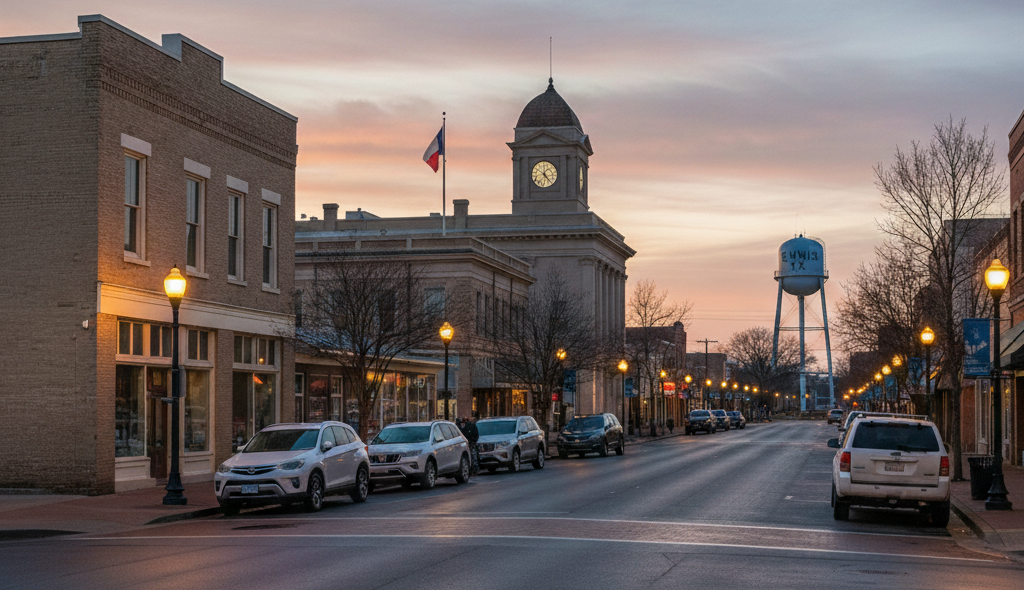
Why Ennis? Bluebonnet City Charm, Affordable Country Living
Ennis sits in Ellis County, about 35 miles south of downtown Dallas along Interstate 45, offering small-town warmth with easy access to the major employment and entertainment centers of the Metroplex. The city’s position near I-45, U.S. Highway 287, and State Highway 34 provides direct routes north toward Dallas, west toward Waxahachie, and southeast toward Corsicana, making it convenient for commuters who want country charm without giving up metropolitan reach.
Founded in the late 19th century as a railroad and cotton hub, Ennis has grown into a friendly, close-knit community that blends historic character with new growth. Its charming downtown district, revitalized with local shops, restaurants, and year-round events, reflects deep community pride and a strong sense of identity. Beyond the downtown core, new residential developments and established neighborhoods offer a range of housing options surrounded by open land and scenic prairie views.
Recreation and events play a major role in Ennis’s quality of life. The city is known as the official “Bluebonnet City of Texas,” hosting the annual Bluebonnet Trails Festival each spring, along with the Ennis Freedom Fest and the popular Ennis Autumn Daze. Residents also enjoy access to local parks, sports facilities, and nearby Lake Bardwell, a favorite for boating, camping, and fishing.
For families, Ennis is served primarily by Ennis ISD, which offers a comprehensive academic program including advanced courses, fine arts, and extracurricular opportunities across all grade levels. Nearby schools in neighboring districts and private or charter options in Ellis County provide additional educational flexibility, all within a reasonable commute of local neighborhoods.
Ennis offers a welcoming lifestyle rooted in tradition, convenience, and community spirit. It’s a true small-town feel just a short drive from the heart of the DFW Metroplex.
What Makes Ennis Special:
- Central Metroplex Connectivity: Grand Prairie sits between Dallas and Fort Worth with direct access to I-30, I-20, SH-360, and the President George Bush Turnpike, putting major job centers across the central Metroplex within a practical daily commute. Its position in the heart of the region gives residents multiple freeway options toward Dallas, Fort Worth, Arlington, and DFW Airport, so commute patterns can flex as jobs or schedules change.
- Established Neighborhoods and New Development: As a large, established suburb, Grand Prairie offers a mix of classic ranch homes, mid-century properties, and newer subdivisions, plus townhomes and some master-planned communities. Buyers can find everything from entry-level homes to move-up properties on larger lots, making the city a fit for first-time buyers, growing households, and downsizers who still want a traditional single-family neighborhood feel.
- Destination Recreation and Lake Access: Residents enjoy a wide-range park and recreation system that includes neighborhood parks, athletic fields, and miles of trails. Along with destination amenities like Joe Pool Lake, Loyd Park, and the EpicCentral entertainment district. Outdoor enthusiasts can stay busy with walking, biking, youth sports, and lake activities, often without leaving the city.
- Multiple School District Coverage: Most families in Grand Prairie are served by Grand Prairie ISD, Arlington ISD, or Mansfield ISD, depending on the neighborhood, with GPISD in particular offering choice schools, STEM and fine arts programs, and specialty campuses from elementary through high school. A variety of charter and private schools nearby provide additional choices for parents without adding long commutes.
- Entertainment Hub and Urban Amenities: Grand Prairie leans into its role as an entertainment hub with attractions such as EpicCentral, Lone Star Park, and seasonal events that draw both residents and visitors. Local restaurants, shops, and services sit alongside national retailers and large shopping corridors, so day-to-day errands, nights out, and family fun can almost always be found close to home.
- Centered for Regional Expansion: Positioned in the center of the Metroplex, Grand Prairie benefits from ongoing regional growth and investment radiating out from both Dallas and Fort Worth. Its mix of established neighborhoods, expanding amenities, and strong transportation links gives the city long-term appeal for buyers who want convenient access to multiple job centers without sacrificing suburban space and lifestyle.
Ennis Housing Market Stats
How To Use These Charts
Use these charts to track; Days on Market, Closed Sales, Sales Price and Shows to Pending.
Just hover over the image to see specific data points for each month.
SALES PRICE
The median sales price represents what price Grand Prairie homes actually sold for in any given month, not what sellers hoped to get. This is the single most important number for understanding real estate market conditions in Grand Prairie, part of the Best Southwest area.
Why median matters more than average: Grand Prairie’s evolving housing market ranges from small one bedroom condos under $120,000 to vast single-family estates listing for upwards of $2,100,000. The median finds the exact middle point, half the homes sold for more, half sold for less. This eliminates distortion from short sales and buyers who overpay.
For Sellers: rising median prices can signal strong buyer demand among Grand Prairie’s population (210,600 as of 2025, up from 196,100 in 2020).
For Buyers: tracking price trends reveals whether you’re getting appreciation potential or negotiating leverage. The gap between list prices and sales prices tells you everything about market power. When homes sell at or above list, sellers control negotiations. When sales prices fall below listings, buyers have leverage.
MEDIAN DAYS ON MARKET
Median Days On Market Shows: how many days a home in Grand Prairie sits on the market before going under contract. The median approach takes the highest and lowest numbers and finds the exact middle, eliminating distortion from extreme outliers like quick cash sales or overpriced listings that sit for months.
Why It’s Important: This number reveals everything about supply and demand dynamics in Grand Prairie. Low days on market (under 30 days) means strong buyer demand. Homes are moving fast and multiple offers are common. High days on market (over 60 days) signals buyer selectivity, more inventory relative to demand, and significant negotiating power.
For Sellers: Understanding current days on market helps set realistic expectations about timing and pricing strategy. If homes are selling in 20 days, the market rewards well-priced properties. If homes are sitting for 90 days, you need aggressive pricing and marketing to compete effectively.
For Buyers: This metric tells you whether you need to make quick decisions or have time for thorough due diligence. Seasonal patterns matter with Spring and Summer typically showing lower days on market as family buyers coordinate with school schedules.
MEDIAN SHOWS TO PENDING
Median Shows to Pending Reveals: how many showings a home in Grand Prairie received before going under contract. This metric helps sellers understand what’s normal when their home gets showings and helps buyers gauge competition levels in the Grand Prairie market.
Why It’s Important: Low shows to pending (under 10) means buyers are making quick decisions. It signals a strong seller’s market where well-priced homes receive offers fast. High shows to pending (over 20) indicates buyer selectivity, with people touring many properties before committing. This data reveals which price ranges and cities have the most buyer interest.
For Sellers: If Grand Prairie homes are averaging 8 showings before going pending, getting 15 showings without offers signals a pricing or presentation problem. This gives you realistic expectations and helps you adjust strategy before losing valuable market time.
For Buyers: High shows to pending means you have time to be selective without losing properties to faster-moving competition. Combine shows to pending with days on market to understand complete market dynamics. Low numbers on both metrics mean hot seller’s market, high numbers mean buyers have the advantage.
CLOSED SALES
Closed Sales Represent: the total number of residential homes that successfully sold in Grand Prairie each month. Unlike active listings or pending contracts, these are actual completed sales where financing cleared, inspections passed, appraisals came in at value, and both parties made it through closing.
Why It’s Important: This is the heartbeat of the local market. High volume signals buyer confidence and healthy fundamentals, while declining volume reveals market friction. Rising prices with increasing volume signals a genuine seller’s market, while rising prices with declining volume suggests weakening momentum.
For Sellers: High closed sales volume indicates strong buyer activity and favorable selling conditions. You’re competing in a market with proven absorption rates, meaning well-priced homes are selling consistently.
For Buyers: High volume means more competition and faster-moving inventory. Declining volume creates opportunities for patient negotiation and gives you time to be selective without losing properties to faster-moving competition.

Bobby Franklin
Realtor®
Serving DFW | Ellis County
16 Northgate Dr. Ste 100
Waxahachie, TX 75165
Ready To Home Shop With Strategy?
Market Insights | Strategic Planning