By Bobby Franklin, REALTOR® — North Texas Market Insider | Serving Ellis County, the I-35E Corridor, and the DFW Metroplex Last updated: July. Continue reading


Why so many Utah families are choosing North Texas
and what you need to know before you move to Texas
Why Utah Money is Flowing to North Texas
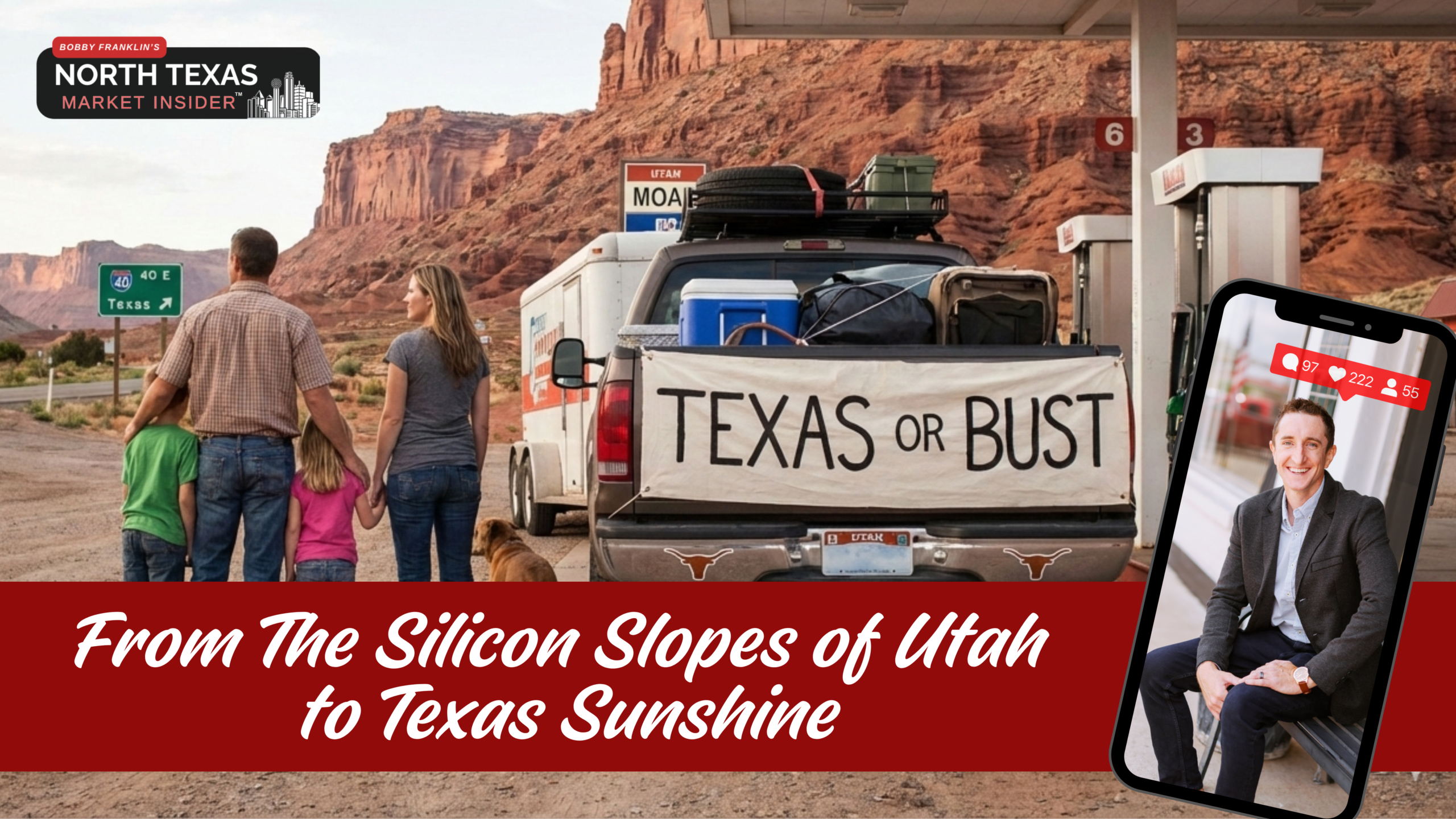
People aren’t just wondering about leaving Utah anymore, they’re actually doing it. Professionals from Lehi, Herriman, and the Salt Lake Valley are quietly trading in crowded corridors along I‑15 for wide‑open space and bigger opportunity in North Texas. For many Utah families, it’s less about “escaping” and more about finally cashing in their equity and buying the lifestyle they really want
In Utah, a $700,000–$900,000 home along the Wasatch Front often means tight inventory, bidding wars, and compromises on space or commute. In North Texas, that same budget can unlock a larger, newer home in a master‑planned community in places like Frisco, Prosper, or McKinney and often with more square footage, newer construction, and upgraded amenities. Add in the tax picture: Utah’s flat income tax sits at 4.5%(2025), while Texas has no state income tax at all, which can mean thousands of dollars each year back in your pocket. That isn’t a sideways move; that’s a strategic upgrade.
This isn’t about hype; it’s about numbers and timing. Utah’s growth has pushed prices, traffic, and overall cost of living steadily higher, especially in key tech and family corridors. North Texas, by contrast, offers a combination of job growth, business‑friendly policies, and housing supply that creates room for both opportunity and lifestyle, without feeling like you’re late to the party.
I’m Bobby Franklin with North Texas Market Insider. I track Utah‑to‑Texas migration trends, study North Texas submarkets at a granular level, and surface the kinds of opportunities most people only hear about after they’ve already disappeared. If you’re in Utah and you’re starting to wonder whether it’s time to make your move, I provide the market intelligence to turn that question into a clear plan.
What’s Driving the Utah Exodus to DFW
Job opportunities and career moves: Utah news outlets reporting on out‑migration say the top reported reason Utahns gave for moving to Texas was jobs, either better opportunities or specific offers they couldn’t match in Utah. For many, it’s not escaping a weak Utah economy; it’s trading up to Texas’ larger, more diversified job market (corporate HQs, energy, aviation, logistics, finance) and specific roles, especially around DFW.
Lower taxes and cost of living headroom: Texas has no state income tax, while Utah’s flat tax is about 4.5%(2025), and Utah coverage explicitly calls this out as a major financial motivator (a $100K earner saving roughly $4,500/year). Cheaper gas and lower housing medians are a big part of the appeal.
Housing options and space, not just “cheaper houses”
Texas offers more choice and size for the money compared to other strong metro economies. For Utahns used to constrained inventory along the Wasatch Front, Texas feels like a place where there’s still room to buy bigger, newer, or on a larger lot without coastal-level prices.
Weather and air quality trade‑off
Movers see Texas as trading snow and inversion for heat and storms; some prefer the more usable non‑winter months and not driving in snow, even though the summer heat is a very real downside.
Cultural mix: family‑oriented but more diverse
Utah→DFW movers constantly talk about their kids having “so many more opportunities in school” and loving the diversity and food in Texas, while still feeling they’re in a family‑oriented, community‑minded state.
Proximity and lifestyle change (ocean, travel, different experiences)
For many Utah families, Texas represents a chance to keep a Western, outdoors‑friendly lifestyle while adding big‑city amenities, major‑airport connectivity, and access to new weekend-trip options.
Click on the article on the right to learn more —->

If you’re relocating from Utah, you’re not just buying a house, you’re making a strategic decision to enter one of the strongest markets in the nation.
Utah Buyer Types
The Career Movers – Utah professionals relocating to DFW for corporate transfers, tech opportunities, or leadership roles with Texas-based companies. They’re trading Salt Lake City’s mountain backdrop for Dallas-Fort Worth’s economic firepower and career acceleration.
The Equity Reinvestors – Homeowners cashing out strong Utah appreciation (particularly from markets like Lehi, Draper, and Herriman) who can leverage that equity to buy more house in North Texas, pay down debt, invest in additional properties, or build financial cushion. They’re making strategic capital moves, not emotional ones.
The Affordability Refugees – Families and first-time buyers priced out of Utah’s bidding wars who discover that DFW’s inventory and price points finally let them get the space, yard, and neighborhood they’ve been chasing. They’re not settling, they’re getting more for less.
The Lifestyle Switchers – People trading Utah’s long commutes, mountain isolation, or inversion for DFW’s big-city amenities, diverse communities, and wide-open Texas skies. They’re making quality-of-life upgrades, not compromises.
What Utahns Need To Know Before They Move

Last Updated: January 22, 2026 Here’s something that’ll wake you up faster than your...

Why the smartest money in America is betting on southern Dallas County, and what it means for...

The Intelligence You Need Before You Buy Here’s the thing about Texas property taxes that...
Where Utah Families Are Landing
Most of my Utah clients aren’t randomly picking a spot on the map, they’re looking for suburbs that feel like an upgrade to the lifestyle they already have. Here are a few of the most common landing zones for Utahns moving to the Dallas–Fort Worth area:
Prosper & Frisco – “Master‑planned and family‑first, minus the Wasatch Front price tag”
If you’re coming from Herriman, South Jordan, or Daybreak and love the master‑planned community fee – HOA amenities, splash pads, youth sports, community events, Prosper and Frisco will feel immediately familiar. You get similar newer construction and top‑rated schools, but typically at a lower price per square foot and without the I‑15 bottleneck to get anywhere.
Plano & Allen – “Established suburbs with real trees and shorter commutes”
Utahns coming from places like Draper, Cottonwood Heights, or Bountiful (where you have mature neighborhoods, strong retail, and solid schools) tend to gravitate here. Plano and Allen offer a wide range of price points, park‑lined streets, and easy access to major employers without feeling like you’re living on the edge of new construction.
Flower Mound & Southlake – “Premium suburbs for high‑equity sellers”
If you’re selling a $900K+ home in Alpine, Highland, or along the Draper/Sandy corridor and want to maintain that premium, low‑density lifestyle, Flower Mound and Southlake deliver. Large lots, top‑tier school districts, and a polished, country‑club‑adjacent atmosphere near DFW Airport. These towns attract Utahns who built serious equity and want to match or exceed that quality of life in Texas.
McKinney, Melissa & North Collin County – “Room to grow at a pace you recognize”
If you’re coming from Eagle Mountain, Saratoga Springs, or the south end of Utah County, places that were farmland ten years ago and are now booming with young families, this corridor will make sense to you. Newer schools, planned communities, and real growth potential, but at price points that let you keep cash in reserve instead of stretching your budget.
Rural corridors like Rio Vista, Blum & Whitney – “Acreage and elbow room for the Heber Valley and St. George crowd”
For Utahns leaving rural communities in Tooele County, or even retirees from St. George who want land, animals, or lake access. The rural pockets south and southwest of DFW offer that lifestyle at a fraction of the cost. You trade mountain views for bigger skies and lower price per acre, but you’re still within reach of the Metroplex when you need it.
Urban Dallas neighborhoods – “Downtown energy for the SLC city crowd”
For Utahns coming from Downtown Salt Lake City, Sugar House, the 9th & 9th district, or Central City – people who value walkability, nightlife, restaurants, and a more diverse, less homogeneous culture – Uptown, Downtown Dallas, and nearby in-town neighborhoods are a natural fit. You get urban living with a Texas cost structure and without the inversion or the cultural insularity that drives some younger Utahns out.
If you tell me what part of Utah you’re coming from (and what you like or don’t like about it), I can usually narrow this list down to 2–3 specific DFW or rural areas that match your lifestyle and budget very closely.

Utah families moving to DFW often cluster in FIVE distinct zones, each with its own education philosophy, price point, and lifestyle trade-offs.
Unlike other agents who push you toward their farm area, I want you in the RIGHT place, not just ANY place.
Learn More About Utahn’s’ Favorite North Texas School Districts
—> The FIVE Strategic Zones (click to read)
Some buyers from Utah choose Texas areas based on lifestyle and values more than a specific city or suburb. Here are four lifestyle “tiers” that tend to fit Utah families moving to Texas.
Tier 1: “We Want the Best Schools Money Can Buy” ($500K–$1.2M)
Best Choices: Coppell ISD, Grapevine-Colleyville ISD, Lovejoy ISD, Carroll ISD (Southlake) These are the top 5 school districts in the entire DFW metroplex according to Niche 2026 rankings. Carroll ISD and Lovejoy ISD both score 95/100 on TEA accountability ratings; Coppell ISD and Grapevine-Colleyville ISD hold A+ Niche grades.
You’re Getting: Academic programs that rival or exceed anything along the Wasatch Front, including Alpine ISD and Davis ISD, which are Utah’s gold standard. Communities like Coppell ($600K median) and parts of Lovejoy ISD in Allen/Fairview ($500K–$850K) actually land in a similar price range to Draper ($960K) or Holladay ($802K), but with zero state income tax.
You’re Saving: Not necessarily on the house itself, Southlake’s $1.24M median is more than most Wasatch Front homes. The real savings come from eliminating Utah’s 4.85% flat income tax. For families leaving Draper or Holladay price points, Coppell or Lovejoy-area homes offer comparable or better schools at a similar or lower price, plus the income tax savings.
Best For: Dual-income professional families leaving Salt Lake County or Utah County tech corridors who need elite schools and won’t compromise, but who also value the income-tax windfall and access to DFW’s massive job market in tech, healthcare, and corporate headquarters.
Tier 2: “Strong Schools, Smart Money” ($400K–$700K)
Best Choices: Allen ISD, Frisco ISD, Plano ISD, Prosper ISD, Wylie ISD (Collin County)
All of these rank in the DFW top 25 on Niche, with Allen ISD at #4 and Frisco ISD at #5 in the metro. Prosper ISD carries an overall A grade with a 98% graduation rate. Wylie ISD (#7 in DFW) is a sleeper that many buyers overlook.
You’re Getting: This is where the value equation gets interesting for Utahns. Allen’s median of ~$510K and Plano’s ~$500K are less than what you’d pay in Lehi ($615K), Herriman ($644K), or Saratoga Springs ($556K)—and the schools are objectively stronger by most national ranking systems. You get newer construction, larger homes, master-planned amenities (pools, trails, community centers), and dramatically more dining, shopping, and entertainment than anywhere along the Wasatch Front.
You’re Saving: A family selling a $615K home in Lehi and buying a $510K home in Allen ISD pockets roughly $100K in equity plus eliminates $7,000+/year in state income tax. Even Frisco at $678K compares favorably to Herriman or Draper when you factor in the tax savings over 5–10 years. Be aware: Texas property taxes are higher (~1.0–1.25% in these districts vs. Utah’s ~0.58%), so monthly payments may be closer than the sticker price suggests.
Best For: Families currently in Lehi, Saratoga Springs, Herriman, or Eagle Mountain who want a lateral or upward move in school quality while eliminating state income tax. Especially appealing to families who feel Utah’s Wasatch Front growth has made their commute unbearable and want more cultural/religious diversity
Tier 3: “We’re Playing the Long Game” ($280K–$475K)
Best Choices: Midlothian ISD, Waxahachie ISD, Red Oak ISD, Melissa ISD, Forney ISD. These districts score in the solid B+ to A- range on TEA ratings. Midlothian ISD and Waxahachie ISD are the strongest in Ellis County, with Midlothian averaging $385K and Waxahachie at $378K. Red Oak offers the lowest entry at ~$338K. Melissa ISD in Collin County ($350K–$500K new construction) and Forney ISD east of Dallas are fast-growing with new schools and infrastructure.
You’re Getting: This tier is where Utahns unlock real financial leverage. For the price of a modest home in Eagle Mountain ($525K) or Spanish Fork, you can buy a significantly larger, newer home in Midlothian or Waxahachie and bank $100K–$200K in equity, or invest the difference. You’re trading Wasatch Front congestion for a slower-paced, small-town Texas feel that many Utahns actually prefer, with historic downtowns (Waxahachie), newer master-planned communities, and lake access at nearby Lake Waxahachie and Joe Pool Lake.
You’re Saving: The math here is dramatic. A family selling a $560K Herriman home and buying a $385K home in Midlothian frees up $175K in cash equity, eliminates $7K+/year in state income tax, and drops their mortgage by $1,000+/month. That’s wealth-building capital, money for investments, college funds, or a second property.
Best For: Families from Utah County or the south end of the Wasatch Front (Spanish Fork, Payson, Saratoga Springs, Eagle Mountain) who are motivated by financial freedom over school prestige. People who liked the feel of smaller Utah cities but want warmer weather, a bigger home, and room to breathe financially.
Tier 4: “We Want Wide-Open Texas” ($200K–$2M+ depending on land)
Best Choices: Whitney ISD (Lake Whitney), West ISD, Gholson ISD, Aquilla ISD, Rockwall ISD (lakeside value) This tier isn’t about school rankings, it’s about lifestyle. Lake Whitney offers waterfront and acreage tracts from under $200K for raw land up to $2M+ for turnkey lake estates. West, Gholson, and Aquilla sit in the rural heart of Central Texas with 10–60+ acre properties available from $475K–$725K. Rockwall ISD ($466K median) gives you Lake Ray Hubbard access with stronger schools, a good option for families who want lake life without going fully rural.
You’re Getting: Many Utahns are outdoor people who ski, boat, camp, and ride, but Utah’s recreation hotspots (Park City at $1.5M median, Bear Lake, Moab-area) are expensive or remote. In Texas, you can own lakefront or multi-acre properties for a fraction of Utah recreation-corridor prices. Lake Whitney is 90 minutes from DFW. Rockwall is 30 minutes from downtown Dallas with a massive lake in your backyard. You trade mountains for lakes and open sky, but the cost of entry for that outdoor lifestyle is dramatically lower.
You’re Saving: A family who dreamed of a lakeside property near Bear Lake, Garden City ($618K median for a typical home, no acreage), or Park City ($1.5M) can get lakefront or large acreage near Whitney for $350K–$600K. That’s $250K–$1M in savings on a comparable outdoor-lifestyle property. Even Rockwall at $466K undercuts most Utah lake-adjacent or mountain-adjacent real estate.
Best For: Families leaving Utah specifically for the outdoor lifestyle trade, people who want land, boats, animals, and room for toys without the premium Utah charges for anything near recreation. Also appeals to remote workers and retirees who don’t need to commute daily and value warm winters over ski seasons.
Job and Career Opportunities
You’re not alone in relocating. Major corporations are making the same decision:
Recent Corporate Relocations to DFW:
∙Charles Schwab: San Francisco → Westlake (full headquarters)
∙Capital One: Major expansion in Plano
∙Oracle: Austin campus (DFW proximity effects)
∙Tesla: Gigafactory Texas (supplier ecosystem benefits DFW)
∙State Farm: Significant Richardson expansion
Major DFW Employers:
∙American Airlines (Fort Worth)
∙AT&T (Dallas)
∙Texas Instruments (Dallas)
∙Toyota North America (Plano)
∙JP Morgan Chase (Plano)
∙Liberty Mutual (Plano)
Salary Expectations:
Tech and professional roles in DFW are often similar or slightly lower on paper than what you might see along the Wasatch Front for comparable positions, but your real purchasing power is usually higher because of no state income tax and different housing costs.
• Utah: A $150K salary is reduced by 4.5% in state income tax(2025) and many families in Salt Lake, Utah County, or Davis County are now facing higher home prices and rising payments, which can squeeze savings.
• Texas: A slightly lower salary can still go further because there is no state income tax, and many Utah families find they can either lower their monthly housing cost or upgrade into a newer, larger home in a North Texas suburb without a massive jump in payment.
The exact numbers will depend on your job, neighborhood, and price point, but for many Utah buyers, the take‑home pay vs. housing trade‑off in North Texas feels like a net win once they run the full math on taxes, mortgage, and lifestyle.
North Texas Reality Check
What Utah Didn’t Prepare You For

1. Alcohol Is Everywhere – And Nobody Thinks Twice About It
Utah has some of the strictest alcohol laws in the country: metered pours capped at 1.5 oz per spirit, beer in grocery stores limited to 5% ABV, state-run liquor stores closed on Sundays and holidays, and cocktails that can’t exceed 2.5 oz of total alcohol. In Texas, full-strength beer, wine, and spirits are sold in grocery stores and gas stations (outside of dry counties). Happy hours are common. Restaurants serve doubles. You’ll see massive wine and spirits aisles where Utah had 3.2% beer. This is the single biggest day-to-day culture shock for most Utah families—not because they drink, but because alcohol is so visibly normalized
2. Property Taxes Will Triple (or More) What You Paid in Utah
Utah’s effective property tax rate is roughly 0.46%. Texas averages around 1.25–1.68% with no state income tax to offset it. On a $500K home, that’s roughly $2,300/year in Utah vs. $6,250–$8,400/year in Texas. The sticker shock is real, especially because there’s no Prop 13-style cap—Texas reassesses annually, and your bill can jump 15–20% in a single year if your area gets hot. Budget for volatility, not stability3. Weather Extremes Beyond Heat: Hail, Tornadoes, Ice Storms.
3. MUDs/PIDs: Invisible Government Layers Taxing Your Home
Utah doesn’t have Municipal Utility Districts. Texas does. If you buy new construction outside city limits (which many Utahns do for the space and value), a MUD can add $1,500–$4,200/year in additional property taxes to repay infrastructure bonds for water, sewer, and drainage. These taxes last 20–30 years before declining. A PID (Public Improvement District) works similarly. That “affordable” new construction home? Factor the real total monthly cost including MUD/PID taxes—most online calculators miss them.
4. The Outdoor Recreation Gap Is Real
Utah ranks #5 nationally for outdoor recreation; Texas ranks #23. In Utah, public lands are everywhere, you’re 15 minutes from a canyon, 45 minutes from a ski resort, and surrounded by five national parks. Texas is the opposite: the vast majority of land is private. There are no mountains to hike into after work. Lakes replace ski resorts. Parks like Big Bend and Palo Duro Canyon exist but require multi-hour drives. The adjustment is significant, plan to invest in lake gear and accept that “outdoor life” in Texas means something fundamentally different.
5. Weather Extremes Beyond Heat: Hail, Tornadoes, and Ice Storms
Utahns expect the heat. What blindsides them: softball-sized hail that destroys roofs and cars ($3,000–$8,000 for hail-resistant roofing), tornadoes that require storm shelters and a genuine safety plan, and ice storms that can shut down the entire state—Texas infrastructure simply isn’t built for freezing temperatures. The 2021 winter storm cost Texas an estimated $195 billion in damage and left 4.5 million people without power. Utah’s connected Western grid and winter-ready infrastructure make events like that almost unthinkable back home. Budget for generators, hail-resistant roofing, and higher insurance premiums
6. Friday Night Football Is a Multi-Million Dollar Community Religion
Utah has strong high school sports culture, but nothing prepares you for Texas football. Stadiums seat 10,000–20,000. Booster clubs operate six-figure budgets. Band, drill team, cheerleading, and ROTC all revolve around the Friday night schedule from August through December. If your kids participate in any extracurricular, band, drill team, football, expect $500–$2,000/year in fees plus summer commitments starting in July. This isn’t optional culture; it’s the social fabric of most suburban and small-town communities
7. Guns Are More Visible Than You’re Used To
Both Utah and Texas are constitutional carry states allowing permitless concealed carry for adults 21+, so the laws are actually similar. The surprise isn’t legal—it’s cultural. In Texas, open carry in holsters is common and visible: you’ll see sidearms in grocery stores, restaurants, parks, and gas stations regularly. In Utah, carry culture exists but tends to be more discreet. The visibility of firearms in daily Texas life requires a genuine psychological adjustment, especially for families who weren’t around firearms often despite Utah’s permissive laws.
8. Scorpions and Fire Ants Are Your New Roommates
Utah has rattlesnakes and black widows, but Texas introduces two pests you’ve never dealt with: striped bark scorpions that enter homes seasonally seeking water and shelter, and fire ants that build mounds across every lawn during warm months. Budget $75–$125/month for professional pest control during peak season. Expect to see 1–2 scorpions weekly in many North Texas neighborhoods. Shake out your shoes before putting them on this becomes second nature.
9. BBQ Is a Regional Identity, Not Just Cuisine
Utah doesn’t have a defining food culture the way Texas has barbecue. There are four distinct regional styles: Central Texas (salt-pepper-post oak, no sauce, served on butcher paper), East Texas (saucy, falling-apart, served on a bun), South Texas (barbacoa pits, molasses-based sauces), and West Texas “cowboy style” (direct mesquite heat). This isn’t just food—it’s cultural currency. People drive hours and wait in four-hour lines for legendary pitmasters. Knowing the difference between these styles and having opinions about them is part of being a Texan. Embrace it.
10. Frontage Roads Create a Parallel Highway Universe
Utah’s freeway system is straightforward: on-ramps, off-ramps, done. Texas has over 6,500 miles of frontage roads (locally called “feeders,” “service roads,” or “access roads”) running parallel to every major highway. These create an entirely separate road network with their own traffic lights, U-turns (“Texas turnarounds”), and commercial corridors. Missing your exit can mean a 2–3 mile detour. Understanding this system is essential for daily navigation and it takes most newcomers several months to stop getting confused by the parallel lanes and turnaround patterns.
Climate Reality Check
What Utah buyers actually need to know about Texas weather
I’m not going to sugarcoat it: Texas summers are hot. From June through September, you’ll often see 95–100°F, and unlike Utah’s dry heat, the humidity makes it feel warmer and heavier in the air. Coming from cooler summer evenings and mountain breezes, that first Texas summer can be a shock.
But here’s what most Utah transplants figure out quickly: air conditioning is universal, powerful, and built into almost every home, store, and office. You simply shift your outdoor time to mornings and evenings, treat the afternoon like “indoor season,” and lean on pools, shaded parks, and community amenities. It’s a lifestyle adjustment, not a punishment—and once you plan around it, Texas weather becomes just another part of your new normal.
What You’re Leaving Behind (Utah)
Winter Inversions & Toxic Air
• An average of 18 days per winter where PM2.5 exceeds federal air quality standards, with 5–6 multi-day inversion episodes trapping pollution in the valley like a bow.
• Salt Lake City ranked worst air quality in the entire U.S. in January 2026 as inversions trapped pollution along the Wasatch Front.
• An estimated 30 inversion days per year in Utah’s mountain valleys where cold air and pollution sit on top of you with nowhere to go.
• New research shows Great Salt Lake dust contains heavy metals, arsenic, lead, forever chemicals, and pathogenic bacteria, blown into Wasatch Front communities by winds as light as 10 mph
• An MIT study estimated over 450 deaths annually in Utah are attributable to poor air quality
Wildfire Season That Keeps Getting Longer
• Utah’s 2025 wildfire season burned nearly 165,000 acres. More than the 2022, 2023, and 2024 seasons combined, costing $191.8 million to fight
• Over 1,100 wildfires reported in a single year, with the fire season growing by two weeks to over a month depending on location
• About 60,000 structures statewide have been deemed “high risk” for wildfires
• Home insurance rates jumped an average of 59% from 2021 to 2024, the biggest increase of any state in the country, with some HOAs seeing a sixfold premium increase
• Some homeowners are being dropped entirely by insurance companies citing wildfire risk.
The Earthquake You’re Trying Not to Think About
• There’s a 57% probability of a magnitude 6.0+ earthquake and a 43% probability of a magnitude 6.75+ earthquake hitting the Wasatch Front in the next 50 years
• New research reveals the Wasatch Fault dips more gently at depth than expected, increasing earthquake risk beyond previous models
• Earthquake insurance roughly doubles your homeowners premium and comes with deductibles around 15% of your dwelling coverage, meaning $60,000+ out of pocket on a $400K home
• The 2020 Magna earthquake caused $50 million in damage at just magnitude 5.7, imagine a 7.0
Drought That Won’t Let Up
• 100% of Utah was in moderate-to-severe drought as of mid-2025, with the governor declaring a state of emergency
• Reservoirs dropped 10% in a single month, five times the typical rate, because 95% of Utah’s water supply depends on snowpack
• Localized water restrictions pop up across the state, with “survival watering” guides replacing normal lawn care advice
• Drought has impacted southern Utah eight of the last ten years
The Lifestyle Trade-Offs Nobody Discusses
What Texas Weather Gives You:
✅ Outdoor Living 8–9 Months Per Year: Patios, fire pits, outdoor kitchens actually get used from March through May and September through November. Utah’s brutal winters keep you inside nearly half the year.
✅ No Inversion Anxiety: You’re not checking AQI apps every winter morning. You’re not keeping kids indoors for weeks because the valley is a toxic soup bowl. North Texas is flat and open, air moves freely.
✅ No Earthquake Hanging Over Your Head: No Wasatch Fault, no retrofitting older homes, no $60,000 earthquake deductibles, no “Big One” anxiety.
✅ Affordable Climate Control: Your average monthly electric bill in the DFW area runs about $150–$157/month. Utah’s electricity is cheaper at around $118/month, but factor in Utah’s winter natural gas heating costs averaging $67/month, and your total annual energy costs are comparable.
✅ Predictable Weather Patterns: You know summer is hot, spring has storms, winter is mild. Utah’s weather increasingly means unpredictable wildfire seasons, worsening inversions, and chronic drought.
✅ No Wildfire Insurance Crisis: You’re not watching your homeowners premium double overnight or getting dropped by your carrier. Average homeowners insurance in Utah is about $894/year before adding earthquake coverage and that’s only if you can get coverage in fire-prone areas.
✅ Real Seasonal Activities: Pumpkin patches, Christmas lights in mild 40–50° weather, spring festivals, fall fairs. These feel authentic when seasons actually change without six months of frozen inversion haze.
What You Give Up:
❌ Mountain Access: Utah’s skiing, hiking, and canyon scenery are world-class. Texas is flat. You’ll trade mountain trails for lake life, state parks, and weekend trips to Colorado or New Mexico.
❌ Year-Round Outdoor Exercise: That trail-running or outdoor cycling routine? June through August shifts to early mornings or evenings. Gym memberships become more valuable in peak summer.
❌ Dry Heat Comfort: Utah summers are hot but dry. Texas humidity is a different beast. But you adapt, everyone does and A/C is built into every square inch of Texas life.
❌ Mild Summers: If you’re in the Salt Lake Valley, you’re used to 90–95°F summers with cool evenings. Texas pushes 95–100°F with warm, humid nights June through September.
❌ Earthquake-Free Living: Just kidding. You’re actually gaining this one. You’re trading earthquake risk for occasional tornado warnings, but with the critical difference of advance warning systems and modern building codes designed for Texas weather.
The Financial Reality Check
Utah’s Hidden Weather Tax
Between earthquake insurance that doubles your premium, wildfire-driven homeowners insurance that jumped 59% in three years, and a median home price of $528,000–$547,000, you’re paying a steep price for mountain views and “four seasons.”
Texas Weather “Discount”: The DFW median home price sits around $387,000–$395,000—roughly $150,000–$160,000 less than Utah’s median. You’re getting more house, more land, and building equity faster.
Break-Even Analysis: Even if your annual electricity runs $400–$500 more in Texas from running A/C hard through summer, you’re saving $10,000–$20,000+ annually in housing costs alone—before you even factor in Utah’s escalating insurance premiums and earthquake coverage. You can run the A/C guilt-free, water your lawn without a timer, and still come out massively ahead financially.
Utah’s Hidden Climate Costs:
Median home price:
$540,000–$572,000 (Salt Lake City)
$330,000–$355,000 (Fort Worth/DFW)
Homeowners insurance: $1,276/year UT | $3,300–$4,085/year TX |
Earthquake insurance| +$500–$1,000/year UT | N/A TX |
Earthquake deductible | 5–15% of dwelling ($25K–$75K) UT | N/A TX |
Average electricity | $106/month UT | $155–$166/month TX |
Significant (cold winters) UT | Minimal (mild winters) TX |
The Math That Matters:
Even with Texas’s higher insurance and electricity costs, call it an extra $3,000–$4,000/year combined, you’re saving approximately $180,000–$240,000 on the home purchase alone. That’s not a rounding error. That’s generational wealth. You can run the AC guilt-free, pay the insurance premium, and still come out massively ahead financially.
What You’re Getting (North Texas)
Summer Reality: Hot but Manageable
June through September: 95–100°F with humidity. For over three weeks from late July to mid-August, average highs peak at 96°F. There are only a few nights each summer where the low temperature exceeds 80°F. Coming from Utah’s dry heat, the humidity is a bigger adjustment than the temperature itself.
What Makes It Workable:
• Universal, affordable AC: Included in every home, not a luxury add-on. Every new construction home in North Texas is built around an efficient HVAC system.
• Comparable energy costs to Utah: The average Texas electricity bill runs about $155–$166/month. Utah’s electricity is lower at roughly $106–$118/month, but once you add Utah’s winter natural gas heating costs, the annual totals are within a few hundred dollars of each other.
• Outdoor activities shift to mornings and evenings: Texans don’t stop living outdoors; they just adjust the clock. Morning runs, evening patio dinners, and weekend lake trips replace midday park hangs.
• Swimming pools are standard, not luxury items: Community pools are built into most master-planned neighborhoods. Backyard pools are far more affordable than in Utah’s rocky terrain.
• Covered patios and outdoor living spaces built into homes: Builders design for the climate. Covered patios, outdoor kitchens, and ceiling fans extend your livable square footage for 8–9 months of the year.
Adaptation Timeline: Most Utah transplants say the first summer is rough, the second is manageable, and by the third they barely notice. Your body acclimates faster than you think and unlike Utah’s winter inversions that trap you indoors for weeks, Texas heat has a simple workaround: air conditioning and shade.
Tornado Season: March-June
(The Part Everyone Asks About)
Reality Check: Yes, North Texas is in “Tornado Alley.” But let’s add context with real numbers.
The entire North & Central Texas region (covering 40+ counties) averages about 26 tornadoes per year. For individual counties, here’s what the NWS data actually shows since 1950:
• Dallas County: 108 tornadoes in 74 years — roughly 1.5 per year across the entire county
• Tarrant County (Fort Worth): 110 tornadoes in 74 years — roughly 1.5 per year, with 78% rated EF0 or EF1 (weak/minimal damage)
• The vast majority touch down in rural or undeveloped areas, not populated suburban neighborhoods
Peak season is April and May, which together account for more than half of all annual tornadoes in the region. By July, tornado activity drops to nearly zero.
• Tornado watches (conditions are favorable) happen several times per spring but rarely produce tornadoes near you
• Tornado warnings (actual rotation detected) might affect your specific area 1–3 times per year
• Modern Doppler radar and cell phone alerts give 10–30 minutes of advance warning—unlike Utah’s Wasatch Fault earthquakes, which give zero
How Texans Handle It:
1. Weather apps on your phone push free alerts automatically
2. Know your shelter spot — interior room, lowest floor, away from windows
3. When sirens sound, you shelter for 15–30 minutes
4. Life returns to normal
The Honest Comparison: Utah residents live with a 43–57% probability of a major earthquake on the Wasatch Fault in the next 50 years, with zero warning possible and catastrophic structural damage to unreinforced buildings. Texans get advance warning for severe weather and can take protective action every single time. Which would you rather have?
Hail: The Hidden Weather Event
What They Don’t Tell You:
Hail storms can cause roof and vehicle damage, primarily March through June. Texas ranks #1 nationally in hail-related property damage, and Tarrant County (Fort Worth) has logged 126 severe hail days since 2000 second only to the Panhandle. NOAA climate data puts it at about 2–3 damaging hail days per year for any specific DFW location.
What This Means Practically:
• Comprehensive auto insurance is essential, it covers hail damage and most Texans carry it as standard
• Roof inspections should happen after major storms – this is routine, not unusual
• Homeowners insurance covers hail damage to roofs – roofing contractors here specialize in hail claims and handle the insurance process for you
• Garage parking becomes more valuable – most new construction homes include 2-car garages minimum
The Insurance Reality (Be Honest Here):
Texas homeowners insurance is not cheap. The average annual premium runs about $3,300–$4,085, significantly higher than Utah’s average of roughly $1,276/year. Hail and severe weather are the primary reasons. This is a real cost difference you should budget for.
But here’s the full picture:
Utah’s $1,276 base premium doesn’t include earthquake coverage, which costs an additional $500–$1,000+ per year with deductibles of 5–15% of your dwelling coverage. That means on a $500K Utah home, your earthquake deductible alone could be $25,000–$75,000 out of pocket before insurance pays a dime. Texas hail claims? Standard deductible, and your roofer handles it.
Winter: The Elephant in the Room
You know about the 2021 freeze. Winter Storm Uri caused an estimated $80–$130 billion in economic losses and left 4.5 million Texans without power. It was catastrophic, and it exposed real infrastructure vulnerabilities.
What’s changed since then:
• Texas has invested in grid weatherization and mandated winterization for power plants
• The freeze-free season in DFW averages about 248 days (8 months)
• Average lows in January dip to about 33°F, and extreme cold spells are short-lived
• Snow is rare and most winters see little to none
What you’re giving up from Utah:
Long, brutal winters with months of freezing temperatures, ice-covered roads, high heating bills, and winter inversions that make the air genuinely dangerous to breathe. DFW winters feel like Utah’s late October.
Bottom Line: Make an Informed Decision
Texas weather isn’t Utah weather. That’s the point. You’re trading:
• ❄️ Winter inversions & toxic air → Clean, open-air flatlands year-round
• 🌋 Wasatch Fault earthquake anxiety → Tornado warnings (with advance warning systems)
• 🔥 Escalating wildfire seasons → Severe storm seasons (with insurance that actually pays claims)
• 💧 Chronic drought & water restrictions → Water your lawn without guilt
• 🏔️ Mountain views + $550K median price → More house, more land, at $330K–$355K
• 🧊 6-month winters trapped indoors → 3 months of summer heat adaptation
Utah Relocation Resources
These are the most useful links my Utah clients use while they’re planning and completing a move to Texas.
New Texans vehicle title & registration checklist (TxDMV PDF)
– What to do with your car when you arrive, inspections, title, and plates.
– https://www.txdmv.gov/sites/default/files/body-files/ChecklistForNewTexans.pdf
– Vehicle inspection & registration: https://www.dps.texas.gov/section/vehicle-inspection/new-texas
– Moving to Texas driver license/ID guide: https://www.dps.texas.gov/section/driver-license/moving-texas-guide-driver-licenses-and-ids
– Residency document requirements: https://www.dps.texas.gov/section/driver-license/texas-residency-requirement-driver-licenses-and-id-cards
Voter registration in Texas
– How to register once you’ve established your new address.
– Texas voter registration info & links: https://www.texas.gov/living-in-texas/texas-voter-registration/
– Registration FAQs: https://www.votetexas.gov/faq/registration.html
– Moving to Texas overview: https://pylesspower.com/blog/moving-from-california-to-texas/
– General out‑of‑state move checklist: https://centralcoastmoving.com/checklist-for-moving-out-of-state/
FAQs:
What Utahns Want To Know About Texas
1. Is it really cheaper to live in Texas than in Utah?
For most people, yes, and the gap is bigger than you’d think. The overall cost of living index in Texas is 93 compared to Utah’s 105, meaning Texas runs about 11% cheaper across the board. The biggest difference is housing: average home values in Texas hover around $300,000 versus Utah’s $517,000, that’s a 42% discount on the single largest purchase you’ll ever make. Utah does have lower property taxes (~0.6% vs. Texas’s ~1.6–1.8%), but here’s the kicker: Utah charges a flat 4.50% state income tax(2025) and Texas charges zero. On a $100,000 household income, that’s $4,500/year you keep in Texas. Between the housing savings and the income tax elimination, most Utah families come out significantly ahead, even after Texas’s higher property taxes and insurance.
2. How far does my Utah home equity go in DFW?
Much further than you’d expect. The median home price in Salt Lake City is around $540,000–$572,000, while the DFW metro median sits around $375,000 and Fort Worth proper is closer to $330,000. Many Utah sellers can sell a modest Wasatch Front home and buy a newer, significantly larger home in North Texas while reducing their monthly payment or paying off other debt. It’s common to see families go from a 1,600 sq ft rambler in Sandy or Draper to a 2,500+ sq ft new construction home in a master-planned community, with money left over. Exactly how far your equity stretches depends on your Utah price point and which DFW suburb you choose.
3. What about the bugs? Everyone says Texas has giant cockroaches.
This is probably the #1 culture shock for Utahns, and it’s real. Utah is a dry, high-desert climate with very few bugs, most people there only deal with box elder bugs and the occasional spider. Texas has more insects, period. American cockroaches (the big ones, up to 2 inches) are common outdoors, especially in warmer months. The good news: they’re mostly outdoor roaches, not the infesting kind. Regular pest control service (about $35–$50/month) keeps your home virtually bug-free. It’s one of those things that shocks you for the first few months, then becomes totally normal. Think of it like how you got used to shoveling snow, it’s just part of the deal.
4. I’m LDS. Is there a Church community in North Texas?
A thriving one. Texas has 83 stakes and 10 operating temples, with more under construction and announced. In the DFW area specifically, there are wards and stakes across Fort Worth, Arlington, Burleson, Hurst, Colleyville, Plano, Frisco, Allen, McKinney, Prosper, Denton, Lewisville, Richardson, and more. A Fort Worth Texas Temple is currently under construction, and a Fairview Texas Temple has been announced. You won’t have the same ward density as the Wasatch Front, no one will, but you’ll find an active, welcoming community within days of moving. Many DFW wards have a strong contingent of Utah transplants already.
5. I’ll miss the mountains. What does Texas actually offer outdoors?
This is the honest trade-off. You’re not going to find anything resembling the Wasatch Range, Big or Little Cottonwood Canyons, or Utah’s national parks. Texas is flat, that’s just reality. But what you gain is a different kind of outdoor life: lake culture (dozens of lakes within an hour of DFW for boating, kayaking, and fishing), state parks like Dinosaur Valley and Palo Duro Canyon, extensive trail systems for biking and running, and 8–9 months of outdoor patio and pool weather. Many Utah transplants say they actually spend more total hours outdoors in Texas because Utah’s brutal winters kept them inside for 4–5 months. And Colorado is a direct flight or a day’s drive away for ski trips.
6. How are the alcohol laws compared to Utah?
Night and day. If you’ve been navigating Utah’s famously strict liquor laws, state-run liquor stores, 5% ABV draft cap at bars, no ordering drinks without food at restaurants, no two drinks of the same type at once, Texas will feel like a breath of fresh air. You can buy beer and wine at grocery stores and gas stations, liquor at private liquor stores (closed Sundays), and order whatever you want at any bar or restaurant without ordering food. Bars stay open until 2:00 a.m., and there’s no limit on drink strength. Texas does have “dry” and “wet” counties, but virtually all of the DFW metro is fully wet.
7. What about tornadoes? Should I Be Scared?
Understandable, but let’s put real numbers on it. The DFW metro averages about 1–2 tornadoes per county per year, and roughly 78% are rated EF0 or EF1—the weakest categories with minor damage. Peak season is April and May. Modern radar and smartphone alerts give you 10–30 minutes of advance warning every time. Here’s the comparison that matters: the Wasatch Fault has a 43–57% probability of a major earthquake in the next 50 years with zero seconds of warning. Texans get advance notice, shelter for 15–30 minutes, and go back to normal. Most locals treat tornado season the way Utahns treat avalanche season, you respect it, you prepare, you live your life.
8. Are the schools good? Utah’s class sizes are huge.
Utah spends the least per K-12 pupil of any state in the country and has some of the largest class sizes in the nation. Texas varies widely by district, which is actually an advantage, because you can choose. Many DFW suburbs have nationally recognized school districts: Carroll ISD (Southlake), Northwest ISD, Lovejoy ISD, Prosper ISD, and Frisco ISD consistently rank among the best in the state. Class sizes in these districts are significantly smaller than what you’re used to along the Wasatch Front. Research specific districts before choosing a neighborhood—the quality gap between DFW school districts is larger than what you’re used to in Utah.
9. How long does a Utah-to-Texas move take to plan?
Most families spend 6–8 weeks on the planning side—getting moving quotes, decluttering, organizing records—and another 30–90 days on the home purchase or rental process in Texas. The drive from Salt Lake City to DFW is roughly 1,200 miles (17–19 hours). Professional movers for a 2–3 bedroom home run about $2,590–$6,040, with delivery taking 2–8 days. A pro tip: do a scouting trip to DFW first to narrow your neighborhoods, then work with a local agent who can do video walkthroughs and handle the process between visits. Many of my Utah clients close on their Texas home within 45–60 days of first reaching out.
10. What’s the bottom line – am I really better off financially?
For most Utah families, the math is overwhelming. You save $150,000–$240,000 on the home purchase, keep an extra $4,500+/year by eliminating state income tax, and your overall cost of living drops about 11%. Texas property taxes and insurance are higher, costing roughly $4,000–$6,000 more per year combined. But that extra cost is a fraction of what you save on housing alone. Within the first 2–3 years, the home price savings could pay for a decade of the higher ongoing costs. Add in no state income tax compounding year after year, and you’re not just relocating, you’re fast-tracking your path to financial freedom and generational wealth.
Tracking Prices Across The DFW Metroplex
Your Utah-to-Texas Relocation Specialist
I work with Utah relocators regularly. I understand your expectations, your concerns, and how to translate Utah real estate dynamics to Texas realities.
My job is making your transition seamless, from first consultation through closing and beyond.
What I provide:
∙Virtual property tours for out-of-state buyers
∙Neighborhood guidance based on your Utah comparison points
∙Lender connections who specialize in out-of-state moves
∙Contract negotiation with Texas-specific expertise
∙New construction guidance (if you’re building)
∙Post-move support and community integration help
Your Utah Agent - Selling Before You Move
A smooth relocation isn’t just about finding the right home in Texas. It starts with getting top dollar on the home you’re leaving behind. If you’re selling in Utah before making your move, you need someone on the ground there who operates the way I do here, with local expertise, clear strategy, and no hand-holding required.
Misty Maki | Utah County & Salt Lake County
Principal Broker | Maki Real Estate
📍 Spanish Fork, Utah | Serving Utah County, Salt Lake County & surrounding areas
Misty covers the communities most North Texas transplants are leaving: Spanish Fork, Mapleton, Provo, and Salt Lake City. She runs a structured, no-nonsense operation built on local expertise and clear execution, which is exactly why I trust her with my clients moving in from Utah.
If you’re selling your Utah home before relocating to Texas or looking for your next home in Utah, Misty is your first call.
🌐 www.makirealestate.com
📸 @misty_maki
“Since entering real estate in 2005, I’ve focused on serving clients with professionalism, accurate insight, and calm, strategic guidance. Maki Real Estate was founded with a commitment to using real estate as a vehicle for positive social impact—without compromising on results. If you’re considering buying or selling, it would be my honor to help you make decisions that reflect your lifestyle goals and protect your best outcome.” – Misty Maki

Let’s make your Utah-to-Texas move happen.

Bobby Franklin
Realtor®
Serving DFW | Ellis County
16 Northgate Dr. Ste 100
Waxahachie, TX 75165
Ready To Plan Your Move To Texas?
Market Insights | Strategic Planning